You can't see the wind, you only see what it touches: the trees that bend, the waves that break, the clouds that race. In Japanese mythology that invisible force has a face, green, wild-haired, with a great swollen bag across the shoulders. That's Fujin (風神), the wind god, the eternal counterpart of Raijin. And his story is one of the folklore's most surprising, because it begins far from Japan.
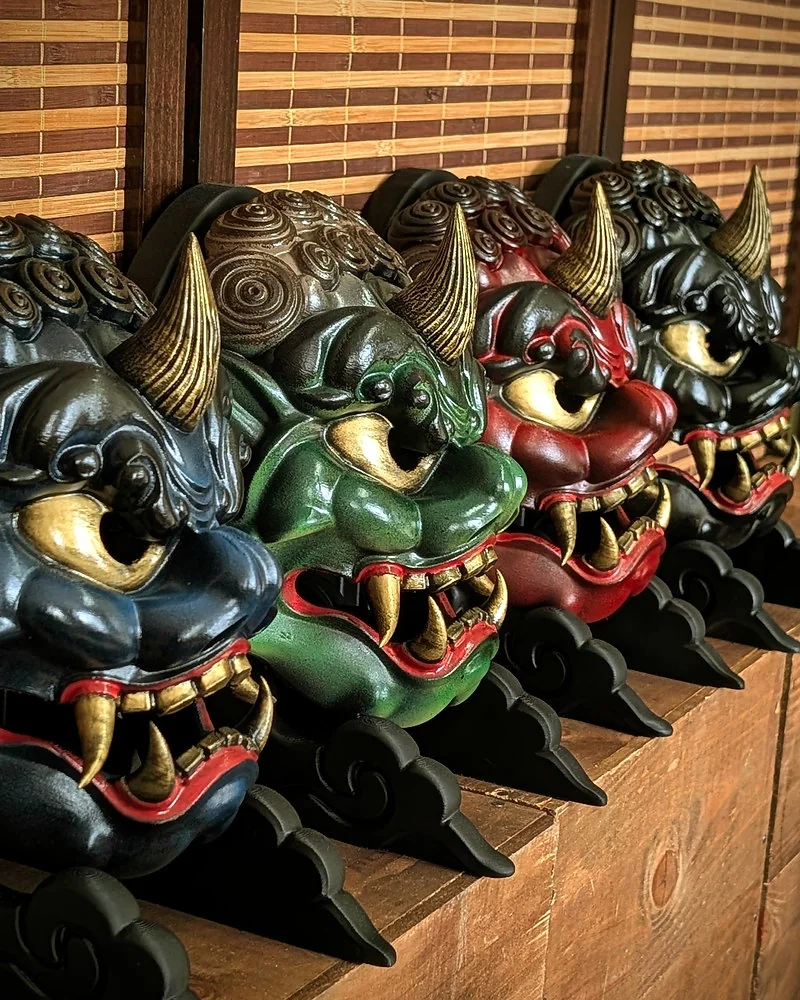
Read the article about Oni masks · See Oni masks
From Greece to Japan along the Silk Road
Fujin's iconography has a lineage few people suspect. In the 4th century BCE, Alexander the Great's conquests spread Greek art as far as Gandhara, in today's Pakistan and Afghanistan. The Greeks had a god of the north wind, Boreas, shown wild-haired and holding a great billowing cloak above his head. That image travelled: in Central Asia the cloak became a bag, in China the god became Feng Bo, and in Japan he became Fujin. The bag of wind he carries on his shoulders is the direct heir of a Greek god's cloak, passed down the Silk Road.
A kami, not a demon
Visually, Fujin looks like an Oni, green skin, fangs, claws, but he's a celestial kami. In the Kojiki he appears as Shinatsuhiko when the creator god Izanagi breathes to clear the mists from the archipelago: he's there to open the sky and let through the sun of Amaterasu. His temperament is chaotic, like the shifting wind, but he isn't malevolent. He's a free traveller, with no master.
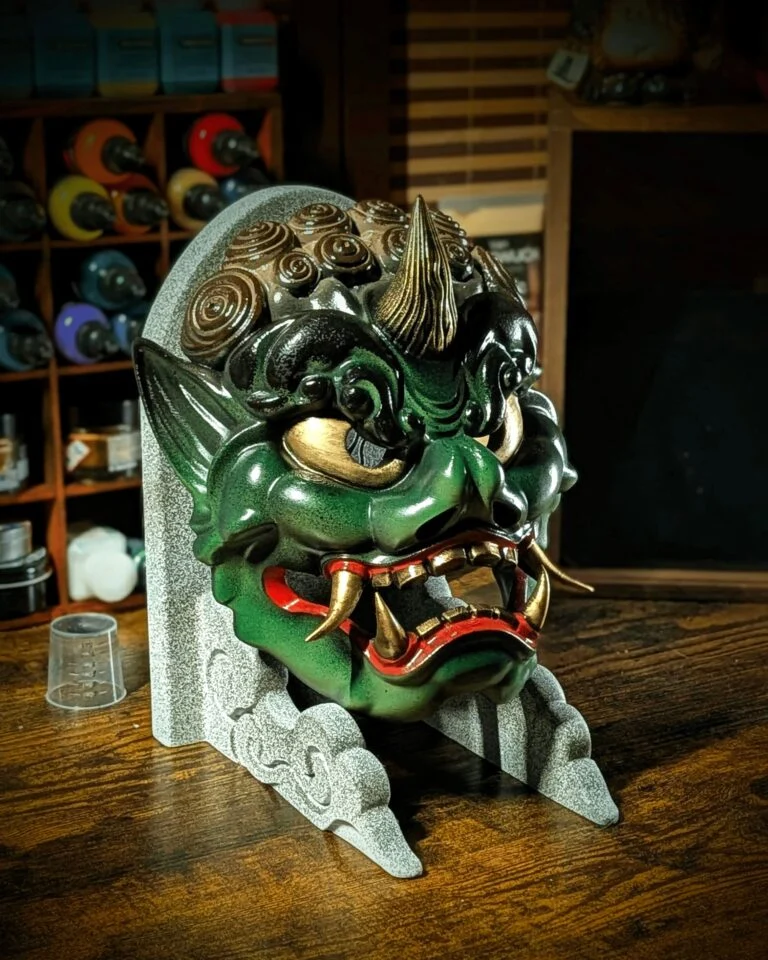
Three details matter. His bag holds all the winds of the world: cracked open, it makes the summer breeze; flung wide, it unleashes typhoons. He's often shown with four fingers per hand, read as the four cardinal points, where Raijin has three for the three tenses, a symbolic reading that captures their complementarity, space and time. And there's the word kamikaze: before its tragic 20th-century meaning, it was Fujin's title of glory, those "divine winds" that sank the Mongol fleet in 1274 and 1281 and saved Japan.
Why he is green
In old Japanese, ao meant both blue and green, the colour of living nature. In the Chinese five-element system, wind is tied to Wood, whose colour is green. Fujin's skin is green because he's the energy that grows the forest and shakes the leaves. It was the painter Sōtatsu, in the 17th century, who fixed his canonical image on a gold-leaf screen, a dynamic Fujin running through the air, green skin against gold, and it's that version tattoo artists reproduce today.
FAQ
Why does Fujin have four fingers?
By a widespread symbolic reading, his four fingers represent the four cardinal points: he masters space and direction. Raijin has three fingers for time (past, present, future).
Is Fujin a villain?
No. He looks fierce to scare off real demons, but he's a protective god, credited with saving Japan from the Mongol invasions. Turbulent, not malevolent.
Did Fujin really come from Greece?
His iconography largely did. The Greek wind god Boreas, with his billowing cloak, inspired Greco-Buddhist figures at Gandhara, which travelled the Silk Road to Japan, where the cloak became Fujin's bag of winds.
Can Fujin be another colour?
Green is canonical, but you'll find blue Fujin, closer to the sky, or grey ones like a storm cloud. The colour remains a choice.