

The Oni Ondeko Mask: a Demon That Actually Protects
- DAI YOKAI
- 2 days ago
- 4 min read

By Jérémy, Dai Yokai founder · @dai.yokai Published: May 2026 · Updated: May 2026
The oni in Ondeko is not an evil demon. On Sado Island it stands for the Shinto gods that protect the villages: the masked dancer drums and moves house to house to drive evil out. That is the mask I saw in a shop in Shizuoka, and the one this model is based on.
A demon that is really a guardian
Dig into Ondeko and the first surprise is that the oni is not the usual folklore monster. On Sado the character represents the Shinto deities protecting the island's villages. The masked dancer is that divine messenger, dancing hard to the drums to drive away evil spirits and secure a good harvest. The face is fierce, the intent is the opposite. That contradiction is exactly what makes the mask worth building: a demon face that is, in fact, a protector. The performance masks are even considered purified, and no one is meant to touch them.
Where Ondeko comes from
The exact origin is unknown. The oldest known record is a late 18th-century picture scroll of Sado's annual events showing Ondeko at the Aikawa Festival, with other sources pointing to around 1744 for the first documented appearance. One origin story ties the drumming to the island's miners: the taiko style is said to come from mimes of miners digging ore in Sado's gold and silver mines during the Edo period. The function has stayed constant: Onidaiko is performed at temple and shrine festivals, mostly around April before rice planting and September before harvest, to pray for and give thanks for the crop. The key moment is kadozuke, when the troupe goes door to door to purify every household.
Not one Ondeko, but dozens
There is no single Ondeko. Around 120 villages on Sado have their own group, split into five rough styles: mamemaki (bean throwing), issoku (one foot), Maehama, hanagasa (flower hat) and Katagami. Katagami is the most common, slower in tempo and influenced by Nō, with the oni using the sliding suriashi step. No two are alike, and the tradition passes only orally. One detail that speaks to my own work: most Sado oni masks have no horns. The "oni equals horns" idea does not hold here. Each community's history shows in the face and hair colours, and effectively every village has its own mask.
The one I saw, and what I did with it
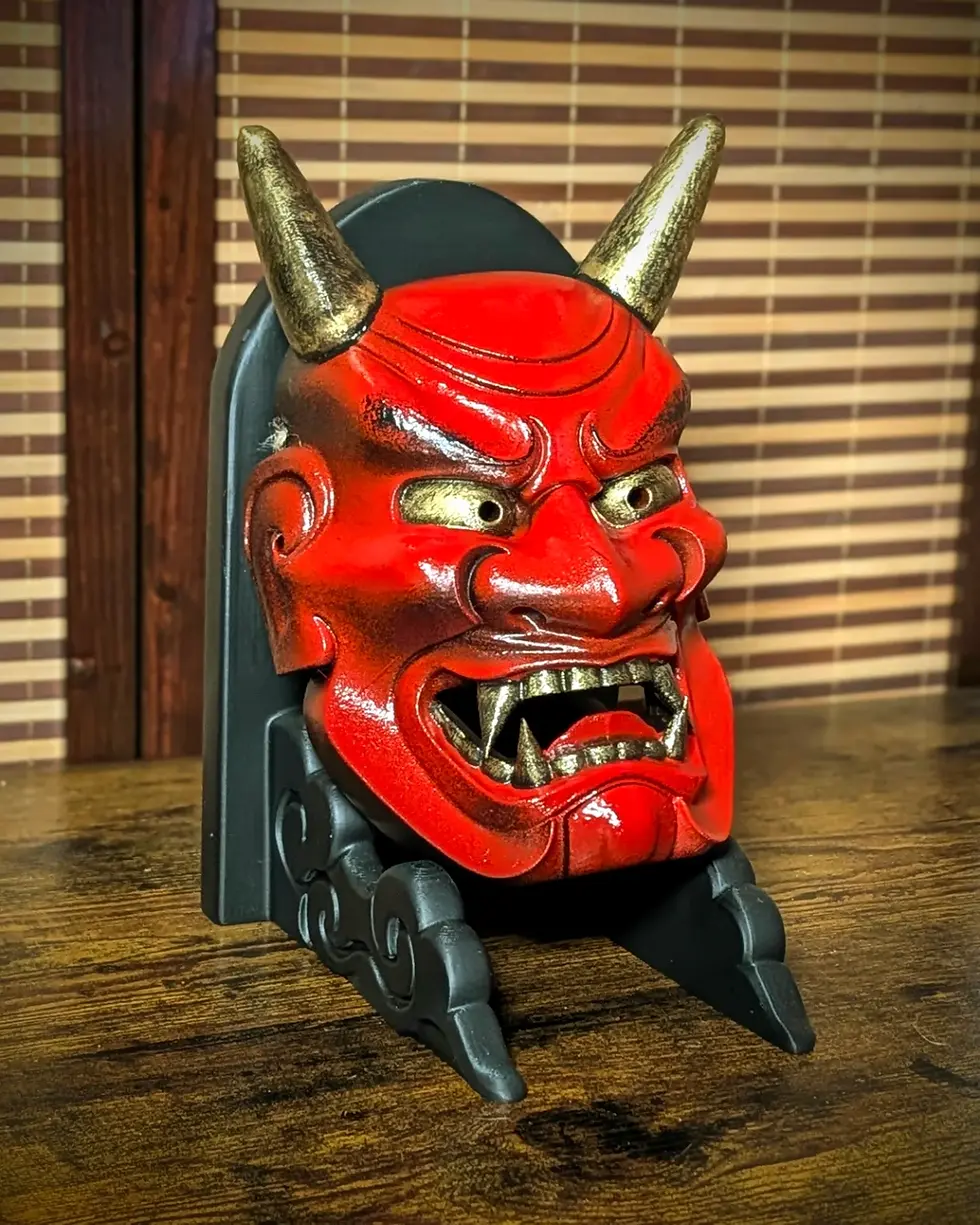
I saw the original in a small shop in Shizuoka. Hung high, not for sale, a family mask. I asked to photograph it, showed them my own masks on my phone, and they were fine with it. I left with photos, not the mask. So this model is based on a traditional one, and I own that. That is the whole logic of Ondeko: a traditional form copied and reinterpreted every generation. I kept the spirit of the face, reworked the volume and jaw, and made my own calls on the eyes and finish. Not a cast, my version of a shape that belongs to everyone.
How it is made
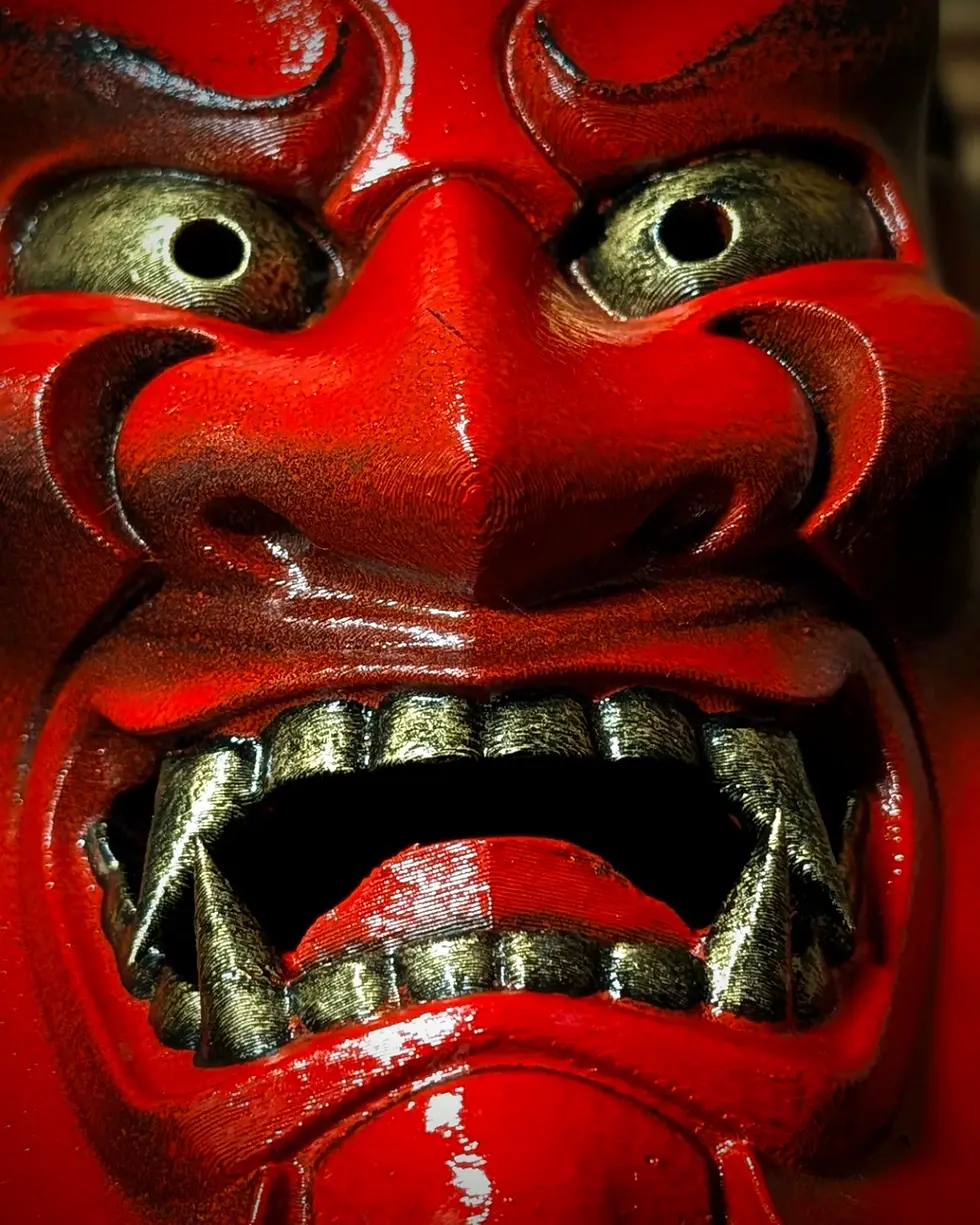
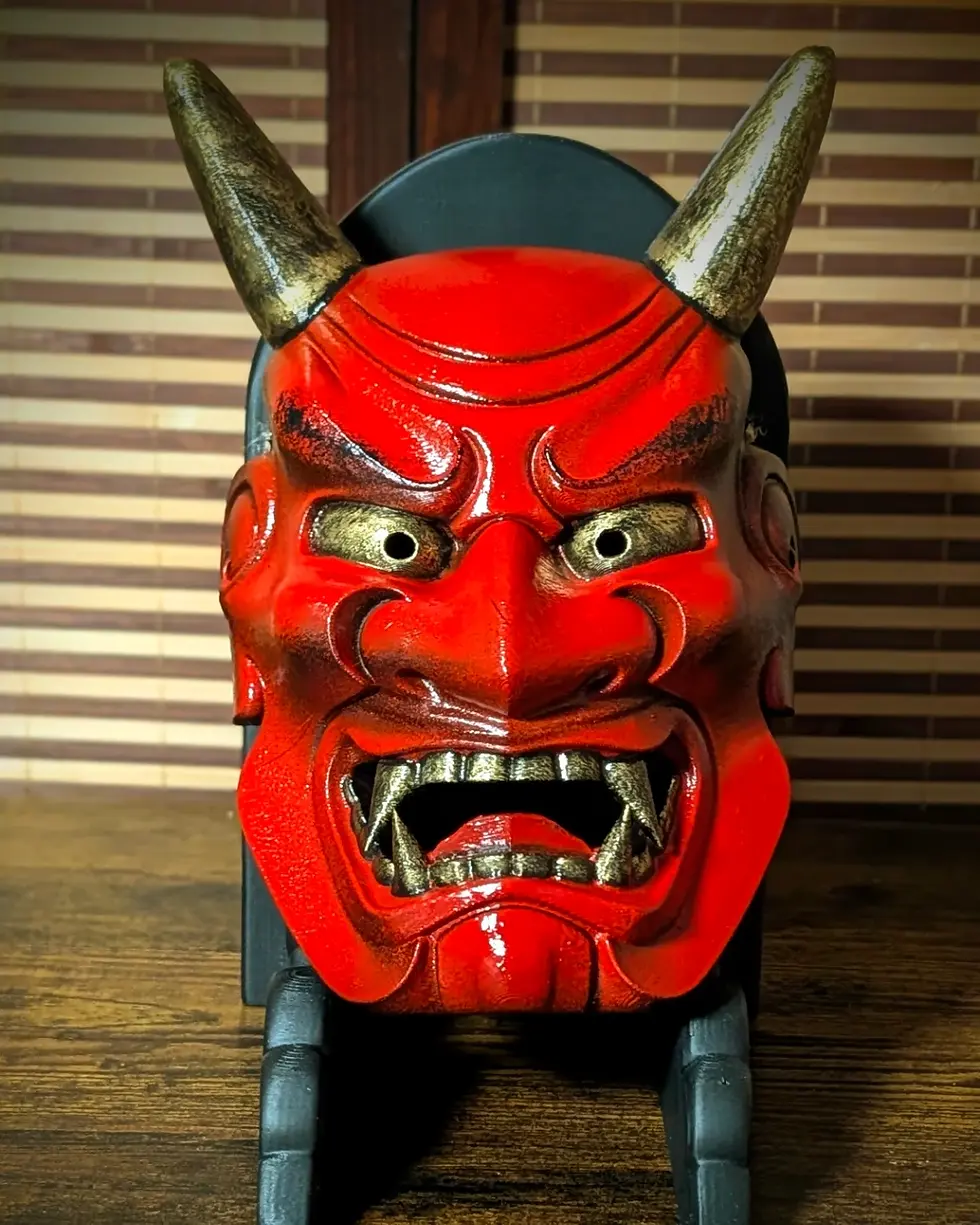
PETG, not PLA. PLA warps in heat, and a mask left in a hot car or in direct sun is a real scenario. PETG holds up and does not go brittle. Every mask is hand-sanded to kill the print lines, the red built in several passes for depth, then varnished. Hand-painted, so no two are exactly alike. It ships with cords; for comfortable wear I recommend adding an elastic cord. Many international customers order it through Etsy to hang it or as a tattoo reference. More on the red in the Aka-Oni article, and on Oni colour symbolism in the Oni guide.
Why remake it
Ondeko never had an official version: 120 villages, 120 masks, copied and reinterpreted for centuries. Mine fits in that line. Based on a mask seen in Shizuoka, remade in PETG in Brittany, with my own choices. A demon face that, on Sado, has always been a protector.
FAQ
Is the Ondeko oni an evil demon?
The opposite. On Sado Island the oni represents the Shinto gods that protect the villages. The masked dancer drives off evil spirits and prays for a good harvest. Fierce face, protective role.
Where does Ondeko come from?
Sado Island, Niigata prefecture. It is a ritual taiko drum dance unique to the island. The oldest known record is around 1744, a picture scroll of the Aikawa Festival.
Why do many Sado oni masks have no horns?
Because the mask changes from village to village: roughly 120 villages each have their own Ondeko and their own mask. The "oni equals horns" assumption does not apply here.
Is the Dai Yokai mask a copy?
No, it is a personal version based on a traditional mask seen in Japan. That is the very principle of Ondeko: a form handed down and reinterpreted each generation. Printed in PETG, hand-painted in my workshop.
Can it be worn or is it decor only?
Both. It ships with cords. For comfortable wear I recommend adding an elastic cord. Many customers hang it or use it as a tattoo reference.
Where is it made?
Entirely in my workshop in Plélan-le-Grand, Brittany. PETG printing, hand-sanding, hand-applied acrylic.


Comments