
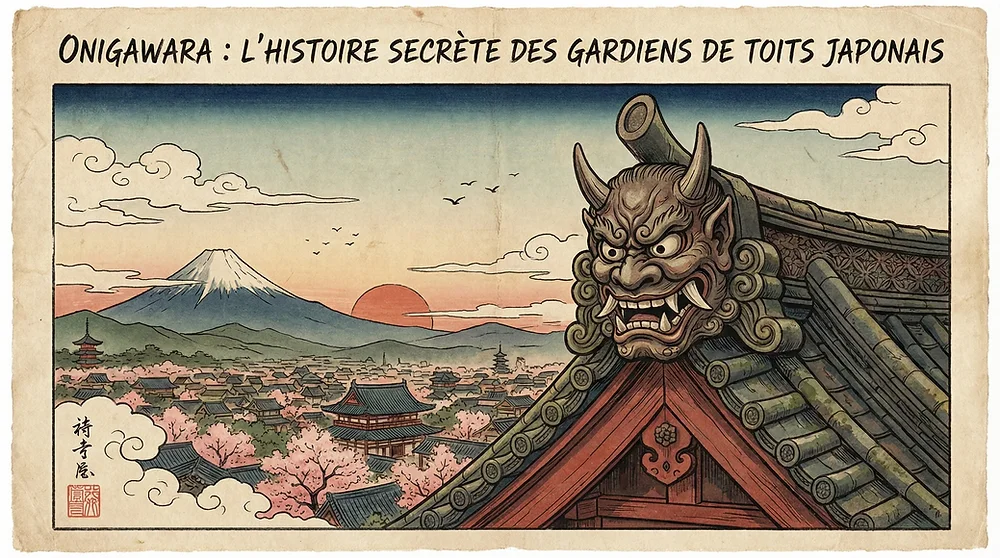
In Kyoto or Nara, you look at the golden Buddhas, the zen gardens, the red gateways. But raise your eyes to the roof and you sometimes meet another stare: a grey creature with bulging eyes and an open mouth, posted at the end of the main ridge. It is an onigawara (鬼瓦), literally ogre tile, and its job is to protect the building below.
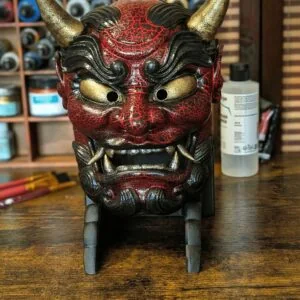
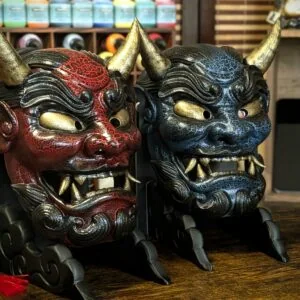
For the wall mask version, see the Oni-Gawara mask. For the wider family, see the Oni masks collection.
From lotus flowers to demon faces
The tile, kawara, reached Japan in the 6th century, brought by craftsmen from Baekje in Korea to build Asuka-dera. Back then the tiles showed lotus flowers, not monsters. The shift came in the Nara period with beast-face kimen tiles. The onigawara with horns and fangs took shape in the Heian and Kamakura periods, when local Oni folklore joined architectural tile work.
What they are really for
The onigawara is more than an ornament. The most fragile point of a traditional roof is the end of the ridge, where the two slopes meet. Left open, it lets in water and wind. The onigawara seals that junction: first engineering, then symbol.
The spiritual layer sits on top. Evil spirits were believed to travel with the wind, making the roof the home first line of defence. The furious stare of the onigawara is meant to freeze illness, misfortune and fire before they enter.
The onishi, master tile-makers
Making an onigawara is the craft of the onishi, the Oni masters. In Takahama, Aichi prefecture, they work from a solid block of clay with wooden spatulas. The hard part is shrinkage while drying, around ten to fifteen percent. Misjudge it, and the tile cracks in the kiln.
Read the article about Oni masks · See Oni masks
The silver-grey tone comes from ibushi firing. Carbon is introduced at the end of the firing and soaks into the clay surface, giving the metallic ibushi-gin, smoked silver, look.
Not always ogres
The name says ogre tile, but the designs vary. Merchant houses often preferred gods of fortune such as Daikokuten or Ebisu. Samurai families displayed their kamon crest. Some buildings even used a monkey at the north-east corner, because saru, monkey, sounds like saru, to leave, a way of telling misfortune to clear off.
To understand why these faces had to be so fierce, see the article on the guardian demons of Japanese roofs.
FAQ
What is an onigawara?
A decorative tile set at the end of the ridge on Japanese roofs, usually with a demon face and a technical role sealing the roof.
How old are onigawara?
Tiles reached Japan in the 6th century. Beast faces appeared in the Nara period, before the horned onigawara settled in later.
Why are they silver-grey?
The colour comes from ibushi firing, where carbon gives the clay its smoked silver look.
Who makes onigawara?
Specialist artisans called onishi, especially around Takahama in Aichi prefecture.