The Tengu is one of the most recognizable figures in Japanese folklore: red face, huge nose, hard stare, sometimes crow wings. It is often presented as a yokai, but it is not that simple. Depending on the story, it can be a demon, a mountain spirit, a swordmaster or a local deity.
That mix explains why the Tengu mask still feels so strong visually. It is not just a long-nosed mask. It speaks of pride, discipline, mountains, power and punishment.

Where does the Tengu come from?
The word Tengu is written 天狗, literally heavenly dog. It originally comes from the Chinese Tiangou, a celestial creature linked to meteors and bad omens.
In Japan, the Tengu slowly changed face. It moved away from the image of the heavenly dog and became a mountain being. In early texts, it is often dangerous: it tricks monks, feeds religious pride and punishes those who believe they stand above others.
Over time, it became more ambiguous. It remains unsettling, but it can also protect, teach or guide. That double role is what makes the Tengu so interesting.
Karasu Tengu or Daitengu: the two main forms
Karasu Tengu
The Karasu Tengu keeps a more bird-like shape, with a clear crow beak. It is usually linked to speed, flight and combat. It often acts as a warrior, messenger or servant.
Daitengu
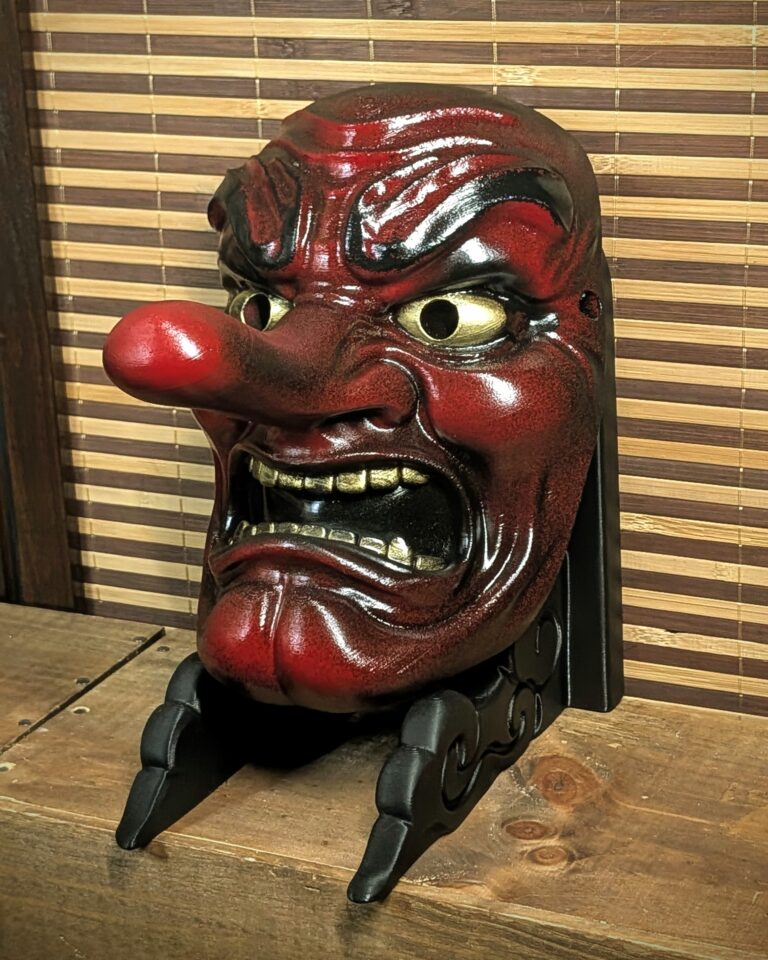
The Daitengu has a red human face and the famous long nose. It is the higher form: a master, a chief, a powerful mountain spirit. This is the version most often seen in Japanese decorative masks, festivals, tattoos and modern images.
Why does the Tengu have such a long nose?
The Tengu long nose is not a random detail. It symbolizes pride.
In Japanese, the expression tengu ni naru, 天狗になる, literally means to become a Tengu. In everyday use, it means to get a big head, to become arrogant, to think too highly of yourself.
That is exactly the moral role of the Tengu in many stories: it punishes those who overestimate themselves. The proud monk, the overconfident warrior or the man who tries to dominate others often ends up humiliated by it.
Why is the Tengu dressed like a monk?
The Tengu is often linked to Yamabushi, mountain ascetics associated with Shugendo, a spiritual practice mixing Buddhism, Shinto and mountain worship.
Several elements of the Tengu image come from those mountain monks: the small black cap, the ascetic robe, the fan, the staff, the high sandals and the constant link to remote forests.
But again, the symbol is ambiguous. The Tengu looks like a monk, but it can also represent the monk corrupted by his own ego.
Two legends to know
Sojobo and Yoshitsune
The most famous legend says that Sojobo, king of the Tengu of Mount Kurama, taught swordsmanship to the young Minamoto no Yoshitsune. Yoshitsune would become one of the best-known warriors in Japanese history.
In this version, the Tengu is not just a monster. It is a master. It passes on discipline, but only to the one who accepts the training.
Emperor Sutoku
Another important figure is Emperor Sutoku. After his death, tradition sometimes presents him as a vengeful spirit turned Tengu. Here, the Tengu becomes darker: resentment, political power, curse and anger after exile.
The Eight Great Tengu
Some traditions speak of the Hachi Daitengu, the eight great Tengu linked to different mountains in Japan. This idea reinforces their bond with sacred peaks. Each great Tengu belongs to a place, a mountain and a local tradition.
So the Tengu is not a generic monster. It is rooted in the Japanese landscape.
The Tengu in irezumi tattooing
In Japanese tattooing, the Tengu works well because it carries a strong expression. Its red face, long nose and severe stare make the composition readable at once.
In irezumi, it can symbolize strength, controlled pride, martial discipline, protection or a link to the mountains. Like the Hannya or the Oni, it always keeps some ambiguity. It protects, but it also warns.
To place this symbol among the major motifs of Japanese tattooing, read the guide to the meaning of Japanese tattoos.
FAQ
What exactly is a Tengu?
A Tengu is a mountain spirit from Japanese folklore. Depending on the story, it can be described as a yokai, a minor deity, a swordmaster or a dangerous guardian.
Why does the Tengu have such a long nose?
The Daitengu long nose is tied to pride. In Japanese, the expression tengu ni naru means to get a big head.
What is the difference between a Karasu Tengu and a Daitengu?
The Karasu Tengu has a crow beak and a more martial role. The Daitengu has a red human face, a long nose and a higher status.
What is the link between Tengu and Yamabushi?
The Tengu borrows several codes from Yamabushi mountain ascetics: clothing, fan, isolation and the connection to sacred peaks.
Is the Tengu mask a lucky charm?
The Tengu mask is not just a lucky charm. It mainly evokes mountains, discipline, power and the danger of pride.