Kami are sacred presences venerated in Shinto. They can be associated with natural forces, places, ancestors, historical people or named deities such as Amaterasu. Calling them “Shinto gods” is convenient, but incomplete: kami are not all creator gods, and Shinto has no single universal list or fixed pantheon.
This guide explains what kami means, why people speak of “eight million gods,” how kami differ from yokai, how they are venerated and which major kami appear most often in Japanese mythology and shrine traditions.
Kami quick facts
| Question | Short answer |
|---|---|
| What is a kami? | A sacred presence venerated in Shinto |
| Does kami mean god? | Sometimes, but the English word is narrower |
| Singular or plural? | Kami is commonly used for both in English |
| How many are there? | Yaoyorozu expresses an immense or countless number |
| Where are they venerated? | At jinja, sacred places, community rites and home altars |
| Are all kami good? | No simple good-versus-evil division applies |
| Main classical sources | Kojiki, Nihon Shoki, Fudoki and other early texts |
What is a kami in Shinto?
Kami is written 神 and can be translated as deity, divinity, spirit or sacred power depending on context. None of those words works in every case. Amaterasu is readily described as a sun goddess, while a mountain kami, an ancestral kami or the kami of a local community does not fit the same Western category.
A kami is defined less by its physical shape than by a relationship of reverence. Shrines identify particular saijin, the kami venerated at that place. Some are named figures from classical mythology, some are ancestors or historical people, and others are connected with natural features, occupations or local communities.
Searches often use “Shintoism gods,” but this guide uses Shinto, the form preferred by English-language shrine institutions and academic references. Shinto has no single founder, central creed or unified scripture. The Kojiki and Nihon Shoki are essential classical sources for mythology and early history, but they are not a Bible-like rulebook.
Types of kami: nature, ancestors and named deities
There is no one exhaustive taxonomy accepted by every shrine. The categories below are a practical guide based on forms described by the Encyclopedia of Shinto. A single kami may belong to more than one category, and traditions can change across time and region.
| Type | What it includes | Examples |
|---|---|---|
| Nature-related kami | Sun, wind, rain, fire, water, mountains or other natural features | Amaterasu, mountain kami, water kami |
| Ancestral or historical kami | Clan ancestors, imperial ancestors and deified people | Hachiman, Tenjin, ancestral ujigami |
| Local and tutelary kami | Kami connected with a community, household, land or occupation | Ujigami, field kami, household kami |
| Classical mythic kami | Named figures recorded in early Japanese texts | Izanagi, Izanami, Susanoo, Okuninushi |
| Syncretic kami | Figures shaped through interaction with Buddhism and other traditions | Gozu Tenno and other combinatory forms |
Why are there “eight million kami”?
Yaoyorozu no kami is often translated as “eight million gods.” The number is not meant as a catalogue with exactly eight million entries. In this expression, it conveys abundance or countlessness. It points to the breadth of sacred relationships found across myths, shrines, families, occupations and landscapes.
That does not mean every object is automatically divine. A particular tree, rock or waterfall may be treated as sacred because of its place, history, exceptional form or ritual role. The careful formulation is that kami may be associated with natural objects and phenomena, not that Shinto simply declares every pebble a god.
Kami and yokai: what is the difference?
Kami and yokai are not two biological species. Kami belong primarily to a language of veneration, shrine practice and sacred relationships. Yokai belong to a broad language of strange beings, apparitions, transformations and unexplained phenomena in folklore.
| Kami | Yokai |
|---|---|
| Venerated in a religious or local sacred context | Described mainly through folklore, stories and strange encounters |
| May be linked with shrines, offerings and matsuri | May be feared, avoided, joked about or treated as a warning |
| Can be a deity, ancestor, sacred force or local presence | Can be a creature, apparition, transformed object or phenomenon |
| Not automatically benevolent | Not automatically evil |
| Meaning depends on the worship tradition and source | Meaning depends on the story, period and region |
The boundary can overlap, but saying that any powerful yokai is simply “promoted” to kami is misleading. Check the specific tradition instead. For more context, read our guide to Japanese yokai.
How are kami venerated?
Jinja, usually translated as Shinto shrines, are places where particular kami are venerated and matsuri are performed. Jinja Honcho states that Japan has about 80,000 Shinto shrines in its network and that every shrine venerates its own kami. Local independence matters: practices and enshrined figures are not identical everywhere.
Visitors commonly pass through a torii, purify at a water basin when one is provided, make an offering and pray before the sanctuary. Two bows, two claps and one final bow is widespread etiquette, but there are shrine-specific exceptions. A respectful visitor follows the instructions at the site rather than assuming one ritual is universal.
A shintai is a sacred object through which a kami is venerated. It may be a mirror, sword, jewel or another object, while a mountain or other natural feature can itself form the sacred focus. These objects are often kept within the inner sanctuary and are not treated like public statues.
Major Shinto kami to know
Lists of “the main Shinto gods” are useful for orientation, but they should not imply a single fixed ranking. The examples below are widely known through major shrines, classical mythology or later religious history.
| Kami | Common association | Major shrine or tradition |
|---|---|---|
| Amaterasu Omikami | Sun and imperial ancestry in classical mythology | Naiku at Ise Jingu |
| Inari Okami | Rice, agriculture and prosperity; foxes as messengers | Fushimi Inari traditions |
| Hachiman | Protection, warriors and the imperial tradition | Usa Jingu and Hachiman shrines |
| Tenjin | Sugawara Michizane, learning, culture and the arts | Dazaifu and Kitano Tenmangu |
| Susanoo | A complex storm-associated figure in classical myth | Yasaka and other regional traditions |
| Okuninushi | Land-making and en-musubi, the tying of bonds | Izumo Oyashiro |
| Raijin and Fujin | Thunder and wind in religion, folklore and visual art | Multiple shrine and artistic traditions |
Continue with the detailed guides to Amaterasu, Inari Okami, Raijin and Fujin.
Kami, Buddhism and changing traditions
Shinto traditions did not develop in isolation. For many centuries, kami worship interacted with Buddhism, local cults, court ritual and imported systems of thought. Shinbutsu shugo, the historical combination of kami and buddhas, produced identities and practices that cannot be explained by a simple modern split between “Shinto gods” and “Buddhist figures.”
This history is one reason rigid pantheon charts fail. Names, functions and relationships can vary between the Kojiki, Nihon Shoki, regional records and living shrine traditions. Reliable writing identifies the source or shrine instead of claiming that one short list represents all of Shinto.
Kami imagery and Dai Yokai masks
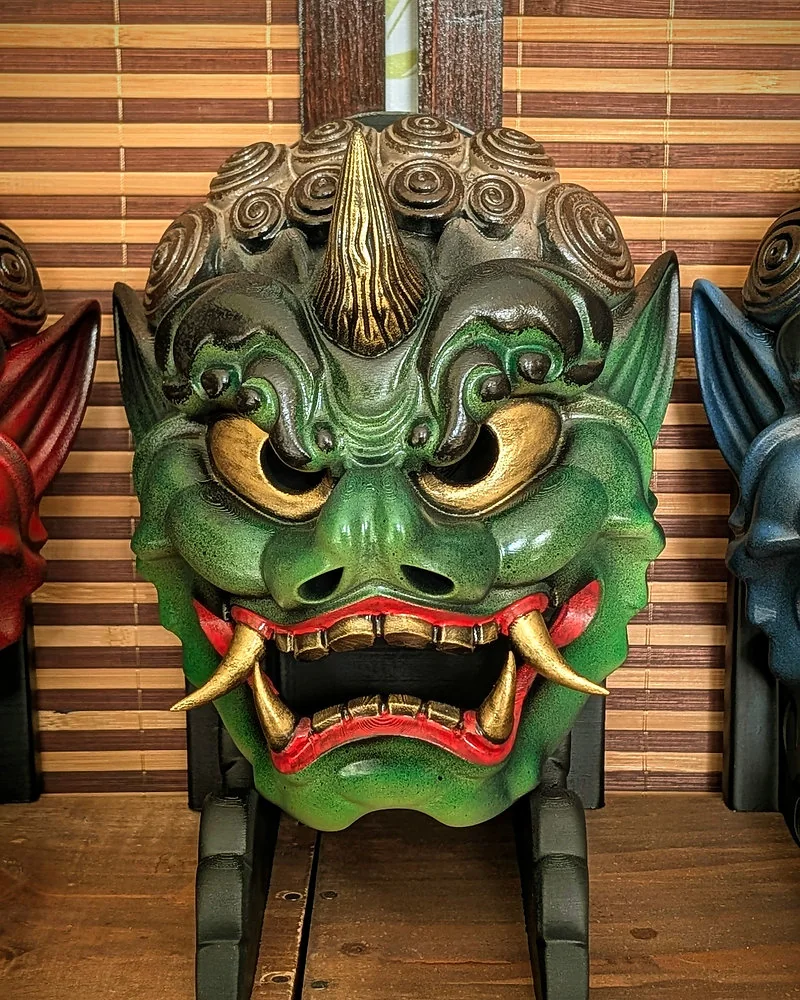
At Dai Yokai, the connection is visual and cultural, not ritual. The workshop in Brittany creates contemporary masks inspired by Japanese folklore, thunder deities and fox imagery. They are made as decorative, collectible or wearable pieces, not as shintai, shrine objects or authentic ritual masks.
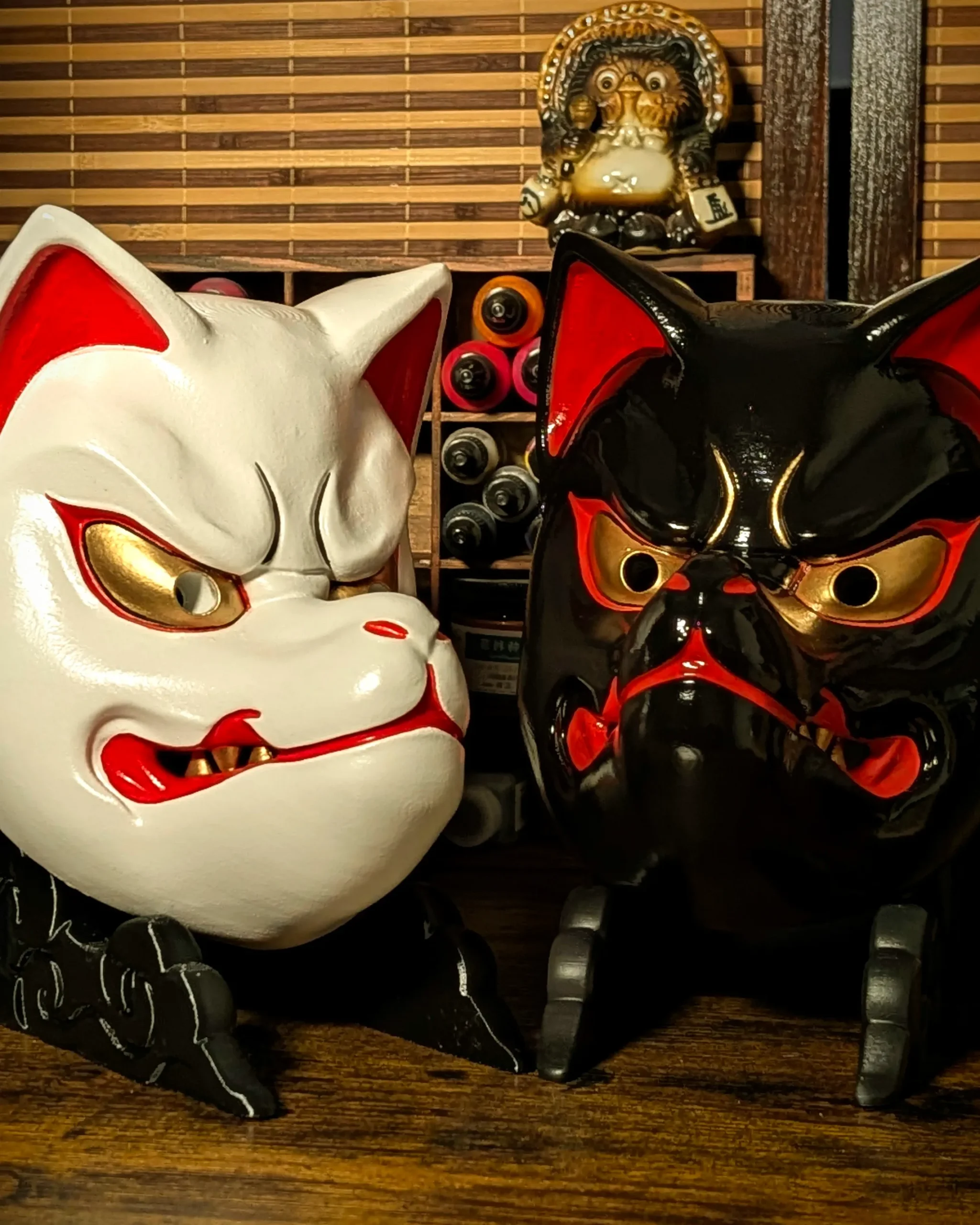
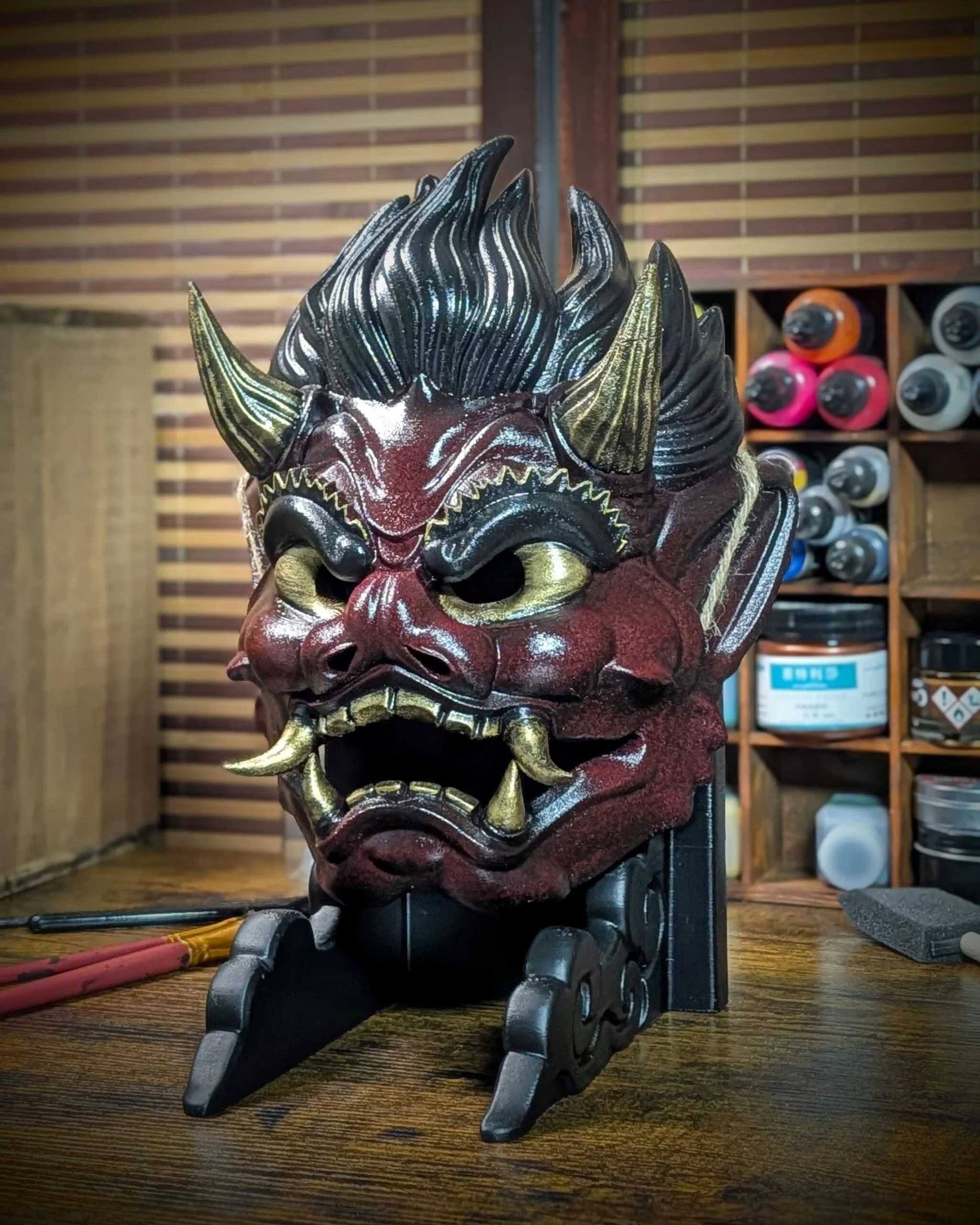
For workshop pieces, browse the handmade Japanese-inspired masks or the Kitsune mask collection.
Sources and further reading
Jinja Honcho, official overview of shrine organisation, local kami, matsuri and Shinto doctrine.
Kokugakuin University, Encyclopedia of Shinto: Introduction to Kami, academic overview of classical, local and syncretic kami.
Kokugakuin University, Saijin, classification and history of kami venerated at shrines.
Ise Jingu, official information on Amaterasu Omikami and Naiku.
Dazaifu Tenmangu, official history of Sugawara Michizane as Tenjin.
Izumo Oyashiro, official overview of Okuninushi and en-musubi.
FAQ
What is a kami in Shinto?
A kami is a sacred presence venerated in Shinto. Kami may be connected with natural forces, places, ancestors, historical people or named deities from classical mythology. The word is often translated as “god” or “spirit,” but neither English term covers its full meaning.
Is a kami the same as a god?
Not exactly. “God” is a useful translation for famous figures such as Amaterasu, but kami can also be associated with mountains, local places, ancestors and natural forces. Shinto does not define every kami as an all-powerful creator or place them in one fixed universal hierarchy.
How many kami are there?
The phrase yaoyorozu no kami is commonly rendered as “eight million kami,” but it is not a census. It expresses an immense or countless number. Shinto traditions include classical deities, local tutelary kami, ancestral figures, nature-related kami and many other objects of veneration.
Are kami good or evil?
Kami are not divided neatly into good and evil. A kami may be approached for protection, harvests or learning, yet sacred power can also be dangerous or disruptive. Rituals, offerings and matsuri maintain a respectful relationship rather than treating every kami as morally perfect.
What is the difference between kami and yokai?
Kami are defined mainly through veneration and religious practice, while yokai are strange beings, apparitions or phenomena found in folklore. The boundary is not a scientific taxonomy, and regional traditions can overlap. It is safer to examine how a figure is described and treated in a specific source.
Where do kami live?
Shinto traditions may associate kami with a shrine, mountain, waterfall, tree, rock or community. A shintai is a sacred object through which a kami is venerated, while a yorishiro can invite or mark a sacred presence. This does not mean that every ordinary object is automatically a kami.
How do people worship kami at a shrine?
Visitors usually approach respectfully, purify their hands and mouth when facilities are available, make an offering and pray before the sanctuary. Two bows, two claps and one final bow is a common pattern, but etiquette can differ by shrine, so local instructions take priority.
What are the most famous Shinto kami?
Widely known kami include Amaterasu at Ise Jingu, Inari, Hachiman, Tenjin, Susanoo and Okuninushi. Raijin and Fujin are also familiar through religious tradition and Japanese art. Each has distinct histories, shrines and regional forms rather than one simple pantheon chart.
A better way to understand kami
Use “Shinto gods” as a starting point, not a complete definition. Ask which kami, at which shrine, in which source and within which practice. That approach keeps the subject understandable without flattening a diverse religious tradition into one imported idea of a pantheon.