Kitsune: The Sacred Fox of Japan — Meaning, Legends, and Mask (2026 Guide).
- DAI YOKAI
- Feb 12
- 11 min read
Updated: 4 days ago
In the twilight of a bamboo forest, a bluish light dances between the trunks. No wind. No torch. Just dozens of floating flames — the Kitsunebi, the fox fires. Somewhere in this mist, a silhouette takes shape: a woman of striking beauty. Or a fox. Or both at once. In Japan, this moment is called the threshold — the instant when the visible and invisible worlds become one.
The Kitsune (狐) is not a simple fox. It is the messenger of the gods, the master of illusions, the cursed lover, the guardian of the harvests, and the nightmare of gullible samurai. No creature in Japanese folklore has so many faces — literally and figuratively.

My name is Jérémy, I am a craftsman of Japanese folklore at Dai Yokai. In my workshop in Brittany, the Kitsune mask is the one that demands the most finesse from me. Where an Oni demands brutality, the Kitsune demands subtlety. It is a mask that smiles and lies at the same time. Here is its complete story.
What is a Kitsune?
The Kitsune (狐) is the supernatural fox of Japanese folklore, both a messenger of the Kami Inari (god of rice and prosperity) and a shape-shifting Yokai capable of taking human form.
The older it gets, the more tails it gains — up to nine for the most powerful (Kyūbi no Kitsune). It can be benevolent (Zenko) or mischievous (Nogitsune/Yako), embodying the fundamental duality between divine protection and supernatural cunning.
Where Does the Word 'Kitsune' Come From? (Etymology)
The exact origin of the word remains debated among scholars. Several hypotheses coexist:
Hypothesis | Source | Explanation |
'Kitsu-ne' (来つ寝) | Nihon Ryōiki (9th c.) | 'Come and sleep' — reference to the legend of the vixen who joins her human husband's bed every night and leaves at dawn |
'Ki-tsune' (来常) | Konjaku Monogatari (12th c.) | 'Always returns' — same legend, insisting on the cyclical return |
Onomatopoeia 'ketsu-ketsu' | Daigenkai by Ōtsuki Fumihiko | Imitation of the fox's yelp |
'Ki' (yellow) + 'tsune' (usual) | Folk etymology | Reference to the coat color |
Whatever the origin, the word kitsune in everyday Japanese designates any fox, without supernatural connotations. It is the context (folklore, religion, literature) that gives it its magical dimension.
The Kitsune and Inari: The Messenger of the Rice God
Why a Fox?
The link between the fox and Inari Ōkami — one of the most revered Kami in Japan — is not a poetic coincidence. It comes from the direct observation of nature.
The ancient Japanese noticed that foxes came down from the mountains in the spring, just when the rice was being planted, and went back up in the autumn after the harvest. Furthermore, foxes hunt the rodents that devour the stored grain. Logical conclusion: the fox is the invisible guardian of the rice.
In 711 AD, the first Inari shrine was erected on Mount Inari in Kyoto — this is the future Fushimi Inari-taisha, with its 10,000 vermilion torii gates. Legend has it that Inari arrived on earth on the back of a white fox to feed the famine-stricken people.
Today, Japan has around 30,000 Inari shrines — a third of all Shinto shrines in the country. In front of each one, two statues of white foxes stand guard, wearing red votive bibs and holding sacred objects.

The Key, the Jewel, and the Sheaf: What the Kitsune Carries
Object | Japanese Name | Meaning |
Key | Kagi (鍵) | Key to the rice granary — material prosperity |
Flaming jewel | Hōju no tama (宝珠) | Wish-granting jewel — spiritual power |
Rice ear | Inaho (稲穂) | Abundance, fertility, nourishment |
Sutra scroll | Makimono (巻物) | Buddhist wisdom, transmission |
Wearing a Kitsune mask or placing one in your home is originally a prayer for prosperity and the protection of harvests. If you are an entrepreneur or a merchant, it is a natural totem.
Zenko vs Nogitsune: The Two Faces of the Fox
The duality of the Kitsune is at the heart of its fascination. It is not 'good' or 'evil' — it is both, depending on the circumstances.
Type | Kanji | Meaning | Nature | Affiliation |
Zenko (善狐) | 善狐 | 'Good fox' | Benevolent, protective, sacred | Inari's messenger, shrine foxes |
Yako (野狐) | 野狐 | 'Field fox' | Mischievous, prankster, sometimes dangerous | Wild foxes, not linked to Inari |
Nogitsune (野狐) | 野狐 | 'Wild fox' (variant of Yako) | Deceitful, manipulative | The fox of dark legends |
Tenko (天狐) | 天狐 | 'Celestial fox' | Quasi-divine, 1,000+ years | The ultimate stage of the Zenko — divine power |
Kūko (空狐) | 空狐 | 'Void fox' | Transcended, beyond good and evil | Rare, state of absolute awakening |
The 13 Elemental Types of the Kitsune

Folklore details 13 categories of Kitsune, each associated with a natural or supernatural element. It is a popular classification that has exploded thanks to manga and video games.
Type | Element | Main Power |
Tengoku | Celestial / Light | Divine guardian, the most powerful |
Kukan | Void / Darkness | Illusions, reality manipulation |
Kaze | Wind | Control of winds and storms |
Seishin | Spirit | Possession, astral projection |
Kasai | Fire | Kitsunebi (will-o'-the-wisps), pyrokinesis |
Chikyu | Earth | Terrain manipulation, earthquakes |
Kawa | River | Freshwater control |
Umi | Ocean | Sea storms, mastery of currents |
Yama | Mountain | Guardian of sacred mountains |
Mori | Forest | Camouflage, communion with nature |
Sanda | Thunder | Lightning, electrical storms |
Jikan | Time | Time manipulation (the rarest) |
Ongaku | Sound | Enchantment through music, bewitching voice |
The Tails of the Kitsune: Power and Wisdom
The number of tails is the marker of a Kitsune's power. Every century of life adds a tail.
Number of tails | Approximate age | Abilities | Appearance |
1 tail | < 100 years | Ordinary fox (or almost) | Classic red coat |
2–3 tails | 100–300 years | Human metamorphosis, Kitsunebi | Red or white |
4–6 tails | 300–600 years | Elemental powers, advanced illusions | White increasingly frequent |
7–8 tails | 600–800 years | Partial omniscience, flight | White or golden |
9 tails (Kyūbi) | 1,000+ years | Quasi-divine, omniscient, cosmic power | Pure white or golden — luminous fur |
The Kyūbi no Kitsune (九尾の狐) is the ultimate culmination. It oscillates between two poles: divine guardian or destructive force. The two most famous legends of Japanese folklore perfectly illustrate this duality.
The Great Legends of the Kitsune
1. Tamamo-no-Mae: The Nine-Tailed Vixen Who Almost Destroyed Japan
This is THE quintessential Kitsune legend. Towards the end of the Heian period (12th century), a woman of supernatural beauty named Tamamo-no-Mae became the favorite of Emperor Toba. Cultured and brilliant, she answered all the questions of the court's scholars. But the emperor fell mysteriously ill.
The diviner Abe no Yasunari discovered the truth: Tamamo-no-Mae was a Kyūbi no Kitsune — a nine-tailed fox from the continent. According to longer versions of the legend, this same creature had previously taken the form of Daji in China (favorite of King Zhou of Shang, 11th c. BC) and Kay Fujin in India, destroying entire kingdoms by seducing their rulers.
Unmasked, Tamamo-no-Mae fled to the plains of Nasu (north of Tokyo). Two warriors — Miuranosuke and Kazunosuke — hunted her down and killed her. But upon dying, her spirit transformed into the Sesshō-seki (殺生石, 'the Killing Stone') — a rock that kills any living being that approaches it.
Real fact: in March 2022, the Sesshō-seki split in two in Nasu. The news went around the world, with the Japanese joking about the 'release' of the fox's spirit.
2. Kuzunoha: The Tragic Love of the White Fox
If Tamamo-no-Mae embodies the destructive Kitsune, Kuzunoha embodies the loving Kitsune.
During the Heian period, Abe no Yasuna — a courtier practicing magic — saved a white fox wounded by a hunter in the Shinoda forest (current Osaka prefecture). Later, a beautiful woman named Kuzunoha appeared and became his wife. She gave him a son: Abe no Seimei, who would become the most famous Onmyōji (master of Yin and Yang) in Japanese history.
But one day, their son caught her in her true fox form. Unable to remain among humans any longer, Kuzunoha wrote a farewell poem on the sliding door:
'If you love me, come find me in the Shinoda forest, where the leaves of the kuzunoha rustle.'
She disappeared forever. This legend is the source of the expression 'Kitsune no Yomeiri' — the fox's wedding — which is invoked when rain falls on a sunny day.
3. Kitsune in Folk Tales
Beyond the two great legends, folklore is full of everyday tales:
Phenomenon | Japanese Name | Folkloric Explanation |
Will-o'-the-wisps in fields at night | Kitsunebi (狐火) | Flames produced by the fox's breath or tail — sign of a nocturnal gathering |
Rain on a sunny day | Kitsune no Yomeiri (狐の嫁入り) | A wedding between a kitsune and a human is taking place |
Sudden possession (madness, fever) | Kitsunetsuki (狐憑き) | A fox has entered the victim's body (often a young woman), through the nails or the chest |
Strangely beautiful woman at dusk | — | Shape-shifted vixen — a mirror, alcohol, or a dog would reveal her true nature |
Kitsunetsuki (fox possession) was considered a real illness until the early 20th century. Psychiatrist Shimamura Shūhei studied it as a form of dissociative disorder within the Japanese cultural context.
The Kitsune in Other Asian Cultures
The supernatural fox is not exclusively Japanese. It has 'cousins' all over East Asia.
Creature | Country | Name | Dominant Nature | Difference from the Kitsune |
Huli Jing (狐狸精) | China | Fox spirit | Often malevolent, seductive | More dangerous, less linked to a specific god |
Kumiho (구미호) | Korea | Nine-tailed fox | Almost always malevolent | Eats the liver or heart of men — no popular 'benevolent' version |
Kitsune (狐) | Japan | Fox spirit | Zenko/Yako duality | Linked to Inari, can be sacred and protective |
The Korean Kumiho is clearly the darkest version: no redemption possible. The Japanese Kitsune, however, can be a saint or a demon depending on its choices — which makes it far more nuanced and narratively rich.
The Kitsune Mask: Meaning and Usage
In Noh and Kabuki Theater
The fox mask is a classic in traditional theater. In Noh, it represents the spirit of the shape-shifting fox — often a woman whose true nature is gradually revealed. The features are androgynous, fine, almost smiling but never completely.
At Matsuri (Festivals)
During Japanese summer festivals — notably the Oji Kitsune no Gyoretsu (fox parade) at the Oji Inari Shrine in Tokyo on December 31st — hundreds of people parade wearing white Kitsune masks. It is a protection ritual for the new year.
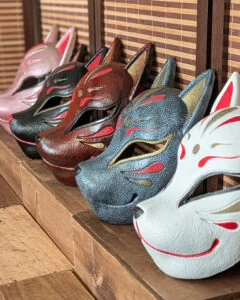
The Meaning of Colors
Mask Color | Meaning |
White | Sacred messenger of Inari — purity, divinity, protection. The most traditional. |
Red & White | Kumadori (theatrical makeup) — protection against illnesses and demons. |
Black | Kuro-Kitsune — fox of the shadows, North Star (Hokuto), a paradoxical good omen. |
Gold / Golden | Prosperity, wealth, millennial Kitsune with golden fur. |
Cracked Red & Gold | Infernal, ancient, powerful — the fox that has crossed the centuries. |
The Kitsune in Pop Culture
Work | Character / Reference | Aspect of the Kitsune |
Naruto (manga) | Kurama — Kyūbi no Kitsune sealed in Naruto | Destructive Kyūbi turned ally |
Demon Slayer | Urokodaki's masks for Sabito and Makomo | Kitsune Mask = protective guardian |
Pokémon | Vulpix / Ninetales / Zoroark | Literal Kitsune (fire + illusions) |
Ōkami (Capcom) | Amaterasu (white wolf, inspired by Inari guardians) | Divine guardian in animal form |
League of Legends | Ahri — nine-tailed fox | Korean Kumiho, seductress |
Ghost of Tsushima | Inari Shrines — guide foxes | Benevolent Kitsune, spiritual guide |
Babymetal | 'Megitsune' — Fox God concept | Fox mask = hidden feminine strength |
Genshin Impact | Yae Miko — 500+ year old Kitsune | Zenko/Tenko, shrine maiden guardian |
The Kitsune in Japanese Tattoos (Irezumi)
The Kitsune is a major motif in Irezumi. In traditional tattooing, it is often represented mid-metamorphosis — half-woman, half-fox — or in its nine-tailed form surrounded by Kitsunebi.
Element | Association in tattoos |
Kitsune + Flames (Kitsunebi) | Supernatural power, transformation |
Kitsune + Maple leaves (Momiji) | Autumn, melancholy, cunning |
Kitsune + Mask | Hidden/revealed identity duality |
Kitsune + Inari Torii | Devotion, prosperity, protection |
Kitsune + Skull | Kitsunetsuki, possession, danger |
Classic placement: Thigh, arm, or back.
To learn more about the rules of Japanese tattooing, check out my comprehensive guide to Irezumi and motifs.
Why I Make a Kitsune Mask at Dai Yokai
Preparing a Kitsune is very different from making a monster. With an Oni, I can be brutal with the volumes. With a Kitsune, I have to be elegant.
The eyes must be almond-shaped, elongated, giving a look that is both laughing and cunning. The snout must be fine, aristocratic — not too animalistic. The ears, large and erect, catch the messages of the gods.
The traditional mask in lacquered wood or papier-mâché (Hariko) is a marvel that I deeply respect. My approach is complementary: I use PETG — a high-resistance polymer — for an 'all-terrain' mask.
Situation | Papier-mâché Mask (Hariko) | Dai Yokai Mask (PETG) |
Festival in the rain | Destroyed | Intact |
Cosplay convention (impacts) | Fragile, splinters | Resistant, flexible |
Long-term wall decoration | Yellows, peels | Stable (UV, heat, humidity) |
Surface for painting | Textured (artisanal charm) | Smooth after sanding (porcelain/lacquer effect) |
Weight | Very lightweight | Lightweight |
The painting follows a strict code:
White base (matte or satin) — white is the color of the sacred.
Red Kumadori lines around the eyes and ears — protection against demons.
Touches of gold (optional) — the divine, wealth.
My Guardian Duo
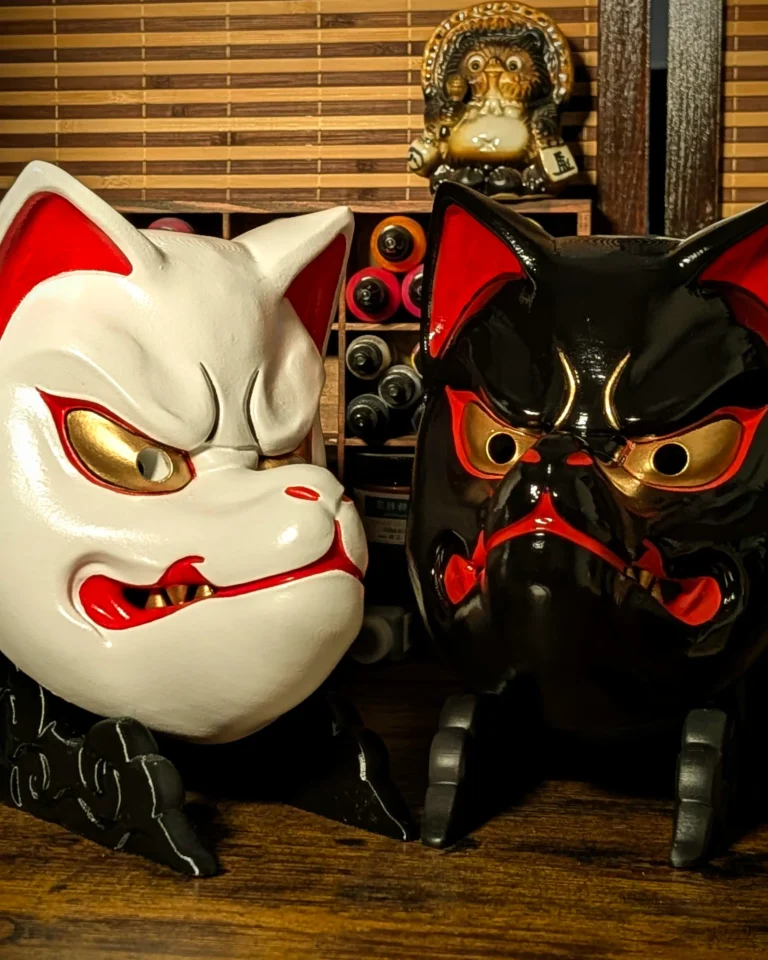
A very Japanese decor trick: hanging two Kitsune masks side by side, like the statues at the entrance of Inari shrines. One with its mouth closed (wisdom), the other with its mouth open or holding an object (communication). My Traditional Kitsune Mask Duo is designed exactly for this.
The Complete Collection
Mask | Style | Atmosphere |
Sacred classic | Zen, Japandi, minimalist | |
Nogitsune, nocturnal | Tattoo studio, gaming setup, dark wall | |
Urban, sleek | Contemporary design | |
Infernal, ancestral | Ancient fox, brute power | |
Divine messenger | Personal shrine, altar | |
Guardian statue (100 cm) | Entryway, garden, centerpiece |
How to Place a Kitsune Mask in Your Home?
The Kitsune mask is the easiest to integrate into your decor. Less aggressive than an Oni, more mysterious than a Dragon.
White or light grey wall → the white of the mask creates a soft contrast, Japandi vibe.
Dark wall → the Black Kitsune plays on textures, mystical vibe.
Side-by-side duo → replicates shrine guardians.
On the side of the head (cosplay) → like in anime, a rallying sign.
On a Hōju Stand → collector's display.
Frequently Asked Questions (FAQ)
What is a Kitsune in Japanese mythology?
A Kitsune is a supernatural fox from Japanese folklore, considered a Yokai (spirit) or a messenger of the Kami Inari. It possesses the power to shape-shift, create illusions, and can take human form after 100 years. The older it gets, the more tails it has (up to nine). It can be benevolent (Zenko) or mischievous (Yako).
What is the difference between Zenko and Nogitsune?
Zenko ('good foxes') are the sacred messengers of Inari, the white foxes of the shrines, protective and benevolent. Nogitsune ('wild foxes') are free spirits, not linked to Inari, often pranksters or dangerous. The distinction is made by their connection to the divine, not by their number of tails.
What does the color of a Kitsune mask mean?
White represents the sacred messenger of Inari (the most common). Black (Kuro-Kitsune) is associated with the shadows and the North Star — paradoxically a good omen. Gold symbolizes prosperity and the millennial golden-furred Kitsune. Red marks protection against demons.
Who is Tamamo-no-Mae?
Tamamo-no-Mae is the most famous Kitsune in Japanese mythology. Under the guise of a beautiful woman, this nine-tailed vixen seduced Emperor Toba in the Heian period before being unmasked by the diviner Abe no Yasunari. Killed by two warriors in the Nasu plains, her spirit transformed into the Sesshō-seki — the Killing Stone.
What is the difference between a Kitsune mask and a cat mask (Bakeneko)?
The difference comes down to proportions. The Kitsune has larger, pointed ears, and a more elongated, slender snout. The cat mask (Bakeneko/Nekomata) has smaller, rounder ears, and a flatter face. The Kitsune carries a more religious and sacred connotation than the cat.
Is the Japanese Kitsune the same as the Korean Kumiho?
No. Although they share a common origin (the Chinese Huli Jing), the Japanese Kitsune can be benevolent or mischievous (Zenko/Yako duality), whereas the Korean Kumiho is almost always malevolent — it devours the liver or heart of its victims. The Kitsune is also intimately linked to the worship of Inari, giving it a sacred dimension absent in the Kumiho.
The Kitsune does not ask you to understand it. It asks you to respect it. If you welcome it with honesty, it will guard your threshold. If you try to trap it, it will show you why foxes are the best liars in the archipelago.
In my workshop, every Kitsune mask I paint is an exercise in patience. The white must be perfect — it is the color of the sacred. The red must be precise — it is the line that separates the world of men from that of spirits. And when I place the finished mask on the shelf, I swear it smiles a little more than when I started it.
To welcome your own Kitsune: the entire collection is here. And if the fox isn't enough for you, explore the Oni that guard the gates of Hell, the Tengu that watch over the mountains, or the Tanuki — Japan's other shape-shifter, much funnier and far less elegant.


Comments