

Japanese Dragon: Mythology, Types & Symbolism of the Ryu.
- DAI YOKAI
- Feb 15
- 10 min read
Updated: May 14
By Jérémy, Founder Dai Yokai · @dai.yokai | Update : february 2026
In the year 596, a purple cloud descended from the sky and enveloped the Hōkō-ji temple in Nara. The monks froze. The cloud took on five colors, then twisted upon itself, and a serpentine body appeared — without wings, without fire, just a presence of water and light. This is the first documented appearance of a Ryū (龍) in Japanese texts.
Forget everything Game of Thrones taught you. The Japanese dragon does not breathe fire, does not sleep on a pile of gold, and no one tries to kill it. In Japan, the dragon is a god. It commands the rain, protects temples, and its image has adorned the ceilings of the most sacred shrines in Kyōto for fourteen centuries.
In this article, I will take you into the deep waters of Japanese mythology to understand the Ryū: its impossible anatomy, its eight named species, its founding legends, and why hanging a Dragon mask in your home is much more than just decoration.

The Ryū is Not a Dragon: Anatomy of a God
The Nine Resemblances (九似) The body of the Ryū is not that of a reptile. It is a divine chimera, an assembly of nine different animals described as early as the 9th century in Buddhist texts:
Body part | Animal | Symbolism |
Head | Camel | Endurance, nobility of the desert |
Horns | Deer | Longevity, renewal (antlers grow back) |
Eyes | Demon (oni) | Vision that pierces illusions |
Ears | Ox | Patient listening — but deaf to criticism |
Neck and body | Snake | Undulation, fluidity of water |
Belly | Giant clam | Vulnerable point, humility of the divine |
Scales | Koi carp | Exactly 117: 81 Yang, 36 Yin |
Claws | Eagle | Power to grasp wisdom |
Paws | Tiger | Earthly grounding, brute force |
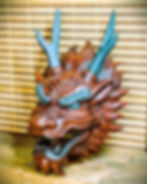
When I model a Ryū Dragon mask in the workshop, every detail counts. The horns must evoke the deer — branched, organic. The scales recall the carp, not the lizard. The whiskers (ryūhige) undulate as if carried by an invisible current. The challenge is to freeze movement in matter.
3 Claws, 4 Claws, 5 Claws: The Toe War This is THE question everyone asks — and the answer is a lesson in ancient Asian geopolitics.
Origin | Claws | Explanation |
Japan (Ryū) | 3 claws | The dragon was born here, in its purest form |
Korea (Yong) | 4 claws | As it travels, it gains a toe |
China (Lóng) | 5 claws | Reserved for the Emperor — exclusive imperial use |

China claims that the dragon is 'complete' within its borders and loses toes as it moves away from the center of the world. Japan reverses the logic: the Ryū was born in Japan with 3 claws, and if it traveled too far west, it would have too many and would no longer be able to walk. Rule for recognizing a true Japanese dragon: count the claws. Three, always three.
The Pearl of Wisdom (Tama / 玉) The Ryū often holds between its claws — or under its throat — a luminous sphere called Nyoi-ju (如意宝珠) or simply Tama. It is not a jewel. It is the wish-granting pearl that controls the tides and contains the spiritual essence of the universe. Where the Western dragon guards gold, the Japanese dragon guards knowledge.
The entire difference between the two cultures lies in this pearl.
The 8 Species of Japanese Dragons
Not all Ryū look alike. Japanese mythology identifies eight distinct species, each with its powers and character.
Species | Kanji | Power / Trait | Particularity |
Sui-Ryū | 水龍 | King of dragons, controls the rain | When it suffers, it rains red (blood rain) |
Ka-Ryū | 火龍 | Fire dragon, small (≈ 2 m) | Scarlet body, living inferno — the only Ryū linked to fire |
Han-Ryū | 斑龍 | Multicolored dragon, striped with 9 colors | Measures +12 m, but cannot reach the sky |
Ri-Ryū | 理龍 | Extraordinary vision (sees +160 km) | The 'observing dragon' — associated with clairvoyance |
Fuku-Ryū | 福龍 | Dragon of good fortune | Always depicted ascending (going up = luck) |
Hai-Ryō | 翼龍 | Winged bird-dragon | Chimera: bird body + dragon head — the rarest |
Kin-Ryū | 金龍 | Golden dragon | Associated with the sun and material prosperity |
Tatsu | 竜 | Generic form of the Japanese dragon | The most common term in everyday language |
Anecdote: A solid-colored dragon is considered young (under 500 years old). Multiple colors appear with age and wisdom. Past 1,000 years, some Ryū develop feathers — a sign that they are approaching phoenix status.
Mythology: The Great Dragons of Japan
Ryūjin: The King of the Seas (龍神) The most famous of Japanese dragons. Ryūjin lives in a sumptuous underwater palace — the Ryūgū-jō — built of red and white coral at the bottom of the ocean. Turtles, fish, and jellyfish are his servants.
Legend has it that he offered two jewels to the ancestor of the Emperor of Japan: one to raise the tide, the other to lower it. This is not a trivial myth — it establishes a direct bloodline between the imperial family and the dragon. This is why the Ryū remained an imperial symbol for centuries.
Ryūjin is also a kami in his own right in Shintoism, revered in shrines near the water. If you have read my article on Inari Ōkami, you know that kami are not mere 'gods' in the Greek sense — they are embodied forces of nature. Ryūjin IS the ocean.
Seiryū: The Guardian of the East (青龍) In the system of the four celestial guardians (Shijin), Seiryū — the Azure Dragon — protects the East. He forms a quartet with Byakko (White Tiger, West), Suzaku (Vermilion Bird, South), and Genbu (Black Tortoise, North).
Seiryū is associated with spring, the color blue-green (ao), and the wood element. He is a symbol of renewal and youth. At the Kiyomizu-dera temple in Kyōto, the Seiryū-e festival celebrates this dragon every year with an 18-meter-long dancing effigy.
Yamata no Orochi: The Terrifying Exception (八岐大蛇) Not all Japanese dragons are benevolent. Yamata no Orochi — the eight-headed, eight-tailed dragon-serpent — terrorized a village by devouring a young girl every year.
It was the storm god Susanoo who defeated him, not by force, but by cunning: he had eight vats of sake prepared, one for each head. Once the monster was drunk, Susanoo cut him up. In his tail, he found the legendary sword Kusanagi no Tsurugi — one of the three Imperial Treasures of Japan, which still exist today at the Atsuta Shrine.
The Legend of the Dragon Gate (龍門) This is perhaps the most important legend for understanding the symbolism of the Ryū in everyday Japanese life.
On the Yellow River, an immense waterfall called the Dragon Gate (Ryūmon) blocks the passage of fish. Thousands of koi carp attempt to swim up it. Most fail. But the one that succeeds — the one that perseveres despite the current, the rocks, the exhaustion — transforms into a dragon at the top of the waterfall.
This is the direct origin of the koinobori — those carp-shaped streamers that flutter in the wind on May 5th for Children's Day (Kodomo no Hi). It is also the most requested tattoo motif in traditional irezumi: the carp mid-transformation, half-fish half-dragon (shachihoko). The message is universal: perseverance transforms.
Water vs Fire: East vs West
If you hang a dragon mask in your home, you must understand what message you are sending. In the West and in Japan, the dragon does not say the same thing at all.
Western Dragon | Japanese Dragon (Ryū) | |
Element | Fire | Water (rain, ocean, river) |
Nature | Evil, sin, greed | Good, wisdom, protection |
Habitat | Dark cave | Underwater palace or clouds |
Treasure | Gold and precious stones | Pearl of wisdom (Tama) |
Relationship to humans | Enemy to be killed | Deity to be revered |
Hero | Saint George, Siegfried | None — killing a Ryū is unthinkable |
Wings | Yes (bat) | No — it flies by magic |
Breath | Fire | Mist, clouds, rain |
In a rice-growing culture like Japan, he who controls the rain controls life itself. The Ryū is not a monster — it is the god of abundance.
Dragons of the Temples: Sacred Ceilings of Kyōto
The most spectacular representations of Ryū in the world are not in museums — they are painted on the ceilings of Zen temples in Kyōto.
Kenninji (建仁寺): The Twin Dragons The oldest Zen temple in Kyōto, founded in 1202 by the monk Eisai. Its ceiling houses the Sōryūzu — a monumental painting of 15.8 m × 11.4 m depicting two twin dragons swirling in the clouds. The artwork was created in 2002 by the artist Koizumi Junsaku for the 800th anniversary of the temple, and the work took two years.
The Kenninji also houses a national treasure: the famous Fūjin Raijin-zu folding screen by Tawaraya Sōtatsu (17th century), depicting the gods of wind and thunder — the very same Raijin and Fujin whose masks I offer at the workshop.
Tenryū-ji (天龍寺): The Cloud Dragon The name of the temple literally means 'Temple of the Heavenly Dragon'. A UNESCO World Heritage site, it houses the Unryū-zu (Dragon and Clouds) painting on the ceiling of the Hattō. The artwork, painted in 1997 by Kayama Matazō, measures 10.6 m × 12.6 m.
Its particularity: the dragon's eyes are painted in the happō nirami style — the 'gaze in all directions'. No matter where you stand in the room, the dragon seems to stare directly at you.
Why dragons on temple ceilings?
In Zen Buddhism, the dragon is the guardian of the dharma (Buddha's teaching). It protects the sacred place from the sky. To paint a Ryū on the ceiling is to place a divine guardian above the heads of the monks meditating below.
The Dragon in Japanese Tattoos
The Ryū is the most iconic motif of irezumi — traditional Japanese tattooing. If you are interested in tebori (hand-poked tattooing technique), you know that the dragon is the most complex and respected subject.
Traditional Rules of the Tattooed Dragon Master tattooists (horishi) follow precise rules:
The mouth. A closed mouth protects — it prevents demons from entering. An open mouth chases — it wards off evil. The choice depends on the wearer's intention.
The direction. An ascending dragon (rising towards the sky) symbolizes ambition, success, overcoming oneself. A descending dragon indicates a goal already achieved, or a warning of contained power.
The age. A monochrome dragon is young (under 500 years old). Multiple colors mean wisdom and maturity. Beyond 1,000 years, feathers appear.
Meaning of Colors
Color | Meaning | Association |
Black | Ancient wisdom, mystery | Experience, respect for elders |
Red | Passion, vitality, courage | Love, warrior strength |
Blue | Compassion, serenity | Link with water and Ryūjin |
Green | Nature, renewal | Life, growth, Seiryū |
Gold | Prosperity, divine value | Kin-Ryū, sun, nobility |
White | Purity, mourning, death | Rare — ancestral dragon or ghost |
Historical anecdote: During the Edo period, the hikeshi (firefighters) were among the first civilians to get dragon tattoos. For them, the Ryū — master of water — served as a protective talisman against flames. Fighting fire with the symbol of water.

The Ryū in Pop Culture
The Japanese dragon is everywhere in modern geek culture. Here are its most notable appearances:
Dragon Ball. Shenron is the perfect archetype of the Ryū: serpentine, wingless, deer horns, and he grants wishes. His name literally means 'Divine Dragon'. The seven Dragon Balls are a modern variation of the Tama pearl.
Spirited Away. Haku is the spirit of the Kohaku River — a Ryū in human form. When Chihiro remembers his true name (Kohaku-gawa, 'Kohaku River'), the dragon regains his freedom. This is pure Ryūjin: the dragon IS the river.
One Piece. Kaidō transforms into an Eastern Azure Dragon — a giant Seiryū capable of lifting islands with flame clouds. His title 'Strongest Creature in the World' reflects the divine status of the Ryū in mythology.
Yakuza / Like a Dragon. Kiryu Kazuma's tattoo — a dragon covering his entire back — symbolizes his strength, nobility, and his destiny as a 'carp turned dragon'. His family name, Kiryū (桐生), contains the kanji for dragon.
Sekiro: Shadows Die Twice. The Divine Dragon (Sakura-Ryū) is the secret final boss — a white Ryū surrounded by cherry trees, incarnation of the corruption of a divine power that refuses to die.
Ghost of Tsushima. The armor of the Sakai Clan features a dragon, and the in-game legends refer to Ryūjin as the protector of warriors.
Dai Yokai Craftsmanship: Shaping the Scale
The Challenge of Movement Unlike an Oni mask which has a humanoid and static face, the Ryū is all curves and flow. Its whiskers undulate, its mane seems carried by an invisible current. The challenge is to freeze this movement in a wall mask.
The Japanese artisans who carve temple dragons (miyabori) possess sacred know-how. I clearly do not have this millennial talent — but I have a different tool.
PETG: Precision and Lightness I use PETG 3D printing for the Ryū Dragon mask. PETG allows for very fine details of scales and horns, impossible to achieve in cast resin. The mask remains light (hang it on drywall without reinforcements), solid, and UV-resistant. If you want to understand why I choose this material over resin or PLA, I wrote a comprehensive comparison.
Painting: The Aquatic Effect A dragon lives in water. It must never look dry.
The colors. I often use metallic or iridescent (color shift) paints that change reflection depending on the light — green to blue, gold to red — like the scales of a carp or a sea serpent.
The finish. A gloss varnish gives that 'wet' look, as if the Ryū had just emerged from the ocean. It is a subtle detail, but it makes all the difference between a mask that 'lives' and an inert object.
The gold. The horns and whiskers are gilded to mark the beast's divine status. In tradition, gold on a dragon is not decorative — it is a marker of sacred rank.
Decoration & Feng Shui: Where to Place Your Dragon
The Ryū is the most powerful activator of energy (Qi) in Feng Shui. But it is a strong energy that must be channeled.
Location | Effect | Why |
East Wall (living room/office) | Health and family harmony | Natural direction of Seiryū, the Azure Dragon |
Near a water source (aquarium, fountain, sea view) | Financial prosperity | Water 'activates' the dragon — in Feng Shui, water = money |
Entryway (genkan) | Home protection | The Ryū guards the threshold just as it guards temples |
Desk / gaming setup | Ambition and self-improvement | Reminder of the carp turned dragon |
Classic combinations: The Dragon + Tiger is the most iconic duo in Asian decor and tattooing. Dragon (Yang, Heaven, Spirit) on the left, Tiger (Yin, Earth, Strength) on the right — perfect balance. If you already have an Oni or Tengu mask, the Ryū works very well in a yōkai 'gallery wall' — a concept I detailed in the article The Art of Displaying a Yōkai.
⚠️ To avoid: Never place a dragon in the bathroom (the water there is 'dirty' in Feng Shui, it is a lack of respect) nor in the garage.
FAQ
What is the difference between a Japanese dragon and a Chinese dragon?
The Japanese Ryū has 3 claws, the Chinese Lóng has 5 (reserved for the Emperor). The Japanese one is more serpentine, associated with water and benevolence. The Chinese one is more imposing and linked to imperial power. Both are benevolent — unlike Western dragons.
Why do Zen temples have dragons painted on the ceiling?
The Ryū is the guardian of the dharma (Buddhist teaching). Painted on the ceiling, it protects the sacred place from the sky and watches over the monks meditating below. The two most spectacular examples are at Kenninji (two twin dragons) and Tenryū-ji (dragon whose gaze follows you everywhere) in Kyōto.
What does a Japanese dragon tattoo mean?
A tattooed Ryū symbolizes wisdom, protection, and perseverance. The direction matters: ascending = ambition and self-improvement, descending = goal achieved. The color too: black = ancient wisdom, red = passion, blue = compassion, gold = divine prosperity.