top of page

Kuchisake Onna: The Terrifying Story of the Masked Woman

Introduction


Japan, spring 1979. Thousands of children refuse to walk home from school alone. Police increase patrols in the prefectures of Fukushima, Kanagawa, and Hokkaido. On June 21, a 25-year-old woman is arrested in Himeji—she was carrying a knife and wearing a surgical mask. The cause of this mass hysteria? A single question, whispered through the mist: "私、きれい?"Watashi, kirei?"Am I beautiful?"

This is the full story of Kuchisake-onna (口裂け女), Japan's most terrifying urban legend.


Who is Kuchisake-onna? (Definition)


Kuchisake-onna (口裂け女, literally "slit-mouthed woman") is a yōkai and onryō (vengeful spirit) from Japanese folklore. She is the ghost of a woman mutilated by her samurai husband: he slit her mouth from ear to ear after suspecting her of infidelity. Transformed into a malevolent spirit, she roams the night wearing a surgical mask and poses a trick question to passersby: "Am I beautiful?" Any wrong answer is fatal.


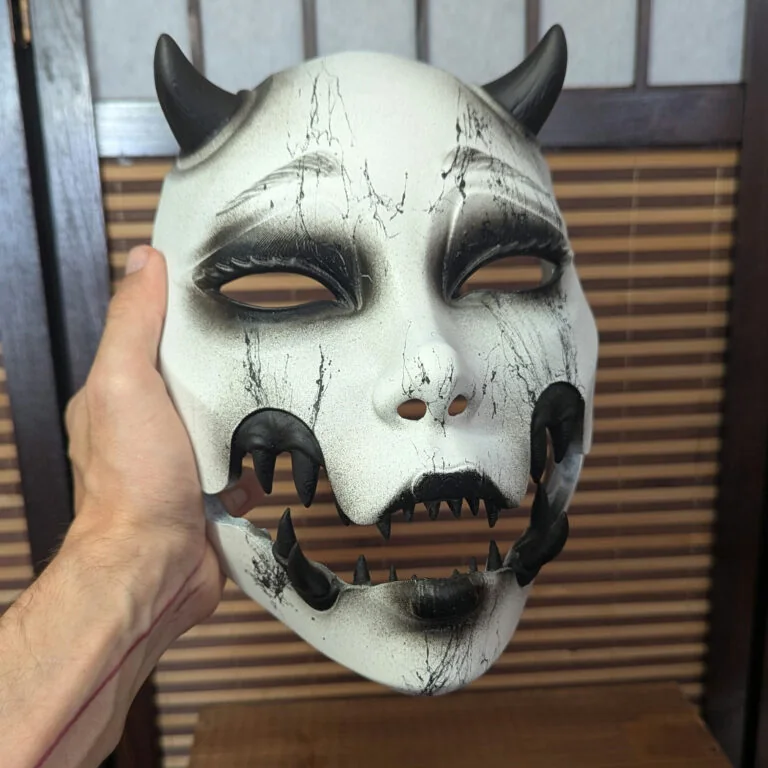
Articulated Kuchisake Onna Mask Dai Yokai

Etymology: The Name That Says It All


Kanji

Reading

Meaning

Kuchi

Mouth

裂け

Sake

To split, to tear

Onna

Women

The name is clinical. No metaphor, no poetry. Three kanji, three facts: a mouth, split open, on a woman. It is this linguistic brutality that makes the name impossible to forget.


The Original History: The Heian Era (794–1185)


The original legend dates back to the Heian period (794–1185), one of the most refined but also the most cruel eras in Japanese history.


The tragedy


A woman of exceptional beauty—the most beautiful in her village—was the wife (or concubine) of an extremely jealous samurai . She used to ask the men of the village if they found her beautiful. One day, the samurai caught her in the company of another man.


Enraged and consumed by dishonor, he drew his weapon and slashed her mouth from the corners to her ears. As he mutilated her, he uttered the phrase that would haunt Japan for centuries:

“誰がお前を美しいと思うか?”Dare ga omae wo utsukushii to omou ka?“Who will find you beautiful now? »

The woman died soon after. But instead of disappearing, she transformed into an onryō (怨霊, vengeful spirit) — the most dangerous type of ghost in Japanese folklore. The same spirits that inspired Sadako ( Ring ) and Kayako ( The Grudge ).


Her goal for eternity: to reproduce on others the mutilation she suffered.


What you need to understand


The Kuchisake-onna is not a monster who kills for pleasure. She is a victim turned predator. Her story is that of a woman destroyed by a patriarchal system where feminine beauty was both worshipped and punished. This theme—beauty as a trap and a condemnation—runs throughout Japanese folklore. It is found in theHannya mask (a woman transformed into a demon by jealousy) and in the legend of the Jorōgumo (a spider that takes the form of a woman to devour men).


How to Respond to Kuchisake-onna? (Survival Guide)


Red kuchisake onna mask split mouth dai yokai

This is THE question everyone is asking. The scene is always the same: you are alone, at night, in a foggy alley. A woman in a surgical mask approaches and asks:


Phase 1:Watashi, kirei?” » — “Am I beautiful? »

Your answer

Consequence

" No "

She kills you instantly with her scissors.

" Yes "

She removes her mask, revealing her split mouth, and asks...

Phase 2: " Kore demo? " — "Even like this?"

Your answer

Consequence

" No "

She kills you instantly

" Yes "

She follows you home and kills you at your doorstep (or disfigures you so that you become a Kuchisake-onna yourself)


The 5 known survival methods

Method

What you do

Why it works

Source / Period

The neutral response

Saying " Maa maa desu " ("You're average / so-so")

This plunges her into confusion — she doesn't know if it's positive or negative

2000s

The reversal

Ask him/her, "And you, do you find me handsome/beautiful?"

Disturbed, she no longer knows what to do and leaves

2000s

The candies

Throwing bekko-ame (amber hard candies) on the ground

She loves candy and stops to pick it up

1970s

The magic word

Yell “ POMADE!” » (ポマード) three times

A possible reference to the smell of the surgeon who operated on her (modern version) — she recoils in terror

1970s

The race

Run as far as possible without looking back

Some versions say that she gets tired over long distances (but according to others, she runs at 100 km/h )

Variable


My advice: If you're at a cosplay convention and someone is wearing an articulated Kuchisake-onna mask , the best survival strategy is a compliment. And a piece of candy.


The Panic of 1979: When the Legend Became Real


This is what makes Kuchisake-onna unique among all the world's urban legends: it caused a documented mass panic .


Timeline of events

Date

Event

December 1978

The first rumor in Yaotsu (Gifu Prefecture). An old peasant woman with a weathered face stands in her garden at night. The children mistake her for Kuchisake-onna.

January 26, 1979

First mention in the press: the Gifu Nichi Nichi Shimbun newspaper publishes an article

March 1979

The rumor spread throughout Japan. The magazine Shukan Asahi (March 23) and then Shukan Shincho (April 5) published articles

Spring 1979

Mass hysteria : children refuse to go out alone. Schools are organizing group returns. Parents are forming escort patrols (PTAs).

1979

Police are increasing patrols in the prefectures of Fukushima , Kanagawa and Hokkaido

June 21, 1979

A 25-year-old woman was arrested in Himeji for wandering around with a knife and a surgical mask, disguised as Kuchisake-onna.

Summer 1979

The school holidays calm the panic. The rumor gradually dies down.

1990s

The legend resurfaced via early internet forums.

2000s

A new wave of popularity. The legend is exported to South Korea and China.

Why 1979?


Professor Iikura Yoshiyuki (Kokugakuin University), a specialist in oral literature, has a theory: in 1979, more and more relatively well-off families were sending their children to juku (preparatory evening schools). Less affluent families supposedly used Kuchisake-onna as a scarecrow: "If you go out at night, she'll catch you." The children took the threat seriously—and then passed it on to their classmates.


The legend spread exactly like a virus: by word of mouth, in school playgrounds, and then amplified by the local press. It is the first purely Japanese urban legend to have had a measurable impact on public life.


Does Kuchisake Really Exist?


No — and yes.


No, not in the supernatural sense. No vengeful spirit has ever been scientifically documented.

Yes, in a social sense: the 1979 Himeji incident (woman arrested with a knife) is a real event. And in 2004, several South Korean press reports indicated sightings of a "masked woman" asking questions of children, reigniting panic.


What makes Kuchisake-onna believable is the surgical mask . In a country where wearing a mask is perfectly normal (long before Covid), any masked woman in a dark alley can become suspicious. That's the genius of this legend: it transforms an everyday gesture into a source of terror.


Kuchisake-onna vs The Other Yokai Women


Japanese mythology is full of dangerous, supernatural women. Here's how Kuchisake-onna compares:


Criteria

Kuchisake-onna (口裂け女)

Hannya (般若)

Yuki-onna (雪女)

Jorōgumo (絡新婦)

Kind

Onryō (vengeful spirit) / urban legend

Noh mask / transformation

Elemental Yōkai (snow)

Yōkai shapeshifter (spider)

Era

Heian (origin) → 1979 (resurgence)

Muromachi (15th century)

Edo → 1904 (Lafcadio Hearn)

Edo → 1776 (Toriyama Sekien)

Method

Trick question + scissors

Rage / transformation

Icy breath

Seduction + silk fabric

Armed

Scissors, knife or sickle

Horns and claws

Deadly cold

Silk threads + fire spiders

Typical victim

Children, students, single men

The man who betrayed her

Mountain travelers

Men seduced

Can we survive?

Yes (bekko-ame, "Pomade", neutral response)

No (if complete transformation)

Yes (if we keep our promise)

No (except with the intervention of a monk)

What it symbolizes

Pressure on beauty / patriarchal violence

Destructive jealousy

Forbidden love / betrayal

The Dangers of Seduction

Dai Yokai Mask

To learn more about these dangerous women of folklore, read my full article: Geisha and Yōkai: When Beauty Hides the Monster .


The 5 Scariest Japanese Urban Legends


Kuchisake-onna didn't come from nowhere. She's part of a uniquely Japanese ecosystem of terror. Here are the legends surrounding her:


Rank

Legend

Place

Principle

Link with Kuchisake-onna

Kuchisake-onna (口裂け女)

Streets, alleyways

Trick question + mutilation

Hanako-san (花子さん)

School toilets

Knock three times on the third door to summon a ghost girl

Targeting children, school environment

Teke Teke (テケテケ)

Stations, corridors

A ghost cut in two, crawling at high speed

Mutilation + superhuman speed

Aka Manto (赤マント)

Public toilets

A voice asks, "Red paper or blue paper?" — both answers are deadly.

Binary trick question (same pattern)

Hitori Kakurenbo (ひとりかくれんぼ)

At home

Hide-and-seek with a possessed doll

Ritual gone wrong


What makes Kuchisake-onna #1 is that she's the only one to have caused a real and documented panic in 1979. The others remain in the realm of playground stories. She, on the other hand, mobilized the police.


Kuchisake-onna in Pop Culture


Artwork

Kind

Year

Role / Appearance

Pom Poko (Studio Ghibli)

Animated film

1994

Brief appearance in a yōkai parade

Kuchisake-onna (Teruyoshi Ishii)

Short film

1996

First live-action adaptation

Carved: The Slit-Mouthed Woman (Kōji Shiraishi)

Horror film

2007

The most faithful full-length film to the legend

Carved 2 + Carved 0

Movies

2008

Sequel and prequel

Jujutsu Kaisen (Gege Akutami)

Manga/Anime

2018+

A reference in the world of plagues

Demon Slayer

Manga/Anime

2019

Stylistic influence (surgical mask + blade)

The Dark Knight (Nolan)

Movie

2008

Possible influence on the Joker (Glasgow scars, the question "Wanna know how I got these scars?") — unconfirmed


My Opinion as a Craftsman: The Articulated Kuchisake-onna Mask


The Kuchisake-onna legend is what inspired me to create my first articulated mask . Why? Because her story hinges on a single gesture: removing the mask . The transition from beautiful to terrifying, in an instant.


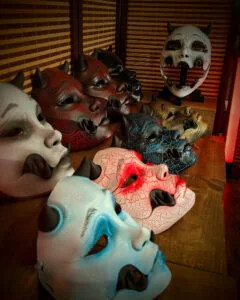
My articulated Kuchisake-onna mask replicates this mechanism exactly. At rest, it resembles a classic half-mask. As soon as you speak or open your mouth, the jaw opens to reveal gaunt teeth and hand-painted raw flesh.


For those who want to take the concept even further, I've also created a version with hair: the articulated Kuchisake-onna + hair . The long, flowing black hair replicates the classic look of the Japanese onryō. And there's the Kuchisake x Tentacles collaboration version, a unique crossover with the artist Melissa from Adopte ton Poulpe.


All made from PETG (high-strength polymer) in my workshop in Plélan-le-Grand, Brittany. PETG is lightweight (suitable for all-day wear at conventions), strong (the hinged jaw withstands hundreds of openings and closings without breaking), and durable (resistant to heat and humidity). Wood is a noble material, but a wooden hinged mechanism would break after a week of heavy use. PETG won't.


Use in Decoration or Cosplay

Atmosphere

Recommended products

Staging

Horror cosplay (convention)

Articulated kuchisake + beige trench coat + toy scissors

You ask passersby, "Am I beautiful?" Their jaws drop. Guaranteed effect.

"Demonic Women" Wall

Matte black background, side lighting. Three stages: beauty → decay → demon

Halloween / Horror Night

The most effective way to scare people. The hair adds striking realism.

Cabinet of curiosities

Next to a Yūrei — the ghost duo of Japan

Numbers and Superstitions of Japan (Culture Bonus)

Since many people interested in Kuchisake-onna also seek to understand Japanese superstitions, here is a bonus table:

Superstition

Explanation

The cursed number: 4 (四, shi )

It is pronounced like "death" (死, shi ). Japanese hospitals often do not have a room 4 or a 4th floor.

The cursed number: 9 (九, ku )

Pronounced like "suffering" (苦, ku )

The surgical mask

Worn daily in Japan for hygiene reasons. This is what makes Kuchisake-onna so terrifying: it blends into normality.

The scissors

In Japanese folklore, sharp objects can become tsukumogami (animated objects) after 100 years.

Frequently Asked Questions (FAQ)


Who is Kuchisake-onna and what is her story?

Kuchisake-onna (口裂け女, "slit-mouthed woman") is an onryō (vengeful spirit) from Japanese folklore. According to the original legend from the Heian period (794–1185), she was the wife of a jealous samurai who slit her mouth from ear to ear after suspecting her of infidelity. As a vengeful spirit, she roams the night wearing a surgical mask and poses the trick question, "Am I beautiful?" before mutilating her victims with scissors. In 1979, this legend caused mass panic in Japan, forcing the police to intervene.


How to survive Kuchisake-onna?


There are five known methods: responding " Maa maa desu " (you're average) to confuse her; turning her question back on her ("And me, am I handsome?"); throwing her bekko-ame sweets, which she loves; shouting "Ointment!" three times (a reference to the surgeon's smell in the modern version); or running for a long time and hoping she gets bored. The neutral response is the most widely cited method in modern folklore.


What is the scariest Japanese legend?


Kuchisake-onna is generally considered the most terrifying Japanese urban legend, and it's the only one to have caused documented mass hysteria in 1979 (police patrols, school escorts, arrests). Other very frightening legends include Hanako-san (the toilet girl), Teke Teke (the ghost cut in half), and Aka Manto (the ghost with trick questions in public restrooms).


Explore the Dai Yokai Universe


Kuchisake-onna proves that a simple mask can contain all the horror in the world. A white surgical mask, a gesture to remove it, and everything changes.


This is precisely what the articulated Kuchisake-onna Mask reproduces—the transition from normal to terrifying, in a single movement of the jaw. Also explore other faces of Japanese horror: Yūrei , the TOP 10 Yokai , and the complete collection of handcrafted Japanese masks .


Comments


bottom of page