Raijin (雷神, rai thunder, jin god) is the deity of lightning in Shinto. He looks like an Oni, coloured skin, fangs, claws, a fierce face, but the two shouldn't be confused: the Oni is a yokai, a creature you fear, while Raijin is a kami, a deity worshipped at shrines. And his demonic look is no accident: it tells the story of his birth.
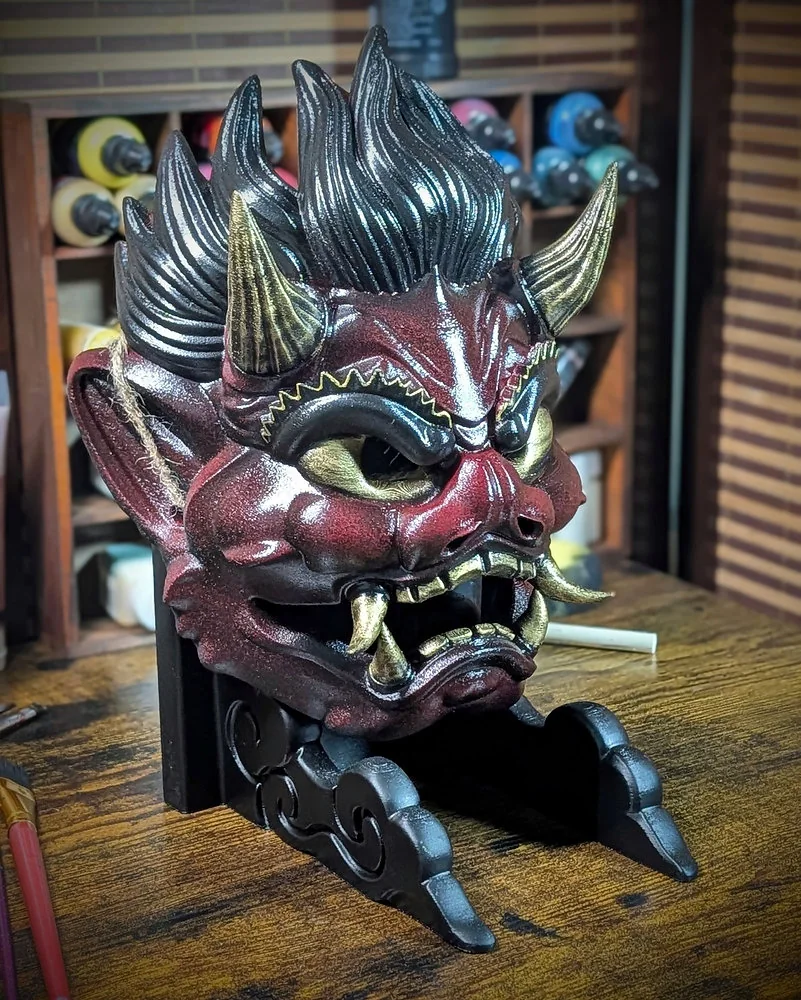
Read the article about Oni masks · See Oni masks
How a corpse fathers a god
The story comes from the Kojiki (712), the founding text of Japanese mythology. Izanagi and Izanami are the creator couple of Japan. Izanami dies giving birth to the fire god, and Izanagi, mad with grief, descends into the Yomi, the land of the dead, to bring her back. When he finally lights a torch to see her, he finds her body in decay. From that corpse are born eight thunder deities (Yakusa no Ikazuchi no Kami), of whom Raijin is the most powerful. That's why he looks like a demon: he was born not of light but of death and of the border between the two worlds. His thunder is the cry of that birth.
The drums and the navel-stealing
Raijin's most recognisable feature is the circle of taiko drums floating around him, joined by a cord: he strikes them to make thunder, each beat a roll. Then there's the navel story. In Japan, mothers still tell children to cover their belly during a storm, or Raijin will come and steal their navel. The origin is probably practical, since storms bring a cold snap and it's wise to protect your stomach, but the saying became folklore.
He's often shown with three fingers per hand, read as the three tenses, past, present and future, while his brother Fujin has four for the four directions. It's a popular symbolic reading rather than dogma, but it captures their complementarity: Raijin masters time, Fujin space.
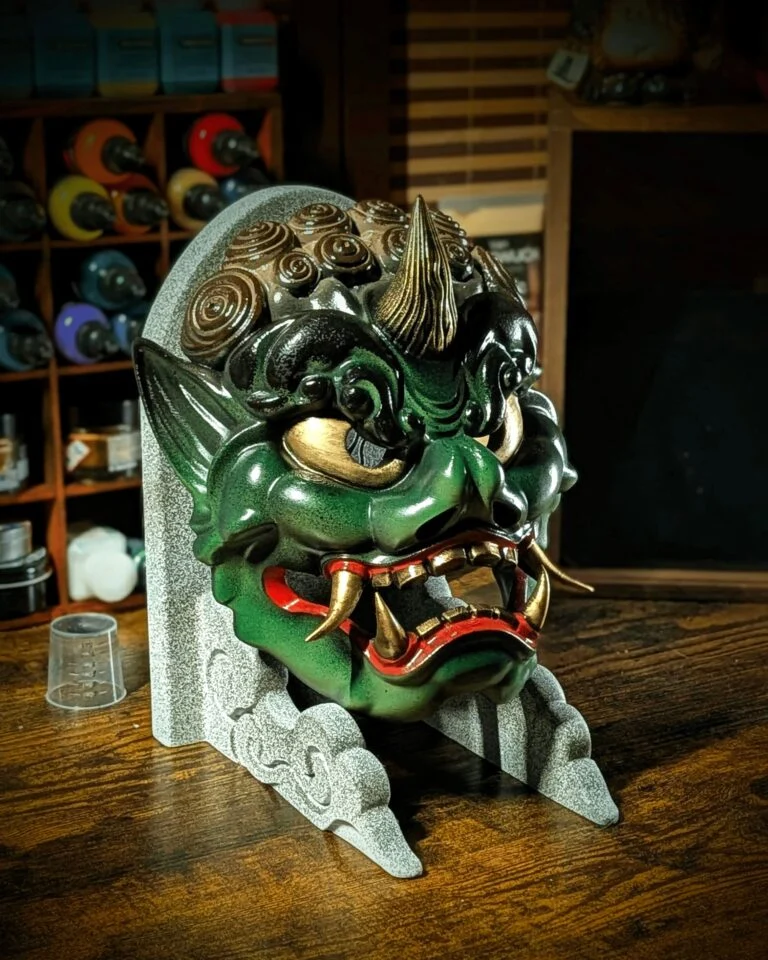
Raijin and Fujin: a pair
The two are inseparable in art as in temples. Thunder without wind is noise in a void, wind without thunder a breath without force: together they make the full storm, Raijin's red against Fujin's green. You'll find them as statues at the Sanjūsangen-dō in Kyoto (Kamakura-period works that fixed their image for centuries), on either side of the Kaminarimon gate at Sensō-ji in Tokyo, and on Tawaraya Sōtatsu's Fūjin Raijin-zu screen (around 1600), a national treasure. They're also credited with the kamikaze, the "divine winds," the typhoons that really did destroy the Mongol invasion fleets in 1274 and 1281.
FAQ
Is Raijin an Oni or a kami?
A kami. He looks like an Oni (fangs, claws, red skin) but he's a Shinto deity worshipped at shrines. You pray to Raijin for protection; you fear Oni.
Why does Raijin have only three fingers?
By a widespread symbolic reading, each finger represents a dimension of time: past, present, future. His brother Fujin has four, for the four directions. Together, time and space.
Why does Raijin steal navels?
It's a Japanese folk saying. The practical reason: storms bring a cold snap, and covering your belly protects your stomach. The myth turned that parental advice into folklore.
What's the link between Raijin and kamikaze?
The kamikaze ("divine winds") are the typhoons that destroyed the Mongol fleet in 1274 and 1281. The Japanese saw in them the work of Raijin and Fujin. The term was later reused in the Second World War.