---
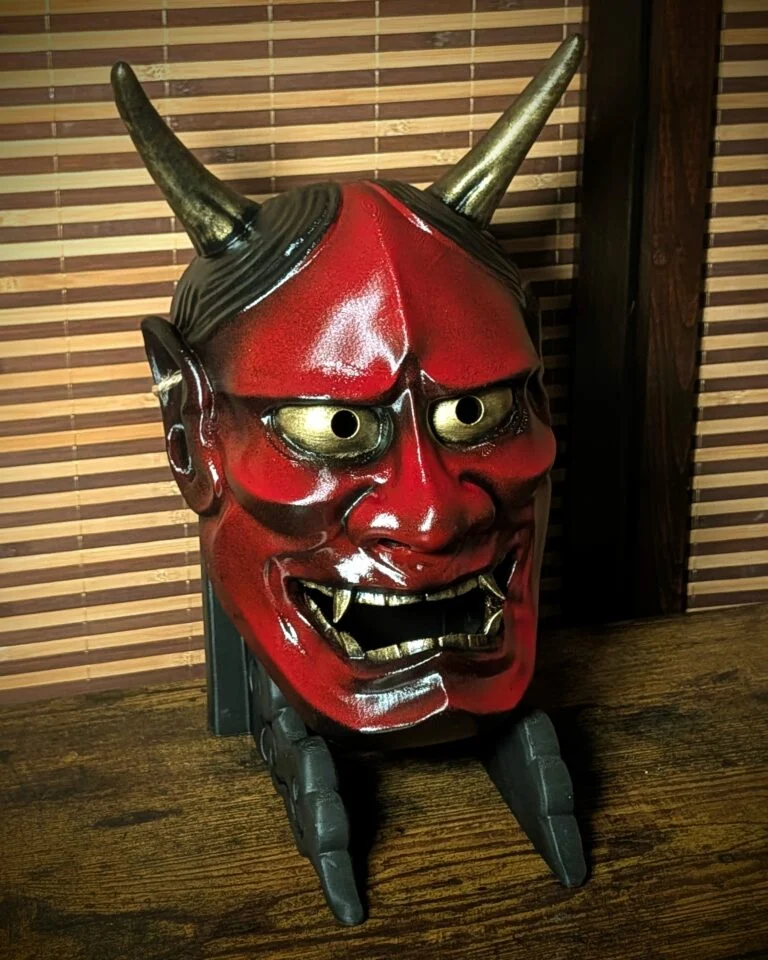
An Oni mask represents a supernatural ogre from Japanese folklore, not a demon in the Christian sense. That difference matters: the Oni is the torturer of the Buddhist hells AND the guardian watching over temple roofs. The creature you fear, and still hang above your door. Here is everything that actually matters: the five colours and what they mean, the tattoo codes, where the horns come from, and how to tell an Oni from a Hannya.
Key takeaways
- The Oni (鬼) is an ambivalent yokai: destroyer in the legends, protector on the rooftops
- Each of the five mask colours maps to one of the Buddhist hindrances of the mind
- In irezumi tattooing, the Oni mask protects the wearer, it never threatens them
What do the colours of an Oni mask mean?
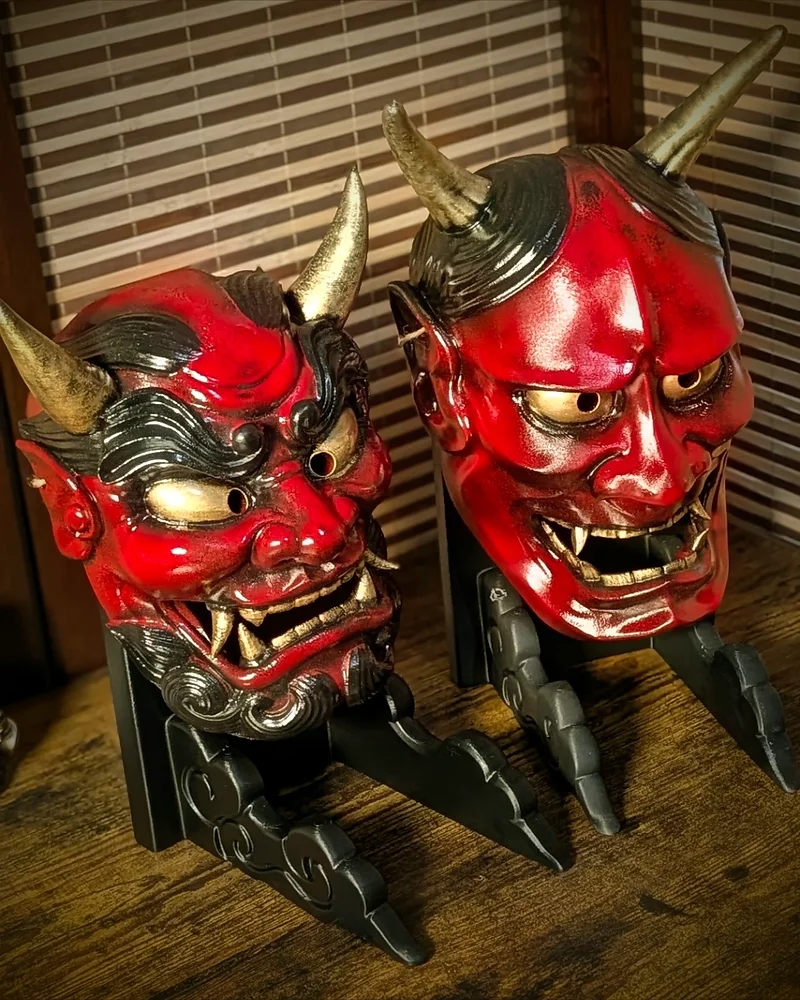
Colour is the first thing people ask me about, so let's start there. An Oni mask's colour isn't decorative. It maps to the Buddhist system of the five hindrances of the mind (*gogai*, 五蓋), the obstacles that block awakening.
- Colour: Name: Buddhist hindrance
- Red: Aka-Oni (赤鬼): Greed, desire
- Blue: Ao-Oni (青鬼): Anger, cold hatred
- Black: Kuro-Oni (黒鬼): Doubt
- Yellow: Ki-Oni (黄鬼): Restlessness, regret
- Green: Midori-Oni (緑鬼): Torpor
At Setsubun, in early February, these colours are symbolically driven out of homes with roasted beans. Red is by far what sells most from my workshop. My own preference goes to the blue ones, though. Red rage is readable in a second; the cold hatred of an Ao-Oni keeps working on you the longer you look at it. Red still outsells it three to one.
The Oni mask in irezumi tattooing
The full breakdown of colours, pairings and placements is in my Oni tattoo article.
In traditional Japanese tattooing, the Oni mask is a protective motif. It guards the wearer; it never turns on them. You'll see it on backs, shoulders and thighs, often paired with peonies, wind bars or waves.
A good share of my customers are tattoo artists, and they don't buy a mask to hang it: they buy it as a 3D composition reference. A physical mask gives you real shadows from every angle, which no flat reference photo can do. Since no dedicated English tattoo guide exists on the site yet, this pillar covers the essentials; for visual references, the Oni mask collection shows how these codes translate into physical pieces.
Where do the horns and the tiger loincloth come from?
Everything in the Oni's look traces back to one compass direction: the north-east. In the Chinese zodiac compass, the north-east belongs to the Ox (*ushi*) and the Tiger (*tora*). It's also the *kimon* (鬼門), the "demon gate" through which evil spirits enter the world. The ox gives the Oni its short thick horns; the tiger gives the claws, the predator's jaw and the striped loincloth. Enryaku-ji temple was built on Mount Hiei, north-east of Kyoto, specifically to block that gate and shield the capital. Add the red or blue skin of the hell torturers, the iron club (*kanabō*) and a giant frame inherited from the mountain kami, and the portrait is complete.
One workshop rule of mine sits exactly here, on the jaw: I always model 4 to 6 teeth between the fangs. Fewer and the mouth looks cramped; more and the snarl stops reading from across a room. I learned that the hard way, on prototypes nobody will ever see.
Where does the word "Oni" come from?
The character 鬼 comes from the Chinese *gui*, the spirits of the dead, brought to Japan in the 6th century with Buddhism. It originally meant "the invisible", what cannot be seen, not "demon". A common reading of the character sees a person wearing a mask, like the shamans who covered their faces to become something supernatural. So from the very start, the mask isn't a costume. The mask IS the Oni.
Is the Oni good or evil?
Both, and that ambivalence is the whole point. In legends like Shuten-doji or Ibaraki-doji, the Oni kidnaps and devours, and gets beaten by cunning rather than strength. In architecture, it stands guard: the onigawara roof tiles have protected temples for centuries. In the Buddhist hells, the Oni Gozu and Mezu carry out justice on the dead. And in the *Nihon Shoki* (720), Japan's official chronicles, "oni" named the rebel peoples who refused imperial rule. The Oni is everything other, abnormal, ungovernable. A mirror of Japan's fears, and of its need for protection.
Oni or Hannya: how to tell them apart
The most common mix-up I see, at every convention and in half my Etsy messages. Someone points at a Hannya and calls it an Oni. The two masks tell opposite stories.
Read the article about Hannya masks · See Hannya masks
- Nature: Ogre, born supernatural: Human woman, transformed
- Driver: Raw force: Jealousy, grief
- Horns: Short, thick: Long, fine
- Expression: Fixed rage, a wall: Shifts with the viewing angle
- Role: Protects: Warns
Simple rule: raw protective energy, go Oni. Emotional complexity, go Hannya.
How to display an Oni mask at home
Facing the entrance or a window, so it watches what comes in, exactly like the onigawara on temple roofs. Above a desk works too, as a focus and willpower anchor. Tattoo studios have turned it into a wall classic.
Practical side: my masks are 3D printed in PETG (245 °C nozzle, 80 °C bed, or the print warps), hand-sanded, painted in acrylics and sealed with matte varnish in my workshop in Brittany, France. A full mask weighs 150 to 350 g, so a standard hook holds it, no wall anchor needed. They hang on sturdy cords, not elastic. And PETG shrugs off humidity; Brittany has tested that claim for me, every single winter. Each piece is made to order and ships tracked worldwide from daiyokai.com or my Etsy shop.
The full Oni collection is here.
FAQ
Are Oni demons?
Not in the Western sense. A Christian demon is purely evil; the Japanese Oni is an ambivalent yokai, by turns destroyer, guardian, judge, even local deity. "Demon" is a lossy translation: the Oni is closer to a many-faced supernatural ogre.
What do the Oni mask colours mean?
They map to the five Buddhist hindrances of the mind: red (greed), blue (anger), black (doubt), yellow (restlessness), green (torpor). At Setsubun, these colours are driven out with beans.
What's the difference between an Oni and a Hannya mask?
The Oni is a masculine ogre, born supernatural: raw force, fixed expression, short horns. The Hannya is a woman transformed by jealousy: an expression that shifts with the angle, fine horns. The Oni protects; the Hannya warns.
Where should I hang an Oni mask?
Facing a door or window to activate its guardian role, or above a desk for focus. The best wall is the one you see first when entering the room.
---
What's the difference between an Oni and a yokai?
Yokai is the general category for spirits, creatures and strange phenomena in Japanese folklore. The Oni is one type of yokai, like the Kitsune or the Tengu.