SETSUBU: MEANING, HISTORY AND RITUALS OF THE DEMON HUNTER
- DAI YOKAI
- Feb 4
- 8 min read
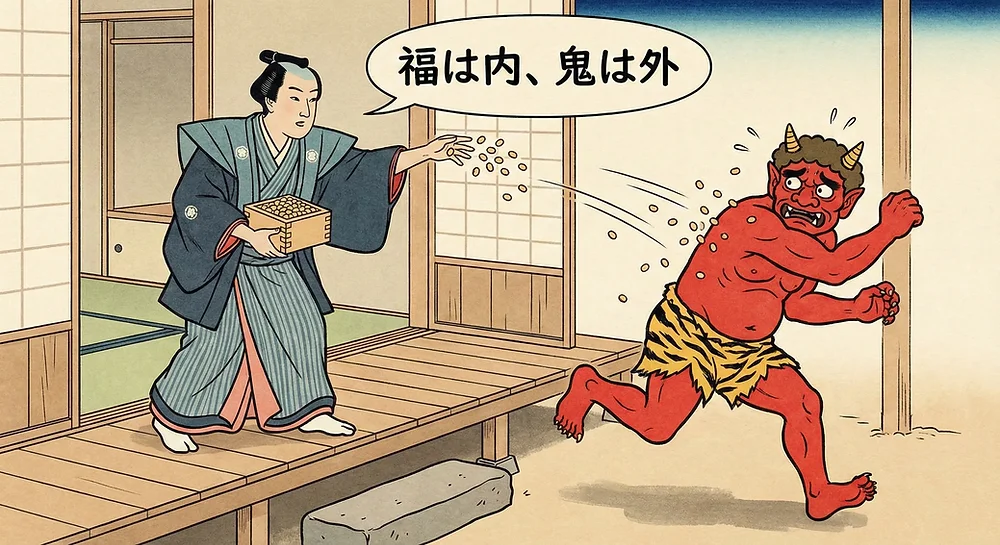
On February 3rd, in Japan, a strange scene unfolded in almost every home, school, and temple.
Laughing children chase an adult wearing a terrifying demon mask, throwing projectiles at him while shouting a magic spell.
This isn't a recess gone wrong. This is Setsubun (節分) .
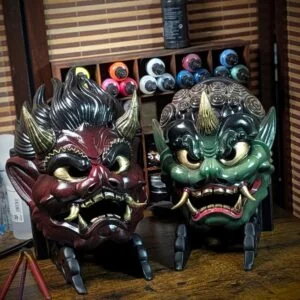
If you follow my work at Daiyokai , you know that I spend my year sculpting Oni masks . Setsubun Day is, in a way, their day of glory (and suffering). It's the day when folklore comes to life.
But behind this seemingly playful ritual lies a thousand-year-old tradition of exorcism, purification, and seasonal change.
Why do we throw beans? Why do we eat a huge maki in silence while looking in a specific direction? And above all, why is the mask an indispensable tool in this ceremony?
In this comprehensive guide, we'll delve into one of Japan's most iconic festivals. From its forgotten Chinese origins to modern practices, get ready to ward off bad luck and welcome spring.

I. ORIGINS AND ETYMOLOGY: THE SEPARATION OF THE SEASONS
Before launching anything, you need to understand the word.
1. The "Division of the Seasons"
Literally, Setsubun means "Division of the Seasons" ( Setsu = Season, Bun = Division).
Historically, there were four "Setsubun" per year (one for each change of season: Spring, Summer, Autumn, Winter).
However, in the old Japanese lunar calendar, Spring ( Risshun ) marked the beginning of the new year. It was the most important time, the renewal of life.
Over the centuries, the term "Setsubun" came to refer exclusively to the eve of spring (February 3 or 4).
So, spiritually, it's a New Year's Eve . And as with any transition to the new year, there's a need to clean house: we sweep away the dust and chase away the bad spirits accumulated during the past year.
2. The Chinese Ancestor: The Tsuina Ritual
The custom did not come from nowhere. It was imported from China during the Nara period (8th century). It was then called Tsuina (追儺) or "The Great Exorcism".
At the imperial court, an officiant called Hosshi (a shaman with four golden eyes) led a procession to drive away the invisible demons of plague and misfortune. He used a bow and reed arrows.
Over time, this aristocratic and solemn ritual became more democratic. It spread to the common people, and the arrows were replaced by something much more accessible to the peasants: beans.
II. THE MAMEMAKI RITUAL: WHY BEANS?
The heart of Setsubun is Mamemaki (豆撒き) , literally "Bean Throwing".
1. The Power of Soy (Fuku-mame)
Roasted soybeans, called Fuku-mame (Happy Beans), are used.
Why soy?
Vitality: Soybeans are a very resistant seed, full of vital energy ( Ki ).
Wordplay (Kotodama): In Japanese, the language is full of sonic magic.
Mame (豆) = Bean.
Ma (魔) = Demon / Evil.
Me (滅) = Destroy / Annihilate.
So Ma-Me (魔滅) can be read as "Destroy the Demon".
Throwing beans is literally like bombarding evil with life energy.
Warning: the beans must be roasted . If you throw away raw beans and they later sprout in the garden, superstition says that misfortune will take root in your home!
2. The Magic Formula: "Oni wa Soto!"
This is the phrase you'll hear everywhere that day. You have to shout it loudly while throwing the seeds:
"Oni wa soto! Fuku wa uchi!" (Demons out! Happiness in!)
We start by throwing beans from inside the house towards the front door (or windows) to chase away the demons. Then, we quickly slam the door to prevent them from getting back in.
Then, beans are thrown inside the room to invite happiness ( Fuku ).
3. Eat Your Age
Once the battle is over, each family member must collect and eat the number of beans corresponding to their age.
If you are 25 years old, you eat 25.
In some regions, they eat one more (+1) to guarantee health for the coming year.
It's a way of internalizing divine protection.
III. THE ROLE OF THE ONI: WHY DOES THE FATHER WEAR THE MASK?
This is where my work as a craftsman takes on its full meaning. Without Oni, there is no Setsubun. An antagonist is necessary for the ritual to function.
1. The Family Scapegoat
In family tradition, it is often the father (or the older brother) who takes on this role. He puts on an Oni mask and plays the part of the demon trying to invade the house.
The children, armed with their boxes of beans, must bombard him to make him flee.
It is a playful catharsis: children have the right (for once) to "attack" paternal authority, which symbolically embodies all external dangers (illness, unemployment, accidents).
When the father runs away and takes off his mask, order is restored and the house is safe.
2. Which Mask to Choose? The Symbolism of Colors
Not all Oni are created equal. Depending on the mask you wear, you embody a different "Poison" to be exorcised. This is related to the Goshiki no Oni (the five Buddhist colors) which I discuss in my detailed articles:
Meaning: Desire, Greed ( Ton'yoku ).
Why hunt it? To free oneself from the thirst for possession and gluttony. It's the most common mask for Setsubun.
Meaning: Anger, Hatred ( Shinni ).
Why chase it away? To appease his heart and not give in to rage next year.
Meaning: Doubt, Ignorance ( Guchi ).
Why get rid of him? To have a clear mind and make good decisions. He's the hardest one to get rid of!
The Green Oni (Midori-Oni): Laziness or poor health. (article to come)
The Yellow Oni (Ki-Oni): Agitation and Regret. (article to come)
IV. OTHER STRANGE RITUALS OF SETSUBUN
Mamemaki is the most well-known, but there are others, darker or more indulgent.
1. Ehomaki: The Scroll of Fortune
It is a more recent tradition (popularized by Osaka merchants and 7-Eleven), but now essential.
On the evening of Setsubun, we eat an Ehomaki (Lucky Direction Maki).
It's a large, uncut maki roll (so as not to "cut" the luck). It often contains 7 ingredients (in homage to the 7 Gods of Happiness).
The Rule: It must be eaten in silence, with eyes closed, looking in the favorable direction of the year ( Eho ), determined by the Chinese zodiac.
Tip: Pair it with a good green tea (Genmaicha) from Chanokaze to digest this hearty meal!
2. Hiiragi Iwashi: The Sardine Head
It's the "Gore" and olfactory ritual.
The Japanese hang on their door a decoration consisting of a holly branch ( Hiiragi ) and a grilled sardine head ( Iwashi ).
Why? The Oni hate two things: thorns (holly pricks their eyes) and bad smells (stinky sardines). It's a very effective repellent talisman (and it also keeps the neighbors away, let's be honest).
V. SETSUBU IN MODERN CULTURE
Today, Setsubun is a major media event.
1. In the Temples (Narita-san)
Large temples organize giant Mamemaki. Often, celebrities (Taiga Drama actors), politicians, or Sumo wrestlers throw beans to the crowd from a platform.
Here, people don't shout "Oni wa soto" (it would be impolite to say there are demons in a sacred temple), they simply shout "Fuku wa uchi" (Happiness within). The crowd jostles to grab the sachets, because they bring good luck.
2. The exception of the "Watanabe"
This is an anecdote I love. If your last name is Watanabe , you are exempt from Setsubun!
For what ?
Legend has it that the medieval hero Watanabe no Tsuna cut off the arm of the terrible demon Ibaraki-Doji at Modoribashi Bridge. Since then, the Oni have been terrified by the mere mention of Watanabe's name. They don't even dare approach a Watanabe's house. No need for beans, your name is enough!
VI. THE DAIYOKAI APPROACH: A MASK FOR LASTNESS
Let's get back to the workshop. Why buy a Daiyokai mask for Setsubun when you can find cardboard masks for €1 at the supermarket?
1. The Immersive Experience
Setsubun is a play. For the children to believe it (and have fun), the "monster" must be believable.
A thin plastic mask with a snapping elastic breaks the magic.
A Daiyokai mask, sculpted in 3D with textures, imposing horns, and meticulous painting, transforms the family man into a true Yōkai . The adrenaline rush is different.
2. Resistance (The Bean Test)
It's a simple thing, but beans hurt! And they scratch.
My masks are printed in PETG (high resistance) and varnished with several protective layers.
They are designed to withstand impacts from projectiles (soybeans, foam balls, toys). You can take a beating without worrying that the mask will crack or the paint will chip at the first impact.
3. After the Party: The Decorative Object (Onigawara)
Once Setsubun has passed, what do we do with the cardboard mask? We throw it away.
A Daiyokai mask, however, changes its function.
It moves from his face to the wall.
He becomes an Onigawara (Ogress Tile), a protective guardian that you hang in the entryway or living room. It continues to watch over the house all year round, waiting for the next February 3rd. It's a lasting object, a Tsukumogami in the making.
VII. PHILOSOPHY: THE MENTAL SPRING HOUSE
Beyond the folklore, Setsubun has a psychological value that I particularly appreciate.
It's a "Reset".
Winter is a time of accumulation: we stay home, we ruminate, we spend less time in the sun. Symbolically, we accumulate inner "Oni" (fatigue, doubt, gloom).
Setsubun forces us to open the windows (literally, to throw the beans) and to shout.
This cry "Oni wa soto!" is liberating. It is an active expulsion of negativity.
This is not just a superstition; it is an act of behavioral psychology. The problem is materialized (the mask), it is fought (the beans), and it is banished.
CONCLUSION
Setsubun is much more than a food fight. It is the living link that unites the Japanese with their past, with nature, and with their fears.
Whether you're in Japan or France, celebrating Setsubun is a wonderful way to mark the end of winter. It's a chance to laugh with family, enjoy delicious maki, and start fresh for spring.
And if you're looking for the perfect face to embody your demons (and defeat them), the Daiyokai workshop has what you need. Whether you choose Red for passion or Black for mystery, remember: in the end, happiness ( Fuku ) must always prevail.
Good Mamemaki everyone!
ABOUT THE AUTHOR
Jeremy — Dayokai
Artisan Maker. I sculpt demons all year round, but February 3rd is the only day I'm happy to have things thrown at them. My masks are designed to be worn, experienced, and displayed.
FAQ: EVERYTHING YOU NEED TO KNOW ABOUT SETSUBN
Can peanuts be used instead of soy?
Yes! In some regions of northern Japan (Hokkaido, Tohoku) where there's a lot of snow, people throw peanuts in their shells. It's more hygienic (you can eat them after collecting them from the snow) and easier to find.
Is Setsubun a public holiday?
No, it's a cultural and religious holiday, but people work and go to school. The rituals often take place in the evening when they get home.
Why shouldn't the Ehomaki maki be cut?
The Ehomaki symbolizes relationships (en-musubi). Cutting the roll with a knife would symbolically mean "cutting ties" or cutting off luck. Therefore, it must be eaten whole, biting into it with gusto (which is quite comical given its size).
TABLE: THE ROLES OF THE RITUAL
Role | Who ? | Action | Essential Accessory | Symbolic |
The ONI (Demon) | The Father / The Eldest | Growl, attack, then flee | Oni Daiyokai Mask (Red/Blue) | Misfortunes, illness, winter |
THE HUNTER | The Children / The Mother | Shout “Oni wa Soto!”, Throw | Fuku-mame (Roasted soybeans) | Purity, vitality, spring |
THE OBSERVER | The ancestors / Kami | Protect the house once it has been purified | Hiiragi Iwashi (Sardine) | The guardian of the threshold |


Comments