Key takeaways
- The Hannya mask (般若の面) represents a woman transformed into a demon by jealousy, not a demon born supernatural
- Its expression shifts with the angle: rage face-on (terasu), sorrow when tilted down (kumorasu). The only mask in the world that works this way
- 3 colours = 3 stages of transformation: white (namanari, the start), red (chūnari, mid), black (honnari, point of no return)
- The name "Hannya" means "perfect wisdom" in Sanskrit. The mask embodies the exact opposite. The paradox is deliberate
- In irezumi, it's the most tattooed motif in Japan
What is a Hannya mask?
The Hannya is a Japanese Noh theater mask (14th century) representing a kijo: a woman whose jealousy, betrayal in love or grief grew so violent that she physically turned into a horned demon. The horns grow, the fangs pierce, the face warps. But tilt the mask down and you still see the sorrow beneath the rage.
It's the confusion I correct most at conventions. People point at a Hannya and say "nice Oni." No. The Oni is a masculine ogre, raw force born supernatural. The Hannya is a human woman who became a monster. It's a trajectory, not a nature, and that's exactly what makes it more tragic. It's also the mask I paint with the most care: every shadow on that face counts. Too dark around the eyes and she's a generic monster; not dark enough and she loses her tragedy. The Hannya lives in between.
Why the word "Hannya" is a paradox
The name carries three origins at once, and the paradox sits at the center of all three. First Hannya-bō (般若坊), the monk-sculptor said to have carved the first mask in the Muromachi era, Japanese tradition naming a mask after its maker. Then Prajñā / Hannya (般若), the Sanskrit term for "perfect wisdom" in Buddhism, the wisdom that leads to enlightenment, while the mask embodies its exact opposite, the loss of wisdom to the passions. And the Hannya Shingyō, the Heart Sutra of Great Wisdom (般若心経): in the Noh play Aoi no Ue, it's precisely the recitation of this sutra that exorcises the Hannya spirit. Wisdom defeats what the absence of wisdom created. One word holding both wisdom and its destruction.
The two founding legends
Kiyohime: the woman who melted a bell
The oldest and most violent Hannya legend, told in the Dainihonkoku Hokekyōkenki (11th century) and staged in the Noh play Dōjō-ji. Kiyohime is an innkeeper's daughter in Kii province. A young monk, Anchin, stops by each year on his pilgrimage. She falls in love. Anchin, bound by his vows, promises to return. He lies. When Kiyohime understands the betrayal, her rage is so intense she transforms: horns, fangs, then her whole body becomes a giant fire serpent. She chases Anchin to Dōjō-ji temple, where he hides under the bell. Kiyohime coils around the bell and melts it with the heat of her rage, burning Anchin alive inside. That's the honnari stage: the point of no return. Nothing human is left.
Lady Rokujō: the jealousy that kills from afar
From The Tale of Genji (11th century), the world's oldest novel. Lady Rokujō is a Heian-court aristocrat, Prince Genji's former mistress. When Genji abandons her for a younger woman (Lady Aoi), Rokujō's jealousy is so toxic that her spirit leaves her body in her sleep to torment and finally kill Lady Aoi. The most terrifying part: Rokujō doesn't control it. She wakes to the smell of purification incense on her clothes and realizes her own spirit has killed, without her consent. The Noh play Aoi no Ue immortalizes the scene, where the Hannya mask is at its most powerful: a face simultaneously woman and demon, depending on the tilt.
The 3 colours = 3 stages of transformation
Not decoration. Each Hannya colour tells you where in the transformation the woman stands.
| Colour | Stage | What's left of the human |
|---|---|---|
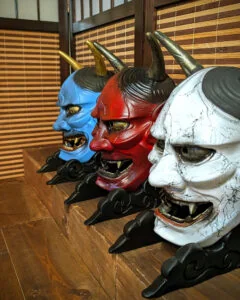
| White (Shiro-Hannya) | namanari (start) | A lot. Barely visible horns, near-human face. Jealousy is just starting to gnaw |
| Red (Aka-Hannya) | chūnari (mid) | Little. Developed horns, visible fangs, rage dominant. But the eyes can still weep |
| Black (Kuro-Hannya) | honnari (no return) | Nothing. Full transformation. The woman is gone, only the demon remains |
Red (Aka-Hannya) is the most requested: the most dramatic stage, enough rage to be striking, enough humanity to be tragic. White (Shiro-Hannya) is the subtlest, the connoisseur's choice: the face of a woman who knows she's becoming a monster and can't stop.
Terasu and Kumorasu: the technical secret
The Hannya is the only mask in the world whose expression changes with no articulated mechanism. The secret comes from the 14th-century Noh sculptors. Terasu (照らす, "to illuminate"): tilt the mask up, light hits the cheekbones and forehead, the expression turns to rage, fury, power. Kumorasu (曇らす, "to cloud"): tilt it down, the eye sockets shadow, the cheeks hollow, the expression turns to sorrow, resignation, suffering. The mask doesn't move. The light transforms it. That's why a wall-mounted Hannya works so well: across the day, the changing natural light subtly shifts its expression. Calm in the morning, raging under low evening light.
How to display a Hannya mask
The Hannya isn't a guardian like the Oni. It doesn't protect, it warns, a reminder that unchecked passions destroy. A few principles: facing a space of reflection (desk, library, reading nook) as a memento, "master your inner demons"; under side or changing light to activate the terasu/kumorasu effect, since flat front light kills the duality; paired with an Oni, masculine raw force beside feminine emotional complexity; or in a trio with a Kezurata (cracked, kintsugi-inspired) and a Hannya Berserk, three stages of the same suffering.
The Hannya in irezumi tattooing
The Hannya is the most tattooed motif in traditional Japanese tattooing. It stands for mastered passion: "I acknowledge my inner demons and don't let them win." A talisman against betrayal and self-destruction.
FAQ
Is the Hannya an Oni?
No. The Oni is an ogre born supernatural: raw force, fixed expression, thick horns. The Hannya is a human woman turned demon by jealousy: fine horns, an expression that shifts with the angle. The Oni protects, the Hannya warns.
Why does the Hannya change expression?
It's the genius of the 14th-century Noh sculptors. The mask is carved with asymmetrical volumes that react to light. Tilted up (terasu): rage. Down (kumorasu): sorrow. The mask doesn't move, the light does.
What do the 3 Hannya colours mean?
White (namanari): the start, the woman is still nearly human. Red (chūnari): mid-stage, rage dominant but the eyes still weep. Black (honnari): point of no return, the woman is gone, only the demon remains.
Does "Hannya" mean wisdom?
Yes, paradoxically. Hannya (般若) comes from the Sanskrit Prajñā ("perfect wisdom"). The mask embodies the exact opposite: the loss of wisdom. And it's the recitation of the Hannya Shingyō (Heart Sutra) that exorcises the Hannya spirit in Noh theater.
Which Hannya mask is the most popular?
Red (Aka-Hannya, chūnari stage). The most dramatic: enough rage to be striking, enough humanity to be tragic. White is the subtlest and the connoisseur's favorite.