

Rōnin: What Happens When a Samurai Loses Everything
- DAI YOKAI
- 2 days ago
- 6 min read
By Jérémy, Dai Yokai founder · @dai.yokai Published: February 2026 · Updated: May 2026
Key takeaways
A rōnin (浪人, "wave-man") was a samurai who lost his master through death, defeat, exile, or personal choice
Around 400,000 rōnin lived in Japan during the 1650s
The two most famous: Miyamoto Musashi (greatest swordsman in history, 60 undefeated duels) and the 47 Rōnin of Akō (revenge of 1702)
The word rōnin is still used in modern Japan for students retaking university entrance exams
I recreate samurai mempo war masks in PETG, hand-finished in my workshop in Brittany, France
The word rōnin literally means "wave-man." A person carried by the current, with no harbor to return to. In feudal Japan, that meant a samurai without a lord. No income, no clan, no social standing. Just a man with two swords and the skills to use them.
Some rōnin were broken men. Others became the most extraordinary warriors in Japanese history.

How a samurai became rōnin
The bushidō (武士道, "way of the warrior") demanded absolute loyalty to one's lord. If that bond broke, the samurai's identity broke with it.
The most common cause was simple: a feudal lord died without an heir, the shōgun confiscated the domain, and every samurai in the lord's service became rōnin overnight. After the Battle of Sekigahara in 1600, when Tokugawa Ieyasu defeated the western coalition, the losing side's warriors were cast out by the thousands. By the 1650s, Japan had roughly 400,000 rōnin. One in five warriors, wandering without a master.
Other causes: disgrace (a samurai who insulted a superior), military defeat, or sometimes a deliberate choice. A few warriors left their lords voluntarily to pursue martial perfection on their own terms.
The kanji for rōnin actually changed over time. The older spelling, 牢人, means "rejected man" or "prisoner." The Edo-period spelling, 浪人, shifts the image to "drifting man." The shame became romance. That shift is exactly why the rōnin went from outcast to legend.
Miyamoto Musashi: 60 duels, zero defeats
Miyamoto Musashi (宮本武蔵, 1584-1645) is Japan's most famous rōnin and arguably the greatest swordsman who ever lived.
He fought at Sekigahara on the losing side. He could have found a new master afterward. He refused. Instead, he spent decades on a musha shugyō (武者修行, warrior pilgrimage), walking across Japan and fighting anyone who would face him. Sixty duels. Not a single loss.
His most famous fight: the 1612 duel against Sasaki Kojirō on Ganryū Island. Musashi arrived late on purpose (psychological warfare), fought with a wooden sword carved from a boat oar, and killed Kojirō with one blow.
He invented the Niten Ichi-ryū (二天一流, "school of two heavens"), a fighting style using two swords at once. Most samurai thought it was ridiculous. Musashi proved them wrong sixty times.
Late in life, he retired to a cave called Reigandō and wrote the Go Rin No Sho (五輪書, Book of Five Rings), a treatise on strategy that is still studied today by martial artists, military strategists, and business executives. Think of it as Japan's answer to Sun Tzu's Art of War.
The five books: Earth (foundations), Water (fluidity and technique), Fire (offensive tactics), Wind (critique of other schools), and Void (the ultimate mental state of acting without thinking).
The 47 Rōnin: Japan's greatest revenge story
This is not fiction. It is a documented historical event that took place between 1701 and 1703.

In March 1701, a feudal lord named Asano Naganori drew his sword inside Edo Castle and wounded Kira Yoshinaka, the shōgun's master of ceremonies. Kira had been publicly humiliating Asano and demanding bribes that Asano refused to pay.
The shōgun condemned Asano to seppuku (ritual suicide) the same day. Kira received no punishment. The injustice was obvious.
Asano's domain was confiscated. His 300 samurai became rōnin. Forty-seven of them refused to accept the verdict.
For two years, their leader Ōishi Kuranosuke ran an elaborate deception. He divorced his wife, moved to Kyoto, drank publicly, visited geisha houses. The other rōnin scattered, disguising themselves as monks, merchants, laborers. The goal: convince Kira that no one was coming for him.
On the night of December 14, 1702, the 47 attacked Kira's residence in Edo. They killed 28 guards, found Kira hiding, and offered him the honor of dying by seppuku. He refused, trembling. Ōishi beheaded him with the same blade used for Asano's seppuku.
That morning, the 47 walked through Edo carrying Kira's head and placed it on Asano's grave at Sengaku-ji temple.
On February 4, 1703, the shōgun sentenced the 47 to seppuku, granting them the honorable death of samurai rather than criminal execution. Forty-six took their own lives the same day. The 47th, Terasaka Kichiemon (sent as a messenger), was later pardoned.
Why it still matters
The shōgun was trapped. The people saw the 47 as heroes. The law demanded their death. Seppuku instead of execution was the compromise he found. It became a symbol of imperfect justice that still resonates.
Sengaku-ji temple in Tokyo still stands. You can visit the 47 graves arranged around Asano's, see the statue of Ōishi, and find the Kubi-arai Ido ("head-washing well") where the rōnin cleaned Kira's head before placing it on the grave. Every December 14, the Akō Gishi Sai festival draws thousands of visitors in period costume.
Rōnin vs samurai vs ninja
Samurai (侍) | Rōnin (浪人) | Ninja / Shinobi (忍者) | |
Status | Warrior serving a lord | Warrior without a master | Secret agent, mercenary |
Code | Strict bushidō | Bushidō in theory, freedom in practice | No official code, pure pragmatism |
Weapons | Daishō (katana + wakizashi), bow, spear | Daishō (kept even without a master) | Shuriken, kunai, poisons, concealed weapons |
Combat style | Frontal, announced | Variable, from noble duels to banditry | Stealth, ambush, espionage |
Income | Lord's stipend (rice) | No fixed income | Paid per mission |
Mask | Mempo war mask | Sometimes a worn mempo, often bare-faced | Hood, cloth |
Rōnin in pop culture
Work | Type | Year | What to know |
Seven Samurai (Kurosawa) | Film | 1954 | The foundational film. Reinvented as The Magnificent Seven |
Yojimbo (Kurosawa) | Film | 1961 | Wandering rōnin manipulates two clans. Inspired A Fistful of Dollars |
Vagabond (Inoue) | Manga | 1998-2015 | The best adaptation of Musashi's life. 37 volumes |
Samurai Champloo (Watanabe) | Anime | 2004 | Hip-hop meets Edo. Two rōnin, opposite philosophies |
Ghost of Tsushima | Video game | 2020 | Player chooses: samurai honor or rōnin tactics |
Ghost of Yōtei | Video game | 2025 | Spiritual successor, 1603, dedicated article |
47 Ronin (2013 film) | Film | 2013 | Hollywood fantasy version, visually striking |
One Piece (Wano arc) | Manga | 2018+ | Nine Red Scabbards directly inspired by the 47 Rōnin |
Usagi Yojimbo (Sakai) | Comics | 1984+ | A rabbit rōnin, direct homage to Musashi |
The rōnin's mask
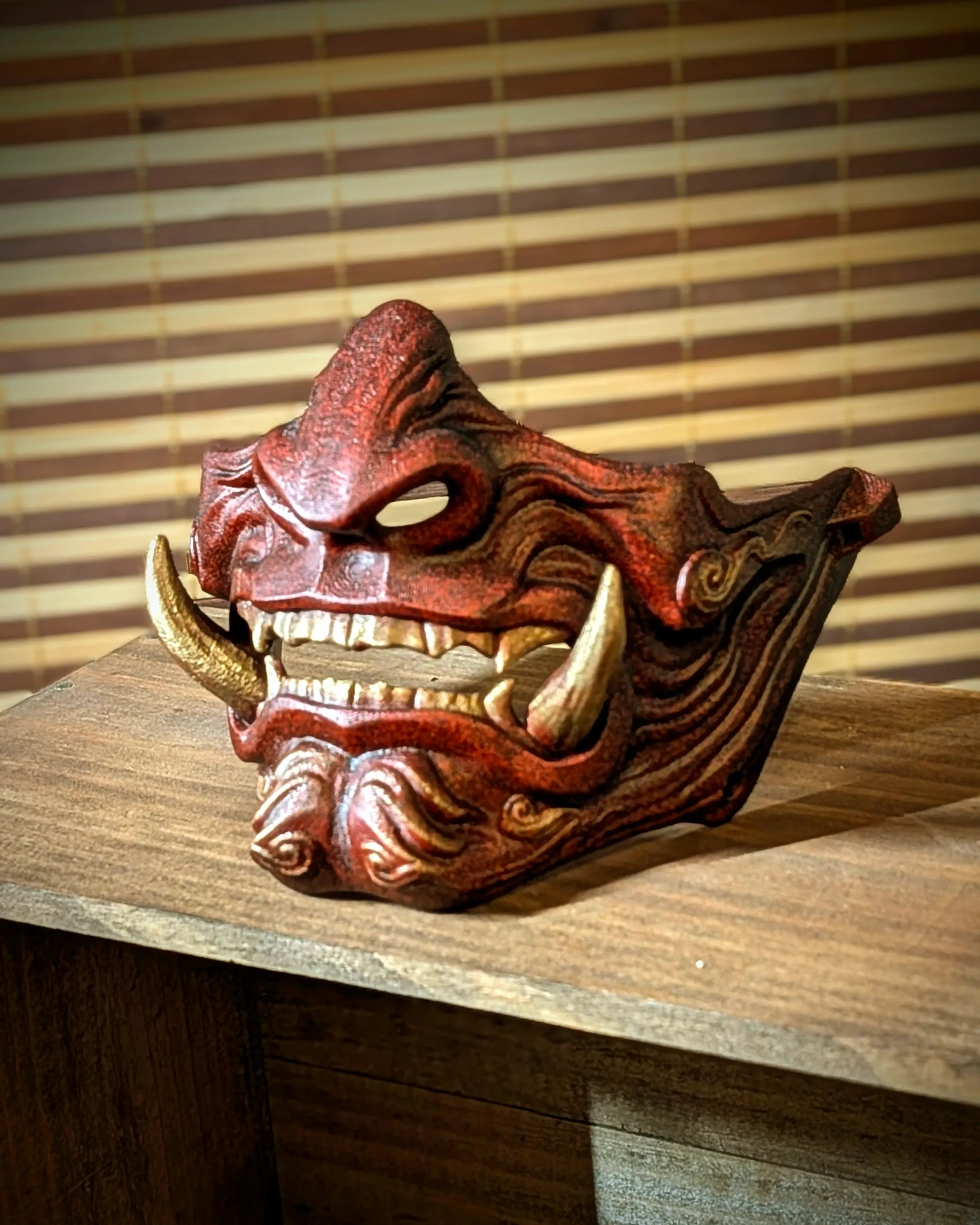
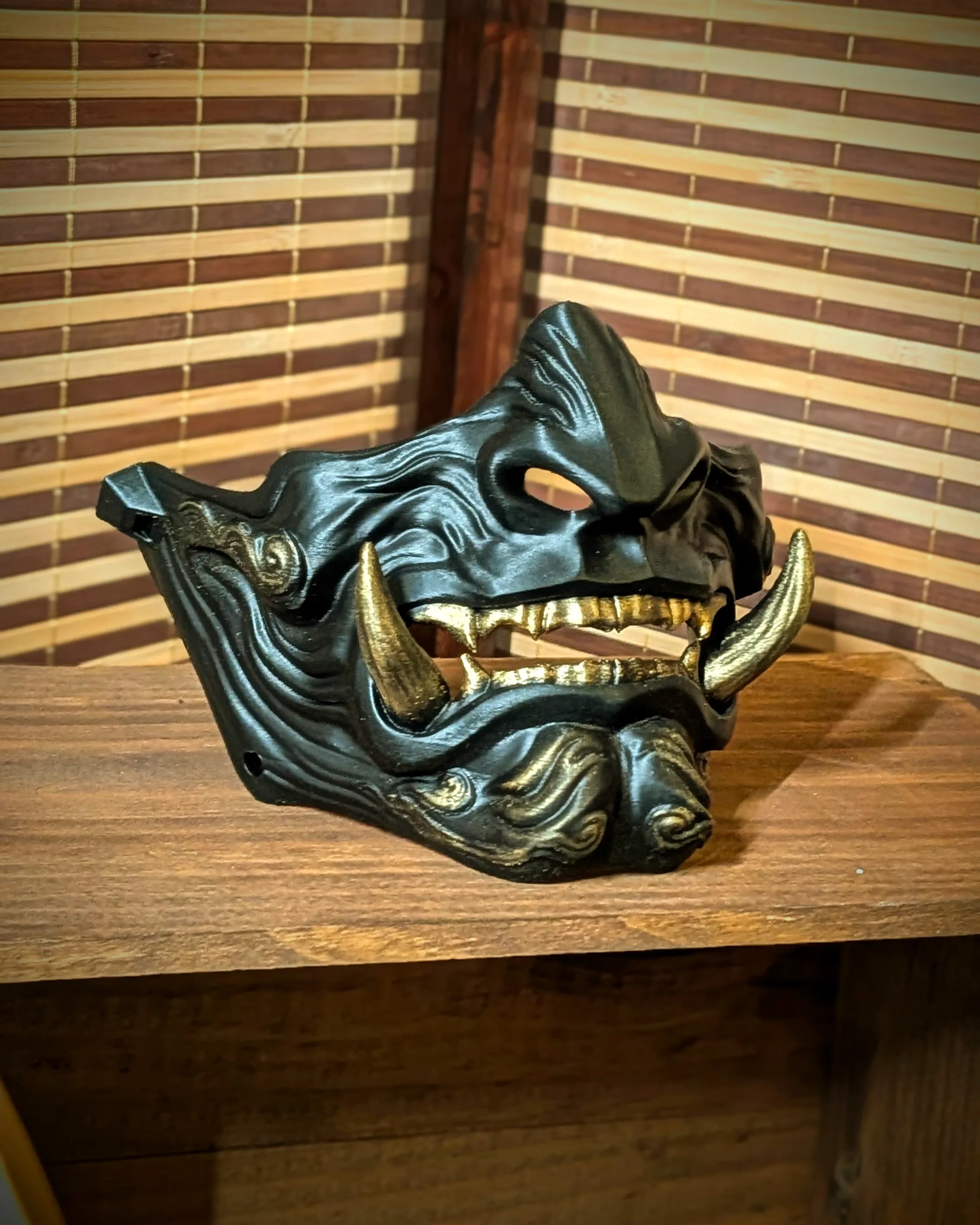
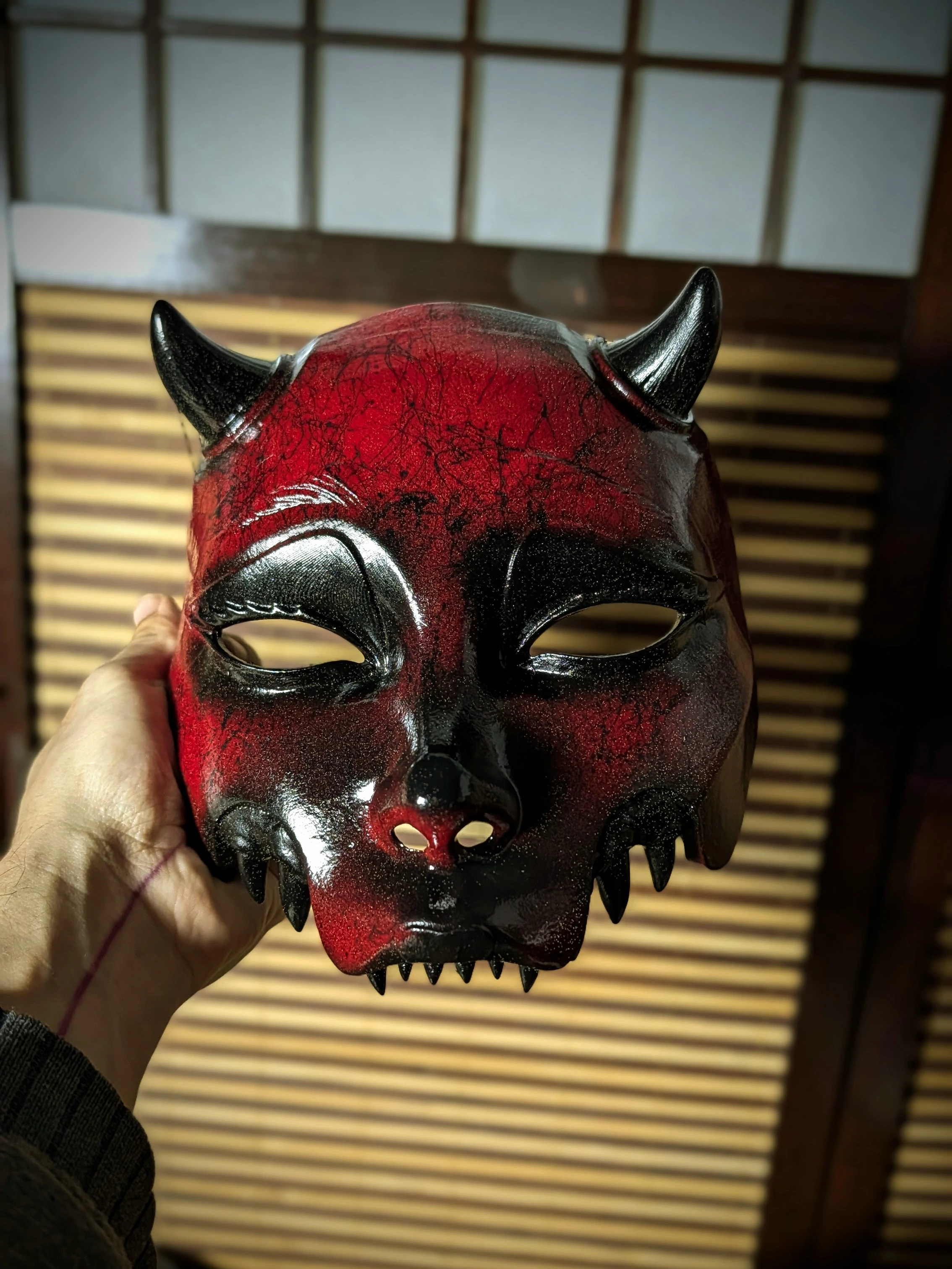
In feudal Japan, the mempo (面頬) was the half-mask worn by samurai under their helmet. For a rōnin, the mempo carried extra weight. Without full armor, without a clan banner, the mask became the only visible proof of his warrior past. A scratched, battle-worn mempo was a dangerous man's calling card.
That "wandering warrior" look is exactly what I try to capture with my Mempo half-masks. PETG is the right material for it: lightweight (you can wear it all day at a convention), impact-resistant (the originals had to survive sword strikes, mine survive crowd jostling), and moisture-proof (no warping, unlike wood or leather). Each one is sanded and painted by hand in my workshop in Plélan-le-Grand, Brittany.
Model | Style | Best for |
Dark, minimal, elongated Tengu nose | Lone rōnin cosplay, "shadow warrior" decor | |
Blood red, aggressive | Ghost of Tsushima vibes, war samurai cosplay | |
Icy blue, spectral | Ghost rōnin, Yuki-onna aesthetic |
Browse the full collection of handmade Japanese masks.
Rōnin in modern Japan
The word did not disappear. It shifted.
A rōninsei (浪人生) is a student who failed a university entrance exam and spends a year or more studying to retake it, often at a yobikou (prep school). A "salary rōnin" is someone between jobs. And a "voluntary rōnin" is a freelancer or entrepreneur who chose to serve no master.
The parallel with Musashi holds. The modern rōnin rejects the system to carve their own path. In a society that still values group loyalty and corporate devotion, calling yourself rōnin takes nerve.
FAQ
What is a rōnin?
A rōnin (浪人, "wave-man") was a Japanese samurai who lost his master through death, defeat, exile, or choice. Without a clan, the rōnin kept his swords and training but lived outside the social hierarchy. Around 400,000 rōnin existed in 1650s Japan. The most famous are Miyamoto Musashi and the 47 Rōnin of Akō.
Did the 47 Rōnin really exist?
Yes. It is a documented historical event. In 1701, Lord Asano was condemned to seppuku after attacking the shōgun's master of ceremonies, Kira. 47 of Asano's samurai spent two years planning revenge, attacked Kira's residence on December 14, 1702, and beheaded him. They were sentenced to seppuku on February 4, 1703. Their graves at Sengaku-ji temple in Tokyo are visited every year.
What is the difference between a rōnin and a ninja?
A rōnin is a samurai without a master who follows the bushidō code (honor, frontal combat, swords). A ninja (shinobi) is a covert agent specializing in espionage, sabotage, and assassination, with no code of honor. The two are fundamentally different figures in Japanese society.
Who was the most famous rōnin?
Miyamoto Musashi (1584-1645). He fought 60 duels without losing, invented a two-sword fighting style (Niten Ichi-ryū), and wrote the Book of Five Rings, a strategy treatise still studied worldwide.
Is the word rōnin still used today?
Yes. In modern Japan, rōninsei (浪人生) refers to students retaking university entrance exams. More broadly, the word describes anyone between jobs or choosing to work independently.