top of page

Daruma: The Japanese Doll That Refuses to Fall (Meaning, Colors & Ritual)

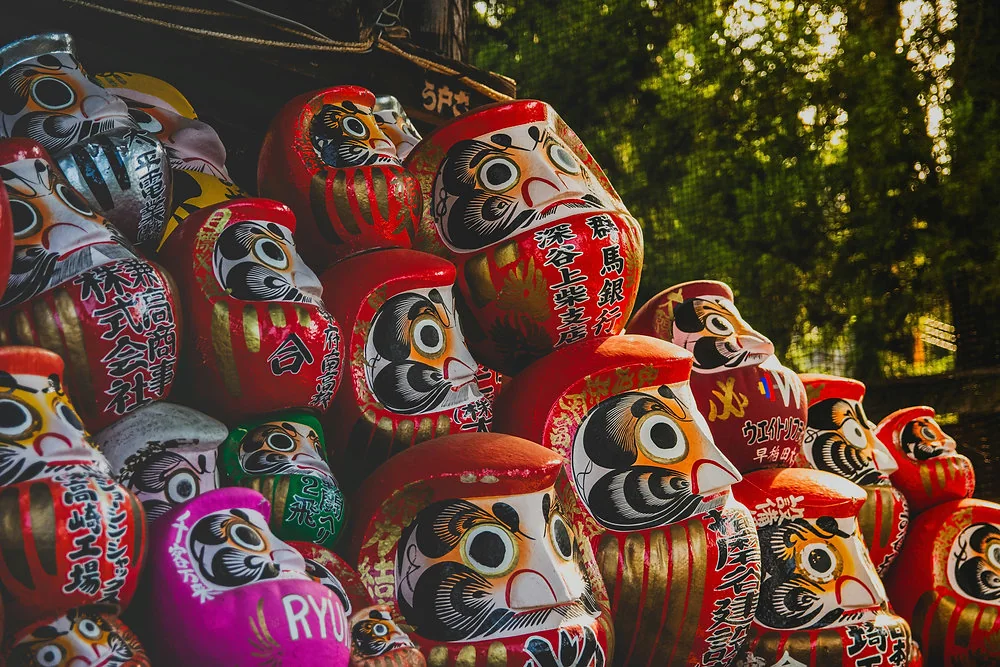
A red face. No arms. No legs. White eyes that stare at you with fierce determination. If you've ever set foot in Japan—or even in a Japanese restaurant—you've undoubtedly seen one. The Daruma doll (だるま) is perhaps the most stubborn good luck charm in the world. Push it: it gets back up. Knock it over: it returns. That's its job.


The Daruma (だるま) is a traditional Japanese papier-mâché figurine, round and limbless, representing the Buddhist monk Bodhidharma. A symbol of perseverance and good fortune, it is used as a lucky charm to make a wish: the left eye is painted while focusing on a goal, then the right eye when it is achieved. Origin: Shōrinzan Daruma-ji Temple, Takasaki (Gunma Prefecture), 17th century.

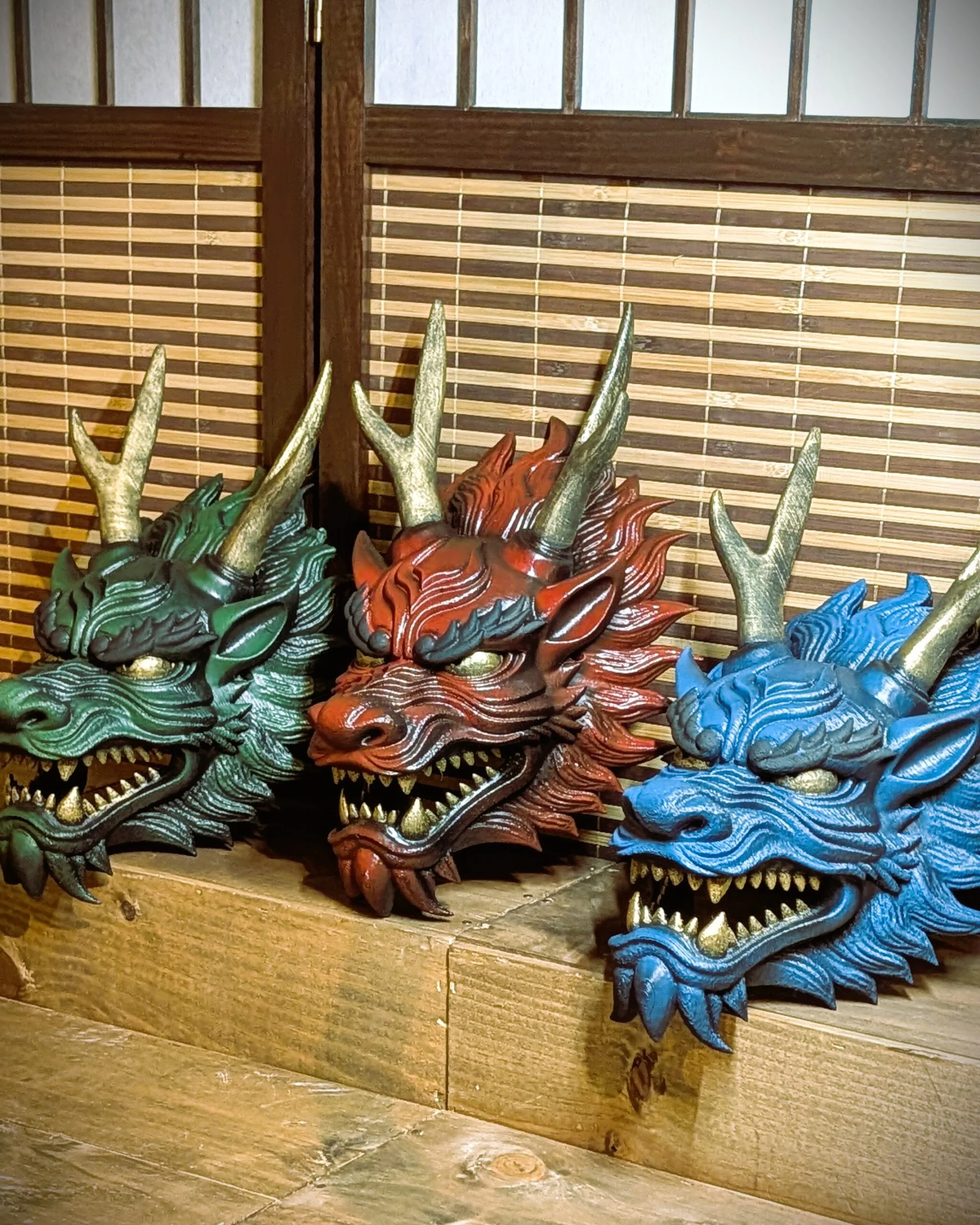
In my Dai Yokai workshop, I make masks of demons , foxes , and thunder gods . Expressive faces, full of emotion. But the Daruma doll is something else entirely.

It's an expressionless face that forces you to act . It doesn't protect you. It doesn't bless you. It stares at you. Until you move.


A Japanese ukiyo-e print by the artist Tsukioka Yoshitoshi, from the series One Hundred Aspects of the Moon. It depicts Bodhidharma (Daruma) in seated meditation, draped in a bright red robe. He is shown with a thick black beard and bushy eyebrows, his gaze serene as he faces a rocky cliff. A full moon shines in a clear sky behind him, framed by vine branches with golden leaves.

And behind this round, grumpy doll lies the story of a completely mad Indian monk who meditated for so long that his arms and legs fell off.


What is a Daruma? Etymology and Origins


Meaning of the name

Term

Writing

Meaning

Daruma

だるま / 達磨

Bodhidharma's Japanese name

Bodhidharma

बोधिधर्म (Sanskrit)

"He whose nature is awakening"

Dharma

法 (hō in Japanese)

Buddhist law, teaching

Okiagari-kobōshi

起き上がり小法師

"Little monk getting up" (roly-poly toy)

The word "Daruma" is the Japanese pronunciation of "Dharma," the last part of Bodhidharma 's name (Bodaidaruma 菩提達磨 in Japanese). The monk became so iconic in Japan that his name alone now refers to the doll.


Bodhidharma: the monk who lost his limbs


The Daruma story begins with a man, not a doll.


Bodhidharma was a Buddhist monk originally from India (or Persia, according to some sources), who is believed to have lived between the 5th and 6th centuries. He is credited with two immense achievements: the transmission of Chan Buddhism to China (which would become Zen in Japan), and—according to legend—the introduction of martial arts to the Shaolin monastery.


But what interests us is meditation.


Legend has it that Bodhidharma sat facing a wall in a cave at the Shaolin Temple and meditated for nine consecutive years . Without moving. Without sleeping. Without closing his eyes.

As a result, its arms and legs atrophied and fell off . Hence the round, limbless shape of the Daruma doll.

A Japanese ukiyo-e print depicting Daruma standing on a rock in the middle of a raging sea. He wears a red robe adorned with gold patterns and holds a pilgrim's staff. Two green dragons emerge from the waves as a red sun rises on the horizon beneath a stormy sky with lightning.

The legend of the cut eyelids


There's worse. According to another version, Bodhidharma fell asleep during his meditation. Furious with himself, he cut off his eyelids and threw them to the ground. Green tea plants grew where they fell—which is why in Japan it's said that tea helps you stay awake.


This is also why the Daruma has big, wide-open eyes without eyelids : it refuses to sleep. It refuses to give up.


The Birth of the Doll: Takasaki, 17th Century


The first creation of Daruma dolls from papier-mâché is attributed to the Shōrinzan Daruma-ji temple in Takasaki, Gunma Prefecture (about 1.5 hours north of Tokyo). In the 17th century, the temple's monks created them as protective amulets for the New Year.


In 1783 , a famine struck the region. A priest from the temple taught local farmers how to make Daruma dolls to sell and survive the crisis. The doll became popular. Today, Takasaki produces about 80% of Japan's Daruma dolls —approximately 1.7 million per year.


Anatomy of the Daruma Doll — Every Detail Has Meaning

Nothing is left to chance on a Daruma doll. Every facial feature, every color, every inscription is coded.


Symbolic Anatomy Chart

Element

Description

Hidden symbolism

Round shape

No arms or legs, weighted base (roly-poly toy)

Resilience — “falls 7 times, gets up 8” (七転び八起き, Nanakorobi Yaoki)

White eyes

Empty pupils at purchase

A wish not yet made — the journey begins

Eyebrows

Drawn in the shape of a crane (鶴, tsuru)

Longevity — the crane lives 1,000 years (Japanese proverb)

Mustache/Beard

Drawn in the shape of tortoise shells (亀, kame)

Immortality — the tortoise lives 10,000 years

Eyebrows + Beard

Together = Tsuru-Kame symbol

Good fortune and a long life combined

Harsh expression

A determined, almost angry look

The Ganbaru spirit (頑張る) — never give up

Red dress

Traditional dominant color

Buddhist monk's robe + protection against diseases

Kanji on the stomach

Often 福 (fuku), 勝 (shō), 大願成就

"Happiness," "Victory," "Great wish fulfilled"

Weighted base

Weight at the bottom → always returns to an upright position

Principle of Okiagari-kobōshi (monk tumbling)

Hokusai's Great Daruma


In 1817, the printmaker Katsushika Hokusai created a giant Daruma doll, 18 meters high and 11 meters wide (approximately 200 square meters), for the Hongan-ji temple in Nagoya Betsuin. The work was unfortunately destroyed during the bombings of 1945. However, it proves that the Daruma was not merely a popular good luck charm—it was a major subject in Japanese art.


Meaning of the Daruma Colors

The traditional color is red, but today Daruma dolls come in all colors. Each color corresponds to a type of wish.


Complete color chart

Color

Japanese

Meaning

Wish / Use

Red 🔴

赤 (Aka)

Good fortune, luck, prosperity

Universal wish — the most popular

White

白 (Shiro)

Purity, balance, harmony

Marriage, love, inner peace

Gold 🟡

金 (Kin)

Wealth, fame, financial success

Business, entrepreneurs, investments

Black

黒 (Kuro)

Protection, prevention of harm

Warding off bad luck, spiritual bodyguard

Green 🟢

緑 (Midori)

Health, vitality, physical fitness

Healing, sport, well-being

Blue 🔵

青 (Ao)

Studies, academic success, career

Exams, diplomas, career progression

Violet 🟣

紫 (Murasaki)

Personal development, spirituality

Meditation, inner growth

Rose 🩷

桃 (Momo)

Love, romance, relationships

Dating, couples, fertility

Orange 🟠

橙 (Daidai)

Safety, child protection

Motherhood, education, family

Yellow 🌕

黄 (Ki)

Protection, safety, caution

Travel, accidents, prevention

Money 🩶

銀 (Gin)

Social status, reputation

Reputation, leadership

Red: Why is it the default color?


Two main theories coexist. The first: Bodhidharma wore a red Buddhist monk's robe during his nine years of meditation. The second, more pragmatic: in Japan, red was associated with protection against smallpox and childhood illnesses. Red Daruma dolls were placed at the bedside of the sick as healing talismans. The color red has remained.


The Eye Ritual — How to Use a Daruma Doll


This is THE ritual that makes the Daruma unique among all the lucky charms in the world. No prayer. No incense. Just a paintbrush, an eye, and a lens .


The 5 steps of the ritual

Stage

Action

Detail

1. Choose

Buy or receive a Daruma doll with white eyes.

Choose the color according to your preference (see table above)

2. Formulate

Set a clear, achievable goal within one year.

Not vague ("to be happy") — concrete ("open my workshop")

3. Paint the left eye

Using a brush and black sumi ink, draw the pupil of the left eye (viewed from the front = right eye of the Daruma doll)

This gesture = your commitment. The Daruma now "sees" your goal.

4. Expose

Place it on an altar, a high shelf, or your desk.

He needs to look at you every day — it's a constant visual reminder

5. Complete

When the goal is achieved, paint the second eye

The Daruma "regains its sight" — wish granted, mission accomplished

And then what? The Daruma-Kuyo (cremation ceremony)


At the end of the year (or when the wish is fulfilled), the Daruma doll is returned to the temple to be ritually burned during the Daruma-Kuyo (だるま供養). This fire releases the spirit of the wish and thanks the Daruma for its service. Even if the wish has not been fulfilled, the Daruma is burned—it has done its job; failure is part of the process. A new, larger one is purchased, and the cycle begins again.


It's the Daruma cycle: formulate → persevere → complete → burn → start again . Exactly like the roly-poly toy that gets right back up after every fall.


Daruma-ichi — Japan's Daruma Markets


At the beginning of each year, temples organize giant fairs dedicated to the Daruma doll. It's quite a spectacle: thousands of red dolls lined up, monks painting the first eye ( kaigen ), food stalls, and a collective energy of renewal.


Table of the 5 Great Daruma-Ichi

Festival

Place

Date

Special feature

Nanakusa Taisai

Shorinzan Daruma-ji Temple, Takasaki (Gunma)

January 6-7

The oldest and largest — the “original temple” of the Daruma

Kawasaki Daishi

Heiken-ji Temple, Kawasaki (Kanagawa)

January 3

One of the most popular near Tokyo

Fuji Bishamonten

Myōhō-ji Temple, Fuji (Shizuoka)

February 1-3

Giant Daruma dolls, traditional market atmosphere

Jindai-ji Daruma-Ichi

Jindai-ji Temple, Chōfu (Tokyo)

March 3-4

The most accessible from central Tokyo

Katsuo-ji

Katsuo-ji Temple, Minoh (Osaka)

All year round

"Temple of Victory" — thousands of votive Daruma dolls displayed on the hillside

The Daruma in Pop Culture


The Daruma doll has transcended its religious affiliation. It can be found everywhere.


Pop culture painting

Work / Context

Kind

Role / Reference

Squid Game (Netflix)

Series

The game "1-2-3 Soleil" uses a giant doll inspired by the Daruma doll (the game is literally called "Daruma-san ga koronda" in Japanese)

Daruma-san ga koronda

Japanese children's game

The Japanese equivalent of "Red Light, Green Light" — players must freeze when the Daruma doll "turns over"

Takeshi's Castle

TV show

Obstacles in the shape of a giant Daruma

Animal Crossing

Video game

Collectible decorative item

Demon Slayer

Manga/Anime

Tumbling aesthetics and perseverance — Tanjirō embodies the Daruma spirit

Election campaigns

Japanese policy

Candidates paint the left eye of the Daruma doll at the campaign launch, and the right eye if they win. This is a national televised tradition.

Companies

Japanese business

Startups and established companies buy a Daruma doll to launch a project — it is displayed in the office until the project is successful.

Irezumi Tattoo

Motif of perseverance — often accompanied by waves (struggle) or cherry blossoms (impermanence)

Daruma-san ga koronda → Squid Game


For fans of the Netflix series: the deadly game in episode 1 of Squid Game is an extreme version of the Japanese children's game Daruma-san ga koronda (だるまさんが転んだ), literally "The Daruma Has Fallen." One player turns their back, the others advance. When they turn around, everyone must be perfectly still—like a Daruma doll. If you move, you're out. The connection to the doll is clear: stay still, persevere, don't give up.


My Daruma Blood Rage — The Dai Yokai Approach


When I decided to create a Daruma doll at Dai Yokai , I knew I didn't want to make a gentle replica of Takasaki's doll. I wanted to capture the dark side of Bodhidharma—the monk who mutilated his eyelids, who let his limbs rot out of sheer discipline. It's brutal. It's extreme. It's fascinating.


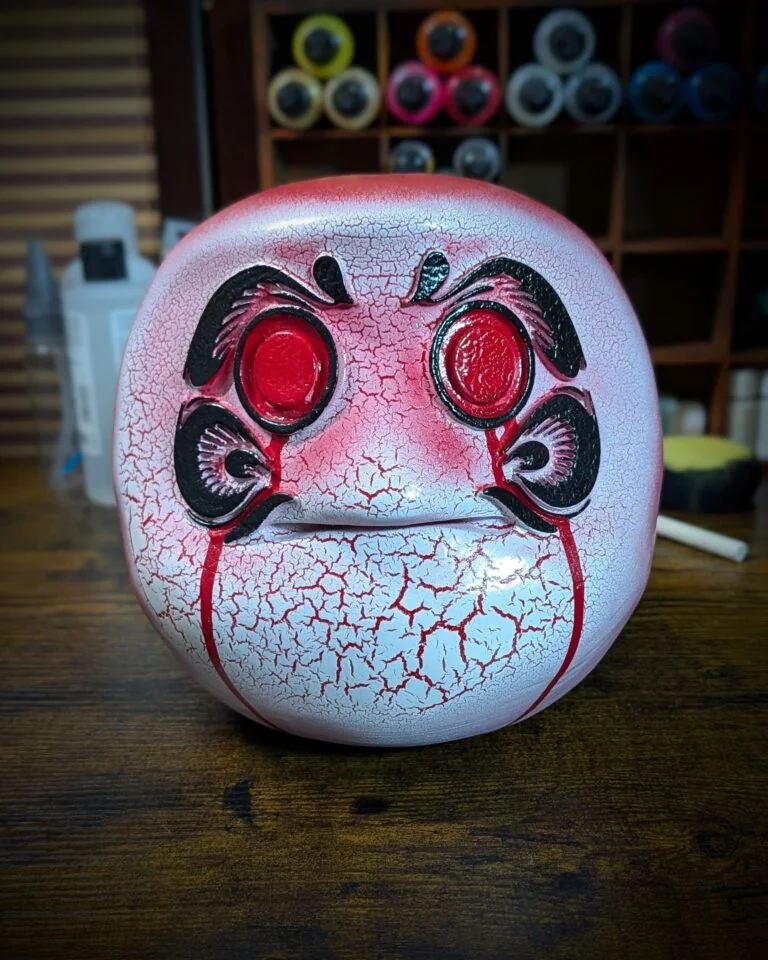
My Daruma Blood Rage is a handcrafted reinterpretation: a Daruma enraged , with visible veins, a blood-red finish, and an organic texture—not the clean, smooth red of traditional papier-mâché. This is the Daruma before it became a cute figurine. This is the monk in his cave, teetering on the edge of madness, his eyes wide open for the past nine years.


Traditional Daruma Table vs. Blood Rage

Criteria

Traditional Daruma (Papier mache)

Daruma Blood Rage (Dai Yokai)

Material

Paper mache, fragile

High-Strength PETG Polymer

Weight

Light (hollow)

Lightweight (~120g) but sturdy

Texture

Smooth, painted flat

Organic, veined, sculptural relief

Color

Uniform bright red

Blood red gradient, "flesh" effect

Expression

Severe but stylized

Enraged, almost horrific

Resistance

Sensitive to water, shocks, and heat

Waterproof, unbreakable, meets convention standards

Use

Eye ritual, vow, cremation

Wall decoration, art object, conversation piece

Price

€5–50 (mass market)

See workshop price (handmade in France)

My opinion as a craftsman — The challenge of red


Red is the most treacherous color in painting. A poorly mixed red either turns out to be "toy plastic" or "dull brick." For Blood Rage, I use a three-layer gradient: a dark burgundy base, an intermediate vermilion red, and highlights of bright red on the prominent areas (eyebrows, nose, cheekbones). Then a very diluted black wash in the recesses to create depth. The goal: to make the Daruma look like it's been burned from the inside out .


Like Bodhidharma after 9 years facing the wall.


Daruma vs Maneki-Neko vs Omamori — Japanese Lucky Charms Compared


Japan is full of talismans. Here's how the Daruma fits in.


Lucky charm comparison chart

Criteria

Darumaだるま

Maneki-Neko招き猫

Omamoriお守り

Ema絵馬

Shape

Round doll without limbs

Cat sitting, paw raised

Embroidered fabric bag

Wood chip

Origin

Zen Buddhism (Bodhidharma)

Edo period, folk folklore

Shinto / Buddhism

Shinto

Function

Formulate a wish + perseverance

Attracting customers / wealth

Specific protection (health, exams, love)

Write a wish at the temple

Ritual

Paint the eyes (left then right)

Place facing the entrance

Wear on oneself or hang

Hang on the temple

Duration

1 year (then cremation)

Permanent

1 year (then return to the temple)

Left at the temple

Key color

Red (perseverance)

White/tricolour (lucky) or gold (silver)

Variable depending on protection

Natural wood

Customizable

Yes (kanji, color, size)

Limit

Limited (type of protection)

Yes (written wish)

Dai Yokai Link

How to Display a Daruma Doll as Decoration


The Daruma is not just a temple talisman. It is a powerful decorative object — especially in its handcrafted version.


Decor Placement Guide Chart

Investment

Effect

Recommended association

Office / Home office

Daily reminder of your goals — the Daruma is "watching" you

A single Daruma doll, prominently displayed at eye level.

Entrance / Genkan

Protection and hospitality — Japanese tradition

Gaming setup

Dark Japanese atmosphere, reminiscent of Squid Game / Demon Slayer

Daruma Blood Rage + black Kitsune mask + red LED

Yokai Collection Shelf

The Daruma doll as a "human" piece amidst the demons

WithHannya (rage), Tengu (pride), Oni (strength)

Japanese-style living room

A sculptural red object against a clean background — immediate visual impact

On light wood, white or black wall, minimalist room

Gift

Giving someone a Daruma doll = wishing them perseverance

For a project launch, an exam, a personal challenge

Daruma and Irezumi Tattoo


The Daruma is a classic motif in traditional Japanese tattooing , often underestimated compared to Dragons or Kitsune .


Tattoo associations chart

Association

Meaning

Visual style

Daruma + Waves

Perseverance in the face of adversity, fighting against the current

Ukiyo-e style, blue/red

Daruma + Cherry Blossoms

Fleeting beauty + determination — the vow that withstands time

Pink/red, poetic

Daruma + Flames

Ritual cremation, purification, rebirth

Red/gold, intense

Daruma + Snake / Dragon

Inner strength, spiritual transformation

Tebori style, complex

Daruma + Skull

Vanity, memento mori — you can't cheat time

Black/red, dark

Daruma + Kanji 七転び八起き

"Fall 7 times, get up 8" — the mantra etched into the skin

Calligraphy + Daruma

Daruma one-eyed (one painted eye)

Current goal — a "living" tattoo until the wish is fulfilled

Minimalist or full color

Frequently Asked Questions (FAQ)


What is a Daruma and what is it used for?


The Daruma (だるま) is a Japanese papier-mâché figurine representing Bodhidharma, the founder of Zen Buddhism. It is a good luck charm used to make a wish: the left eye is painted while focusing on a goal, then the right eye when it is achieved. Its roly-poly shape (weighted base) symbolizes perseverance—it always rights itself when pushed, embodying the proverb Nanakorobi Yaoki ("Fall seven times, stand up eight").


Which Daruma color should I choose?


Each color corresponds to a type of wish. Red is the most common (general luck and fortune). Blue is for studies and career. White is for love and harmony. Black is for protection. Gold is for financial wealth. Green is for health. If you're unsure, red is always a safe choice—it's the original and universal color of the Daruma doll.


Which eye of the Daruma doll should I paint first?


Traditionally, the left eye is painted first (when viewed from the front, it's the eye on your left when you look at the Daruma doll). This eye represents the beginning of the journey, the making of the wish. The second (right) eye is painted upon fulfillment of the goal. Some temples perform the kaigen (eye opening) during a ceremony with a monk.


Why doesn't the Daruma have arms or legs?


According to legend, the monk Bodhidharma meditated facing a wall for nine consecutive years without moving. His complete immobility caused his limbs to atrophy and then disappear. The Daruma doll replicates this round, limbless form to symbolize extreme discipline and absolute determination. The weighted base (like a roly-poly toy) adds a symbol of resilience—no matter how hard it is knocked, the Daruma always gets right back up.


What is the connection between Daruma and Squid Game?


The deadly game in episode 1 of Squid Game is based on Daruma-san ga koronda (だるまさんが転んだ), a Japanese children's game similar to "Red Light, Green Light." The name means "The Daruma has fallen over." Players must freeze when the "Daruma" turns over—like the doll that remains motionless and impassive while everything around it moves.


What should you do with a Daruma doll whose wish has not been granted?


It is returned to the temple at the end of the year for the Daruma-Kuyo ceremony (ritual burning). Even if the wish is not fulfilled, the Daruma has served its purpose: it reminded you of your goal for a year. The fire releases the spirit of the wish. A new Daruma is then purchased, often larger than the previous one, and the cycle begins again. Failure is part of the process.


Conclusion — The Daruma won't let you down


The Daruma doll is not a passive object placed on a shelf. It's a visual contract with yourself . Every morning, as you pass by it, its single eye reminds you: "You're not finished yet."


It's this raw energy that I wanted to capture in the Daruma Blood Rage . Not the gentleness of papier-mâché. The rage of the monk who has refused to sleep for 9 years.


If the world of Japanese lucky charms and protectors fascinates you, also explore the power of the Oni mask (demonic guardian), the cunning of the Kitsune (messenger of Inari), or the serenity of Kintsugi (the art of sublimating injuries).


And if you have a goal in mind — a project, a dream, a fight — take a Daruma doll. Paint the left eye. And never take your eyes off it.


Comments


bottom of page