

Mempo: why the samurai hid his face behind a demon
- DAI YOKAI
- Feb 13
- 4 min read

Updated: May 15
By Jérémy, Dai Yokai founder · @dai.yokai Published: February 2026 · Updated: May 2026
Key takeaways
Mengu (面具) is the general term for any samurai facial armor. Mempo (面頬) is the most common type: a half-mask covering nose to chin
5 types of mengu exist, from a simple chin guard to a full-face mask
The masks were made by specialized armorers: the Katchu-shi (甲冑師)
Dual function: protect the face AND terrify the enemy. The demon grimaces, horsehair mustaches, and gold teeth were not decorative
Mempo are my best-selling masks. The half-mask format works equally well as wall decor and cosplay
Mengu vs Mempo: clearing up the confusion

Everyone says "mempo" when talking about samurai masks. That is a shortcut.
Mengu (面具) is the general term. 面 (men) = face, 具 (gu) = equipment. "Face equipment." Any samurai facial armor is a mengu.
Mempo (面頬) is a specific type of mengu. 頬 (hō/pō) = cheeks, jaw. The mempo covers nose to chin. It is the most common and most recognizable.
Every mempo is a mengu. Not every mengu is a mempo.

The 5 types of mengu
Japanese armorers (Katchu-shi) developed 5 levels of facial protection, from minimum to maximum.
Type | Kanji | Area covered | Use |
Hanpō | 半頬 | Chin and lower jaw only | Minimal protection, free breathing, fast combat |
Mempo | 面頬 | Nose to chin | The standard. Protection + intimidation. Most used historically |
Sōmen | 総面 | Entire face | Full mask. Maximum protection but limited vision and heat |
Happuri | 半首 | Forehead and cheeks (no nose/chin) | Cavalry. Protects from blows coming from above |
Hanbō | 半防 | Throat and chin | Throat protection against thrusting strikes |
The mempo was the perfect compromise. It protected the lower face (sword strikes often targeted the neck and jaw), left the eyes free for combat, and allowed normal breathing. That is why it dominated battlefields from the 15th to 17th century.

The Katchu-shi: armorers who sculpted terror
The Katchu-shi (甲冑師) were specialized armorers, as respected as katana swordsmiths. Making a mengu was not just metalwork. It was engineering AND art.
Materials: forged iron, lacquered leather (nerigawa), often both combined. Iron for impact zones (chin, nose). Lacquered leather for flex zones (cheeks). The interior was lined with fabric to absorb shock and sweat.
The most impressive details: horsehair mustaches (tsuketare) fixed to the upper lip, teeth lacquered in gold or silver, removable noses (hana, for masks also used during tea in the field), and ventilation holes under the chin (ase nagashi, literally "sweat drainage") to evacuate perspiration and saliva during combat.

The psychology of the war mask
The mengu was not just armor. It was a psychological weapon.
On a 16th-century battlefield, visibility is poor. Dust, smoke, rain. The foot soldiers (ashigaru) cannot see faces. They see silhouettes. And those silhouettes wear demon faces.
Mengu expressions are always the same: rage, contempt, ferocity. Never fear. Never neutrality. A samurai wearing an Oni-faced mempo says: "I am no longer a man. I am the thing that kills you."
The inspiration came directly from folklore. Mengu grimaces are modeled on Noh masks (Hannya, Oni) and Buddhist temple guardians (Niō). Warriors literally wore the faces of Japanese demons into battle.
Why Mempo are my best-selling masks
It is the format that works best. For several reasons.
As wall decor, the half-mask is easier to integrate than a full mask. Takes less space, simple mounting, and the "jaw only" format has a streamlined quality that fits contemporary interiors.
For cosplay, it is the most comfortable mask. Eyes and forehead free, normal breathing, ability to speak. Wearable at a convention all day without issue.
In tattoo studios, it has become a staple. A mempo on the wall above the workstation creates a samurai atmosphere without clutter.
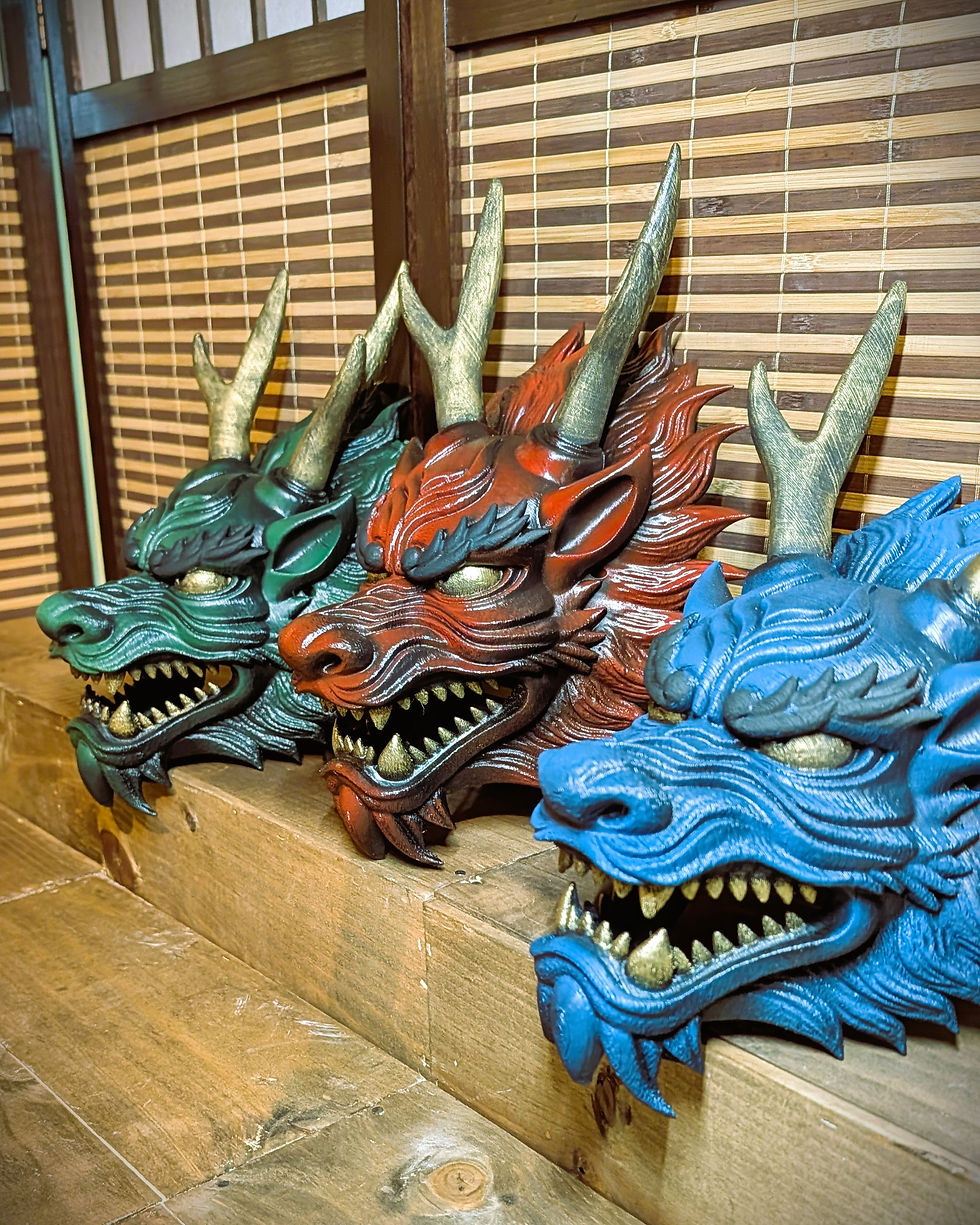
Dai Yokai Mempo come in several versions:
Red Tengu Mempo: the Tengu's long nose in half-mask format
Black Tengu Mempo: dark, cinematic version
Blue Tengu Mempo: spectral version
White Tengu Mempo: zen version
All PETG, 80-120 grams, hand-painted. Half the weight of a full mask.
→ Full Mempo half-mask collection
The Mempo in modern culture
The mempo outlived the samurai. It appears everywhere: in video games (Ghost of Tsushima, Sekiro, For Honor), in Japanese streetwear (mempo-shaped anti-pollution masks), and in tattooing. In irezumi, the masked warrior is a classic motif: the mempo symbolizes warrior discipline and self-mastery.
For the full history of samurai (bushido, katana, armor): Samurai Guide. For the story of masterless samurai: Ronin Guide.
FAQ
What is the difference between mengu and mempo?
Mengu (面具) is the general term for any samurai facial armor. Mempo (面頬) is the most common type: a half-mask covering nose to chin. Every mempo is a mengu, but there are also sōmen (full-face), hanpō (chin only), happuri (forehead and cheeks), and hanbō (throat).
Why do samurai masks have demon faces?
To terrify the enemy. On a smoky battlefield, foot soldiers only see silhouettes wearing demon faces. The grimaces are modeled on Noh masks (Hannya, Oni) and Buddhist temple guardians (Niō). It is psychological warfare.
What were historical mempo made of?
Forged iron for impact zones (chin, nose), lacquered leather (nerigawa) for flex zones (cheeks). Interior lined with fabric. Details: horsehair mustaches, gold or silver lacquered teeth, sweat drainage holes under the chin.
Can Dai Yokai half-masks be worn for cosplay?
Yes. Dai Yokai Mempo are PETG (80-120 g), much lighter than a full mask (150-350 g). Eyes and forehead free, normal breathing and speaking. Wearable at conventions all day.
What is the link between mempo and yokai masks?
Armorers (Katchu-shi) drew directly from Noh masks and yokai folklore to sculpt mengu grimaces. A mempo with an Oni or Tengu face is not just armor: it is a yokai mask worn to war.


Comments