

The blue Oni is not the angry one. He's the one who walks away.
- DAI YOKAI
- May 3
- 5 min read
By Jérémy, Dai Yokai founder · @dai.yokai Published: January 2025 · Updated: May 2026
Key takeaways
The Ao-Oni (青鬼) embodies cold hatred (shinni) in Buddhist doctrine, not hot anger
The Japanese word Ao (青) does not simply mean "blue." It spans deep ocean blue, forest green, and storm gray
In the tale Naita Aka Oni, the blue Oni sacrifices everything so his friend can be happy
Painting blue requires a purple undercoat, not black, to avoid a flat plastic look
For the full meaning of the Oni mask (etymology, anatomy, all 5 colors, good vs evil), see the complete Oni mask guide.
"Ao" does not mean blue
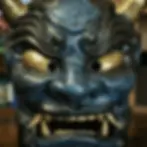
This trips up every Westerner who gets into Japanese folklore. Modern Japanese translates Ao (青) as "blue." But historically, the word covered a much broader spectrum: the blue-black depths of the ocean, the dark green of ancient forests, the gray of a gathering storm. Traffic lights in Japan are still called ao-shingō ("blue signals") even though they're green. Green apples are ao-ringo.
The Ao-Oni is not the demon of a summer sky. It is the demon of depths, of what cannot be fathomed. If the red Oni is earthly and human (blood, flesh), the blue is supernatural and spectral (spirit, magic, cold). That is why traditional tattoo art surrounds the blue Oni with dark waves and storm clouds, while the red sits in flames.
Cold hatred vs hot anger
In the Buddhist Five Poisons, blue maps to shinni (瞋恚): hatred. Not anger. The distinction matters.
Anger (red) is hot, impulsive, it explodes and burns out. Hatred (blue) is cold, strategic, it endures. It is the emotion of tacticians, of grudge-holders, but also of those with iron discipline.
This is what draws quiet, reflective, introverted people to the blue Oni mask. It represents power that doesn't broadcast itself. Contained force, ready to strike with precision rather than brute chaos. The red Oni dominates a room. The blue one watches it.

The hero nobody sees
In the children's tale Naita Aka Oni (泣いた赤鬼, 1933), the blue Oni is the most tragic character. He volunteers to fake an attack on a village so that his red friend can play the hero and finally be accepted by humans. The plan works. But to keep it working, the blue must vanish. He leaves a letter: "For you to keep your happiness, I must go. Goodbye."
The red Oni cries. But it is the blue who gave up everything.
When you look at an Ao-Oni mask, you are looking at absolute loyalty. The guardian who protects from the shadows, who accepts being the villain so others can live in the light. For the full tale: Aka-Oni and the story of the crying demon.
Why blue is harder to paint than red

Red forgives mistakes. Blue does not. A poorly applied blue looks flat, plastic, lifeless. Red can recover from an uneven layer with a wash. Blue just makes it more obvious.
My specific issue with blue: there are far fewer high-quality blue pigments in acrylic paint compared to red. With red I can choose between carmine, vermillion, cadmium, and more. Blue offers fewer truly dense options. So I turned that into a feature: I mix blues of different pigment qualities (a dense, saturated one for deep areas, a thinner one for transitions), and the inconsistency creates natural gradients I could never achieve with a single uniform blue.
An accident that became technique.
Here is the process:
Purple undercoat. This is the Dai Yokai blue secret. I never start with black. The first layer in every recess is deep purple or dense indigo. Purple gives chromatic richness: it suggests the blood beneath this blue skin is magical, otherworldly. Black would give a flat, dead blue.
Prussian Blue in translucent layers. Airbrush, not opaque. The purple must bleed through in the recesses. The face starts gaining depth. Some masks get Ultramarine Blue instead, depending on the intensity I want.
Cyan or turquoise highlights. Dry-brushed on raised edges: cheekbones, brow ridge, chin. The contrast between dark purple depths and bright turquoise peaks creates the "spectral" or "ice" effect that defines Dai Yokai blues.
Cold metal for horns and teeth. Aged silver, steel, or pale gold. Red calls for warm gold and bone horns. Blue calls for cold metals. It reinforces the icy nobility.
Total painting time: 3 to 5 hours, same as red. But blue demands more patience on transitions because mistakes show immediately.

How to display a blue Oni mask
Blue integrates into a contemporary interior more easily than red. It is less visually aggressive. Where red imposes, blue settles in.
Above a desk. Its natural home. Blue promotes focus. Having the face of the strategist looking back at you is a reminder to stay clear-headed. The cracked blue Oni Gawara works especially well in gaming setups and tattoo studios.
Cool light, not warm. The most common mistake. A warm yellow bulb (2700K) on a blue Oni turns it greenish. Use cool white light (5000-6000K) or, for maximum impact, a blue/purple LED that amplifies the spectral effect.
Light or neutral walls. Unlike red, which needs a dark wall to glow, blue works on white, light gray, or raw concrete. The contrast is naturally balanced.
Paired with red. The Red/Blue Oni Gawara Duo Pack is my best seller. Red on the right (Yang, passion), blue on the left (Yin, strategy). Symbolically, it reunites the two friends from Naita Aka Oni who were separated by fate. On your wall, they finally watch over you together.
Browse the full Oni mask collection on daiyokai.com.
FAQ
What is the difference between the blue Oni and the red Oni?
The red is impulsive, burning, active: an offensive guardian. The blue is strategic, cold, patient: a defensive guardian. In decor, red dominates a room, blue calms it. In the Naita Aka Oni tale, the red is the naive hero, the blue is the loyal friend who sacrifices himself.
Why use a purple undercoat instead of black?
Purple adds chromatic depth that black kills. Under a translucent blue, purple creates supernatural reflections in the mask's recesses. Black would produce a flat, lifeless blue. That is the difference between "plastic blue" and "spectral blue."
What lighting works best for a blue Oni mask?
Cool white light (5000-6000K) or blue/purple LEDs. A warm yellow bulb (2700K) turns the mask greenish and kills the icy effect. This is the most common display mistake.
Can I order a custom blue?
Yes. Deeper cyan, navy, turquoise, metallic midnight blue, blue and gold: contact me with a reference photo. Every blue Oni is hand-painted, so every variation is possible.