Ibaraki-dōji is a famous oni associated with Shuten-dōji and the warrior Watanabe no Tsuna. The core legend says that Tsuna severed the oni's arm and that Ibaraki later recovered it through disguise. The bridge, gate, sword, residence and even parts of Ibaraki's identity change across medieval tales, Noh, Kabuki and ukiyo-e.
Ibaraki-dōji at a glance
| Element | What the tradition supports | What varies |
|---|---|---|
| Identity | A named oni linked with Shuten-dōji | Origin, gender presentation and exact rank |
| Opponent | Watanabe no Tsuna | The framing and sequence of their encounters |
| Main event | Tsuna cuts off one of Ibaraki's arms | Modoribashi bridge or Rashōmon gate |
| Recovery | Ibaraki returns in an elderly woman's form and takes the arm | Whose aunt, which residence and how the arm is revealed |
| Sword | Higekiri or Higekirimaru in the Modoribashi tradition | Later names and sword legends |
Who is Ibaraki-dōji?
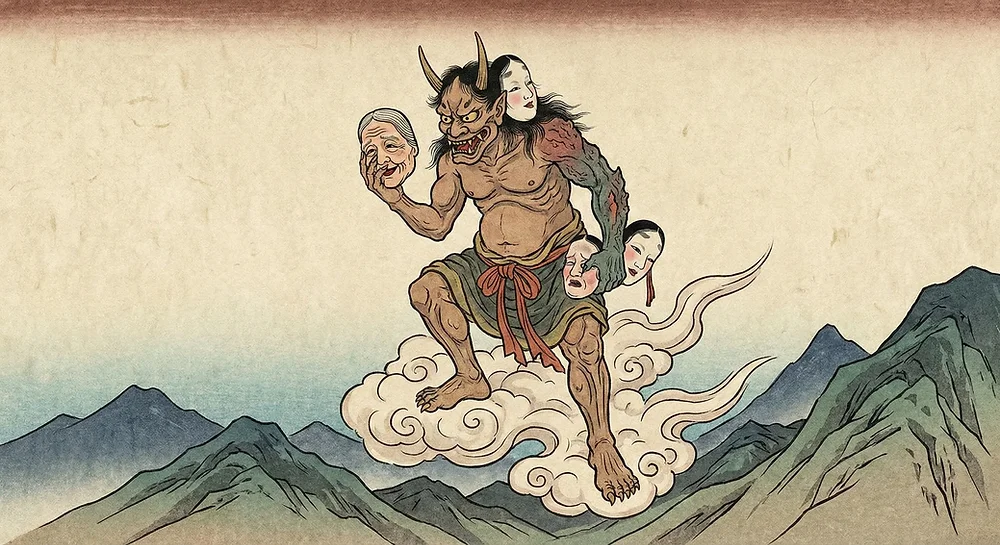
Ibaraki-dōji appears in a network of Japanese warrior tales, illustrated narratives and stage works. The character is usually connected with Shuten-dōji's oni band and with Watanabe no Tsuna, one of the celebrated retainers of Minamoto no Yorimitsu, also called Raikō.
There is no single canonical biography. Some texts focus on the Mount Ōe oni, others on the encounter with Tsuna, and later regional accounts supply childhood stories and local birthplaces. Treating every detail as one continuous life story hides how the legend developed.
For the wider Mount Ōe cycle, read the Shuten-dōji legend. For Tsuna's other legendary exploits, use the separate Watanabe no Tsuna guide.
Modoribashi and Rashōmon are different versions
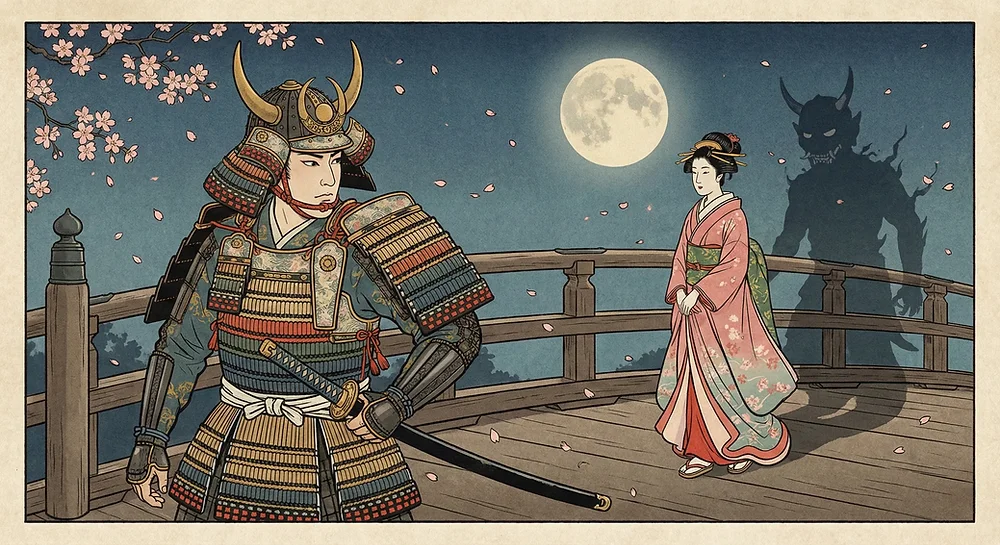
In the Ichijō Modoribashi version, Tsuna encounters a woman near the bridge and offers assistance. She transforms into an oni and attempts to carry him away. Tsuna remains composed and cuts off the demon's arm with Higekiri. Ukiyo-e titles and museum records preserve this bridge setting.
The Noh play Rashōmon places the confrontation at Kyoto's famous southern gate. In that dramatic version, Tsuna rides out to test the claim that an oni occupies the gate and battles the creature there. Later art and popular retellings often identify the Rashōmon demon as Ibaraki-dōji, merging the stage tradition with the Modoribashi cycle.
Both versions are culturally important. The accurate approach is not to choose one as the only true story, but to identify which source or artwork is being described.
| Version | Setting | How the encounter begins | Useful source clue |
|---|---|---|---|
| Modoribashi | Ichijō Modoribashi bridge | A woman asks Tsuna for help, then reveals an oni form | Print titles often name Higekiri and Ibaraki-dōji |
| Rashōmon | Rashōmon gate | Tsuna investigates reports of an oni at the gate | The Noh play emphasises the gate confrontation |
| Later combined retellings | Often Rashōmon | Elements from both cycles are blended | Common in summaries, prints and modern adaptations |
How the severed arm was recovered
After the encounter, Tsuna is warned to guard the severed limb and avoid visitors. Ibaraki eventually arrives disguised as an elderly woman. The disguise gains trust, the arm is shown, and the oni takes it back before escaping.
Even this celebrated scene has variations. The British Museum identifies the visitor as Tsuna's aunt. The Cleveland Museum of Art describes Ibaraki as the aunt of Minamoto no Yorimitsu in a related visual tradition. Theatre and prints reshape the residence, warning period and reveal. What remains stable is the combination of disguise, recognition and recovery.
The episode shows cunning, but claims that Ibaraki copied a relative's scent, memories or every detail of her personality are modern embellishments. The historical artworks support transformation and deception, not a defined supernatural power system.
Was Ibaraki-dōji born human?
Settsu traditions recorded in early modern geographical works describe a frightening child born with teeth, long hair or unusual strength. Accounts connect the child with areas now in Amagasaki or Ibaraki and sometimes with a barber's household. These stories help explain regional claims to Ibaraki's birthplace.
They should be labelled as regional origin legends. The central arm-severing cycle does not require Ibaraki to have been a rejected human child, and no reliable source supports the article's former claim that rejection uniquely transformed Ibaraki into an oni after tasting blood.
Ibaraki-dōji and Shuten-dōji
Ibaraki is frequently described as a companion, retainer or leading member of Shuten-dōji's group. Noriko Reider's study of the Shuten-dōji tradition includes Ibaraki's encounter with Tsuna as part of the broader Mount Ōe narrative world.
Later theatre, manga and games expand the relationship into loyalty, rivalry, family or romance. Those interpretations can be meaningful within a particular work, but there is no basis for presenting Ibaraki as Shuten's definitive spouse or lover across the tradition.
Gender, disguise and performance
Premodern narratives commonly present Ibaraki with masculine or youthful language, while the arm-recovery episode requires an old-woman disguise. Kabuki performance adds another layer because roles and transformations are shaped by theatrical casting conventions.
Modern works freely recast Ibaraki as male, female or androgynous. That creative flexibility should be described work by work. The old-woman disguise alone does not prove one fixed gender identity, and popularity within a community should not be claimed without evidence.
What the name dōji means
Dōji (童子) can mean a child, youth or acolyte and appears in Buddhist and legendary names. In Ibaraki-dōji and Shuten-dōji, it is part of the established name. It does not by itself prove that the character left human society at a specific age or possessed a face that never aged.
Ibaraki-dōji, Shuten-dōji and Tsuna compared
| Figure | Role in the cycle | Best-known motif | Avoid claiming |
|---|---|---|---|
| Ibaraki-dōji | Named oni linked with Shuten and Tsuna | Severed arm recovered through disguise | One fixed origin, gender or magical ability list |
| Shuten-dōji | Leader of the Mount Ōe oni in the famous tale | Defeat by Raikō's party | That every Ibaraki story happens during the Mount Ōe raid |
| Watanabe no Tsuna | Warrior and legendary demon slayer | Cuts off the oni's arm | That all versions use the same location or sword name |
A note from the Dai Yokai workshop
Dai Yokai does not claim to reproduce one authentic Ibaraki-dōji face. The surviving tradition offers many designs across Noh, Kabuki, ukiyo-e and modern media. My contemporary Oni masks are printed in PETG, sanded, painted and hand-finished in Brittany, France, drawing on the broader visual language of Japanese oni rather than a ritual original.
To compare the wider creature category, read the Oni meaning guide, or browse the contemporary handmade Oni masks.
FAQ
Who is Ibaraki-dōji?
Ibaraki-dōji is a named oni in Japanese legend, closely associated with Shuten-dōji and famous for fighting Watanabe no Tsuna. In the best-known episode, Tsuna cuts off the oni's arm. A later episode has Ibaraki return in disguise and recover it.
Where did Watanabe no Tsuna fight Ibaraki-dōji?
The location depends on the version. Some narratives place the encounter at Ichijō Modoribashi bridge, while the Noh and later Rashōmon tradition moves it to Kyoto's Rashōmon gate. Modern summaries often merge the two locations, but they belong to different retellings.
Which sword cut off Ibaraki-dōji's arm?
The sword is commonly identified as Higekiri or Higekirimaru in the Modoribashi tradition. The blade later acquired other names, including Onikiri, in its own evolving legend. It is safer to name Higekiri for this episode than to treat every sword name as interchangeable.
How did Ibaraki-dōji recover the severed arm?
In a famous later episode, Ibaraki takes the form of an elderly woman, gains access to the place where the arm is stored, then seizes it and escapes. Sources differ over the woman's identity and whether the guarded residence belongs to Tsuna or Minamoto no Yorimitsu.
Was Ibaraki-dōji born human?
Some regional and early modern accounts give Ibaraki a human birth in Settsu and describe an abandoned, frightening child. That is one origin tradition, not a universal part of every medieval version. Other narratives introduce Ibaraki simply as an oni connected with Shuten-dōji.
What is Ibaraki-dōji's relationship with Shuten-dōji?
Ibaraki is commonly presented as a companion, retainer or important member of Shuten-dōji's oni band. Later works interpret the bond in different ways. Claims that they were definitively lovers, spouses or relatives are interpretations rather than one settled traditional fact.
Is Ibaraki-dōji male or female?
Many premodern narratives use a male or youthful presentation, while stage performance and modern media vary the character's gender. Ibaraki's disguise as an old woman is a plot device and does not by itself establish a female identity across the tradition.
Is Ibaraki-dōji the same as a Hannya?
No. Ibaraki-dōji is a named oni from warrior and theatrical legends. Hannya is a specific Noh mask and role associated with a woman transformed by jealousy and rage. Both can look fierce or horned, but their stories and theatrical identities are different.
Sources and further reading
- Allen Memorial Art Museum, Watanabe no Tsuna and the Demon of Rashōmon
- Smithsonian National Museum of Asian Art, Tsuna and Ibaraki at Modoribashi
- British Museum, The Old Woman Taking Away the Oni's Arm
- Cleveland Museum of Art, Sketch of Ibaraki-dōji
- Ota Memorial Museum of Art, Higekiri and the Ibaraki legend
- Noriko T. Reider, Shuten Dōji: Drunken Demon