Watanabe no Tsuna (953-1025) was a historical Heian-period warrior who became a legendary demon slayer. Later tales connect him with Minamoto no Yorimitsu's Four Guardians, the sword Higekiri and an oni whose arm he severed. The encounter appears at Ichijō Modoribashi in some traditions and Rashōmon in others.
Watanabe no Tsuna at a glance
| Question | Evidence-led answer | Important limit |
|---|---|---|
| Was Tsuna a real person? | A Heian-period warrior dated 953-1025 | The supernatural exploits are legendary |
| Who was his lord? | Minamoto no Yorimitsu, also called Raikō, in historical memory and tale cycles | The stories expand their relationship |
| Which oni did he fight? | Ibaraki-dōji in the Modoribashi and severed-arm cycle | The Rashōmon demon is not named identically in every version |
| Which sword appears? | Higekiri or Higekirimaru in the Modoribashi tradition | Onikiri is part of a layered naming tradition |
| Why is he still remembered? | Literature, Noh, Kabuki and ukiyo-e made him an ideal demon-slaying warrior | Artworks preserve different retellings |
The historical warrior and the legendary hero
Tsuna lived during the Heian period and is remembered as a warrior associated with Minamoto no Yorimitsu. Museum catalogues date him to the late tenth and early eleventh centuries. That historical core matters, but it does not turn every later supernatural episode into biography.
Warrior tales, illustrated books, theatre and prints gradually made Tsuna a model of courage and composure. In these narratives he belongs to Raikō's Shitennō, or Four Guardians, and participates in the world of the Mount Ōe expedition against Shuten-dōji. The literary grouping is central to Tsuna's fame even when a source is not recording a contemporary military roster.
For the larger oni cycle, read the Shuten-dōji legend and the separate guide to Ibaraki-dōji.
Modoribashi and Rashōmon are two traditions
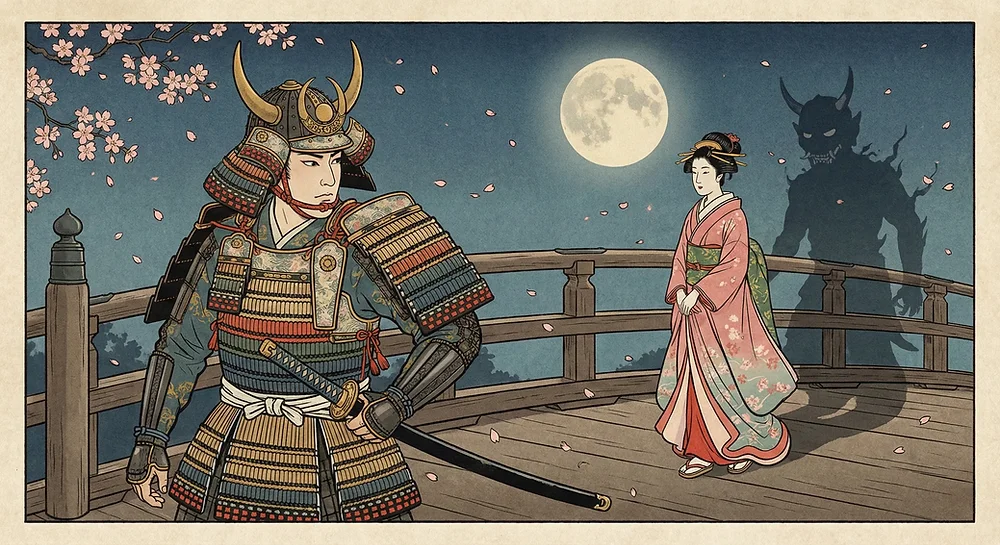
In the Ichijō Modoribashi story, Tsuna meets a woman near the bridge. After he agrees to help her, she reveals an oni form and tries to carry him away. Tsuna cuts off the attacker's arm with Higekiri. Museum records for Kuniyoshi prints explicitly identify the demon as Ibaraki-dōji, the bridge as Modoribashi and the sword as Higekirimaru.
The Noh play Rashōmon uses Kyoto's ruined southern gate as its dramatic setting. Tsuna goes to investigate a report that an oni occupies the gate and fights the creature there. Hokusai and other artists also depict Tsuna at Rashōmon. Later popular retellings frequently name that oni Ibaraki-dōji, blending the gate play with the bridge cycle.
| Tradition | Place | Opening of the encounter | Best way to describe it |
|---|---|---|---|
| Modoribashi cycle | Ichijō Modoribashi bridge | A woman requests help, then transforms | Tsuna cuts Ibaraki-dōji's arm with Higekiri |
| Rashōmon tradition | Rashōmon gate | Tsuna investigates reports of an oni | A theatrical gate battle, later often merged with Ibaraki's story |
| Modern combined version | Usually Rashōmon | Details from both stories are joined | Useful as folklore only when the merger is acknowledged |
Higekiri, Higekirimaru and Onikiri
The sword in the Modoribashi episode is usually called Higekiri or Higekirimaru, “Beard Cutter.” The Smithsonian catalogue describes it as a blade lent to Tsuna by Minamoto no Yorimitsu. The name also belongs to a much wider sword legend involving changing owners, rival blades and successive names.
Onikiri, “Oni Cutter,” is often linked with Higekiri, but sources do not all give one simple sequence in which the Rashōmon strike automatically renames the sword. The careful wording is that Higekiri and Onikiri became connected in the blade's later tradition. Claims about a surviving shrine sword also need to distinguish devotional identification from an unbroken, independently proven provenance.
| Name | Meaning | Safe use in this article |
|---|---|---|
| Higekiri | Beard Cutter | The clearest name for Tsuna's blade in the Modoribashi encounter |
| Higekirimaru | A fuller form of Higekiri | Used in museum titles and print inscriptions |
| Onikiri | Oni Cutter | An alternate or later name in the wider sword legend, not a universally fixed rename event |
How Ibaraki-dōji recovered the arm
The severed arm does not remain a trophy. In a famous continuation, Tsuna is warned to guard it and admit no visitor. An elderly woman eventually gains entry, asks to see the arm and reveals herself as Ibaraki-dōji before escaping with it.
The British Museum describes the disguise as Tsuna's aunt. Other artworks and catalogues connect the old woman with Minamoto no Yorimitsu. Retellings also vary the warning, the number of guarded days and the residence. The stable core is disguise, access and recovery, not one exact timetable.
The Watanabe name and Setsubun
Setsubun is marked by mamemaki, the throwing of roasted beans while calling for oni to leave and good fortune to enter. A documented folk belief adds an exception: some households named Watanabe do not throw beans because the oni already fear Tsuna's name.
This is better described as a family or regional custom than a universal “Watanabe privilege.” Japanese library reference records document examples of Watanabe households that follow it, while ordinary Setsubun practice varies across Japan. The legend survives because a heroic name functions symbolically like protection.
What Tsuna represents in oni imagery
Tsuna and Ibaraki form a paired image: disciplined warrior against disruptive oni, human blade against supernatural body, victory followed by the oni's clever return. The episode is less a simple monster hunt than a contest between force and transformation.
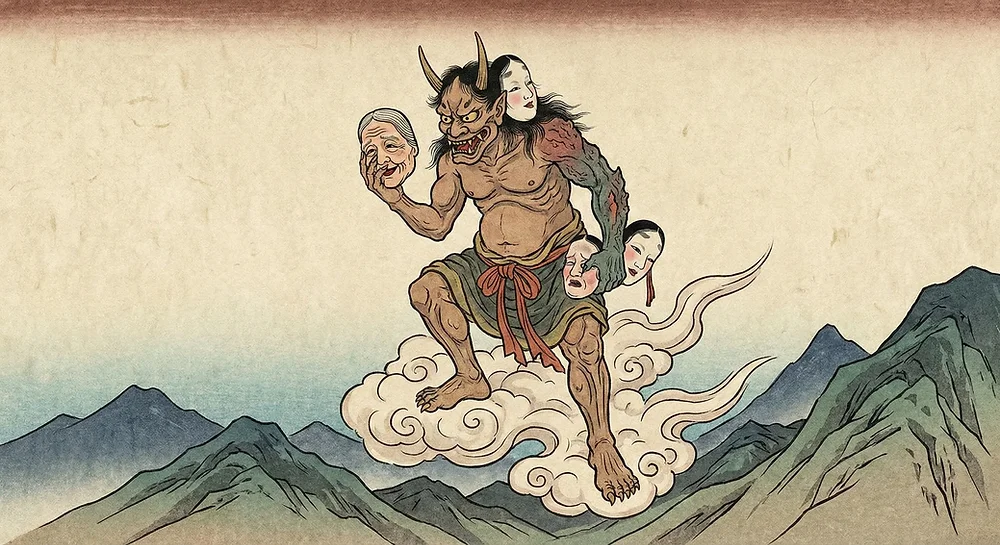
Oni masks do not represent one named creature by default. Horns, teeth and powerful expressions belong to a broad visual language used in folklore, festivals, theatre and modern craft. A mask can evoke the tension of Tsuna's legend without claiming to reproduce an authenticated face of Ibaraki-dōji.
A note from the Dai Yokai workshop
Dai Yokai does not present an “authentic Watanabe no Tsuna mask.” My contemporary Oni masks are printed in PETG, sanded, painted and hand-finished in Brittany, France. They draw on the broader visual language of Japanese oni rather than copying one ritual object or claiming a direct historical reconstruction.
To explore that visual language, read the Oni mask meaning guide or browse the contemporary handmade Oni masks.
FAQ
Who was Watanabe no Tsuna?
Watanabe no Tsuna (953-1025) was a Heian-period warrior remembered as a companion of Minamoto no Yorimitsu, or Raikō. Later tales and artworks transformed him into a model demon slayer, especially through his encounters with Shuten-dōji and Ibaraki-dōji.
Did Watanabe no Tsuna really exist?
Yes, Tsuna is treated as a historical warrior, but the oni battles belong to legend and later literature. A careful account separates the person from the supernatural biography built around him.
Did Tsuna fight Ibaraki-dōji at Rashōmon or Modoribashi?
Both locations appear in the tradition. The Modoribashi cycle names Ibaraki-dōji and Higekiri, while the Noh play Rashōmon stages a gate encounter. Later summaries and artworks often combine the two.
What sword did Watanabe no Tsuna use?
The Modoribashi encounter is commonly linked with Higekiri or Higekirimaru, a sword lent by Minamoto no Yorimitsu in some accounts. Other names, including Onikiri, belong to the blade's wider and changing legend.
Is Higekiri the same sword as Onikiri?
They are often linked as names in the same legendary sword tradition, but the sequence and reason for each name vary by source. It is safer to call the arm-cutting blade Higekiri in the Modoribashi episode and explain Onikiri as a later or alternate name.
How did Ibaraki-dōji recover the severed arm?
In a famous continuation, the oni returns disguised as an elderly woman, gains access to the guarded arm and escapes with it. Sources disagree over whose relative the woman impersonates and where the scene occurs.
Why do some Watanabe families not throw beans at Setsubun?
A documented folk custom says that some households named Watanabe do not need to drive oni away because Tsuna already defeated them. This is a family or regional tradition, not a rule followed by every person with the surname.
Was Tsuna one of Raikō's Four Guardians?
In legendary warrior cycles, Tsuna is counted among the Shitennō, the four celebrated retainers of Minamoto no Yorimitsu. The grouping is important to the stories, but it should not be treated as a complete contemporary military record.
Sources and further reading
- Smithsonian National Museum of Asian Art, Tsuna and Ibaraki at Modoribashi
- British Museum, Watanabe no Tsuna at Rashōmon
- British Museum, The Old Woman Taking Away the Oni's Arm
- Ota Memorial Museum of Art, Higekiri and the Ibaraki legend
- National Diet Library Collaborative Reference Database, Watanabe households and Setsubun
- National Diet Library, Setsubun and warding off evil spirits