What Is an Oni in Japanese Folklore
Oni is a broad term for supernatural figures found in Japanese legends, Buddhist imagery, festivals and local traditions. The translations "demon" and "ogre" work as a first approximation, but neither covers every depiction. For the wider context, see the guide to yōkai in Japanese folklore.
Calling an Oni simply "the Japanese demon" flattens a figure that can threaten, punish, guard an entrance or represent an uncontrollable force, depending on the source. That range is why the same visual family works equally well in irezumi, wall decoration or a festival costume.
Where Does the Word Oni Come From
The character 鬼 entered Japanese through Chinese writing and religious traditions, where it could refer to spirits of the dead or dangerous supernatural beings. An older Japanese explanation links oni to onu, "to hide." That is a historical hypothesis, not a single proven origin of the word.
Nippon.com's interview with historian Koyama Satoko traces how the Chinese gui (鬼), spirits of the dead who could be good or evil, reached Japan by at least the seventh century and narrowed over time into a word used only for evil beings. Early Japanese chronicles already used "oni" loosely: the Nihon Shoki (720) describes people from outside Japan mistaken for oni, and later texts record oni as everything from a one-eyed field-eating creature to human outsiders feared for their difference.
For the history of the word Oni and the Nihon shoki reference, see Nippon.com, interview with historian Satoko Koyama.
Why Do Oni Have Horns and Tiger-Skin Clothing
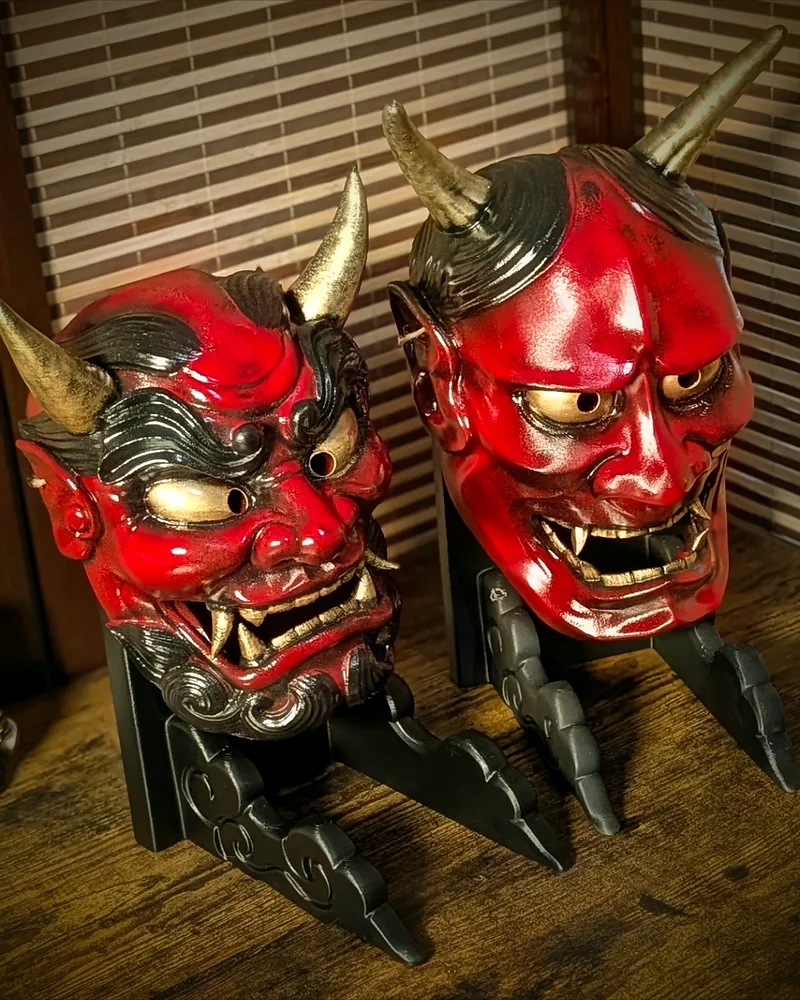
In traditional cosmology, the north-east is kimon, the demon gate. That direction corresponds to the Ox and the Tiger in the directional zodiac, which is the usual explanation for ox horns and tiger-stripe clothing in Oni imagery.
This is a widely repeated visual tradition, not a rule that every Oni depiction must follow. According to Koyama's research, oni were not consistently shown with horns until sources like the twelfth-century Konjaku Monogatari, and metal clubs only became a standard attribute during the Edo period. Older images used hammers instead, and colors such as red and blue for Oni skin trace back to Buddhist gaki (hungry ghosts) and yaksha guardian figures rather than to the horns themselves.
Scroll the table horizontally.
| Common feature | Careful explanation |
|---|---|
| Horns and tiger-skin loincloth | Often linked to the north-east, positioned between the Ox and Tiger in the Japanese directional zodiac |
| Red, blue or dark skin | Colors found in different stories and Buddhist imagery, without a universal meaning |
| Fangs, claws and jaw | Visual features that strengthen the creature’s threatening appearance |
| Kanabō | A club that became a popular Oni attribute, particularly in representations developed from the Edo period onwards |
| Imposing size | A frequent characteristic in some stories and depictions, but not a universal one |
For the development of horns, tiger imagery and the kanabō, see Nippon.com, interview with historian Satoko Koyama.
When I model my own Oni masks, I generally try to keep four to six visible teeth between the fangs. This helps the expression remain readable even when the mask is viewed from a distance.
What Do an Oni Mask's Colors Mean
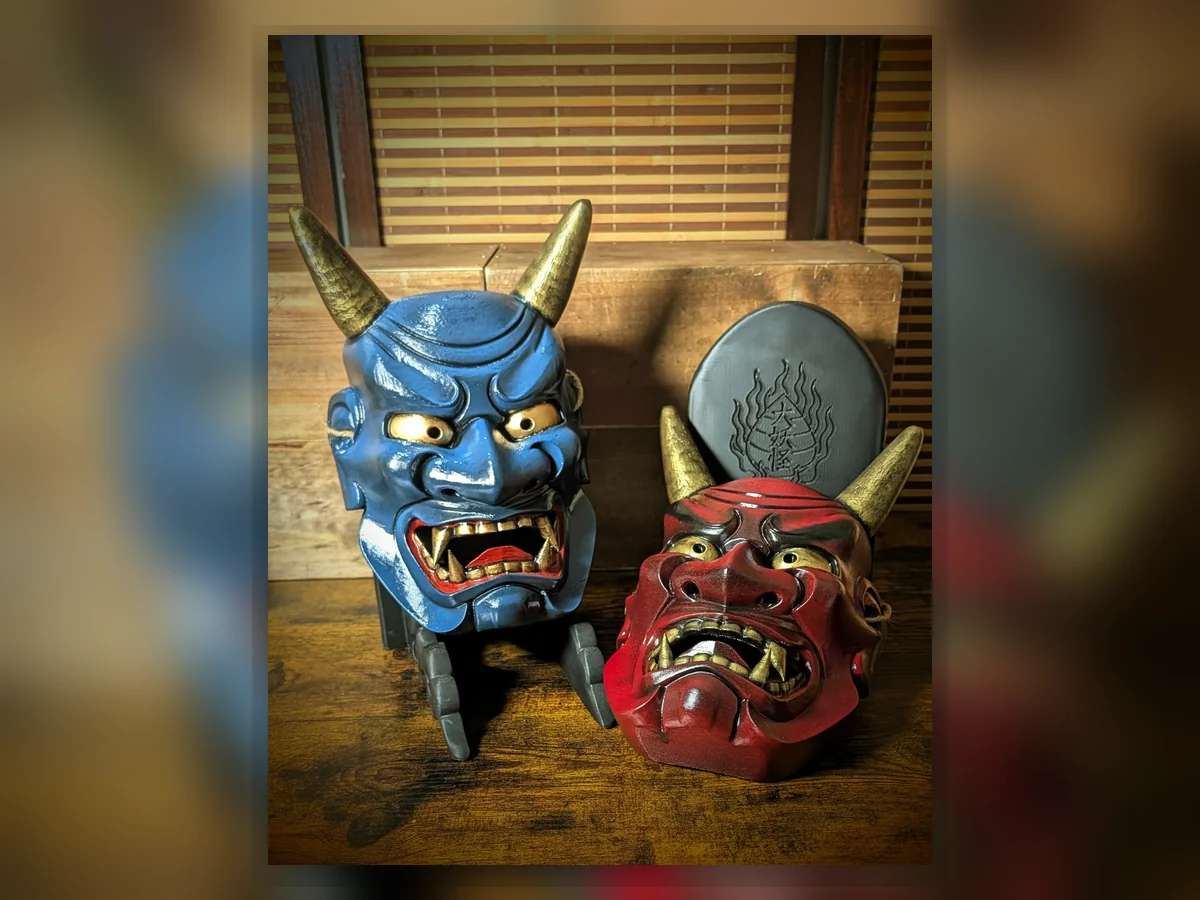
Colors are not a fixed dictionary. Their meaning shifts between tradition, artwork and period. A commonly cited framework links five Oni colors to the five hindrances of Buddhist practice, but that grid should be read as one possible interpretation, not a rule that applies to every mask, region or tattoo.
Scroll the table horizontally.
| Color and name | Association in some Setsubun traditions | Visual effect in my work | Possible use |
|---|---|---|---|
| Red, Aka-Oni | Greed and desire | Immediate presence, vivid energy | Tattoo, cosplay, bold wall display |
| Blue, Ao-Oni | Anger and hostility | A colder and more restrained presence | Red-and-blue pair, display, irezumi-inspired composition |
| Black, Kuro-Oni | Doubt | Dense shadow, more inward energy | Tattoo studio, dark wall, understated setting |
| Yellow, Ki-Oni | Restlessness and regret | Tension, instability, movement | Graphic composition or symbolic piece |
| Green, Midori-Oni | Torpor and inertia | Heaviness, slowness, imposing presence | Collection, color contrast, folklore display |
A 2018 study published in the Journal of the Color Science Association of Japan documents regional combinations and interchangeable colors in Oni imagery, which is evidence against a single, universal color code rather than for one. For a closer look at one color, see the Aka-Oni, red mask meaning guide.
For white Oni and the distinction between a character, a material surface and a painted finish, see the guide to choosing Japanese mask colours.
For regional color combinations and the five hindrances, see Color Science Association of Japan and Ryūshōji.
Is an Oni Always Evil
No single answer covers every story. An Oni can be a violent opponent, a punisher in Buddhist hell imagery, or, in certain ritual and architectural contexts, a frightening face used to keep misfortune away. Gozu and Mezu, the ox-headed and horse-headed wardens, provide a more specific example of Japanese hell imagery.
Some traditions also depict Oni, or closely related figures, in the role of a guardian. The Yabu of Kure is one particular example, covered in my article about the Oni Yabu mask.
Onigawara, the demon-faced roof tiles found on Japanese temples and traditional buildings, show this protective use directly: a threatening face placed at a roofline to ward off harm. That function belongs to the object and its placement, not to every Oni depiction automatically. Nippon.com's historical account also shows the darker side of the figure: the term "oni" was repeatedly applied to outsiders, disabled children and women who did not fit the expectations of their time, a use that carried real prejudice rather than folklore alone.
Why Are Oni Driven Out During Setsubun
Setsubun, the day before the traditional start of spring, is marked by mamemaki: throwing roasted soybeans while saying "Oni wa soto, fuku wa uchi," or "Oni out, fortune in." In this context, Oni represent misfortune, illness or harmful influence to be symbolically expelled before the new season, not a fixed cast of characters. A family member may wear an Oni mask so children have something to aim at, but the ritual works with or without one, and colors and chants vary by region and institution.
This is a large, well-documented topic on its own. For the full explanation, including primary sources from the National Diet Library and Japan's Consumer Affairs Agency, see the Setsubun meaning, mamemaki and Oni guide.
For Setsubun, the Tsuina rite and bean throwing, see National Diet Library of Japan.
Oni, Hannya, or Tengu: Three Different Traditions
Oni express supernatural strength, punishment or protection. Hannya represent a human transformation driven by jealousy and grief. Tengu belong to a separate mountain tradition, tied more closely to discipline, pride, martial training and guardianship. Treating the three as interchangeable "scary Japanese masks" erases what actually distinguishes them. For the mountain figure, see the Tengu mask meaning guide.
Oni vs Hannya: What Is the Difference
| Oni | Hannya | |
|---|---|---|
| Nature | Supernatural creature or ogre from folklore | Woman transformed by jealousy, obsession and grief |
| Main context | Folklore, festivals, legends and art | Noh theater and stories of transformation |
| Expression | Raw force, threat, punishment or protection | Rage mixed with suffering and sorrow |
| Silhouette | Wide face, heavy volumes | Narrower face, two pronounced horns |
Hannya is not simply "the female Oni," and not every horned mask should be labeled Hannya. The distinction matters for anyone choosing a piece for a tattoo reference or a collection. See the Hannya mask meaning guide for the full picture, including Kezurata, the cracked Hannya design and the Neko Hannya, cat and Noh fusion.
This is a confusion I hear regularly at conventions: many visitors instinctively call a Hannya mask an “Oni”, even though the two tell very different stories.
Closer to the Noh demoness, see the handmade Hannya masks.
Why did samurai wear Oni masks?
The question usually refers to fearsome-looking armour masks. Historical menpō protected the lower face and helped secure the helmet. They could have wrinkles, teeth or a moustache, but a fierce expression does not identify an Oni by itself. The Met's Edo-period half mask, made from iron, lacquer and hair, is catalogued as armour, without an Oni identification.
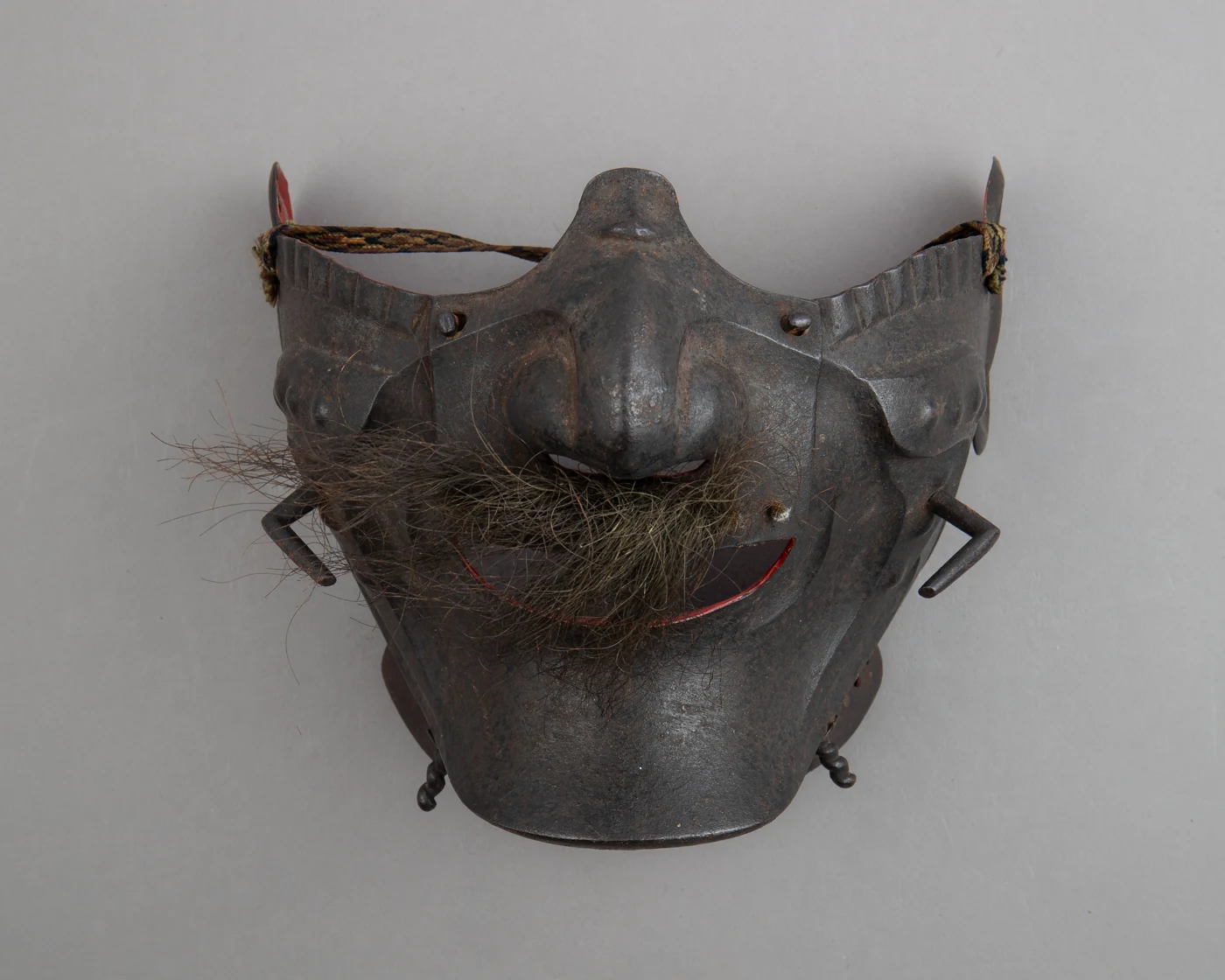
It is useful to separate three images: a warrior wearing facial armour, an Oni depicted in a helmet, and a modern half mask that deliberately combines armour lines with demon fangs. Their resemblance does not make them the same historical object. An intimidating appearance is easier to observe than a claim that every samurai wore an Oni face to frighten enemies or obtain supernatural protection.
For coverage, materials and helmet attachments, continue with the menpō and mengu armour guide. Dai Yokai's Samurai Mempo and Oni Mempo show two contemporary design choices: armour-inspired facial lines and an emphasis on fangs. Both are PETG creations finished by hand in Brittany, not protective equipment.
The Oni Mask in Irezumi and Tattoo Culture
In contemporary Japanese-inspired tattooing, an Oni can read as a menacing force turned against evil, a symbol of protection, or a confrontation with destructive impulses. None of these meanings is automatic. Color, pose, accompanying motifs and the full composition decide the reading, and that composition should be discussed with the tattoo artist rather than assumed from the mask alone.
A physical mask can help at this stage: it shows how light falls across the brow, how the horns sit, and whether the mouth still reads clearly from a distance, before that language becomes a tattoo design. For the full breakdown of colors, composition and irezumi placement, see the Oni mask tattoo meaning guide.
Choosing or Displaying an Oni Mask
For a wall or a tattoo studio, check the mask reads clearly from a few meters away: horns, eyes, fangs and shadow should hold their shape at that distance. Red and black tend to carry the most presence indoors; blue reads cooler and less common. For cosplay or convention use, weight, fit, visibility and the attachment system matter as much as the design itself, since a mask that photographs well is not automatically comfortable to wear for hours.
Practical guidance on mounting, stands and materials is covered in the how to display a Japanese mask guide and the PETG, PLA or resin mask comparison.
Dai Yokai's Contemporary Oni Masks
Dai Yokai is a craft workshop based in Brittany, France. Its Oni masks are contemporary creations inspired by Japanese folklore and Oni imagery, not reproductions of historical ritual objects or authentic Noh pieces. One example is the handmade red Oni mask.
Each piece starts as a PETG 3D print, then goes through sanding, priming, painting, varnishing and hand finishing. Small variations in patina and detail are part of working piece by piece rather than casting identical copies. Before choosing a handmade Oni mask, check the size, weight, mounting system, finish and intended use for that specific piece.
By Jérémy, creator of Dai Yokai. Since 2022, I have made contemporary masks inspired by Japanese folklore in Brittany. Each PETG base is sanded, primed, painted, varnished and finished by hand. See my workshop in Brittany.
Editorial method: this article separates documented historical or religious sources, regional traditions, modern interpretations and workshop experience. Some links lead to masks I design and sell. Any protective function described here is presented as symbolism, not a guaranteed effect.
Sources
- Nippon.com: "Oni" and Outsiders in Japanese Cultural History
- The Metropolitan Museum of Art: Oni, Hokusai School, Edo period
- Color Science Association of Japan (J-Stage): study on Oni colors
- Nohgaku Performers' Association: Noh masks
Frequently Asked Questions
What does an Oni mask mean?
It represents a supernatural figure from Japanese folklore. Depending on the story or ritual, it can express threat, punishment, protection or the expulsion of misfortune, most visibly during Setsubun.
Are Oni always evil?
No. Many legends show Oni as violent opponents, but onigawara roof tiles and some ritual imagery use a frightening Oni face to keep harm away. The specific source and context decide the reading.
Do Oni colors have a fixed meaning?
No. A popular framework links five Setsubun colors to the five Buddhist hindrances, but documented research shows regional variation and interchangeable colors, so the grid does not apply to every mask or tattoo.
Why do Oni have horns and tiger-skin clothing?
A widely repeated explanation ties the look to kimon, the north-east demon gate placed between the Ox and the Tiger in the directional zodiac. Historical sources also show that horns and metal clubs became standard only gradually, over several centuries.
What is the difference between an Oni mask and a Hannya mask?
Oni is a broad term for supernatural beings in folklore and ritual. Hannya is a specific Noh theater mask showing a woman transformed by jealousy, resentment and grief. Hannya is not simply a female Oni.
What can an Oni tattoo mean?
It can suggest strength, punishment, protection, resilience or a confrontation with destructive impulses. Color, pose, accompanying motifs and the full composition determine the meaning, so it is worth discussing with the tattoo artist directly.
Is an Oni mask required for Setsubun?
No. A family member may wear one so children have something to aim at during mamemaki, but the bean-throwing ritual works with or without a mask, and practices vary by household, temple and shrine.
Are Dai Yokai's Oni masks traditional Japanese objects?
No. They are contemporary handmade pieces created in Brittany, France, inspired by Japanese folklore. Each PETG base is sanded, painted, varnished and finished by hand. They are not historical replicas or ritual objects.
In Short
An Oni mask does not represent a single idea. It can be threat, punishment, protection or a symbol of misfortune driven out, depending on the legend, the ritual and the modern use. Reading it correctly means separating folklore, Setsubun, architecture and irezumi rather than collapsing them into one meaning. Dai Yokai's Oni masks are contemporary PETG pieces, sanded, painted and finished by hand in Brittany.
To compare shapes, colors and uses after reading the guide, browse the handmade Oni mask collection.