An Oni mask tattoo can express strength, danger, punishment, protection, inner conflict or the will to confront fear. It does not have one fixed meaning. The reading depends on the Oni's expression, surrounding motifs, color choices, tattoo style and the personal meaning agreed with the artist.
Oni mask tattoo meaning at a glance
| Possible reading | What supports that reading |
|---|---|
| Protection or deterrence | A frightening face worn as a warning, often reinforced by a defensive pose or personal story. |
| Strength and endurance | A forceful expression, large scale and a composition built around surviving hardship. |
| Danger or punishment | Hell imagery, weapons, fire or a deliberately threatening scene. |
| Inner conflict | A mask-like face, divided color scheme or pairing that represents anger, fear or impulses to control. |
| Transformation | A personal narrative about confronting destructive behavior rather than a fixed traditional code. |
The important distinction is between a cultural figure and a personal tattoo meaning. Japanese sources and artworks show Oni in more than one role. A tattoo wearer may choose one of those associations, but no chart can decide the meaning without the composition and the wearer's intent.
Is the Oni good, evil or protective?
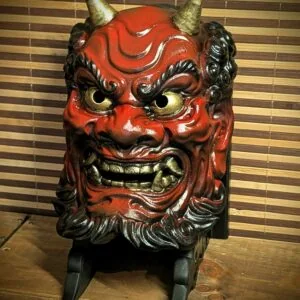
Oni are supernatural beings often depicted with horns, fangs and great physical force. Folklore, Buddhist imagery, festivals and popular culture do not give them one moral role. They may be violent ogres, punishers, comic figures or frightening presences used to drive danger away.
That is why 'protection' is a possible Oni tattoo meaning, not the official meaning. A protective reading usually comes from the wearer's story and the complete design. Fire, a weapon or a violent scene may instead push the image toward danger or punishment.
For the creature's wider history, read the complete Oni mask meaning guide. This page stays focused on tattoo intent and composition.
Do Oni tattoo colors have a fixed code?
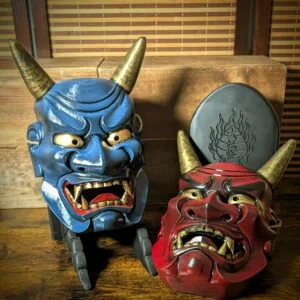
No. Red and blue Oni are familiar in modern Japanese depictions and Setsubun traditions, and older art also varies. There is no universal historical dictionary in which every red, blue, black, gold or white Oni tattoo always carries the same meaning.
| Color choice | Careful way to read it |
|---|---|
| Red | Often feels hot, forceful or urgent in a modern design. That is a visual association, not a binding irezumi rule. |
| Blue | Can feel cold, distant or contrasting beside red. The artist and the surrounding scene decide the meaning. |
| Black and gray | Prioritizes value, texture and readability. It does not automatically mean secrecy or death. |
| Gold or yellow | May suggest brilliance, authority or simply a strong palette. Ask the artist instead of assuming a traditional code. |
| White | Usually depends heavily on skin tone, highlights and the rest of the palette. It has no single Oni meaning. |
Oni, Hannya and onigawara are not the same motif
| Figure | What it is | Tattoo distinction |
|---|---|---|
| Oni | A broad class of supernatural beings in Japanese folklore and religious imagery. | Can be shown as a creature, face or mask-like design. Its meaning changes with the scene. |
| Hannya | A specific Noh theatre mask representing a woman transformed by jealousy and rage. | Recognizable by its mask form and theatrical lineage. It is not simply a female Oni. |
| Onigawara | A demon-faced roof tile used in Japanese architecture. | An architectural guardian image, not proof that every Oni tattoo is protective. |
Compare the separate Hannya tattoo meaning guide. Keeping these figures distinct avoids flattening every horned Japanese face into the same symbol.
Background, pairings and Japanese tattoo composition
Large Japanese-style tattoos often use wind, clouds, waves, rocks, flames or flowers to connect the motif to the body's movement. A background can give an Oni a setting and make a sleeve, chest panel or back piece read as one composition. It is not mandatory for every Oni tattoo.
| Design element | Question to settle with the tattoo artist |
|---|---|
| Flames or smoke | Do they describe the scene, improve flow, or merely fill space? |
| Waves, wind or clouds | Do they match the chosen season, movement and other motifs in the body suit? |
| Peony, chrysanthemum or maple | Is the flower chosen for season and composition, or only from a generic symbol chart? |
| Weapon, rope or kanabō | What action is taking place, and does it support punishment, conflict or defence? |
| Hannya or another face | Are the figures telling a coherent story rather than forming a decorative duel? |
Placement: let anatomy decide
An Oni face can work on an arm, thigh, chest, calf or back. There is no culturally required placement. The useful question is whether the eyes, horns and mouth remain readable when the body bends and whether the background follows the anatomy.
- Sleeve or thigh: enough curved surface for a face plus background, with strong movement around the limb.
- Chest or back: room for a larger narrative, multiple figures or a more complete Japanese-style composition.
- Calf or forearm: a compact design needs controlled horns and negative space so the face does not collapse at distance.
Workshop note: using a physical mask as reference
This is a practical observation from my Dai Yokai workshop, not a traditional tattoo rule. A physical mask gives an artist several real viewpoints, changing shadows and a clear sense of how horns, brow, nose and fangs project from the face. That can help when adapting the design to a curved, moving part of the body.
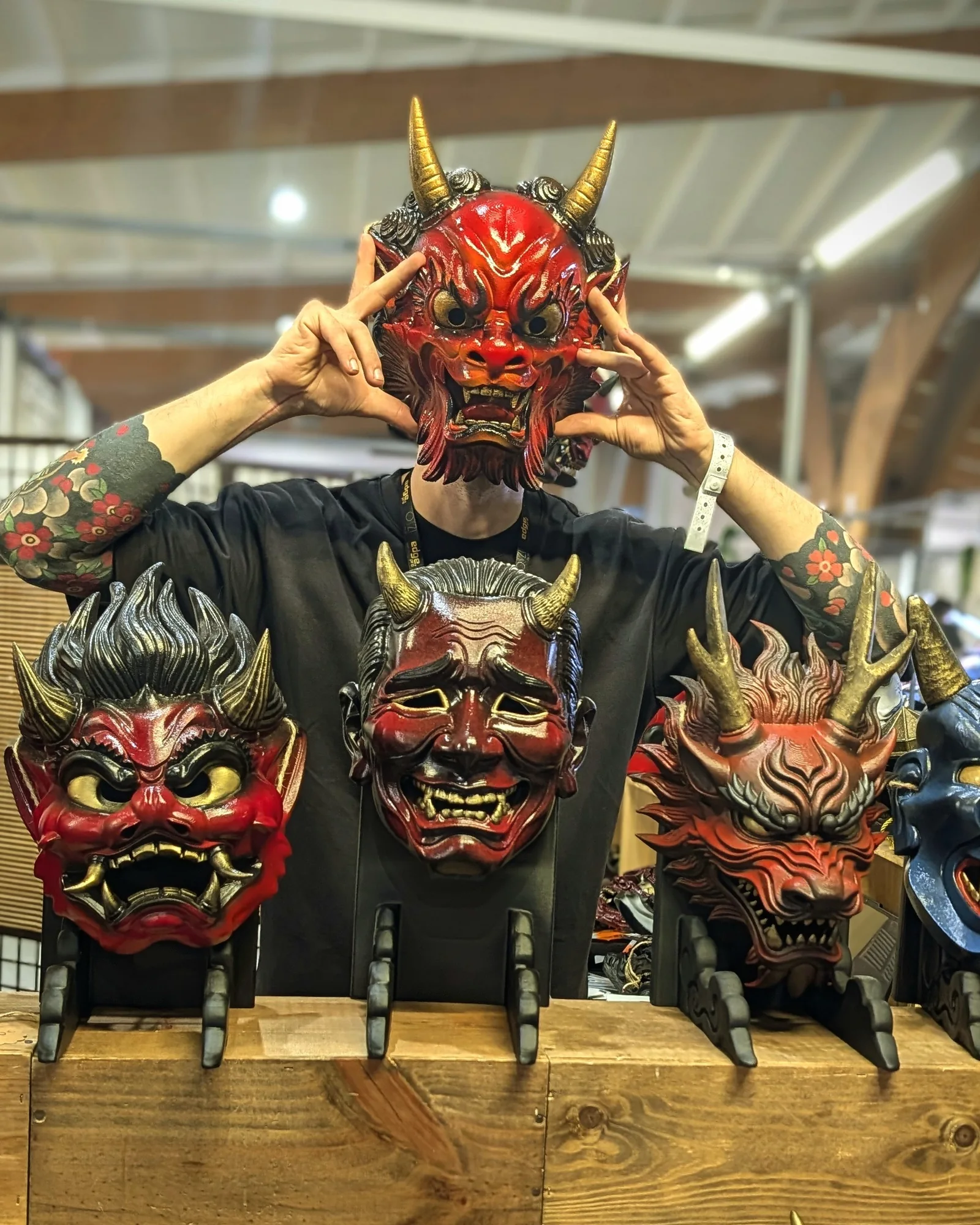
For the wider visual vocabulary, use the Japanese tattoo motifs guide. Then ask the tattoo artist how those references fit their own lineage, drawing method and composition.
Historical reference is not a modern symbol dictionary
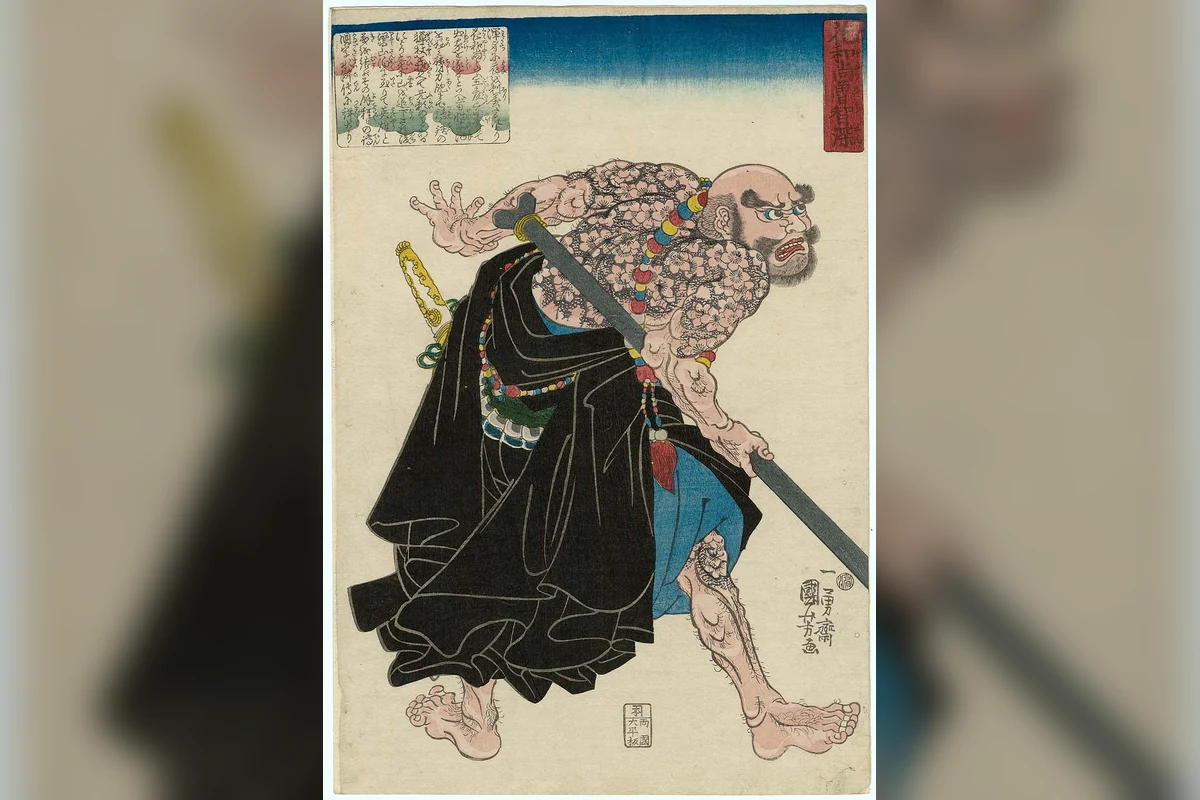
Utagawa Kuniyoshi's nineteenth-century prints of the tattooed Suikoden heroes are central references for the visual history of Japanese tattooing. They show bodies, movement and narrative scenes. They do not provide a modern chart saying that one Oni color or placement always means one thing. Historical evidence should guide visual research without being stretched into rules it does not contain.
The words irezumi and horimono also carry different histories and nuances. Academic work discusses Japanese tattooing as a body-wide, costume-like form, while contemporary artists work across traditional, neo-Japanese, blackwork and mixed styles. Ask a chosen artist what vocabulary they use and what lineage informs their drawing. That answer is more useful than labelling every Japanese-inspired Oni as traditional irezumi.
If the goal is a culturally grounded tattoo, bring several references rather than copying one mask or print. Identify which details come from theatre, folklore, architecture, ukiyo-e or modern mask making. This gives the artist room to build an original composition while keeping the sources legible.
FAQ
What does an Oni mask tattoo mean?
An Oni mask tattoo can express strength, danger, punishment, protection, inner conflict or the will to confront fear. It has no single universal meaning. The final reading depends on the expression, surrounding motifs, color choices, tattoo style and the personal intent agreed with the tattoo artist.
Is an Oni mask evil?
Not in one simple sense. Oni can appear as violent ogres, punishers in Buddhist hell imagery, comic figures or beings whose frightening appearance is used defensively. A tattoo can emphasize any of those readings.
Do Oni tattoo colors have fixed meanings?
No universal color code governs Oni tattoos. Red and blue Oni are familiar in Japanese art and Setsubun imagery, but modern tattoo meanings vary by artist and wearer. Treat color charts as design prompts, not historical rules.
What is the difference between an Oni and a Hannya tattoo?
Oni are a broad class of supernatural beings in Japanese folklore and religious imagery. Hannya is a specific Noh theatre mask representing a woman transformed by jealousy and rage. They can share horns and fangs, but they are not interchangeable motifs.
Does an Oni tattoo need a Japanese background?
No. Background elements can connect a large Japanese-style composition across the body, but a standalone Oni mask can work in contemporary Japanese-inspired, blackwork or neo-traditional tattooing. The choice should support the artist's composition and the wearer's intent.
Is an Oni tattoo a yakuza tattoo?
No motif by itself proves criminal affiliation. Large Japanese tattoos have a complex history and can still attract stigma in Japan, but an Oni tattoo alone is not evidence that its wearer belongs to the yakuza.
Can an Oni be female?
Yes. Oni are not inherently male, and stories and images vary. This is separate from Hannya, which is a defined Noh mask linked to a woman transformed by jealousy and anger.
Is an Oni tattoo disrespectful?
Not automatically. Respect means researching the figure, avoiding invented claims of sacred authenticity and working with a tattoo artist who understands Japanese visual references. Rules about visible tattoos in Japanese baths or gyms are a separate practical issue.