
The history of tattooing in Japan is often compressed into a dramatic story about ancient ritual, criminals and the Yakuza. The real history is less tidy. Different regions, communities and periods used permanent body markings for different reasons, and decorative tattooing developed beside punishment, censorship and social stigma.
Japanese tattoo history at a glance
| Period | What can be stated carefully |
|---|---|
| Early written records | Chinese and Japanese texts describe tattooed people, customs or punishment; prehistoric dogū remain indirect evidence |
| Edo period, 1603-1868 | Punitive tattooing and decorative tattooing existed in the same society |
| From 1720 | Punitive marks were applied to the face or arms for some crimes |
| 1827-30 | Kuniyoshi’s Water Margin warrior-print series became an important visual reference |
| Early Meiji period to 1948 | Tattooing was prohibited by law |
| From the 1960s | Yakuza films helped reinforce the association between tattoos and organized crime |
| Today | The national prohibition has ended, but social attitudes and venue policies still vary |
Early records are stronger evidence than dogū theories
Jōmon-period dogū figures sometimes have lines or markings on the face and body. Those markings may invite comparisons with tattooing, but they do not prove what was done to human skin. A careful history should label that interpretation as disputed rather than presenting a ritual or protective function as fact.
Written evidence is firmer. Nippon.com’s historical overview notes early Chinese descriptions of tattooed inhabitants and references to tattooing in the Kojiki of 712 and Nihon shoki of 720. These sources still need context: they describe different communities, regions and uses, not one uninterrupted irezumi lineage.
Ainu sinuye and Ryukyuan hajichi are distinct histories
“Tattooing in Japan” includes Indigenous and regional practices that should not be folded into mainland decorative horimono. Ainu women practiced sinuye; research on Ainu art and gender describes it as a female practice connected with beauty and the afterlife.
In the Ryukyu Islands, women’s hand markings known as hajichi carried their own local meanings. A J-STAGE study on hajichi records the 1899 prohibition and the stigma that followed. These traditions deserve their own histories rather than being treated as early versions of modern irezumi.
Edo Japan: punishment and decoration existed together
During the Edo period, tattooing had contradictory social roles. Research published in the Japanese Review of Cultural Anthropology describes decorative tattoos among laborers, firefighters and messengers from the eighteenth century. The same study records punitive tattooing on the face or arms from 1720 until the end of the period.
That overlap does not prove the popular story that convicts invented large decorative tattoos to conceal their punishment marks. Punitive marking and decorative body art can be discussed together, but their relationship should not be reduced to one unsupported origin tale.
Suikoden and Kuniyoshi changed the visual scale
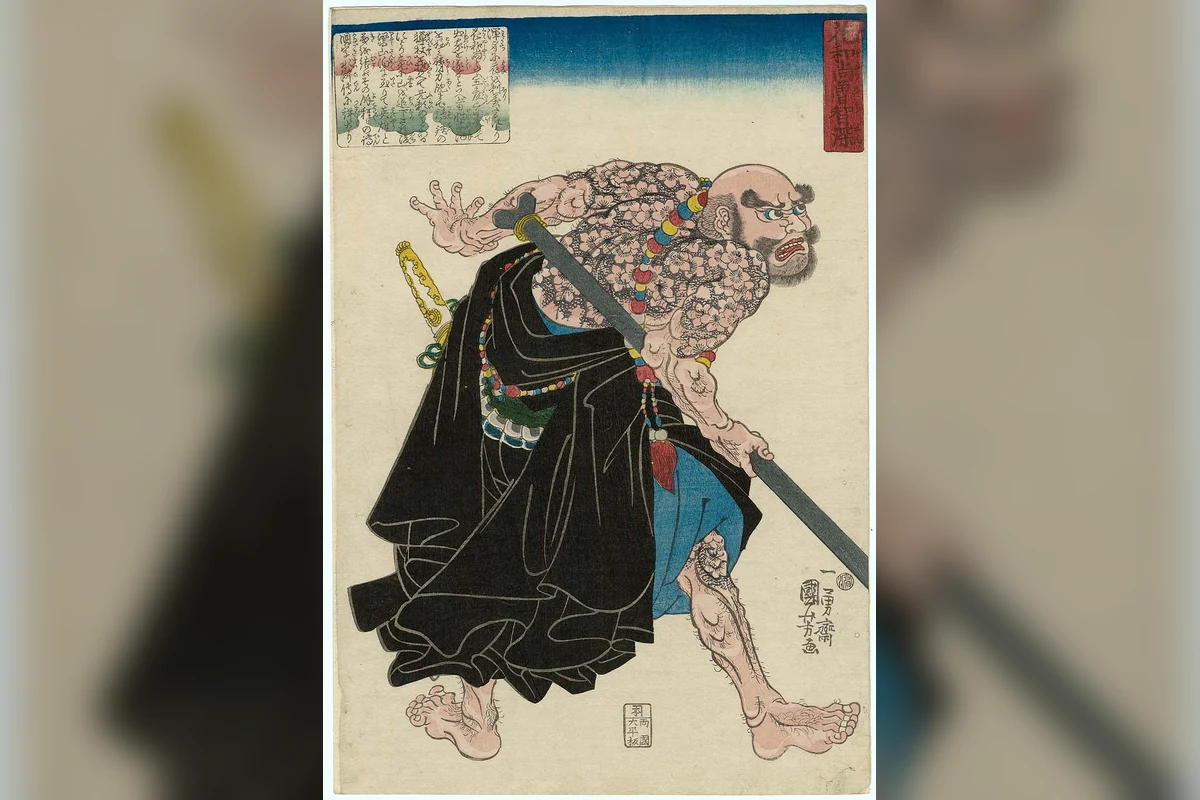
The Chinese novel Water Margin, known in Japan as Suikoden, supplied stories of outlaw heroes. Utagawa Kuniyoshi’s 1827-30 series presented muscular warriors in dynamic scenes, including richly patterned and tattooed bodies. The British Museum records that this series established Kuniyoshi as a leading artist of warrior prints.
These prints became important references for the narrative scale, movement and imagery associated with Japanese decorative tattooing. They did not invent every motif or every bodysuit form, but they are a documented bridge between popular print culture and the visual world discussed around horimono.
The Meiji prohibition and the 1948 change
From the beginning of the Meiji period, tattooing was prohibited as Japan’s government pursued modernization and controlled practices it considered undesirable. The J-STAGE history cited above dates the prohibition from the early Meiji era until 1948. The practice did not simply disappear, but it was pushed further from public view.
The end of the ban in 1948 changed the legal framework, not every social attitude. Earlier punitive uses, modern policing, public ideas about respectability and later media all contributed to a stigma that cannot be explained by one event.
On September 16, 2020, Japan’s Supreme Court held that tattooing in the case examined was not a medical act. Venue access rules remain separate.
The Yakuza association is real but incomplete
Some organized-crime members adopted extensive tattoos, but full-body Japanese tattooing was never exclusively a Yakuza practice. The same academic study notes that mass-produced Yakuza films from the 1960s reinforced the public association between tattoos and criminal groups.
That distinction matters. A tattoo can reflect personal taste, craft, identity or membership in many different communities. The image alone does not identify the wearer as a criminal, and history should not erase tattooed workers, artists, enthusiasts, Ainu women or Ryukyuan women.
Tebori is a technique, not a test of moral strength
Tebori describes tattooing by hand with a specialized tool. It is part of Japanese tattoo history, but it is not the only “true” way to make Japanese-style work. Contemporary practitioners may use tebori, electric machines or both. Claims that it is always slower, more painful or more expensive depend too heavily on artist, body area and project to be universal.
For the technique itself, read the separate guide to tebori hand tattooing. For symbolism and design choices, see the broader irezumi meaning and motif guide.
Tattoo access in Japan today
The postwar prohibition ended, but private and public-facing facilities can still apply access policies. The official Japan travel etiquette guide says tattoos are generally restricted at many hot springs, public baths, pools and gyms, while noting exceptions and more tolerant local bathhouses.
Visitors should check the specific venue, ask whether a waterproof cover is accepted and consider a private bath when necessary. “Tattoos are banned in Japan” is therefore too broad: the historical national prohibition ended, while current access rules vary by establishment.
From historical imagery to contemporary craft
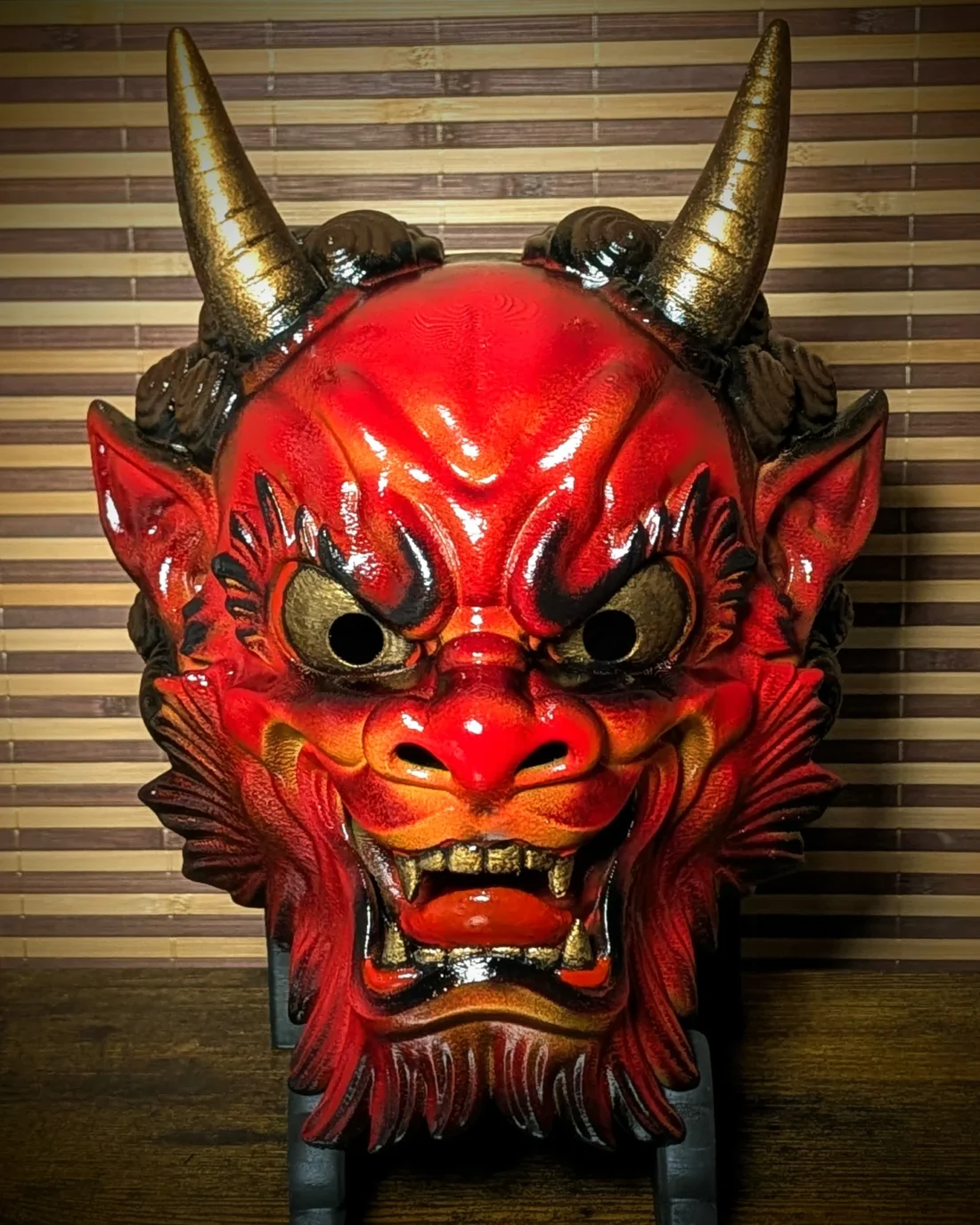
Dai Yokai works with Oni, Hannya and other mask forms in a Brittany workshop. PETG bases are sanded, primed, painted, varnished and finished by hand. These contemporary pieces can echo the visual energy of Japanese prints and tattoo motifs, but they do not reproduce a historical ritual function. For symbolism and design choices, use the dedicated Japanese tattoo motif guide.
Sources and further reading
- Nippon.com, overview of Japanese tattoo history and early written records
- Japanese Review of Cultural Anthropology, Edo tattooing, Meiji prohibition and postwar stigma
- British Museum, Kuniyoshi and the 108 Heroes of the Water Margin
- J-STAGE, Ainu sinuye and gender
- J-STAGE, the history and suppression of Okinawan hajichi
- Japan National Tourism Organization, current visitor guidance on tattoo access
FAQ
When did tattooing begin in Japan?
There is no single proven starting date. Markings on prehistoric dogū figures have sometimes been interpreted as tattoos or body paint, but they are not direct evidence on human skin. Written sources provide firmer ground: early Chinese accounts and Japan’s eighth-century chronicles describe tattooed people, regional customs or tattooing used as punishment.
Do Jōmon dogū prove that people were tattooed?
No. Some dogū clay figures carry facial and body markings that have inspired tattoo interpretations, but the markings could represent paint, scarification, clothing or artistic convention. Without preserved tattooed skin or another direct form of evidence, they cannot prove that Jōmon people practiced tattooing. They should be presented as a hypothesis, not a settled origin story.
Were tattoos used as punishment during the Edo period?
Yes. Academic histories describe punitive marks on the face or arms from 1720 until the end of the Edo period. Decorative tattooing also developed among groups such as laborers, firefighters and messengers. The two practices existed in the same society, but it is too simple to claim that decorative bodysuits were invented only to hide criminal marks.
How did Kuniyoshi influence Japanese tattoo history?
Utagawa Kuniyoshi’s 1827-30 print series on the heroes of the Water Margin helped popularize muscular warriors, dramatic action and richly patterned bodies. The British Museum records that the series established him as a leading artist of warrior prints. These images became important visual references, although they did not single-handedly invent Japanese decorative tattooing.
When were tattoos banned in Japan?
Tattooing was prohibited from the beginning of the Meiji period until 1948, according to research published through J-STAGE. The policy did not erase the practice, but it pushed tattooing away from public view. The postwar legal change ended that prohibition, while social stigma and restrictions at some private facilities continued.
Are Japanese tattoos only associated with the Yakuza?
No. Some organized-crime members adopted extensive tattoos, and postwar Yakuza films reinforced that public association. Japanese tattoo history also includes decorative work among Edo laborers and firefighters, Ainu women’s sinuye and Ryukyuan hajichi. A tattoo does not identify its wearer as a member of organized crime.
What is tebori in Japanese tattooing?
Tebori is a hand-tattooing method in which pigment is inserted with a specialized tool. It is a technique, not the complete definition of irezumi, horimono or Japanese tattooing. Contemporary artists may use tebori, electric machines or a combination. Pain, speed and price vary by artist, body area and project, so universal comparisons are unreliable.
Can people with tattoos visit onsen in Japan?
Policies vary. Japan’s official tourism guidance says tattoos are generally restricted at many hot springs, public baths, pools and gyms, but also notes exceptions and more tolerant local bathhouses. Check the specific venue before visiting and ask whether a waterproof cover is accepted. A private bath can be another option.