Japanese tattooing is instantly recognizable, but its vocabulary is often flattened into rigid online rules. This guide focuses on what irezumi means, how a large Japanese-style composition is built and how to read popular motifs without inventing a universal code.
What does irezumi mean?
Irezumi (入れ墨) broadly refers to tattooing. Internationally, the word is often used for large traditional Japanese compositions, but Japanese vocabulary is more nuanced than a simple list of strict synonyms. A J-STAGE study of the term documents its historical ambiguity and its relationship with horimono.
Usage also changes with speaker, period and community. Research on the perception of tattoos and irezumi in Japan notes that the boundary between Western-style “tattoo” and Japanese-style irezumi is not perfectly clear in modern society. That is why this guide avoids claiming that one word always proves respect or expertise.
| Term | Practical meaning | Important nuance |
|---|---|---|
| Irezumi | Tattooing; internationally, often traditional Japanese tattoo work | Usage and connotations vary by context |
| Horimono | Literally a carved or engraved thing; also used for decorative tattooing | Not automatically the only correct term |
| Wabori | Japanese-style tattooing | May describe style rather than one technique |
| Tebori | Hand tattooing with a specialized tool | A technique, not a synonym for the whole composition |
| Horishi | A title used for a tattoo practitioner or carver | Naming customs vary between artists and lineages |
Wabori vs irezumi: one tattoo, several descriptions
Wabori and irezumi are not two competing tattooing techniques. Wabori usually points to Japanese-style work. Irezumi is a broader term whose use changes with context, while horimono can describe decorative tattooing. Tebori tells you how pigment is applied by hand. These words can therefore describe different aspects of the same project.
For example, imagine a back piece with a dragon, waves and an integrated background. This is a teaching example, not a commission documented here. An artist might discuss it as wabori, horimono or irezumi according to their vocabulary. If the outlines are made by machine and the colour is added by tebori, describe those two stages explicitly. The subject alone cannot tell you which tool was used.
There is a concrete published comparison. The Japan Foundation's 2016 Sydney programme described Horisumi's wabori demonstration using a tattoo machine. Its artist profile uses horimono, irezumi and wabori for his Japanese-style work and describes a combination of machine outlines and hand-applied shading and colour. A style name does not establish an exclusively manual process.
In a consultation, separate two questions: which visual tradition informs the design, and which parts will be made by hand or machine? The Tebori guide explains the technique in more detail.
How a Japanese tattoo composition works
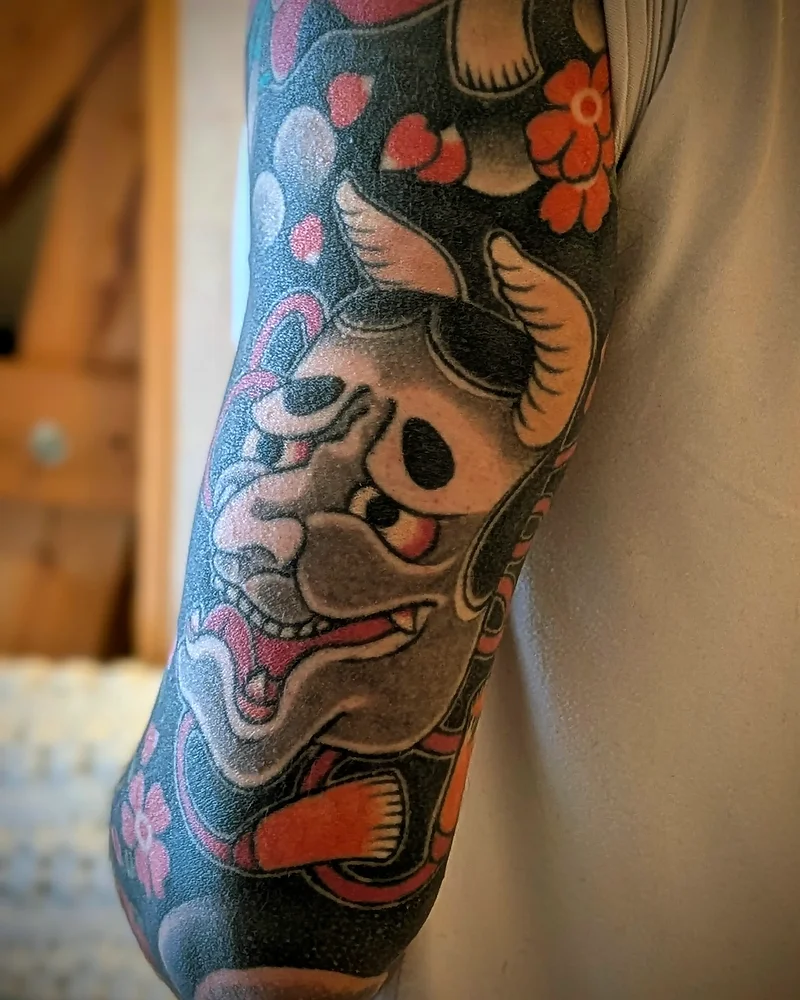
Large traditional Japanese work is usually designed around the body rather than placed like a sticker. A main subject may be connected by background elements such as waves, clouds, wind bars, flames or petals. Negative space keeps the drawing readable, and the direction of the composition follows the arm, back, chest or leg.
This does not mean every Japanese-inspired tattoo must become a bodysuit or use the same background. Artists may follow inherited conventions, personal study or a particular school, but there is no single internet chart that covers every valid composition.
| Element | Role in the composition |
|---|---|
| Main subject | Carries the central story or visual identity |
| Background | Connects subjects and creates movement across the body |
| Negative space | Separates forms and preserves readability |
| Body flow | Adapts the drawing to anatomy and movement |
| Season and setting | Can make flowers, weather and animals feel coherent |
Popular irezumi motifs and common readings
Motifs are easier to understand when you start with their source stories and then examine the tattoo composition. The descriptions below are common readings, not automatic translations.
| Motif | Common context | What not to assume |
|---|---|---|
| Ryū dragon | Water, rain, power and wisdom are frequent associations | Every dragon does not carry the same personality or pairing rule |
| Koi | Perseverance and transformation are often connected with the Dragon Gate story | A downward koi does not automatically mean failure |
| Oni | Danger, punishment, force or a guardian-like presence depending on context | Red and blue do not form one universal moral code |
| Hannya | A female demonic spirit from Noh associated with jealousy, resentment and grief | Resilience or protection are possible modern readings, not fixed theatrical meanings |
| Tengu | Mountain beings linked in different sources with pride, martial skill or religious practice | The long nose alone does not define one message |
| Fudō Myō-ō | A Buddhist Wisdom King recognized by the sword, rope and immovable resolve | Religious iconography should not be reduced to generic toughness |
| Flowers | Season, contrast, impermanence or a story-specific setting | Peony and cherry blossom meanings are not interchangeable |
Read the dedicated guides for the Japanese Ryū dragon, Oni tattoo meaning, Hannya tattoo meaning, Tengu mask meaning and Fudō Myō-ō.
For a samurai face covering, the menpo guide with tattoo drawing studies separates the chin, moustache, mouth and fastening, then shows how a half mask can be composed with a kabuto.
For wind and thunder motifs, compare Raijin's thunder drums with Fujin's wind bag. Their attributes identify the figures; the wider tattoo composition gives the pairing its context.
Pairings, color and direction are not a universal code
Claims such as “a koi must always swim upward,” “a dragon can never appear with flames,” or “red Oni and blue Oni have fixed opposite personalities” are too absolute. A specialist may recommend or reject a combination for reasons tied to narrative, season, lineage, anatomy or visual balance. That is different from declaring the same rule valid for every artist and every tattoo.
Ask what each decision does in the specific design. Color may separate forms, direction may follow the body, and a pairing may refer to a story or simply support the composition. A clear explanation is more useful than a copied symbolism chart.
Irezumi history in one careful outline
Japanese tattooing has more than one history: decorative body art, punitive marking and regional practices should not be collapsed into one straight line. Edo-period urban culture and woodblock prints are especially important to the imagery now associated with large Japanese-style tattoos. Distinct Indigenous and regional traditions also require their own context. The National Ainu Museum stresses that Ainu history and culture are distinct, while the Okinawa Prefectural Museum documents hajichi, the former tattooing tradition of women in Okinawa and Amami.
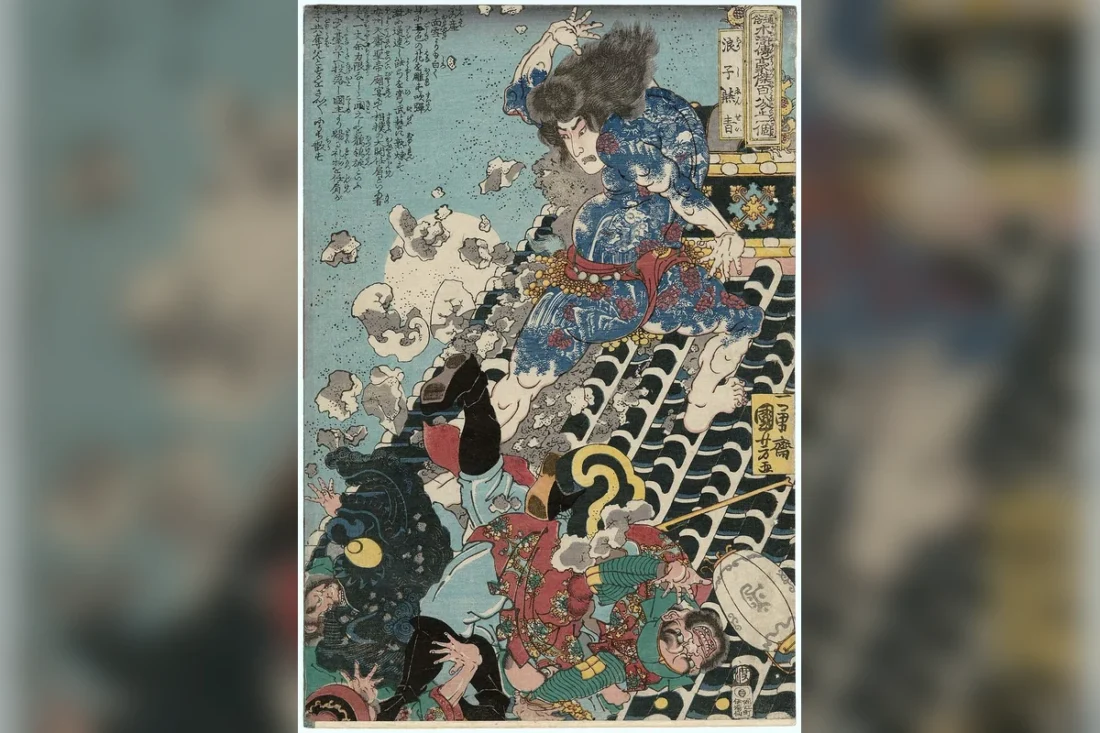
The British Museum records that Kuniyoshi’s 1827-30 series of the 108 heroes of the Water Margin established him as a leading artist of warrior prints. Tattooed heroes from this visual world became influential references, but no single print created all of modern irezumi. For the longer timeline, read the history of Japanese tattooing.
Tattoos, onsen and access in Japan
The profession’s legal status is a separate question. A Japanese Ministry of Health notice recalls the Supreme Court decision of September 16, 2020: the tattooing acts at issue were not medical acts reserved to physicians. That decision should not be confused with a right of entry to every private bath, gym or other venue.
Do not confuse a venue policy with one rule for an entire country. The official Japan travel etiquette guide says tattoos are generally restricted at many hot springs, public baths, pools and gyms, but also notes exceptions, more tolerant local bathhouses and differences between establishments.
Check each venue before visiting and ask whether a waterproof cover is accepted. The continuing association between tattoos and organized crime has influenced social attitudes, but a tattoo does not identify its wearer as a member of any group.
What to ask before choosing an artist
- Does the portfolio show Japanese-style work at the scale you want?
- Which story or source supports the main motif?
- How will the design follow your anatomy and leave room for movement?
- Is the background part of the first project or a possible later extension?
- Why were the colors, direction and surrounding motifs chosen?
- Which technique, schedule, healing plan and budget apply to this exact project?
Avoid copying another person’s completed tattoo. Museum collections, prints, theater references, folklore sources and physical objects can help start the research, but the tattoo artist should build an original composition for your body.
A budget also needs a real consultation: size, placement, detail, colour, technique, sessions, country and the artist’s experience all affect the quote. A generic online total cannot reliably price a large composition before the project is discussed.
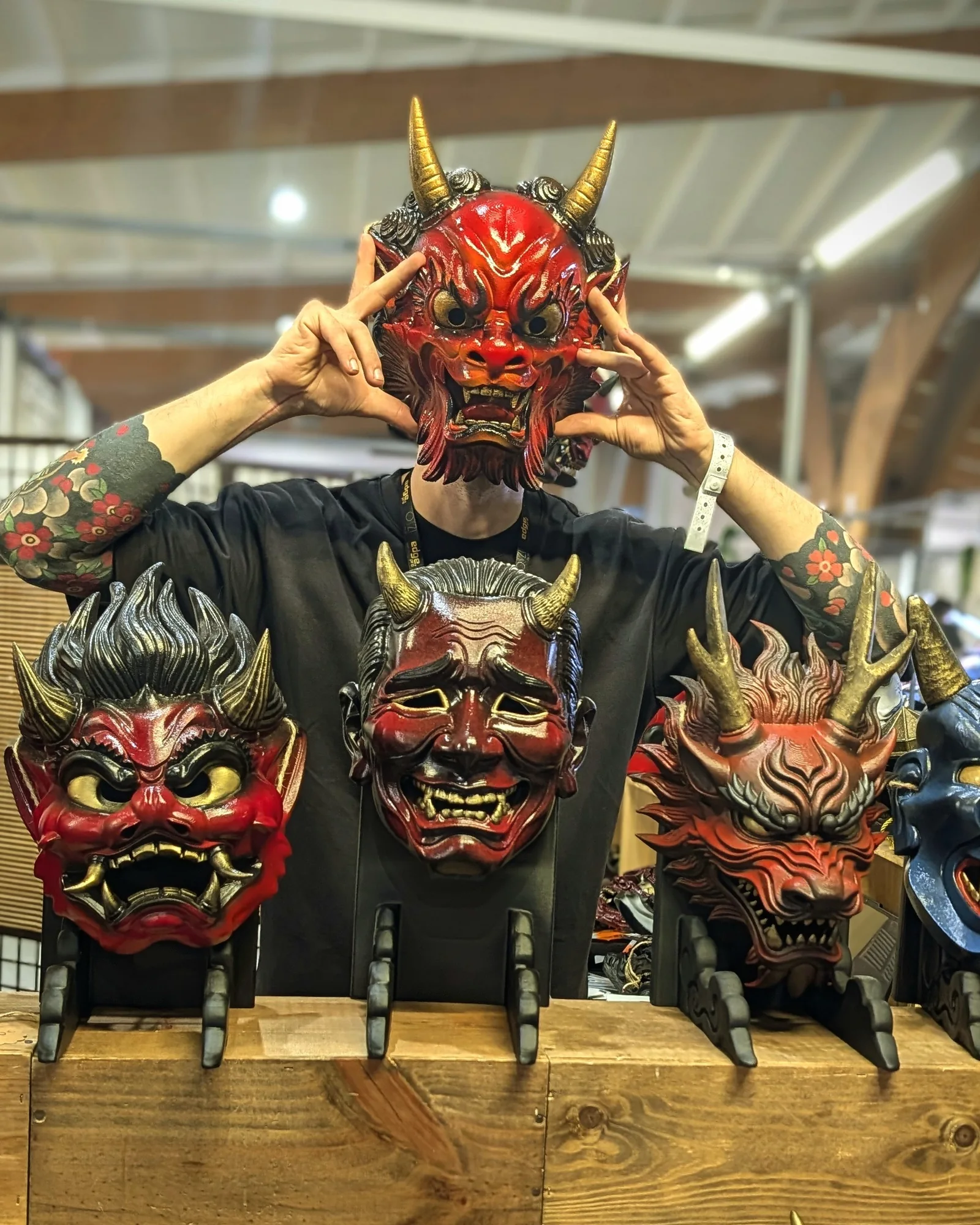
Dai Yokai makes contemporary Japanese-inspired masks in Brittany, France. PETG bases are sanded, primed, painted, varnished and finished by hand. These pieces can serve as studio decor or drawing references, but they are contemporary craft objects, not historical ritual masks. Explore the guide to Japanese masks and their sources.
As Jérémy observes at conventions, Oni and Hannya are repeatedly confused. He enjoys explaining their differences, especially with visitors interested in Japanese tattooing. That experience informs the workshop’s shapes, but does not replace historical sources or a tattoo artist’s work. Dai Yokai makes masks and does not provide tattooing services.
Sources and further reading
- J-STAGE, study of the term irezumi and its relationship with horimono
- J-STAGE, research on perceptions of tattoos and irezumi in Japan
- British Museum, Kuniyoshi study for the 108 Heroes of the Water Margin
- Japan National Tourism Organization, current visitor guidance on tattoos and facility access
- National Ainu Museum, Ainu history and culture as a distinct Indigenous context
- Okinawa Prefectural Museum, historical exhibition on Okinawan hajichi
- Tebori technique guide, tebori technique explained separately
FAQ
What does irezumi mean?
Irezumi is a Japanese term for tattooing, often translated as inserting ink. Outside Japan, it is commonly used for traditional Japanese tattoo compositions with large motifs, strong outlines and integrated backgrounds. The word does not describe one fixed symbolism: the meaning comes from the chosen subject, its source story, the surrounding elements and the wearer’s intention.
What is the difference between irezumi and horimono?
The terms overlap. Irezumi broadly refers to tattooing and is widely used outside Japan for traditional Japanese work. Horimono literally refers to a carved or engraved thing and has also been used for decorative tattooing. Neither word is automatically the only correct or respectful choice in every context, so follow the vocabulary used by the artist you consult.
Is tebori the same as irezumi?
No. Tebori is a method of inserting pigment by hand with a tattooing tool. Irezumi refers more broadly to tattooing or, in international usage, traditional Japanese tattoo work. An irezumi composition may be executed partly or fully by tebori, by machine, or with a combination chosen by the artist.
Does every Japanese tattoo need a background?
No universal rule requires every Japanese-inspired tattoo to have a full background. Large traditional compositions often use waves, clouds, wind bars, flames or petals to connect the main subjects and follow the body. Smaller or contemporary pieces may work without that structure. The important question is whether the design was composed intentionally for its scale and placement.
Do Japanese tattoo motifs have fixed meanings?
They have cultural stories and common associations, but not a single universal dictionary. A dragon, koi, Oni, Hannya or flower can be read differently according to the source story, artist, season, color, direction and surrounding motifs. Treat online meaning charts as starting points and ask the tattoo artist to explain the choices in the specific design.
Must a koi tattoo always swim upward?
No. Upstream movement is often linked with effort and perseverance, but a downward koi does not automatically mean failure or surrender. Direction can support the narrative, body flow or relationship with another motif. Ask the artist why the fish moves in that direction instead of relying on a fixed internet rule.
Are tattoos banned in Japan?
Visitors can have tattoos. In the case decided on September 16, 2020, Japan’s Supreme Court held that the tattooing acts at issue were not medical acts reserved to physicians. Access rules at baths, pools or gyms remain a separate issue: check each venue’s current policy and whether covering a tattoo or booking a private bath is possible.
How should I choose an irezumi artist?
Look for a portfolio showing coherent Japanese-style composition at the scale you want. Ask about source material, body flow, background, color, future expansion, technique, healing and scheduling. A good consultation should explain why the motifs belong together. Do not ask an artist to copy another person’s finished tattoo.