In short
A Tengu mask represents a supernatural mountain being from Japanese folklore. The familiar red, long-nosed face is associated with pride, discipline, danger and spiritual power, while bird-beaked Karasu Tengu preserve an older avian form. Tengu are not simply good or evil: stories portray them as disruptors, protectors, martial teachers and warnings against arrogance.
The image changed over centuries. The name 天狗 means “heavenly dog,” but Japanese depictions moved from celestial omens and birdlike beings to the red, long-nosed mountain figure now familiar in masks. This guide explains the nose, the main forms, the Yamabushi connection, the legends and what a contemporary Tengu mask communicates today.
Where does the Tengu come from?
The word Tengu is written 天狗, literally heavenly dog. It originally comes from the Chinese Tiangou, a celestial creature linked to meteors and bad omens.
In Japan, the Tengu slowly changed face. It moved away from the image of the heavenly dog and became a mountain being. In early texts, it is often dangerous: it tricks monks, feeds religious pride and punishes those who believe they stand above others.
Over time, it became more ambiguous. It remains unsettling, but it can also protect, teach or guide. That double role is what makes the Tengu so interesting.
Karasu Tengu or Daitengu: the two main forms
| Form | Karasu Tengu | Daitengu |
|---|---|---|
| Appearance | Crow beak, more animal body | Red human face, long nose |
| Role | Warrior, messenger, servant | Master, chief, powerful spirit |
| Powers | Speed, flight, combat | Knowledge, strategy, magic, authority |
| Period | Older form | Later dominant form |
Karasu Tengu
The Karasu Tengu keeps a more bird-like shape, with a clear crow beak. It is usually linked to speed, flight and combat. It often acts as a warrior, messenger or servant.
These are recurring visual and narrative patterns, not fixed ranks or a universal allocation of powers. A longer nose does not establish greater strength.
Daitengu
Daitengu are often portrayed as especially powerful or high-ranking Tengu, usually with a human face and long nose. In some traditions, the term indicates rank or status; it does not define a universal category. This long-nosed form is the one most often seen in decorative masks, festivals, tattoos and modern imagery.
Why does the Tengu have such a long nose?
The Tengu’s long nose is now strongly associated with pride and arrogance, but its visual origin is less certain. The feature may reflect the humanisation of an earlier bird’s beak or the influence of older long-nosed figures in Japanese art. It is better treated as an evolving image than as a symbol with one proven origin.
The Japanese expression tengu ni naru, 天狗になる, literally means to become a Tengu. In everyday use, it means to become conceited or to think too highly of yourself.
That is exactly the moral role of the Tengu in many stories: it punishes those who overestimate themselves. The proud monk, the overconfident warrior or the man who tries to dominate others often ends up humiliated by it.
Why is the Tengu linked to Yamabushi mountain ascetics?
The Tengu is often linked to Yamabushi, mountain ascetics associated with Shugendō, a spiritual practice combining Buddhist, Shinto and older mountain traditions.
Several elements of the Tengu image come from those mountain monks: the small black cap, the ascetic robe, the fan, the staff, the high sandals and the constant link to remote forests.
But again, the symbol is ambiguous. The Tengu looks like a monk, but it can also represent the monk corrupted by his own ego.
What is a Tengu mask used for?
Historically, Tengu masks appear in festivals, religious observance, decorative plaques and performance. Some long-nosed masks used in festivals may represent Sarutahiko rather than a Tengu, so context matters.
Today, people also choose Tengu masks for wall display, tattoo reference, collections and cosplay. A contemporary Dai Yokai piece is a handcrafted creation inspired by this visual tradition, not an authentic Japanese ritual object.
Two legends to know
Sōjōbō and Yoshitsune
The most famous legend says that Sōjōbō, king of the Tengu of Mount Kurama, taught swordsmanship to the young Minamoto no Yoshitsune. Yoshitsune would become one of the best-known warriors in Japanese history.
In this version, the Tengu is not just a monster. It is a master. It passes on discipline, but only to the one who accepts the training.
Emperor Sutoku
Another important figure is Emperor Sutoku. After his death, tradition sometimes presents him as a vengeful spirit turned Tengu. Here, the Tengu becomes darker: resentment, political power, curse and anger after exile.
The Eight Great Tengu
Some traditions speak of the Hachi Daitengu, the eight great Tengu linked to different mountains in Japan. This idea reinforces their bond with sacred peaks. Each great Tengu belongs to a place, a mountain and a local tradition.
The British Museum relates Tarōbō to a group of eight, while Japan Search describes forty-eight great Tengu. These are different traditions, not one official nationwide list.
So the Tengu is not a generic monster. It is rooted in the Japanese landscape.
The Tengu in irezumi tattooing
In Japanese tattooing, the Tengu works well because it carries a strong expression. Its red face, long nose and severe stare make the composition readable at once.
In irezumi, it can symbolize strength, controlled pride, martial discipline, protection or a link to the mountains. Like the Hannya or Oni masks, it always keeps some ambiguity. It protects, but it also warns.
To place this symbol among the major motifs of Japanese tattooing, read the guide to the meaning of Japanese tattoos.
What makes a Tengu mask recognizable?
A long nose, strong brow and severe expression make the Daitengu immediately recognizable. Karasu Tengu use a beak and stronger bird features instead. In a handmade piece, these clear shapes help the mask remain readable in a photograph, on a tattoo studio wall or as part of a collection.
For available pieces, explore the handmade Tengu masks.
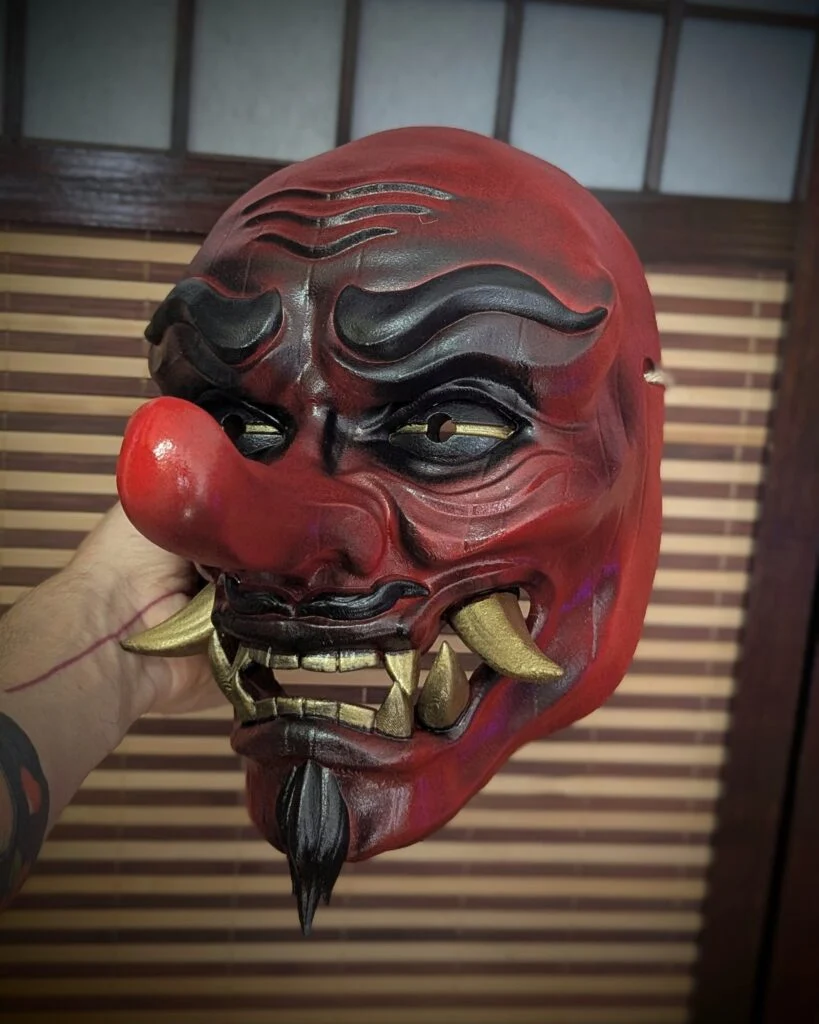
Handmade Tengu masks in the Dai Yokai workshop
At Dai Yokai, the Tengu masks are made in Brittany from a PETG base, then sanded, painted and finished by hand. The goal is not to make a museum copy. It is to keep a readable Tengu expression, visible relief and a handmade surface that works for display, cosplay photos or a tattoo studio wall.
The Tengu Kaze half mask has a short, rounded nose, sculpted moustaches and gold-coloured teeth. It uses cords for wearing. Its profile differs from the long-nosed full mask, so compare the actual model rather than assuming every Tengu piece has the same shape.
If you want a mask mainly for wall display, check the size, hanging point and distance from which it will be seen. If you want to wear it, check comfort, visibility and the fixing system before a full convention day. For practical advice, read how to display a Japanese mask or the PETG, PLA or resin mask guide.
Sources and context
For broader cultural context, see Nippon.com on the history of Tengu imagery, the University of Oregon overview of Tengu masks, the Metropolitan Museum Tengu armour mask and the JNTO article on Shugendō and Yamabushi.
In the workshop
Masks linked to this article
- Traditional Tengu Mask, 120 €
- Traditional Tengu Half Mask, 60 €
FAQ
What does a Tengu mask mean?
A Tengu mask represents a mountain being from Japanese folklore whose meaning changes with the story. Its red face and long nose can suggest power, pride, danger, discipline or spiritual authority. It is best understood as an ambiguous figure: sometimes disruptive, sometimes protective, and often used as a warning against arrogance.
Is a Tengu good or bad?
A Tengu is neither simply good nor simply bad. Medieval stories often portray Tengu as beings that mislead monks, cause disorder or punish pride. Other traditions describe them as mountain protectors, martial teachers or guardians linked to particular places. The contradiction is part of the figure, so not every Tengu should be called a benevolent guardian.
Why does a Tengu mask have a long nose?
The long nose is widely associated with arrogance through the Japanese expression tengu ni naru, meaning to become conceited. Its visual history is more complex: it may have developed from an older birdlike beak or from long-nosed figures in Japanese art. No single origin should be presented as settled fact.
What is the difference between Karasu Tengu and Daitengu?
Karasu Tengu are shown with stronger bird features, especially a beak, wings and sometimes talons. Daitengu are more human in appearance, usually with a red face and long nose, and are often presented as powerful masters or chiefs. These categories are useful visual guides rather than a completely rigid taxonomy.
What is a Tengu mask used for?
Historically, Tengu masks appear in festival processions, religious imagery, decorative objects and theatrical contexts. Some festival masks can represent Sarutahiko rather than Tengu. Today, they are also used for wall display, collections, tattoo reference and cosplay. The intended use depends on the mask’s size, weight, visibility and attachment system.
What does a Tengu mask tattoo mean?
In tattooing, a Tengu mask can express martial discipline, pride, danger, self-mastery or the tension between power and arrogance. Meanings are not universal and depend on the wider composition, the artist and the wearer. For an irezumi-inspired design, discuss the background, placement and accompanying motifs with an experienced tattoo artist.
Why are Tengu linked to Yamabushi?
Tengu are closely associated with Yamabushi, mountain ascetics of Shugendō. Their clothing, small black cap, feather fan, staff and mountain setting borrow from Yamabushi imagery. In medieval stories, that resemblance can be critical rather than flattering: the Tengu may represent a religious practitioner corrupted by pride, resentment or attachment.
Can you wear a Tengu mask for cosplay?
A Tengu mask can be worn if it was designed for that purpose. Before a convention or cosplay event, check fit, weight, visibility, ventilation and the attachment system. Some handmade masks work better as wall pieces or for short photo sessions than for continuous wear, so the intended use should always be checked.