A rōnin was a samurai-class warrior without a current lord or domain appointment. Becoming masterless usually meant losing the stipend, office and institutional relationship that organised a retainer’s life, but it did not create one fixed type of wandering swordsman. Some rōnin found new service; others taught, farmed, entered religious life or survived through insecure work.
| Quick question | Short answer |
|---|---|
| Basic meaning | A samurai-class warrior without a current lord |
| Japanese writing | 浪人, commonly read as “wave person” or drifter |
| Why someone became rōnin | Death of a lord, domain confiscation, dismissal or departure from service |
| Was rōnin a fighting style? | No |
| Best-known historical case | The former Akō retainers, remembered as the 47 rōnin |
| Was Musashi always a rōnin? | No; he entered Hosokawa service in 1640 |
What does rōnin mean?
Rōnin is written 浪人. The two characters are commonly explained as “wave” and “person,” giving the image of someone drifting without a fixed attachment. In the early modern context, its practical meaning was less romantic than the later popular image: a warrior no longer held a formal service relationship with a lord or domain.
That distinction matters. Rōnin was not a martial art, uniform, personality or philosophical school. It did not automatically mean outlaw, mercenary, rebel or heroic wanderer. It described a break in affiliation, while the consequences depended on the period, the warrior’s connections, wealth, skills and prospects for new employment.
PBS’s historical companion to Japan: Memoirs of a Secret Empire defines rōnin through the lost relationship between a samurai, his status and the salary supplied by a daimyō. For the wider warrior system, read the Dai Yokai guide to samurai history, weapons and Bushidō.
How did a samurai become rōnin?
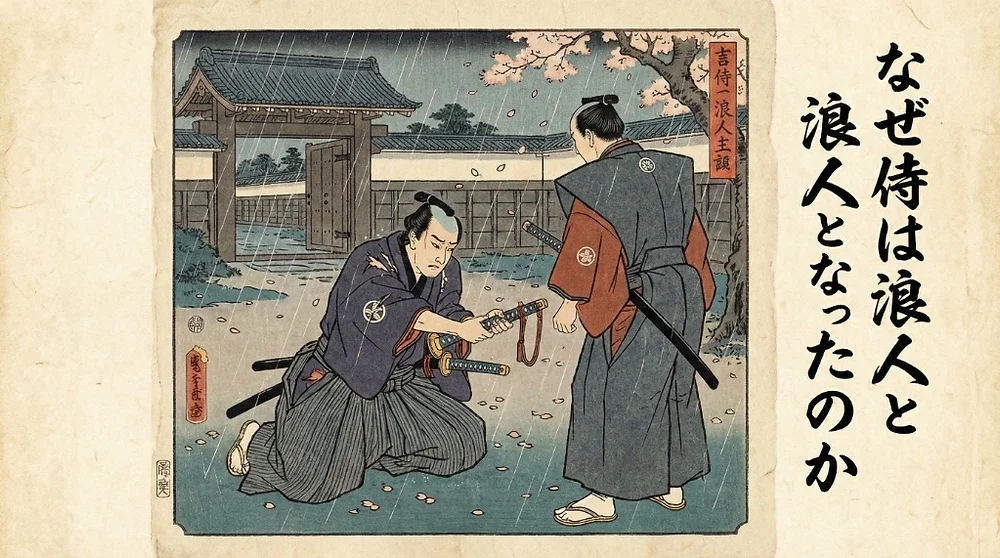
A service relationship could end in several ways. A lord might die without an accepted successor. The shogunate could confiscate or reduce a domain. A retainer might be dismissed, lose favour, leave service or fail to secure a new appointment after war. These circumstances were not morally identical, even if they could all produce a masterless warrior.
| Cause | Immediate consequence | What could follow |
|---|---|---|
| Death of a lord or succession crisis | The existing retainer relationship ended | Service under an heir or a search for a new lord |
| Domain confiscation or defeat | Stipend and office disappeared with the domain | Dispersal, petitions, new employment or insecure work |
| Dismissal or loss of favour | The individual lost his appointment | Negotiation, recommendation to another house or marginalisation |
| Voluntary departure | The warrior broke or left the service bond | Travel, training or a new affiliation, depending on permission and period |
| Failure to find service | Masterless status continued | Teaching, farming, guard work, religious life or other livelihoods |
The consolidation of Tokugawa rule after 1600 reduced large-scale warfare and removed or reorganised many domains. That produced masterless retainers seeking work in a society where military service was becoming more bureaucratic. PBS records that some became farmers or monks, while others worked as mercenaries or turned to banditry. No single path represents them all.
Were rōnin outside samurai society?
A rōnin came from the warrior class, but status in Tokugawa society was connected to household, office and stipend. Losing service could therefore mean economic insecurity and reduced standing without instantly erasing every family connection, skill or claim to warrior identity. Some rōnin retained resources and networks; others lived precariously.
The older article described every rōnin as keeping two swords while becoming “socially nothing.” That is too absolute. Sword rights, clothing, income and legal treatment changed across periods and individual situations. It is safer to describe masterlessness as a loss of formal service, then examine each historical case separately.
Rōnin, samurai and ninja are not the same category
| Term | What it describes | Common mistake |
|---|---|---|
| Samurai | A broad warrior status and service tradition that changed over centuries | Treating every samurai as a full-time duellist |
| Rōnin | A warrior without a current lord or domain appointment | Treating rōnin as a separate combat school or automatic outlaw |
| Ninja or shinobi | People and practices connected with intelligence, infiltration and strategy | Treating ninja as a fixed caste of black-clad assassins |
| Musha shugyō | A warrior pilgrimage for training and testing skill | Assuming every travelling practitioner was permanently rōnin |
The Iga-ryū Ninja Museum describes ninjutsu primarily through espionage and strategy, not “stealth assassination with no code of honour.” Rōnin and shinobi therefore answer different questions: one concerns service status, the other a set of functions and methods.
Was Miyamoto Musashi really a rōnin?
Miyamoto Musashi (1584-1645) is often used as the model of the independent rōnin. His long periods of travel and warrior pilgrimage make the label understandable, but applying it unchanged to his whole life hides an important fact. Kumamoto City records that Hosokawa Tadatoshi invited Musashi to Kumamoto in 1640 and that he entered the service or patronage of the Hosokawa house.
Kumamoto’s official history also warns that the details of Musashi’s earlier life are vague. He claimed to have fought and won around 60 contests by the age of 29. That is not the same as an independently verified record of 60 undefeated duels. Famous details surrounding his fight with Sasaki Kojirō, including deliberate lateness and an oar carved into a wooden sword, belong to a body of retelling that must be handled cautiously.
Better documented are his later years: Kumamoto City’s official guide connects him with the Hosokawa clan, Niten Ichi-ryū, painting and calligraphy. Its page on Musashizuka Park states that he completed The Book of Five Rings in 1645 after writing at Reigandō Cave. Musashi was a major swordsman and author, but not a simple mascot for rejecting every master or institution.
What really happened in the Akō Incident?
The historical core of the 47 rōnin story is the Akō Incident of 1701-1703. In 1701, Asano Naganori drew his sword and wounded the senior shogunal official Kira Yoshinaka inside Edo Castle. Asano was ordered to commit seppuku and the Akō domain was confiscated, leaving his retainers masterless.
The precise cause of Asano’s attack is not securely established. Later versions describe repeated humiliation, refused gifts or demands for bribes, but those explanations should not be repeated as settled fact. What is documented is that a group led by Ōishi Yoshio later attacked Kira’s residence and killed him. The former retainers then submitted to shogunal authority.
| Historical record | Later narrative or point requiring caution |
|---|---|
| Asano attacked Kira inside Edo Castle in 1701 | The exact motive and private conversations remain uncertain |
| Asano was ordered to commit seppuku and Akō was confiscated | Calling the decision obviously unjust is an interpretation |
| Former Akō retainers killed Kira in the 1702-1703 revenge attack | Secret disguises, speeches and personal scenes were expanded in drama |
| The group is remembered as the 47 rōnin | Forty-six were later ordered to commit seppuku; counting and the surviving participant require context |
| The graves at Sengakuji became a memorial focus | Chūshingura changes names, period and incidents for theatre |
The shogunate ordered 46 of the participants to commit seppuku in 1703. The group is nevertheless remembered collectively as the 47 rōnin or Akō gishi. Sengakuji Temple in Tokyo remains associated with their graves, and the official Tokyo tourism guide records an annual Akō Gishisai around 14 December.
The British Museum’s Chūshingura record identifies the historical frame as the Akō Incident of 1701-1703. GO TOKYO documents the continuing Sengakuji commemoration.
The 47 rōnin and Chūshingura are not identical
Kanadehon Chūshingura, first performed in 1748, transformed the Akō events into theatre. Because recent political events could not be represented directly, the playwrights moved the action to the fourteenth century and changed names and circumstances. The work helped turn the former retainers into enduring symbols of loyalty, courage and sacrifice.
That cultural afterlife is part of the subject, not evidence that every dramatic scene occurred. Films, novels, manga, prints and stage plays regularly combine the incident with later inventions. A careful article should name both layers: the Akō Incident for history and Chūshingura for the influential dramatic tradition.
Does rōnin still have a modern meaning?
Yes. In modern Japanese, rōnin commonly appears in education. A rōninsei is a student spending an additional period preparing to retake competitive entrance examinations after not gaining the desired place. The image is again one of being temporarily unaffiliated. Using rōnin for every freelancer or person between jobs is a looser metaphor, not the core dictionary meaning.
Rōnin imagery and Mempo masks
Rōnin did not wear one special mask that identified them as masterless. Mempo and other facial armour belonged to the wider history of samurai equipment, not a separate rōnin uniform. Connecting a half-mask automatically with the 47 rōnin or Miyamoto Musashi would therefore create a visual association that the historical record does not support.
Dai Yokai Mempo are contemporary Japanese-inspired pieces made and hand-finished in Brittany, France. They are not historical armour or replicas tied to a particular rōnin. For the real equipment context, read the guide to Mempo, Mengu and samurai facial armour. The Mempo half-mask collection owns the commercial intent.
Sources and verification
- PBS: A Masterless Samurai, for service, stipends and Edo-period livelihoods
- British Museum: Chūshingura, for the Akō Incident and theatrical transformation
- GO TOKYO: Akō Gishisai, for the Sengakuji commemoration
- Kumamoto City: History and Culture, for Musashi’s Hosokawa service and later work
- Kumamoto City: Musashizuka Park, for the limits of Musashi’s biography and The Book of Five Rings
- Iga-ryū Ninja Museum: What are Ninjutsu and Ninja?, for the rōnin-shinobi distinction
FAQ
What is a rōnin?
A rōnin was a warrior of the samurai class who had no current lord or domain service. A retainer might become masterless when a lord died, a domain was confiscated, employment ended or the warrior left service. The term describes a service condition, not one personality, fighting style or moral code.
What does the Japanese word rōnin mean?
Rōnin is written 浪人. The characters are commonly read as “wave” and “person,” producing the image of someone drifting without a fixed affiliation. In its familiar historical use, the term identifies a warrior who does not currently serve a lord or domain.
Were rōnin still samurai?
They came from the warrior class, but losing a lord also meant losing the office, stipend and institutional relationship that normally structured samurai life. Their legal and economic circumstances varied by period. Some found another lord, while others taught, farmed, entered religion, worked as guards or took less secure employment.
Did the 47 rōnin really exist?
Yes. The Akō Incident of 1701-1703 involved former retainers of Asano Naganori who killed Kira Yoshinaka after Asano had been ordered to commit seppuku. However, many familiar motives, conversations and scenes come from later plays and retellings rather than secure contemporary evidence.
What is the difference between the Akō Incident and Chūshingura?
The Akō Incident is the historical sequence involving Asano, Kira and the former Akō retainers. Chūshingura is an influential 1748 puppet-theatre drama inspired by it. The playwrights shifted the setting to the fourteenth century and changed details, partly to avoid restrictions on depicting recent political events.
Was Miyamoto Musashi a rōnin?
Musashi is often described as a rōnin because of his long periods of travel and warrior pilgrimage without permanent service. That label should not cover his entire life: Kumamoto’s official history records that he entered Hosokawa service in 1640 and spent his final years under clan patronage.
Did Miyamoto Musashi really win 60 duels?
Musashi claimed to have fought and won about 60 contests by the age of 29, but the details of his early life are incomplete and many episodes were expanded by later storytelling. His Niten Ichi-ryū tradition and authorship of The Book of Five Rings are firmer reference points.
What is the difference between a rōnin and a ninja?
Rōnin describes a samurai’s lack of a serving lord. Ninja or shinobi refers to people performing intelligence, infiltration and strategic work. These are not equivalent social categories. The Iga-ryū Ninja Museum stresses espionage and strategy rather than the fictional image of a black-clad assassin.