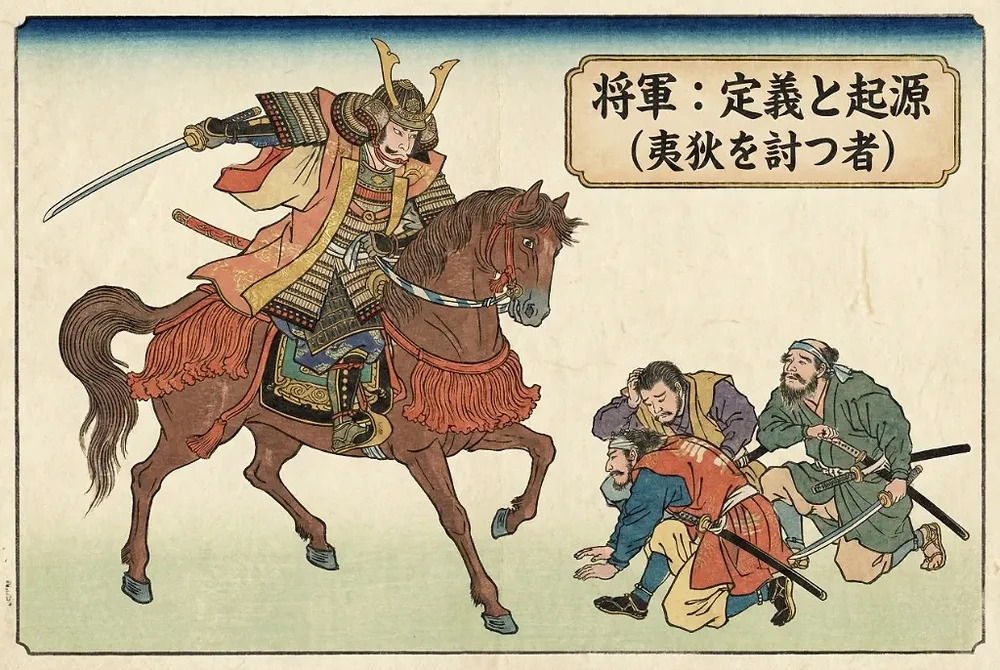
A shōgun was the holder of a military title granted by Japan’s emperor. From the late twelfth century, warrior governments called bakufu used the office to exercise major political and military authority. But a shōgun did not always rule alone: emperors, regents, councils, court nobles and daimyō retained different forms of power depending on the period.
| Quick question | Short answer |
|---|---|
| What was a shōgun? | The head, or sometimes the nominal head, of a warrior government |
| Who granted the title? | The emperor |
| What was the government called? | Bakufu, commonly translated as shogunate |
| Were all shōguns absolute rulers? | No. Their practical authority varied greatly |
| Three major shogunates | Kamakura, Ashikaga and Tokugawa |
| Does Japan have one today? | No |
What does shōgun mean?
Shōgun (将軍) means general. The office most people mean is seii taishōgun (征夷大将軍), an imperial court title conventionally translated as “barbarian-subduing generalissimo.” It had been used for commanders sent on campaigns against the Emishi in northern Honshū. The quoted English phrase reflects the language of that old title; it should not be treated as a neutral modern label for the Emishi.
By the medieval period, the title had acquired a different political weight. Minamoto no Yoritomo had already built warrior institutions before the court appointed him shōgun in 1192. That is why historians may date the Kamakura government from 1185, when Yoritomo’s military administration took shape, or from 1192, when he received the title.
| Term | Meaning in this article |
|---|---|
| Shōgun | A military title and the person who held it |
| Seii taishōgun | The formal historical office most often shortened to shōgun |
| Bakufu | The warrior administration or shogunate |
| Daimyō | A powerful territorial lord |
| Sankin-kōtai | The Tokugawa system of alternate attendance in Edo |
| Sakoku | A later label for Tokugawa maritime restrictions; not total isolation |
Shōgun, shogunate and bakufu are not identical
The shōgun was an office-holder. The bakufu was the government around that office. It included senior advisers, councils, judicial and financial officials, military governors and networks linking the centre to regional authorities. Translating bakufu as “tent government” evokes a commander’s field headquarters, but the historical institution became a durable administration.
This distinction matters because the person with the title was not always the person making every major decision. Under the Kamakura shogunate, the Hōjō regents held decisive power after 1203 while later shōguns could be political figureheads. In the Ashikaga period, deputies and regional daimyō could also eclipse a weak shōgun.
Shōgun vs emperor: who actually ruled Japan?
The popular formula “the emperor reigned while the shōgun governed” is useful only as a first approximation. The imperial court conferred titles and remained a source of legitimacy, ritual status and cultural authority. Warrior governments controlled major military and administrative functions, yet their reach changed over time. Retired emperors, regents, court nobles, shogunal councils and territorial lords could all influence policy.
| Political actor | Typical role | Important limit |
|---|---|---|
| Emperor and imperial court | Conferred titles; maintained court, ritual and cultural authority | Political influence varied by reign and period |
| Shōgun | Head or nominal head of a warrior government | Could depend on regents, councils and military coalitions |
| Regents and senior councils | Managed succession, decisions and administration | Their authority depended on the current institutional balance |
| Daimyō and domains | Governed territories and supplied military power | Autonomy varied under each shogunate |
| Religious institutions and court nobles | Held land, prestige and political networks | Influence was substantial but uneven |
There was therefore no single seven-century constitutional arrangement. The Kamakura, Ashikaga and Tokugawa systems each organised power differently, and each changed during its own lifetime.
The three major shogunates
| Shogunate | Conventional dates | Political centre | Key point |
|---|---|---|---|
| Kamakura | c. 1185 or 1192-1333 | Kamakura | Yoritomo established warrior government; Hōjō regents later ruled through shōguns |
| Ashikaga or Muromachi | 1336 or 1338-1573 | Kyoto | Shogunal authority fluctuated as regional daimyō became stronger |
| Tokugawa or Edo | 1603-1867 or 1868 | Edo | Fifteen Tokugawa shōguns governed through the bakufu-domain system |
The alternative starting and ending dates are not mistakes. A title, an administration, a military victory and a formal abolition do not always occur in the same year. Good timelines state which event their date represents.
Kamakura: Yoritomo, the Hōjō regents and the first bakufu
Minamoto no Yoritomo emerged from the Genpei War with a network of loyal warriors and administrative rights. The court appointed military governors and estate stewards through his government, helping it exercise authority beyond Kamakura. His appointment as shōgun in 1192 confirmed an office after much of the machinery already existed.
After Yoritomo’s death, the Minamoto family did not simply rule as one uninterrupted shogunal dynasty. The Hōjō family controlled the regency, and later shōguns came from Fujiwara and imperial lineages. This is the clearest warning against defining every shōgun as an all-powerful ruler.
The Kamakura government also faced the Mongol-led invasions of 1274 and 1281. Japanese defenders resisted both campaigns; storms damaged the invading fleets, especially in 1281. Reducing the outcome to two miraculous typhoons erases the fighting, logistics and political consequences.
Ashikaga: a Kyoto shogunate with changing authority
Ashikaga Takauji established a new warrior government in Kyoto during the conflicts of the fourteenth century. The Muromachi period produced major developments in Noh, ink painting, garden design and elite cultural patronage. These developments involved courts, temples, performers, merchants and patrons, so they should not be credited to the shōgun alone.
The Ōnin War of 1467-1477 devastated Kyoto and accelerated political fragmentation. Regional daimyō gained power during the long era of conflict commonly called Sengoku. Its boundaries differ by historian, so a neat 1467-1615 label is a convention, not a universally fixed period.
Tokugawa: the bakufu-domain system
Tokugawa Ieyasu won the decisive Battle of Sekigahara in 1600 and received the title of shōgun in 1603. He passed the office to Hidetada in 1605 while remaining politically active. The durable Tokugawa system developed across the first three shōguns, including Iemitsu, rather than appearing fully formed in one act by Ieyasu.
Historians often describe Tokugawa rule as a bakuhan system: the bakufu governed alongside more than two hundred domains. The shogunate set broad rules, managed strategic lands and foreign relations, and supervised the daimyō, while each domain retained its own administration. This was neither a modern unitary state nor a loose collection of independent countries.
Sankin-kōtai, alternate attendance, required daimyō to maintain residences in Edo and spend prescribed periods there. It supported political supervision and tied regional elites to the shogunal capital. The system was developed over time and standardised under Iemitsu; calling every family member a “hostage” is too blunt for all periods and arrangements.
Was Tokugawa Japan closed to the world?
No. From the 1630s, the shogunate imposed severe maritime restrictions, banned most Japanese overseas travel and expelled the Portuguese. But controlled foreign relations continued. Dutch and Chinese merchants traded through Nagasaki, and diplomatic exchanges linked the shogunate with Joseon Korea. The government also obtained foreign information through regulated channels.
The familiar word sakoku, “closed country,” is useful only if it means a controlled system of restrictions. It is misleading when it suggests that no people, goods, books or diplomatic messages crossed Japan’s borders.
How the shogunate ended
Commodore Matthew Perry’s arrival in 1853 intensified pressure on a government already facing domestic, fiscal and political problems. Treaties opening ports exposed divisions over foreign relations and shogunal legitimacy. Opposition gathered around domains that called for restoring imperial rule, but the result was a contested transfer of authority rather than a single instant collapse.
Tokugawa Yoshinobu, the last shōgun, proposed returning governing authority to the imperial court in 1867 while still seeking a place in a new political order. The Restoration of Imperial Rule proclamation followed on January 3, 1868 in the Gregorian calendar, corresponding to the twelfth month of Keiō 3 in the Japanese calendar. Armed conflict continued in the Boshin War of 1868-1869. Samurai status and privileges were then dismantled through reforms over several years, not erased on one day in 1868.
For another Tokugawa-period conflict between warrior ideals and government law, read the evidence-based guide to rōnin and the Forty-seven Rōnin. The broader samurai history guide explains how the warrior class changed across periods.
Did shōguns and samurai wear mempō masks?
Mempō and other forms of mengu were facial armour used by samurai. They could protect parts of the face, help secure a helmet and present an intimidating appearance. Designs ranged from restrained to fierce, but a mempō was not a special “shōgun mask,” and no single demonic expression represented every clan.
Read the dedicated history of menpō and mengu for the documented armour context. Dai Yokai’s handmade Mempo half-masks are contemporary artistic pieces inspired by samurai armour, not historical replicas or proof of one clan’s battlefield design. They are 3D printed in PETG, then sanded, painted and finished by hand in Brittany, France.
Sources and further reading
- The Metropolitan Museum of Art: Shoguns and Art
- World History Encyclopedia: Shogun
- Edo-Tokyo Museum: House of Tokugawa
- National Archives of Japan: the return of governing authority and Restoration
- National Diet Library: Japan-Netherlands chronology
- National Institutes for Cultural Heritage: Tokugawa correspondence with Korea
FAQ
What is a shōgun?
A shōgun was the holder of a military title granted by Japan’s emperor. From the late twelfth century, warrior governments headed by shōguns exercised major political and military authority, although the balance of power varied by period.
What does the word shōgun mean?
Shōgun (将軍) means general. The best-known historical office was seii taishōgun (征夷大将軍), a court title conventionally translated as “barbarian-subduing generalissimo.” That translation reflects the language of an old imperial campaign title, not a modern description of the Emishi people.
What is the difference between a shōgun and the emperor?
The emperor conferred titles and remained the centre of the imperial court, ritual and cultural authority. A shōgun headed a warrior government. Their influence was not fixed: emperors, retired emperors, regents, shōguns, councils and daimyō all held different forms of power at different times.
What was the bakufu?
Bakufu is the usual Japanese term for a shogunate or warrior government. It was an administration, not only one ruler: officials, councils, military governors and relationships with regional lords all formed part of it.
What were the three shogunates?
The three major shogunates were Kamakura, Ashikaga or Muromachi, and Tokugawa or Edo. Their conventional dates are approximately 1185 or 1192 to 1333, 1336 or 1338 to 1573, and 1603 to 1867 or 1868.
Did the shōgun control all of Japan?
Not in the same way throughout history. Shogunates claimed broad authority, but actual control depended on institutions, alliances and regional lords. Under Kamakura, Hōjō regents could rule through figurehead shōguns; under Ashikaga, powerful daimyō often acted with considerable independence.
Was Tokugawa Japan completely closed?
No. The Tokugawa government tightly restricted travel, ports and foreign relations, especially from the 1630s, but regulated contacts continued. Dutch and Chinese trade, diplomacy with Korea and other controlled exchanges make “completely closed” misleading.
Does Japan still have a shōgun?
No. Tokugawa Yoshinobu returned governing authority to the imperial court in 1867. The new government abolished the bakufu, and the Boshin War followed in 1868-1869. Japan is now a constitutional monarchy with an elected government.