A menpo mask was samurai facial armour, usually covering the nose and the face below the eyes. It protected vulnerable areas and helped secure the kabuto helmet. Menpo, also written mempo, is one form within the broader category of mengu. Its fierce face could look intimidating, but it did not carry one universal symbolic meaning.
| Quick question | Short answer |
|---|---|
| What is a menpo? | A common form of samurai armour covering the nose and lower face |
| Menpo or mempo? | Both are English spellings of menpō |
| What is mengu? | A broader term for facial armour |
| Main functions | Face defence and firmer helmet support |
| One fixed meaning? | No, the object, expression and armour context matter |
What is a menpo mask?
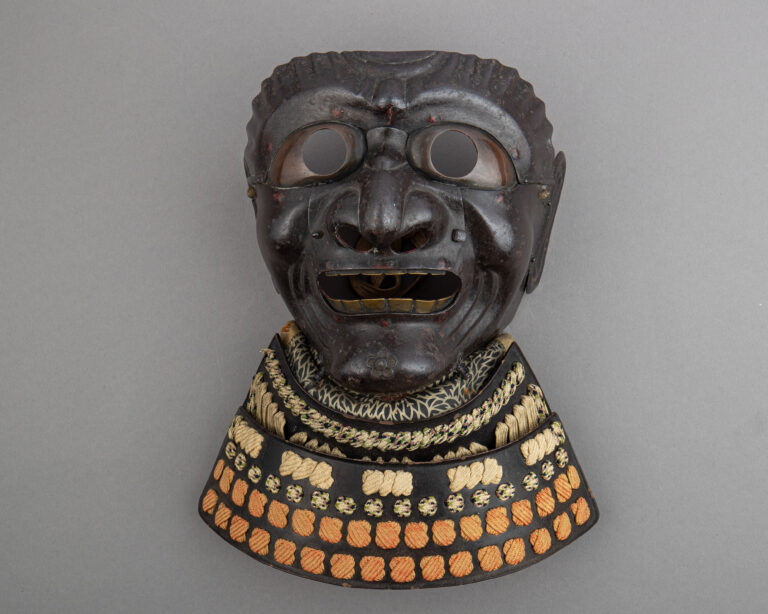
Menpō (面頬) names a form of Japanese facial armour. In English it appears as menpo, mempo or menpō. The Metropolitan Museum of Art describes the majority of its samurai masks as half-length pieces covering the nose and the face below the eyes. This is more precise than calling every samurai face guard a demon mask.
The Metropolitan Museum of Art records a half mask made from iron, lacquer and hair, dated to the Edo period. Its catalogue explains two practical functions: facial defence and helping secure the helmet more firmly. These documented uses should come before modern symbolic interpretations.
Menpo, mempo and mengu: what is the difference?
Menpo and mempo are not two different objects. They are common romanisations of the same Japanese word, menpō. Mengu is the broader category used for facial equipment or face armour. A menpo can therefore be described as a type of mengu, while a full-face sōmen or a chin guard belongs to a different coverage category.
| Term | What it describes | Coverage |
|---|---|---|
| Mengu | Broad category of samurai facial armour | Varies by form |
| Menpō, menpo or mempo | Lower-face armour, the best-known form | Nose, cheeks and face below the eyes |
| Sōmen | Full-face armour | Most or all of the face |
| Hanbō or hanpō | Chin and lower-jaw guard | Lower jaw, usually without the nose |
| Happuri | Open facial guard | Forehead and cheeks |
The main types of samurai face armour
Online guides often announce exactly five types, but historical terminology is not that tidy. Names can describe coverage, construction, expression or an armour-making tradition. A useful beginner classification starts with which part of the face is covered, then adds style terms only when the individual object supports them.
Sōmen: full-face armour
Sōmen covers the full face and is visually the most complete form. It survives in museum collections, but the Met notes that half-length menpo form the majority of its masks. Full coverage should therefore not be treated as the default samurai mask.
Menpo: nose and lower-face armour
Menpo leaves the eyes open while covering the nose, cheeks and lower face. Some examples have a removable nose section. The shape could support the helmet cords, and a laced neck or throat defence could hang below it as part of the wider armour system.
Hanbō and happuri: lighter coverage
Hanbō or hanpō protects the chin and lower jaw while leaving the nose exposed. Happuri protects the forehead and cheeks while leaving the central face open. These forms show why mengu is more useful as an umbrella term than using menpo for every piece of samurai facial armour.
What did a menpo do in a suit of armour?
A menpo worked with the kabuto helmet and the rest of the armour. Its practical value was not limited to stopping a direct blade. It covered vulnerable facial areas and provided a shaped surface around which helmet cords could be tied, helping keep the kabuto stable.
| Feature | Practical role | What not to overclaim |
|---|---|---|
| Iron or lacquered surface | Facial defence and a durable finish | It did not make the face invulnerable |
| Shaped cheeks and chin | Fit around the lower face | One shape did not fit every warrior |
| Helmet-cord support | Helped hold the kabuto more firmly | The mask was not an isolated costume prop |
| Throat guard | Extended protection below the jaw on some sets | It was not always integral to every menpo |
| Open eyes and breathing gaps | Preserved vision and airflow | Comfort varied by form and fit |
A Los Angeles County Museum of Art education record describes a late 16th to 17th-century metal half mask that protected the face and throat. The object has rounded cheeks, a small nose and a horsehair moustache. It is a useful dated example, not proof that every mask was built the same way.
Materials, lacquer, moustaches and removable noses
Surviving menpo are often iron with lacquered or dark-finished surfaces. Hair, textiles and lacing may complete the object. Red lacquer is common inside many examples. Wrinkles, teeth and moustaches could turn a technical piece of armour into a highly individual face, especially in the peaceful Edo period when armourers displayed their metalworking skill. For the political setting of Edo-period armour, see how the Tokugawa shogunate worked.
The British Museum catalogues an Edo-period armour whose lacquered iron mask depicts a grimacing man with wrinkles, copper teeth and an animal-hair moustache. Another British Museum menpo record describes lacquered iron with a throat guard. Museum objects support the details, while also showing variation between sets.
Did a menpo symbolize a demon?
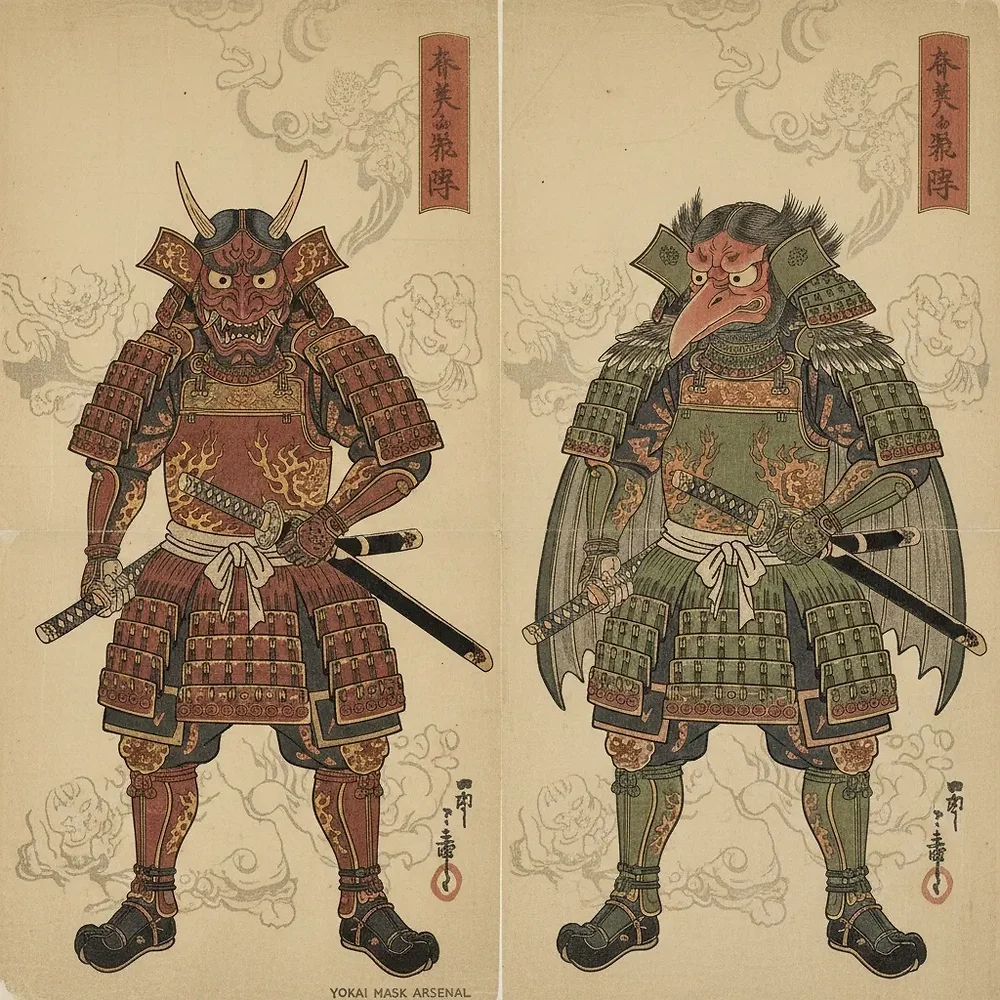
Not automatically. Fierce brows, bared teeth, wrinkles and hair can make a menpo look demonic to a modern viewer, but facial armour does not have one dictionary meaning. Some pieces suggest an angry man, an old face or another character. The safest reading begins with the museum record, maker, period and complete armour set.
The intimidating appearance was real, but the popular claim that every mask copied an Oni or a Noh character goes too far. Noh masks belong to theatre, Oni belong to folklore and religious imagery, and menpo belongs to armour. Visual influence and resemblance should be discussed object by object.
For the question behind modern “samurai Oni mask” images, see why samurai armour and Oni imagery should be distinguished.
Menpo mask tattoo meaning and composition
A menpo mask tattoo takes its starting point from facial armour. A wearer may choose it to express resolve, self-control or a personal sense of protection, but those are contemporary interpretations. The historical object does not translate into one compulsory tattoo meaning. Decide first whether the drawing shows an identifiable piece of armour, an imagined warrior or a deliberate combination with an Oni.
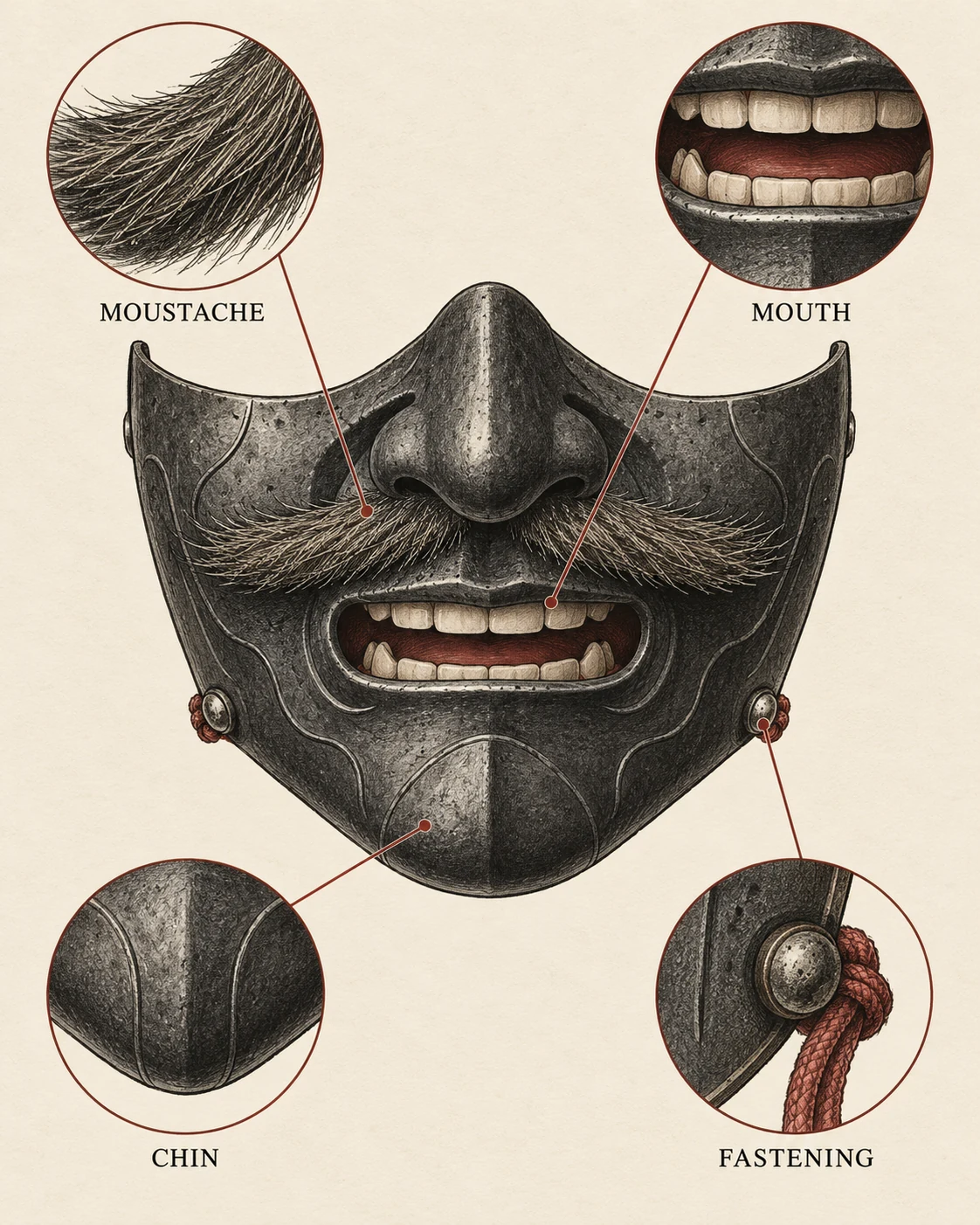
Four details that keep the armour readable
Before adding a background, compare a front view with a three-quarter view of a documented object. The Met's Edo-period menpō provides a useful reference for iron, lacquer and hair. Read each feature as part of that particular face, rather than treating every fierce mask as a demon.
| Detail | What to study | Question for the drawing |
|---|---|---|
| Chin and jaw | The lower edge, rounded or angular planes and any throat defence | Will the silhouette remain clear where the tattoo wraps around the body? |
| Moustache | Its shape and position on the chosen object; hair is not present on every example | Can the dark hair remain distinct from the mouth? |
| Mouth and teeth | The actual opening, lips and tooth shapes | Are the teeth taken from armour, or deliberately changed into Oni fangs? |
| Attachment points | The mask edges and relationship to the helmet cords | Do the visible cords belong to a coherent helmet-and-mask arrangement? |
Example: menpo and kabuto in one composition
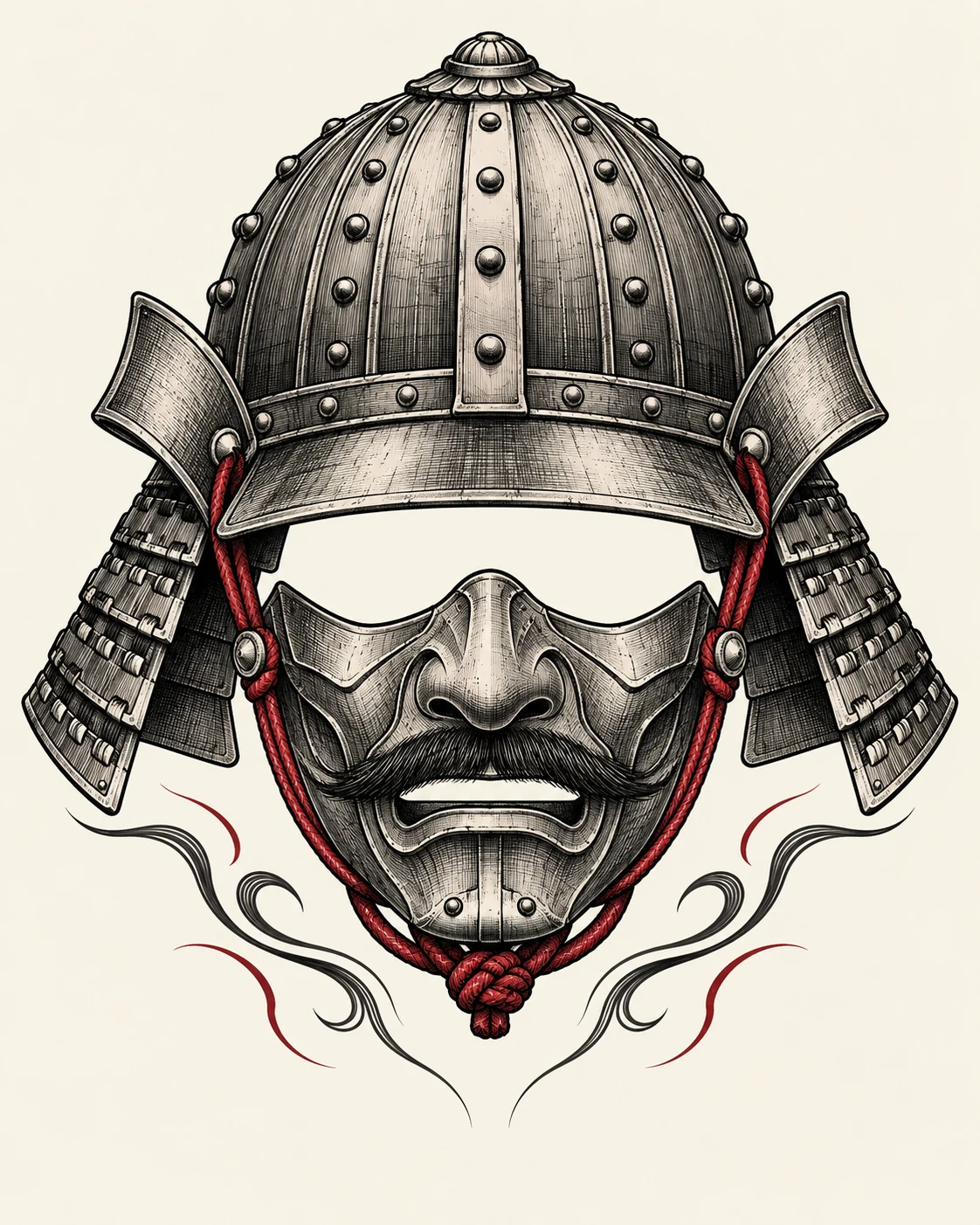
For an armour-led design, start with the kabuto above the face, leave the eye area legible and let the menpo define the jaw below. The helmet's outline gives the upper shape; the mask and any throat defence carry the lower part. This is a contemporary composition proposal, not a drawing of a particular warrior or a traditional tattoo rule.
A simple first study can leave out flowers, waves and smoke. Once the face reads clearly, a tattoo artist can choose the surrounding elements, scale and direction for the intended body area. If the design instead puts an Oni inside a helmet, name that choice: it depicts an Oni wearing armour, rather than proving that historical menpo were all Oni masks.
Use the Japanese tattoo motifs and composition guide for the wider drawing questions, and the Oni tattoo guide when the creature itself is the main subject. Bring identified objects and several viewpoints to the consultation, then let the artist create an original composition for you.
Historical armour versus a contemporary Mempo half mask
Dai Yokai does not present its Mempo masks as antiques, reproductions of a documented armour school or protective equipment. They are contemporary Japanese-inspired pieces made in Brittany, France. PETG forms the base, then each piece is sanded, primed, painted, varnished and finished by hand.
If the lower-face silhouette is what interests you, explore the Mempo half-mask collection. Compare the armour-led shape of the red Samurai Mempo, the fangs of the Oni Mempo and the theatrical references of the Hannya Mempo. These are contemporary workshop designs; each product page explains its dimensions, fastening and intended use.
How to identify a menpo accurately
First check coverage: full face, nose and lower face, chin only, or forehead and cheeks. Then examine materials, attachment points, throat defence, finish and any signature. Finally, compare the object with a museum catalogue. A fierce expression alone cannot tell you that the mask represents an Oni, a specific clan or a particular battle.
Sources and further reading
- The Metropolitan Museum of Art: Half Mask (Menpō)
- LACMA: Samurai, Art of Armor education guide
- British Museum: Edo-period armour with menpo
- British Museum: Menpo with throat guard
FAQ
What does a menpo mask mean?
A menpo was facial armour, not a mask with one fixed symbolic meaning. It protected part of the face, helped the helmet fit more securely and could give the wearer a fierce, controlled appearance. The expression, finish and complete armour set changed the message from one object to another.
What is the difference between menpo, mempo and mengu?
Menpo and mempo are English spellings of menpō, a common lower-face armour form. Mengu is a broader term for samurai facial armour. In practice, museum catalogues also use more precise names such as sōmen for a full mask and hanbō for a chin and lower-jaw guard.
Why did samurai wear menpo masks?
Menpo helped defend the nose, cheeks and lower face, and the helmet cords could use the mask to hold the kabuto more firmly. Fierce modelling, teeth, wrinkles and moustaches also created an imposing appearance, although protection and helmet support are better documented than simple claims of psychological warfare.
What were historical menpo made from?
Surviving museum examples are commonly made from iron with lacquer, sometimes with hair and textile components. Materials and construction vary by object. The Metropolitan Museum of Art records an Edo-period half mask made from iron, lacquer and hair.
What are the main types of samurai face armour?
Useful categories include sōmen for full-face armour, menpō for armour covering the nose and face below the eyes, hanbō or hanpō for the chin and lower jaw, and happuri for the forehead and cheeks. Historical naming varies, so these are practical distinctions rather than one universal five-type system.
Did every samurai wear a menpo?
No. Armour changed across periods, schools, rank, role and individual preference. Museum collections preserve many menpo, but that does not mean every samurai used one or that one design was standard throughout Japanese history.
Is a menpo the same as a Noh or Oni mask?
No. A historical menpo is armour. Noh masks are theatrical objects, while Oni are figures from Japanese folklore and religion. Some armour has a fierce or demon-like face, but resemblance does not make every menpo an Oni mask or a Noh mask.
Are Dai Yokai Mempo masks historical armour?
No. Dai Yokai Mempo pieces are contemporary Japanese-inspired half masks made in Brittany from PETG, then sanded, painted and finished by hand. They borrow the strong lower-face silhouette of armour without being presented as antiques, battlefield protection or ritual objects.
Read the armour before reading the symbol
Menpo is best understood first as armour. Identify the coverage, materials, date and complete set before assigning a demon, clan or tattoo meaning. That approach keeps menpo, mempo and mengu clear while leaving room for the craft and personality visible in each historical object.