Ondeko is Sado Island’s local name for Onidaiko, a group of festival performances combining oni masks, taiko drumming and dance. The masked oni is not simply a monster to defeat. Depending on the community, the performance is offered for purification, good fortune, family well-being, harvests or fishing. There is no single Ondeko choreography or mask.
| Quick question | Short answer |
|---|---|
| What does Ondeko mean? | Sado pronunciation of Onidaiko, or demon drumming |
| Where is it from? | Sado Island, Niigata Prefecture |
| Is it one fixed dance? | No, communities preserve different versions |
| How many broad styles? | Five |
| Is the oni simply evil? | No, it can serve a protective ritual role |
| Are Dai Yokai masks official festival masks? | No, they are contemporary interpretations |
Ondeko and Onidaiko: two readings of 鬼太鼓
The name is written 鬼太鼓: oni means oni or demon, and taiko means drum. Onidaiko is the standard reading, while Ondeko is the pronunciation used on Sado. English-language sources alternate between the two, so both forms are useful search terms.
The translation “demon drumming” can mislead if it is read as a performance about evil. Sado’s tourism authority often glosses the masked oni as a deity figure. The dance is a divine service dedicated to local gods, and its function can include purification, good fortune and prayers connected with agriculture, fishing or household well-being.
Where does Ondeko come from?
Ondeko belongs specifically to Sado Island in Niigata Prefecture. Its exact origin is not known. The island’s tourism authority points to a late eighteenth-century picture scroll of Sado’s annual events that depicts Ondeko at the Aikawa festival. This is an early documented image, not proof of one precise founding date or one creator.
Sado received cultural influences through exile, mining, maritime trade and local shrine life. Noh also became deeply rooted on the island. These layers help explain why local performance traditions developed in several directions, but no single origin story should be presented as settled fact.
What happens during kadozuke?
During spring festivals, many Ondeko groups first dedicate a dance at a shrine and then move through their community. Kadozuke means presenting the local performance at the entrance of each household. The dancing and drumming are associated with purification and good fortune, and households may offer money, food or sake in return.
Dates and sequences vary. April 15 is especially important on Sado because festivals are held in many communities, but Ondeko also appears at other spring and autumn festivals. It is better to check the local schedule than assume every village follows the same calendar.
The five broad Ondeko styles
| Style | Main feature | Important nuance |
|---|---|---|
| Mamemaki | An older court-robed figure performs with a measuring box; some versions include bean scattering | Associated especially with Aikawa |
| Issoku | One-foot hopping or jumping movement | Some performances may be unmasked |
| Maehama | Two oni dance with flute and taiko | Some villages include a guide or speaker |
| Hanagasa | Ondeko appears within a flower-hat dance sequence | The rarest broad style |
| Katagami | An A-Un pair of oni dance in turn | Most widespread; some versions include lion dance |
These five styles are categories used to organize a much more varied living tradition. Around 120 Sado communities maintain Onidaiko groups. Even within one category, dancers can squat, turn, pause, shake their heads, hold sticks and beat the drum differently. Sado’s official tourism page states that no two dances are exactly alike.
Katagami and the influence of Noh
Katagami is the most widespread style and is especially common in central Sado. It is often described as having a slower tempo and suriashi, the sliding steps associated with Noh. This influence should not be extended automatically to every Ondeko style.
What makes an Ondeko mask different?
There is no universal Ondeko face. Community masks vary in expression, color, hair, mouth shape and construction. Many Sado examples do not have horns. Some Katagami performances use an A-Un pair, one mouth open and one closed, while other styles organize performers differently.
The official Japan National Tourism Organization describes masks carved from paulownia wood, with hair that may use horse mane, rice straw or other fibres. These are examples from living Sado groups, not specifications that every mask must follow.
| Ondeko performance mask | Generic modern oni image |
|---|---|
| Connected to one Sado community and troupe | Can be detached from a specific local tradition |
| Design varies by village and style | Often standardised as red or blue with horns |
| Used within dance, drumming and festival practice | Often used for decor, tattooing, games or cosplay |
| May have no horns | Horns are commonly emphasized |
| Meaning comes from the local performance context | Meaning is often broad: strength, danger or protection |
Ondeko is not the same as every oni tradition
The broad meaning of an oni mask includes many religious, theatrical, festival and popular contexts. Ondeko is one specific Sado tradition. It also differs from Setsubun, where the familiar call “Oni out, good fortune in” accompanies bean throwing. Similar imagery does not make the rites interchangeable.
How to watch Ondeko respectfully
Ondeko can be visually spectacular, but it remains a community religious service rather than a staged attraction alone. Sado tourism asks visitors not to cross in front of a troupe during kadozuke and not to enter private property. Follow local directions, keep a respectful distance and ask before photographing close household rituals.
Dai Yokai’s contemporary Ondeko interpretation
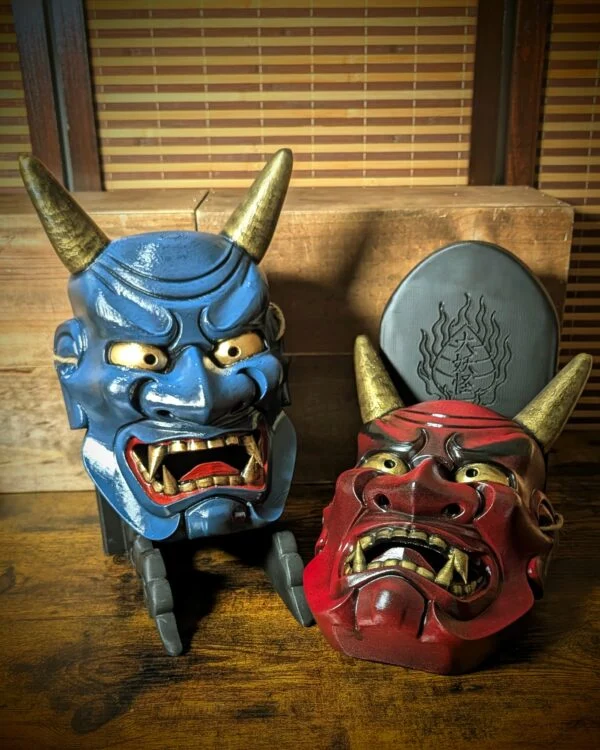
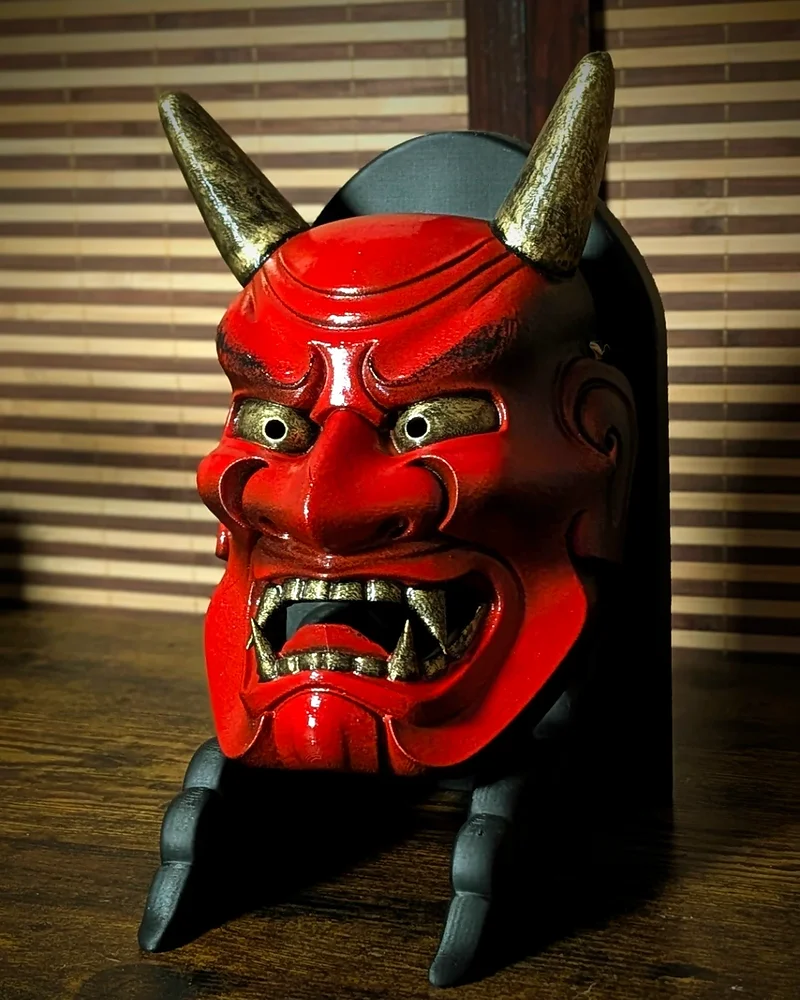
The Dai Yokai red and blue Ondeko masks are contemporary decorative pieces, not reproductions of one Sado village mask. Their horns, strong color contrast and paired composition use familiar modern oni imagery while referring to the energy of Sado’s mask-and-drum tradition.
Each base is 3D printed in PETG in the Dai Yokai workshop in Brittany, France, then cleaned, sanded, primed, painted by hand with acrylic layers and varnished. The masks are mainly intended for wall display, tattoo studios, collections and photography. They are not official performance masks or ritual objects.
| Dai Yokai piece | Format | Intended use |
|---|---|---|
| Red Oni Ondeko mask | Single red decorative mask | Wall display, collection and photos |
| Blue Oni Ondeko mask | Single blue decorative mask | Wall display, collection and photos |
| Red and blue duo | Two-mask composition | Larger wall, tattoo studio or convention display |
See the red and blue Oni Ondeko duo, the red Oni Ondeko mask, or compare the broader collection of handmade Oni masks.
Sources and further reading
- Sado Sightseeing Navi: Sado’s Spring, Beckoned by Oni
- Sado Sightseeing Navi: traditional culture and five Onidaiko styles
- Sado Sightseeing Navi: Onidaiko and kadozuke
- Japan National Tourism Organization: Katagami Onidaiko
FAQ
What does Ondeko mean?
Ondeko is the local Sado pronunciation of Onidaiko, written 鬼太鼓 and commonly translated as demon drumming. It names a family of mask-and-drum performances dedicated at local festivals. The fierce oni is not simply an enemy: in many Sado communities the masked figure helps bring purification, good fortune and prayers for harvests or fishing.
Is Ondeko the same as Onidaiko?
Yes. Onidaiko is the standard reading of 鬼太鼓, while Ondeko is the pronunciation used on Sado Island. English sources use both spellings. The tradition is not one fixed choreography: approximately 120 communities maintain local groups, and their masks, rhythms, movements, costumes and accompanying roles can differ.
Is the Ondeko oni evil?
Not in the simple sense of an evil monster. Sado tourism sources describe the masked oni as a deity figure within a performance dedicated to the gods. During kadozuke, groups visit homes and offer dance and drumming associated with purification and good fortune. Meanings and details still vary by community.
Where does Ondeko come from?
Ondeko is specific to Sado Island in Niigata Prefecture. Its exact origin is unknown. A late eighteenth-century picture scroll of Sado’s annual events depicts an Ondeko performance at the Aikawa festival, providing an early documented visual record without proving one single origin story.
What are the five Ondeko styles?
Sado sources group the dances into five broad styles: Mamemaki, Issoku, Maehama, Hanagasa and Katagami. These are useful categories, not rigid templates. Villages adapt movements, rhythms, masks, costumes and supporting characters, so two troupes placed in the same style can still perform differently.
Why do many Ondeko masks have no horns?
Most Sado Ondeko masks shown by the island’s tourism authority do not have horns, although designs vary. Each community preserves its own face, colors, hair and costume. This is a useful reminder that the horned red or blue oni familiar from popular imagery is not the only valid oni design.
What is kadozuke?
Kadozuke is the practice of an Ondeko group traveling through its community and presenting the local dance at household entrances. Sado tourism sources describe it as an offering of purification and good fortune. Families may welcome the troupe with a celebratory gift, local food or sake.
Are Dai Yokai Ondeko masks traditional festival masks?
No. Dai Yokai Ondeko masks are contemporary decorative interpretations inspired by Sado’s mask-and-drum imagery. They are made in Brittany from PETG, then sanded, primed, hand-painted and varnished. They are not official community masks, consecrated objects or replicas intended for an Ondeko performance.
One island tradition, many village forms
Ondeko is best understood as a family of community traditions, not one fixed demon dance. Its meaning comes from the relationship between mask, drum, movement, shrine, household and village. The fierce face attracts attention, but the local rite, the people who transmit it and the differences between communities are the real subject.