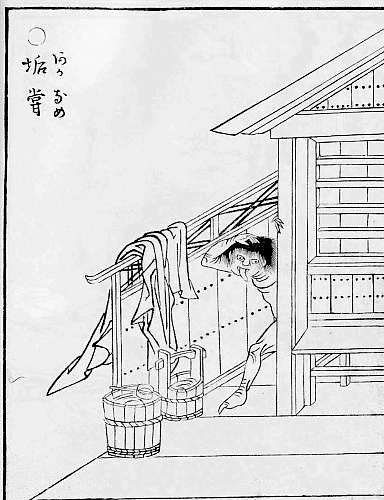
Akaname (垢嘗) is a yōkai drawn by Toriyama Sekien (鳥山石燕) in his illustrated collection 百鬼夜行 (Hyakki yagyō), first published in 1776 according to the National Diet Library (NDL) catalog record. The name translates as grime licker. On the digitized plate, it appears leaning from behind a partition, its long tongue pointing towards two buckets.
What the name 垢嘗 says
The compound joins 垢, grime, and 嘗, the act of licking. Grime licker is a descriptive translation. Sekien’s plate gives this name with a gloss showing how to read it. The name is printed above the figure.

Reading and drawing Sekien’s plate
- Posture. The figure leans from behind the partition. Its head, arm and foot give useful reference points for drawing the pose.
- Hair. It is disheveled.
- Tongue. It is long and hangs in front of the partition towards the two buckets. This detail ties the image to the name and is worth keeping legible.
- Setting. The partition, wooden building, tiled roof and two buckets set the scene.
- Black and white. The plate is monochrome. Any added color is the illustrator’s choice.
The buckets and the character 垢 connect the scene with washing or bathing. The association stays implicit, suggested by the image and the name.
For a second figure by Sekien, see our article on Menreiki.
Dating the sources, from 1686 to 2020
- 1686, a name. According to the table on page 6 of an article by Kagawa Masanobu (香川雅信), the Kokon hyakumonogatari hyōban (古今百物語評判, catalog record) contains the name 垢ねぶり (akaneburi), which also appears as the title of chapter six in volume two. The digitised page locates the passage.
- 1776, a first edition. The kaidai (解題), the explanatory text of the NDL record, places the first edition of Sekien’s collection in An’ei 5, or 1776.
- 1805, a copy. The copy digitized by the NDL, source of the online image, dates from 1805.
- 2020, an analysis. In this article, titled “鬼魅の名は” and published in the journal 日本民俗学 (Nihon minzokugaku), Kagawa observes a sharp increase in the number of yōkai names during the seventeenth century and relates it to haikai literature.
Sources
- Toriyama Sekien, 百鬼夜行 3巻 拾遺 3巻, NDL Search record, 1805 copy, with a kaidai placing the first edition in 1776
- Volume 1 of the 1805 copy, view 14, Akaname on the right-hand page
- Kagawa Masanobu (香川雅信), “鬼魅の名は”, 日本民俗学, no. 302, 2020, pp. 1-35, DOI 10.34560/nihonminzokugaku.302.0_1
- Kokon hyakumonogatari hyōban (古今百物語評判), 1686, record in the University of Toyama repository