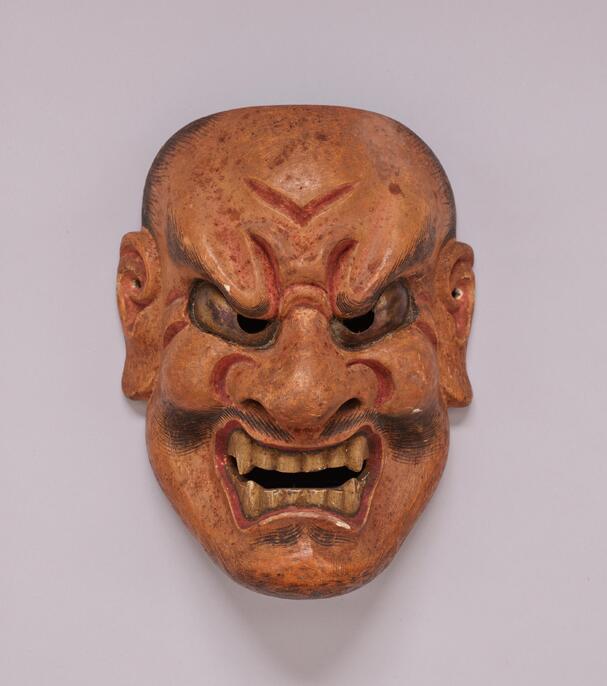
Shikami (顰) is a type of Noh mask that shows anger through its brows and fangs. One example is held by the Tokyo National Museum and published on ColBase as C-142. Raised brows, a creased forehead and four fangs stand out on this example.
The C-142 mask
According to the record, C-142 is a painted wood mask made in Japan during the Edo period, in the 17th century. The museum notes a branded mark reading “Tenkaichi Yūkan” on this object.
Another Shikami, numbered C-1556 and published on e-Museum, is a colored wood mask from the Edo period, between the 17th and 19th centuries. It was formerly in the Konparu Sōke collection, and its record attributes it to Shakuzuru.
Reading the face
The record for C-1556 on Japan Search describes sharply raised eyebrows, deep creases between them and four fangs showing in the taut mouth. All three features are also visible in the photograph of C-142.
Supernatural roles
Shikami serves several supernatural roles. The record gives the spider spirit in Tsuchigumo and the supernatural figure in Momijigari as examples.
Momijigari: Shikami or Hannya
The repertoire page for Momijigari (Maple Viewing) on the-noh.com lists Shikami or Hannya for the nochi-shite, the protagonist of the second part. The choice comes when the character returns in supernatural form. Our Hannya article covers that mask’s use in other plays.
Sources
- Tokyo National Museum, Shikami, C-142, ColBase.
- Japan Search, record for C-1556.
- the-noh.com, Momijigari repertoire page.
- e-Museum, Shikami, C-1556.
- Image of C-142: Tokyo National Museum, ColBase, CC BY 4.0, as stated in the ColBase terms of use.