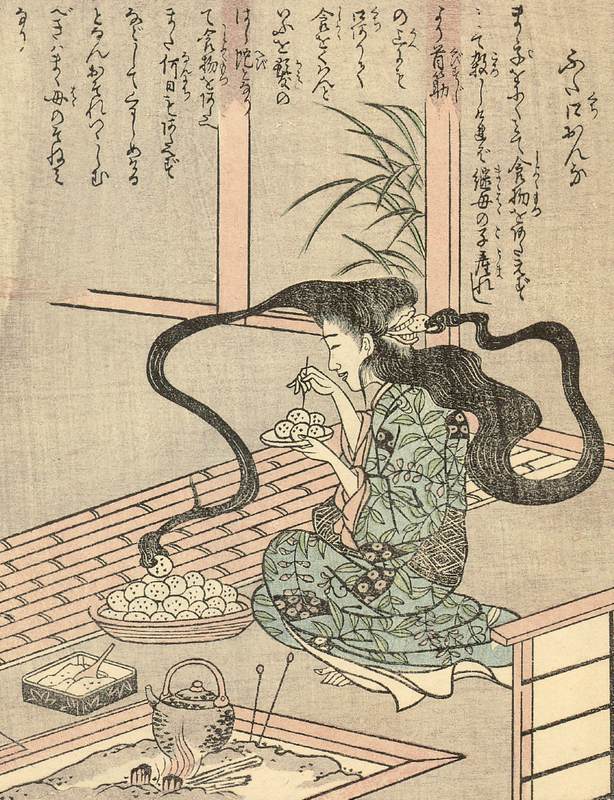
The name Futakuchi-onna (二口女) means two-mouthed woman. In Takehara Shunsen’s illustration, the second mouth opens behind the woman’s head, between two long locks of hair. The story printed alongside it gives that mouth a voice.
The 1841 book and its plate
The National Diet Library records a five-volume edition of the Ehon Hyaku Monogatari (絵本百物語), also titled Tōsanjin Yawa (桃山人夜話), dated Tenpō 12 (1841). The text is by Tōsanjin, the illustrations by Takehara Shunsen, also known as Shunsensai. The plate and story appear in another digitized copy, held in the Tokyo Shiryō collection of the Tokyo Metropolitan Central Library and published by the National Institute of Japanese Literature (NIJL) in its Kokusho Database.
On frame 30, in the second volume, a woman sits in profile indoors, beside a plate of small, round morsels. A toothed mouth appears behind her head. Two long locks of hair curl into loops, one near the dish, the other near that second mouth, as if they were at work.

The story in chapter 17
Chapter 17, titled 二口女, begins on frame 31 and ends on frame 32. The book sets its version in the former province of Shimōsa. There, a second wife lets the first wife’s child starve to death. A wound behind this woman’s head becomes a mouth that demands food and speaks.
Hunger drives both moments in the story. A child is denied food, and a second mouth demands it. The illustration makes the locks seem to move around the meal.
Another hidden mouth, in Tottori
The Tottori Prefectural Museum publishes a transcription of a tale, Kuwazu nyōbō (食わず女房, the wife who does not eat), collected on August 19, 1988 at Ōtani, in the town of Misasa. In it, a man takes a wife who says she needs no food, then catches her tucking rice beneath her hair. The storyteller identifies her as a spider in human form, and this version continues towards the mountains.
In both stories, the hair conceals a mouth or the place where food disappears. The book sets its story in Shimōsa. The museum records a different version that was passed down orally and collected in Ōtani.
Other figures (Hannya, Yuki-onna, Kuchisake-onna, Jorōgumo) are presented with their sources in the article on female yōkai.