Ryōō, also spelled Ranryōō or Ryo-O depending on the source, is a bugaku dance performed in a mask with a hanging chin. The National Theatre of Japan describes the gestures that bring the mask to life.
Where Ryōō sits in gagaku
Within gagaku, which brings together music and dance, bugaku refers to dance performed with musical accompaniment. The National Theatre of Japan’s “Appreciate” page places Ryōō among the left dances (samai), in the category of lively dances known as hashirimai. The version it describes has a single dancer.
The theatre’s bugaku classification lists Nasori, a right dance, as the pair of Ranryōō: a left piece is matched with a right one. Ranryōō also belongs to the instrumental kangen repertoire, which shares some pieces with bugaku, so it can be heard without dance.

Reading the mask
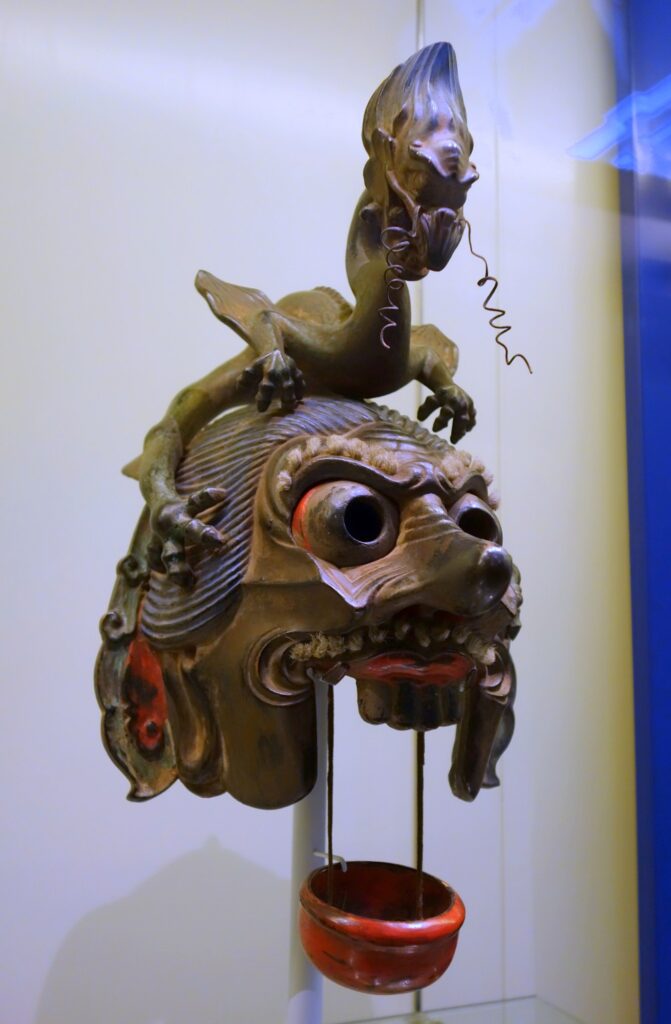
According to the “Appreciate” page, the mask has a hanging chin and eyes that move with the dance. Those are the first two details to look for. It offers two readings of the figure: a dragon or a garuda.
The same text links the piece to the prince of Lanling, a military commander of China’s Northern Qi dynasty (550 to 577), whom it calls Chang Gong. He is said to have hidden his handsome face behind a fearsome mask in battle. In the dance, this story gives the performer the role of a commander leading his men.
Collections in London and Tokyo hold two examples of this mask type.
- The Victoria and Albert Museum dates the Ryōō shown here to 1450-1550 (W.516-1922). On this example, a metal rod lets the performer move the eyes.
- The Tokyo National Museum describes another Ryōō in polychrome wood from the Kamakura period (13th to 14th century).
Two gestures to look for on stage
The National Theatre describes the performer’s entrance, the main dance and the exit. It adds that the passage known as the Saezuri is often shortened.
The dancer holds a gilded baton in the right hand. According to the theatre’s notes, two extended fingers on the left hand represent a sword. The suspended chin moves as the performer dances.
Comparing with Okina
The Okina mask known as Hakushikijō, covered in another Journal article, also has a separate jaw. The Okina article explains how its jaw is attached and used in a Noh performance.
Sources
- National Theatre of Japan, Ryōō, “Appreciate” page: category, structure, gesture, mask and story.
- National Theatre of Japan, bugaku classification: pairing with Nasori, kangen repertoire.
- Victoria and Albert Museum, family trail, stop 3: Ryōō dated 1450 to 1550.
- Tokyo National Museum, e-Museum record C-14: Ryōō in polychrome wood, Kamakura period.