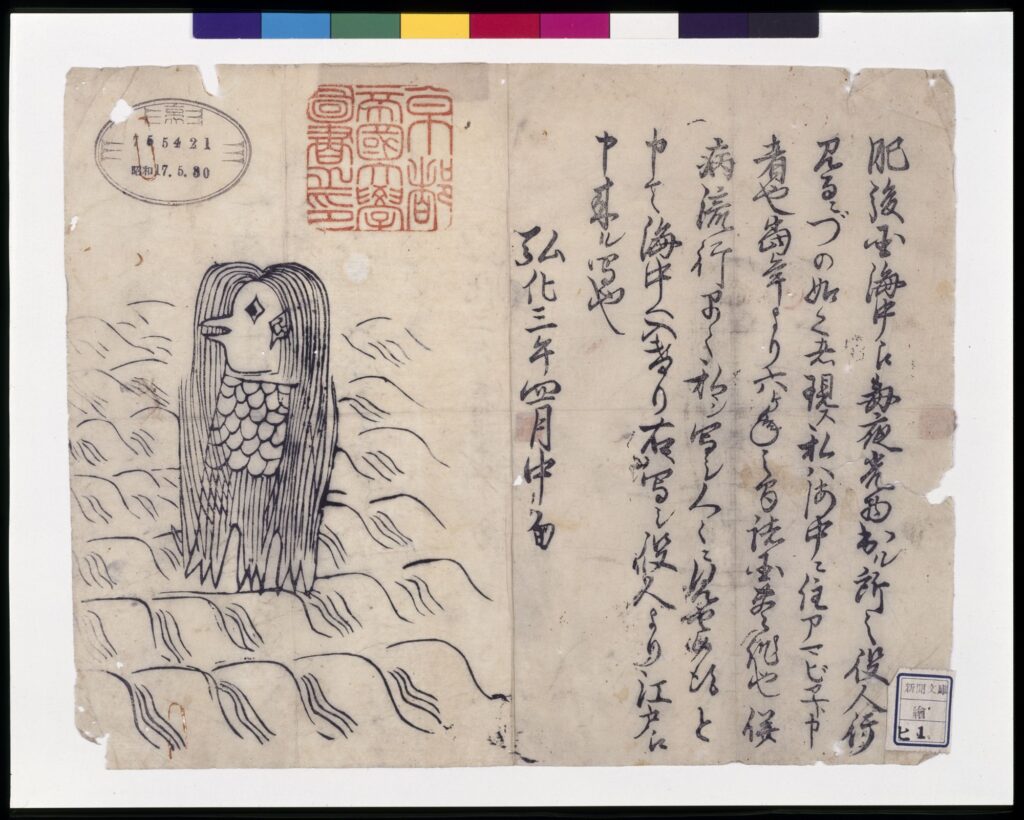
On a Japanese sheet dated 1846, a figure calls itself Amabie and asks a local official to copy its image and show it to others. The drawing sits beside the story. In 2020 the same figure appeared on posters in Tokyo. The Kyoto University Library transcription helps you read the original sheet alongside these later uses.
Start with the library record
The record gives access to the digitised sheet. The catalogue entry and the inscription serve different purposes. The sheet is dated by its own text: the middle of the fourth month of the third year of the Kōka era, that is, 1846.
The transcription page on the English version of the site sets out the terms for reuse: credit “Main Library, Kyoto University”, give the source and state any changes made to the image.
The story: a place, a witness, a request
The text sets the scene in the sea of Higo and casts a local official as the witness. It presents itself as a copy of a dispatch sent to Edo. That framing does not turn the encounter into an established fact: this is the story the sheet tells, not an administrative record.
The figure’s request comes down to two actions: copy its image and show it. The transcribed text does not say what the copy is meant to achieve, and it does not date the origin of any belief. The name Amabie appears without comment, and the sources gathered here cannot say where it comes from.
Yuki Furukawa and Rei Kansaku’s article offers a cross-check: its Figure 1 translates the sheet and gives its date, and its account of the encounter follows the 1846 text (JAMA, 2020).
Reading the drawing
The drawing takes up the left of the sheet and the text the right. The figure has hair, a beak and a body covered in scales. Three appendages extend from beneath the body. “Appendages” is the safer word: the drawing does not shape them like human legs.
The text asks for the image to be copied, and the sheet supplies one right beside the story. To check a detail, go back to image 85 of the record rather than a recent copy, which may have redrawn the figure.
How Amabie was taken up in 2020
In 2020 Amabie reappeared on posters. In Figure 2 of their article, Furukawa and Kansaku reproduce a photograph taken by Furukawa on May 13, 2020 of Amabie posters at Shimbashi Station. On page 38 of a budget document, Japan’s Ministry of Health, Labour and Welfare reproduces its own COVID-19 poster featuring the figure.
Copying an image and showing it is what Amabie asks for in the story, and it is also what a poster does. The parallel describes an action. It says nothing about what the designers of the 2020 posters intended, and none of those posters is evidence of a belief handed down unbroken since 1846.
Three layers to keep apart
- The sheet: a prediction and a request, to be checked against the record and its transcription.
- The cultural revival: uses documented by specific witnesses, such as the dated photographs in JAMA or the ministry document.
- Modern claims: a statement that presents Amabie as a cure, credits it with healing or dates an old belief adds something the 1846 text does not contain. Look for its source elsewhere.
For general background, the Journal’s article defining yōkai is the place to start. On how a figure is represented and handed down, another article follows the legend of Yuki Onna.
Sources
- Kyoto University Library, record RB00000122: full sheet at image 85; and the manuscript date recorded on the sheet.
- Kyoto University Library, transcription and reuse conditions, English version of the site.
- Yuki Furukawa and Rei Kansaku, JAMA, vol. 324, no. 6, 2020, pp. 531-533. Figure 1 (translation and date) and Figure 2 (posters, May 13, 2020).
- Ministry of Health, Labour and Welfare (Japan), budget document, p. 38: COVID-19 poster using Amabie.