The Okina mask is the old man’s face worn in Okina, a ritual performance. The Hikone Castle Museum record places the origins of the rite before the establishment of Noh. The same name thus covers a rite, a role and a type of mask. The Tokyo National Museum record also distinguishes the Hakushikijō, Okina’s white mask, from the Kokushikijō, Sanbasō’s black mask. On two Okina masks held in museums, three details guide the eye: the mouth, the detached chin and the wrinkles.
Okina as rite, role and mask
- The rite: the Hikone record describes it as a ritual performance that predates the establishment of Noh. It is also performed in Noh programmes.
- The role: Okina is also the old man who dances. Senzai and Sanbasō, two other roles in the sequence, are covered below.
- The mask: according to the same record, the Hakushikijō is one type of Okina mask, used exclusively in this rite.
The University of Bologna project places Sanbasō’s dance within an older ritual programme, Shikisanban, which included three elderly figures.
The Hikone Hakushikijō: a subtle smile, a detached chin
The museum’s record describes a sixteenth-century Hakushikijō in colored hinoki wood, 18.6 cm, donated by the Ii family. Two details shape the reading. The mouth carries a subtle smile. The chin is detached and forms a separate piece, which the record calls kiriago.
A gold inscription by Genkyū Mitsushige attributes the mask to Nikkō. It is an attribution, not the carver’s signature.
The Cleveland Okina: finding the joint and the cords
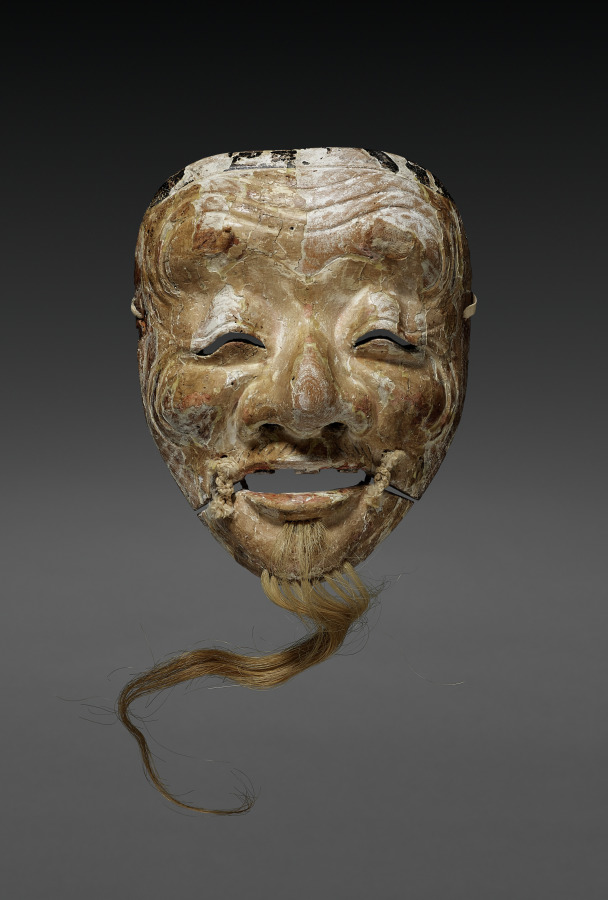
The Cleveland Museum of Art holds another Okina mask, dated to the fifteenth century and made of polychrome wood and hemp (20.4 × 16.1 cm, accession number 1977.33). Its frontal photograph shows an old man’s features: a wrinkled forehead, a mustache and a hemp beard. Here the chin takes the form of a separate jaw, held by visible cords.
On that photograph, first trace the line where the jaw parts from the face, then look for the cords that hold it in place. What you see tells you how this particular mask is assembled; it does not describe a mechanism shared by other masks, old or recent.
White for Okina, black for Sanbasō
Rather than translating the names Hakushikijō and Kokushikijō word for word, this article keeps to the distinction drawn in the Tokyo National Museum record on e-Museum: a white mask for Okina, a black mask for Sanbasō.
The mask described there, C-1887, is a Kokushikijō from the Nanbokuchō period (fourteenth century), in polychrome wood. Its black face is wrinkled, and the record mentions fastenings. For this object alone, CT scanning suggests the wood was originally a single block that may have been cut with a saw. The finding does not extend to other Kokushikijō masks or to the Okina masks above.
Senzai, Okina, Sanbasō: one documented sequence
The Tokyo record places Sanbasō after Okina’s dance. The characters page of a project by the University of Bologna and a Venetian museum describes the sequence this way: Senzai dances as a prelude, and Sanbasō is played by a kyōgen performer, first without a mask, then masked and with bells. That is how one source presents it, not a rule for every school or every performance.
A practitioner’s account adds another angle. In a Japan Foundation article published in June 2025, Mansai Nomura, who performed at the 65th Shiki-Noh in February 2025, gives his reading of the passage of the mask and of the ritual dimension. It is a performer’s perspective, not a general definition.
Keeping mask, role and moment together also helps when reading other stage faces, such as the Hannya mask.
Sources
- Hikone Castle Museum, Hakushikijō record: ritual use, date, material, kiriago, attribution inscription.
- Cleveland Museum of Art, Okina mask, 1977.33: date, materials, dimensions, frontal photograph.
- Tokyo National Museum, e-Museum, Kokushikijō C-1887: the two masks distinguished, Sanbasō’s place, CT findings.
- University of Bologna, “Characters” page: roles and the sequence described.
- Japan Foundation, account by Mansai Nomura, June 2025: a practitioner’s reading.