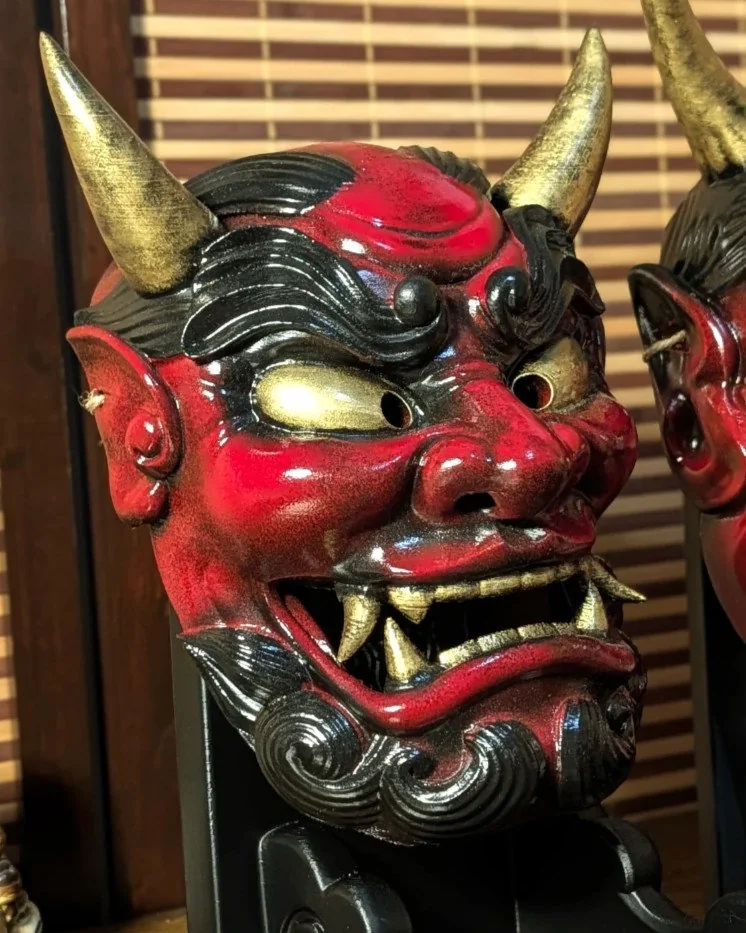
A red Oni, or Aka-Oni (赤鬼), does not have one universal meaning. In a documented five-color Setsubun teaching, red represents craving or greed, one of the five Buddhist hindrances. In Hamada Hirosuke’s 1933 story Naita Aka Oni, the red Oni is instead a kind, lonely figure who wants human friendship.
| Quick question | Short answer |
|---|---|
| What does Aka-Oni mean? | Red Oni |
| Five-hindrance association | Craving or greed |
| Is every red Oni evil? | No |
| Famous story | Naita Aka Oni by Hamada Hirosuke |
| Is red a universal code? | No, context decides the meaning |
What is an Aka-Oni?
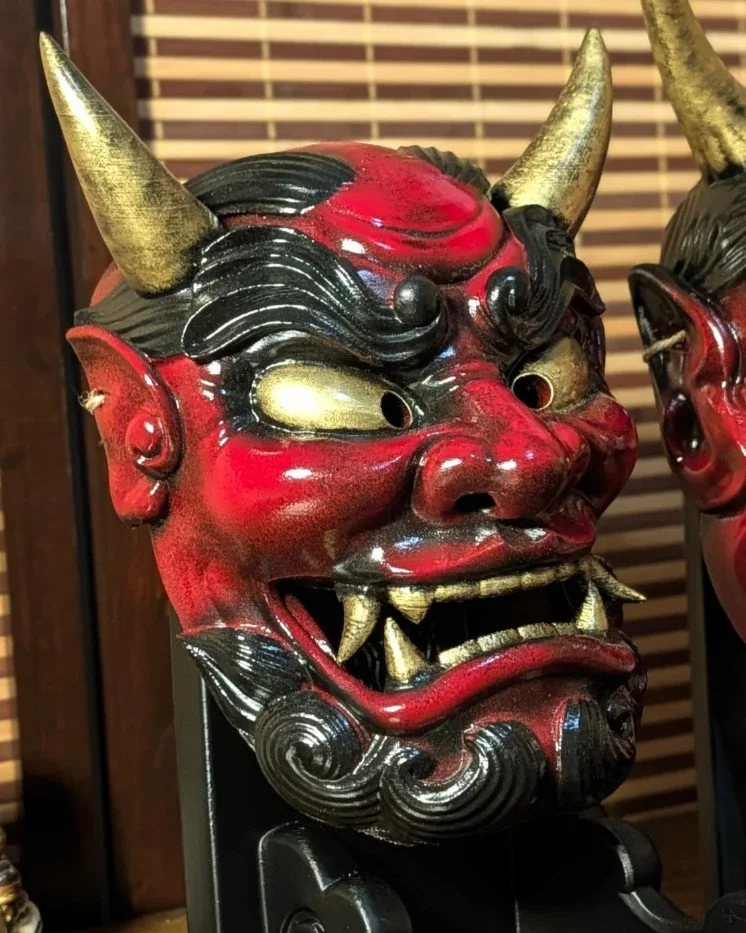
Aka (赤) means red and Oni (鬼) names an ogre-like supernatural figure in Japanese stories, festivals, theatre and visual culture. Aka-Oni therefore means red Oni. The expression is generally descriptive, not the personal name of one official yokai with a fixed origin, rank or personality.
Red Oni appear in Setsubun imagery, temple performances, children’s literature, tattoos, games and contemporary mask designs. Those settings do not all use red in the same way. The safest interpretation begins with the specific ritual, story or artwork rather than treating color as a permanent dictionary code.
What red means in the five-hindrance system
One well-documented Setsubun teaching personifies the five Buddhist hindrances as five colored Oni. These hindrances are mental obstacles that interfere with attention and understanding. In this system, the red Oni represents craving or greed, often written as tonyoku (貪欲) in Japanese explanations.
A study published by the Color Science Association of Japan records the association between Oni colors and the five hindrances. Ryūshōji, a Sōtō Zen temple, gives the same Setsubun explanation: red for desire, blue for anger or hatred, yellow for regret or attachment, green for lethargy, and black for doubt or complaint.
| Oni color | Five-hindrance association | Careful English wording |
|---|---|---|
| Red | Craving or greed | Desire that obstructs clear attention |
| Blue | Anger or ill will | Hostility and resentment |
| Yellow or white | Restlessness and regret | An unsettled or remorseful mind |
| Green | Torpor and sleepiness | Lethargy or inertia |
| Black | Doubt | Uncertainty that blocks understanding |
This is a useful symbolic system, but it is not a rule for every red Oni in Japanese culture. A red figure in a local festival, a modern game or an illustrated story may have a completely different role. Red should also not automatically be labelled Yang, summer, death, protection or raw vitality unless the specific source makes that connection.
Naita Aka Oni: the red Oni who wanted friends
Naita Aka Oni (泣いた赤おに), commonly translated as The Red Ogre Who Cried, is a widely known Japanese children’s story by Hamada Hirosuke. Publisher Kaiseisha dates the original story to 1933, when Hamada was forty. The story was later revised by the author and published in several illustrated editions.
The Kaiseisha account of the book confirms the 1933 writing date and explains that Hamada later rewrote the story in simpler language. The publisher’s book page summarizes its central relationship: a red Oni wants to befriend villagers, while his blue Oni friend agrees to become the apparent villain.
The red Oni puts up a sign inviting people to his home, but the villagers do not trust him. The blue Oni proposes a performance: he will attack the village, and the red Oni will drive him away. The plan succeeds. The villagers begin visiting the red Oni, and the friendship he wanted finally becomes possible.
When the red Oni later visits his friend, the blue Oni is gone. His letter explains that he must leave, because the villagers might discover the trick if they see the two Oni together. The red Oni reads the letter repeatedly and cries. The ending is not evidence that every red Oni is sincere or every blue Oni is self-sacrificing. Those meanings belong to this particular literary work.
The official Hamada Hirosuke Memorial Museum presents Naita Aka Oni among the author’s representative stories and recounts the blue Oni’s proposal. The museum also preserves material showing how the title and text changed through different versions.
Red Oni and blue Oni: compare the context
| Context | Red Oni | Blue Oni |
|---|---|---|
| Five-hindrance Setsubun teaching | Craving or greed | Anger or ill will |
| Naita Aka Oni | Wants friendship with humans | Sacrifices his reputation and leaves |
| Modern character shorthand | Often emotional or direct | Often calm or strategic |
| Universal folklore rule? | No | No |
Modern fiction often reuses a red and blue pair to create an immediate contrast between outgoing and restrained personalities. That convention is useful for reading a specific film, game or manga, but it should not be projected backwards as one ancient rule governing every Oni story.
Does a red Oni mean evil, anger or protection?
Not by color alone. In Setsubun, an Oni may embody an obstacle that is expelled with beans. In a temple performance, the figure’s role comes from that ritual. In Naita Aka Oni, the red character is gentle and lonely. In a tattoo or mask design, red may simply intensify the face and make the horns, teeth and brow more visible.
Claims that every red Oni protects a home, brings courage or represents uncontrolled anger are too broad. Those can be valid interpretations of a specific artwork, but they are not automatic cultural facts. The same caution applies to red-and-gold designs, flames and other modern visual choices.
Red Oni meaning in tattoos and modern design
A red Oni tattoo can suggest intensity, appetite, anger, courage, confrontation or transformation, depending on the composition and the wearer’s intention. Surrounding motifs such as flames, waves, chrysanthemums, snakes or weapons change the reading. The tattooer’s explanation and the complete design matter more than color alone.
For broader composition questions, read the Oni tattoo meaning guide. The complete Oni mask guide covers the creature’s wider history, while the Ao-Oni guide and Kuro-Oni guide compare other color contexts.
How I paint a red Oni mask
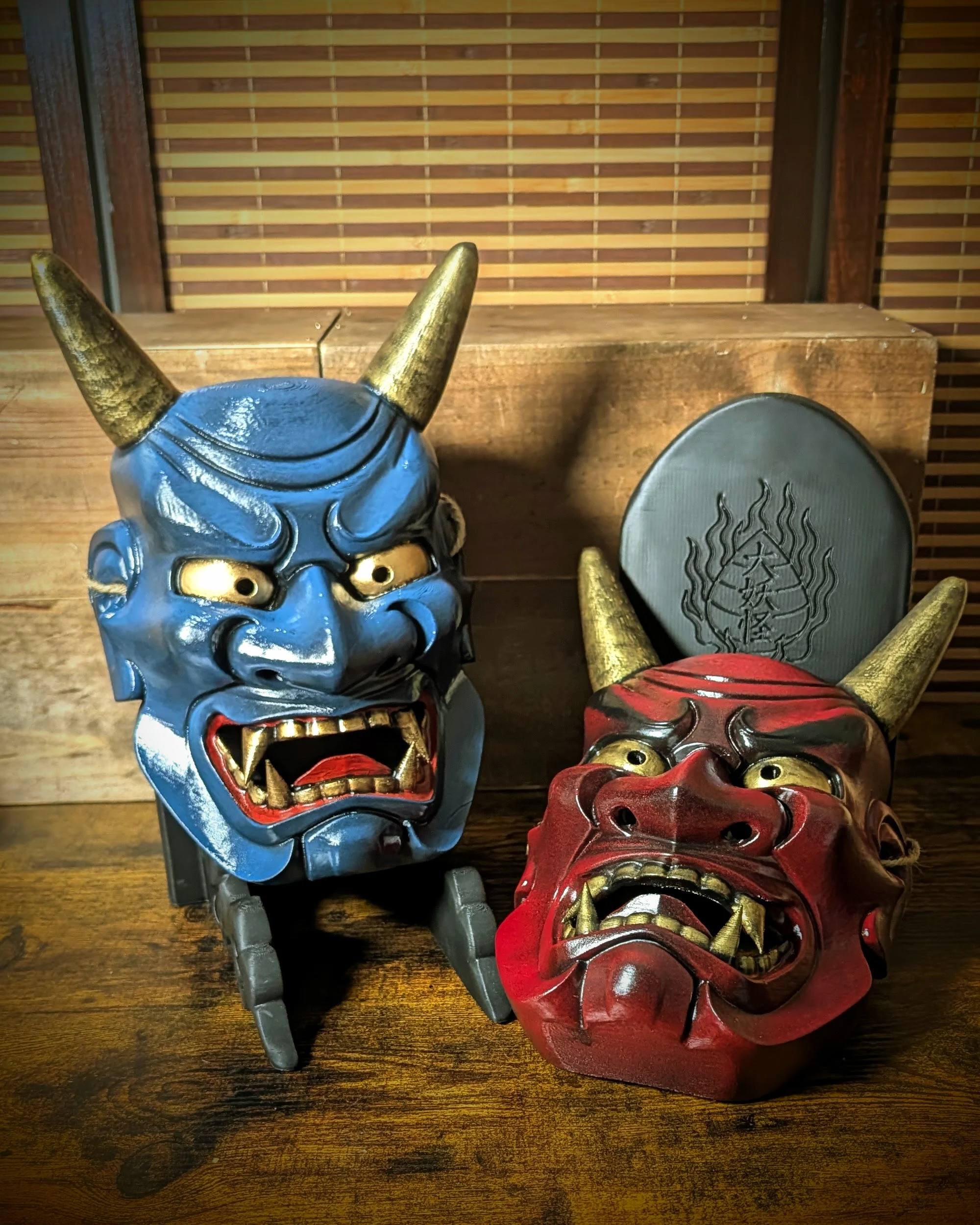
A convincing red mask needs more than one flat coat. In the Dai Yokai workshop, the PETG form is printed, sanded and primed before color is built in layers. Darker tones can sit around the eyes, nose and jaw, while brighter red on the brow and cheeks keeps the sculpted volumes readable.
Horns, teeth and raised details are painted separately, then the surface is varnished and finished by hand. This is a contemporary workshop method in Brittany, France. Dai Yokai masks are Japanese-inspired creations for display, collection, conventions or light cosplay, not historical masks, ritual objects or supernatural protection.
You can compare the physical designs in the handmade Oni mask collection, the red Oni mask and the red and blue Oni Ondeko duo. This article owns the informational intent; the collection and product pages own the commercial intent.
Sources and further reading
- Color Science Association of Japan: colors associated with Oni
- Ryūshōji: Setsubun and the five colored Oni
- Kaiseisha: the history and themes of Naita Aka Oni
- Kaiseisha: Naita Aka Oni book page
- Hamada Hirosuke Memorial Museum: representative stories
FAQ
What does a red Oni mean?
A red Oni has no single meaning in every Japanese story. In one documented five-color Setsubun teaching, red represents craving or greed, one of the five Buddhist hindrances. In Hamada Hirosuke’s Naita Aka Oni, however, the red Oni is a kind figure who longs for human friendship.
What does Aka-Oni mean in Japanese?
Aka-Oni (赤鬼) literally means red Oni. Aka means red, while Oni names an ogre-like supernatural figure found in Japanese stories, festivals, theatre and visual culture. The term usually describes an Oni’s color rather than one creature with a fixed biography or universal personality.
Does a red Oni represent greed or desire?
Yes, within a specific five-color Setsubun interpretation based on the five Buddhist hindrances. That system links red with craving or greed. It should not be presented as the permanent meaning of every red Oni, because color roles change across rituals, stories and modern artworks.
Is a red Oni evil?
Not always. Oni can threaten, obstruct, protect, entertain or change their behavior depending on the story or ritual. Naita Aka Oni makes its red Oni gentle and lonely rather than evil. A red mask can also be a contemporary artistic design without claiming a religious or supernatural function.
What is Naita Aka Oni?
Naita Aka Oni, often translated as The Red Ogre Who Cried, is a children’s story written by Hamada Hirosuke in 1933. A red Oni wants to befriend humans. His blue Oni friend pretends to attack the village so the red Oni can rescue its people, then leaves to protect the deception.
Why does the blue Oni leave in Naita Aka Oni?
The blue Oni leaves because his continued presence could reveal their plan and make the villagers distrust the red Oni again. His departure secures the red Oni’s new friendships but costs both Oni their own friendship. The ending turns the story into a reflection on loyalty, sacrifice and loneliness.
What is the difference between a red Oni and a blue Oni?
In the five-hindrance reading, red represents craving while blue represents anger or ill will. In Naita Aka Oni, red is the friend who wants human acceptance and blue is the friend who sacrifices himself. Modern fiction often reuses the pair, but those character types are not universal folklore rules.
What does a red Oni tattoo mean?
There is no fixed meaning for every red Oni tattoo. Red may emphasize intensity, anger, appetite, courage or dramatic contrast, depending on the artist, wearer and surrounding motifs. The five-hindrance association can inform a design, but it should not override the meaning chosen for the specific composition.
Read the story before reading the color
The most defensible red Oni meaning depends on context. Red represents craving in one five-hindrance Setsubun teaching, but Naita Aka Oni uses the same figure to explore friendship, trust and sacrifice. Identify the ritual, story or artwork first, then interpret the color.