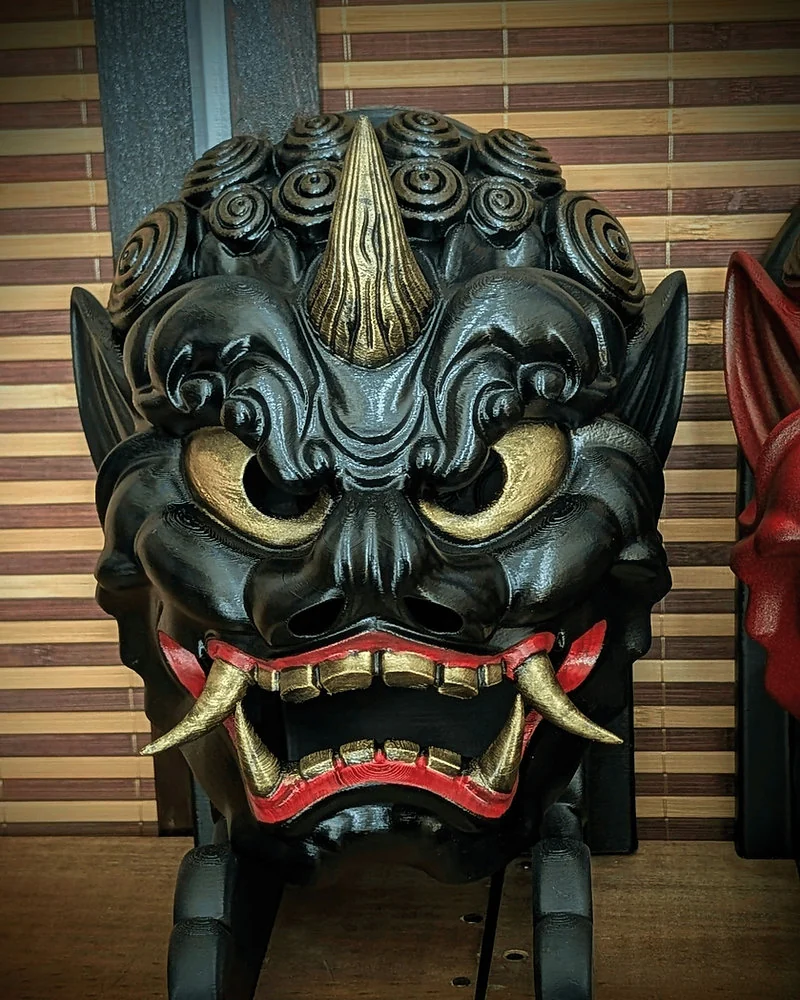
A black Oni, or Kuro-Oni (黒鬼), has no single universal meaning. In one five-color Setsubun teaching, black represents doubt, one of the five Buddhist hindrances. In temple rituals, a black Oni may play a different role. Modern masks and tattoos also use black for contrast, weight and atmosphere rather than one fixed spiritual code.
| Quick question | Short answer |
|---|---|
| What does Kuro-Oni mean? | Black Oni |
| Is it one named creature? | Usually no, it is a descriptive term |
| Five-hindrance association | Doubt |
| Is it the root of all demons? | No reliable source supports that claim |
| Is black always negative? | No, the meaning changes with the context |
What is a Kuro-Oni?
Kuro (黒) means black, and Oni (鬼) names an ogre-like supernatural figure in Japanese stories, visual culture and seasonal customs. Kuro-Oni therefore means black Oni. It is generally a color description, not the personal name of one official yokai with a single biography or fixed rank in the underworld.
Black Oni figures appear in different settings, including Setsubun explanations, temple dances, children’s media, games and contemporary masks. The color alone cannot tell you whether the figure represents doubt, danger, an obstacle, a guardian or simply a dark visual design.
What black means in the five-hindrance system
The clearest documented symbolic reading comes from a modern Setsubun teaching that personifies the five Buddhist hindrances as five colored Oni. These hindrances are mental obstacles that cover or block attention and understanding. In this system, the black Oni represents gi, doubt.
A study published by the Color Science Association of Japan records the five-color association and describes the black Oni as representing doubt and grumbling. Ryūshōji, a Sōtō Zen temple, presents the same Setsubun interpretation: red for desire, blue for anger or hatred, yellow for regret or attachment, green for lethargy, and black for doubt or complaint.
| Oni color | Five-hindrance association | Careful English wording |
|---|---|---|
| Red | Craving or greed | Desire that obstructs clear attention |
| Blue | Anger or ill will | Hostility and resentment |
| Yellow or white | Restlessness and regret | An unsettled or remorseful mind |
| Green | Torpor and sleepiness | Lethargy or inertia |
| Black | Doubt | Uncertainty that blocks understanding |
Doubt is one hindrance among five. It is not described in these sources as the root from which every other hindrance grows. The black Oni should therefore not be called the root of all demons, the ruler of the others or the embodiment of ignorance without a separate source.
Black Oni in Japanese Setsubun rituals
Temple performances show why one color chart cannot explain every black Oni. At Rozanji in Kyoto, red, blue and black Oni enter during the Setsubun rite and try to obstruct the goma fire ceremony. The black Oni carries a large mallet. The demons are eventually driven away by ritual weapons, beans and rice cakes.
The official Rozanji temple account of its Oni dance describes three colors and three ritual props, but it does not assign the black Oni a universal personality such as silent judge or absorber of evil. Its role comes from that specific performance.
At Kinpusenji in Yoshino, the ritual takes another direction. Oni are welcomed with the call Oni mo uchi, then subdued and led toward Buddhist teaching. The event includes Oni of several colors, including black, without reducing each figure to one permanent dictionary meaning.
The official Yoshino town description of Kinpusenji’s Setsubun festival explains that expelled Oni are welcomed, subdued and converted through Buddhist teaching. The example is useful because it shows Oni changing role within a ritual instead of remaining purely evil figures.
What a black Oni does not automatically mean
| Popular claim | Evidence-based answer |
|---|---|
| The black Oni is the root of all demons | Not established by the cited Buddhist or Setsubun sources |
| It guards the deepest gates of hell | Not a general Kuro-Oni role |
| Black absorbs negative energy | A modern spiritual interpretation, not a verified rule |
| Black and gold means a divine spark | An artistic reading, not a fixed Japanese code |
| It belongs on a north wall | Feng Shui is a separate Chinese spatial tradition |
| Every black Oni represents doubt | Only within the specific five-hindrance interpretation |
Modern symbolism is not forbidden, but it should be labelled honestly. An artist can use a black Oni to explore fear, restraint, night or the psychological shadow. Those are contemporary interpretations unless the specific artwork, tattooer or story states otherwise.
Black lacquer, armor and mask surfaces
Black surfaces are historically common in Japanese armor and lacquerwork, but a black finish does not automatically turn an armor mask into a Kuro-Oni. Material, function and represented face must be identified separately. Dark lacquer can protect a surface and create contrast without carrying one religious message.
The Metropolitan Museum of Art catalogues an Edo-period full armor mask made from iron and lacquer. The British Museum records another suit with a lacquered face mask and black throat-guard sections. These objects document dark armor finishes, not a universal black-Oni mythology.
Black Oni meaning in tattoos and modern design
In tattooing, black gives an Oni face weight and lets skin breaks, gray shading, red accents or gold details control the composition. A tattoo may use black to suggest protection, danger, grief or self-confrontation, but the surrounding motifs and the wearer’s intent decide the reading.
For the broader creature, use the complete Oni mask meaning guide. For color comparison, read the blue Oni guide and the red Oni guide. Tattoo composition is covered separately in the Oni tattoo guide.
How I paint a black Oni mask
Painting a mask black is not simply covering every surface with one flat color. A single finish can erase the sculpted brow, nose, fangs and jaw. In the Dai Yokai workshop, the surface is built with controlled differences in sheen and value so the face remains readable under normal room lighting.
The skin can stay matte while horns, teeth or raised details use satin, gray or gold accents. A restrained anthracite dry-brush can reveal the ridges without turning them gray. This is a workshop method and visual choice, not a claim that black and gold carries one sacred Japanese meaning.
How to display a black Oni mask
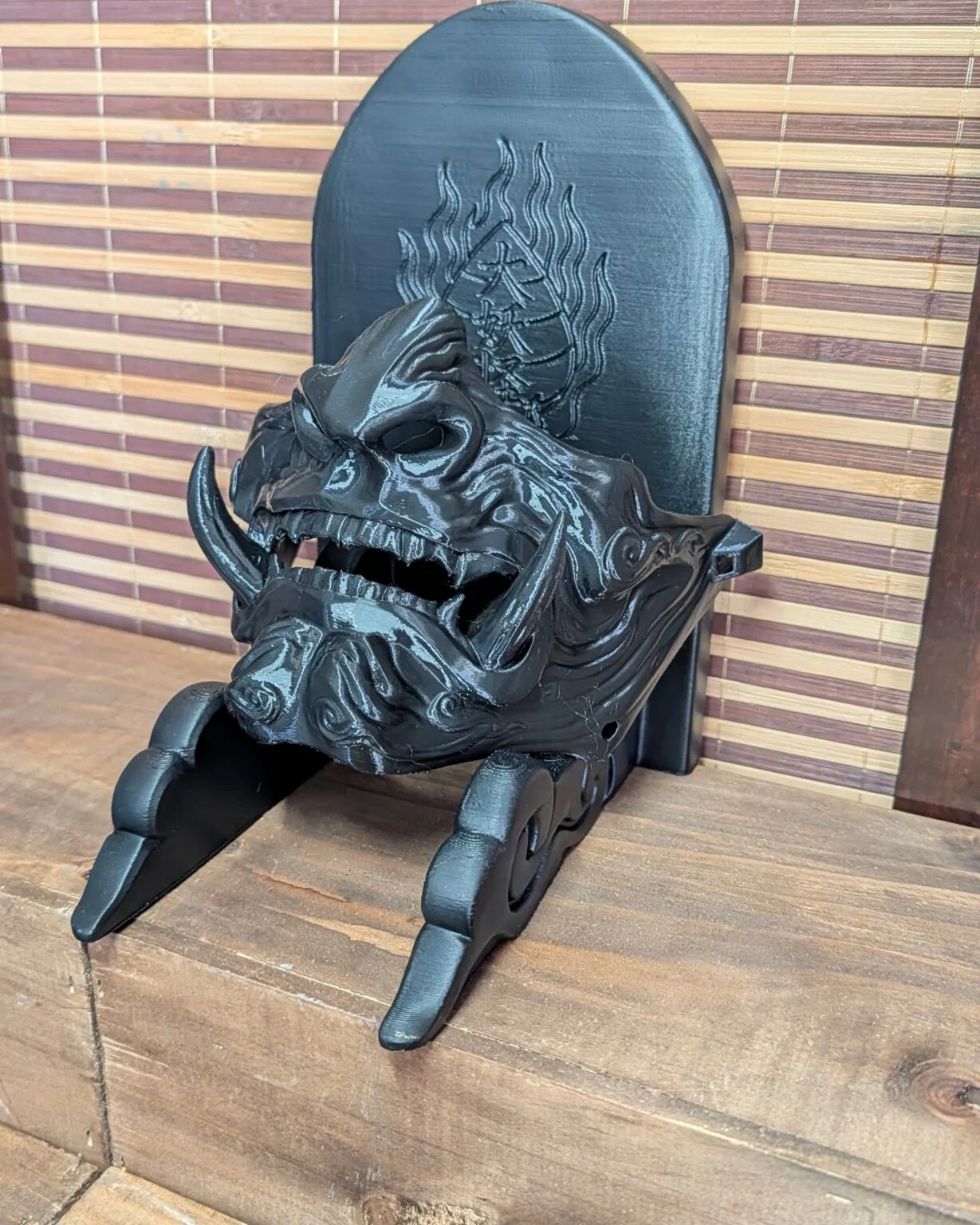
Display is a visual question, not a Feng Shui rule. A black mask needs separation from the wall and enough side or overhead light to reveal its volumes. A pale, raw-wood or concrete background usually gives stronger contrast than a dark corner. Avoid prolonged direct sunlight and excessive heat.
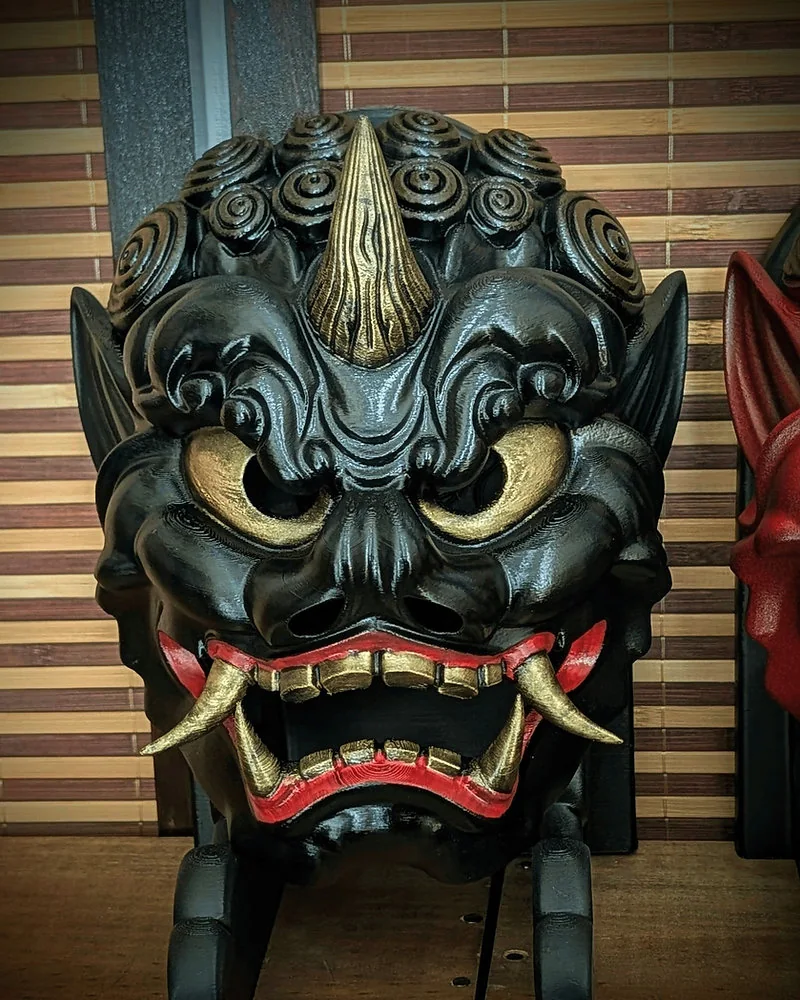
From Kuro-Oni imagery to a handmade Dai Yokai mask
Dai Yokai black Oni masks are contemporary Japanese-inspired creations made in Brittany, France. Their PETG forms are printed, sanded, primed, painted, varnished and finished by hand. They are designed for display, collection or light convention wear, not as ritual objects, antiques or protective armor.
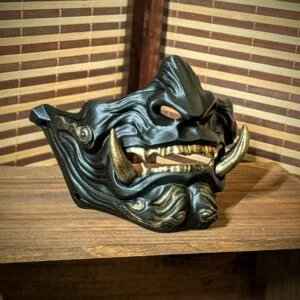
The closest physical reference is the black Oni Mempo half mask. You can also compare it with the wider handmade Oni mask collection. The article explains the cultural contexts; the collection page owns the commercial search intent.
Sources and further reading
- Color Science Association of Japan: colors associated with Oni
- Ryūshōji: Setsubun and the five colored Oni
- Rozanji: Setsubun Oni dance
- Yoshino Town: Kinpusenji Oni Fire Festival
- The Met: Full Mask (Sōmen)
- British Museum: armor with lacquered face mask
FAQ
What does a black Oni mean?
A black Oni does not have one universal meaning. In a documented five-color Setsubun teaching, it represents doubt, one of the five Buddhist hindrances. In temple rituals, a black Oni may simply be one member of a group of demons that obstructs a rite before being expelled, welcomed or converted.
What does Kuro-Oni mean in Japanese?
Kuro-Oni (黒鬼) literally means black Oni. Kuro means black and Oni names an ogre-like supernatural figure. The expression is usually descriptive rather than the proper name of one creature with one fixed story, rank or personality. Its meaning depends on the festival, artwork, story or modern design.
Does a black Oni represent doubt?
Yes, within one five-color Setsubun interpretation. That teaching connects the black Oni with gi, doubt, one of the five hindrances that obstruct meditation and clear understanding. It should be described as one documented symbolic system, not as the permanent meaning of every black Oni in Japanese culture.
Is the Kuro-Oni the root of all demons?
No reliable source establishes the Kuro-Oni as the root of all demons. Doubt is one of five hindrances, not the origin of the other four. Kuro-Oni is also not a universal ruler or deepest guardian of Buddhist hell. Those ideas belong to modern storytelling unless a specific work clearly defines them.
Is a black Oni mask bad luck?
There is no general rule that a black Oni mask brings bad luck or absorbs bad energy. Oni can be threatening, protective, comic or ritually transformed depending on the context. A contemporary black mask may be chosen for its visual weight and contrast without making a religious or supernatural claim.
What is the difference between black, red and blue Oni?
In the five-hindrance reading, red is linked with craving, blue with anger or ill will, and black with doubt. Outside that system, colors vary by story and festival. Modern character design often makes red feel hotter, blue cooler and black darker, but that visual contrast is not a universal folklore law.
What does a black and gold Oni mask mean?
Black and gold do not create one fixed traditional Oni meaning. Gold can emphasize horns, teeth, cracks or raised details, while black makes the silhouette and highlights more dramatic. The final interpretation belongs to the specific artwork. It should not automatically be labelled divine, protective or connected with kintsugi.
Are Dai Yokai black Oni masks traditional Japanese masks?
No. Dai Yokai black Oni masks are contemporary Japanese-inspired creations made in Brittany, France. Their PETG forms are sanded, primed, painted, varnished and finished by hand. They borrow the horns, fangs and heavy brow of Oni imagery without being presented as historical, ritual or protective objects.
Read the ritual before reading the color
The most defensible Kuro-Oni meaning is doubt within one five-hindrance Setsubun teaching. Beyond that system, a black Oni can be a ritual obstacle, a converted demon, a fictional character or a contemporary design. Identify the source first, then interpret the color.