Setsubun is the Japanese observance held just before Risshun, the traditional beginning of spring. Its best-known custom is mamemaki: scattering roasted soybeans while saying “Oni wa soto, fuku wa uchi,” or “Oni out, fortune in.” An Oni mask is common in family and school celebrations, but it is not required and local practices vary.
| Quick question | Short answer |
|---|---|
| What does Setsubun mean? | Seasonal division |
| When is it? | The day before Risshun, usually February 2 or 3 |
| Main custom | Mamemaki, scattering roasted soybeans |
| Common chant | Oni wa soto, fuku wa uchi |
| Is an Oni mask required? | No |
| Other associated custom | Eating ehomaki facing the year’s lucky direction |
What does Setsubun mean, and when does it happen?
Setsubun (節分) literally means “seasonal division.” The traditional calendar recognized a division before each seasonal beginning, but modern use normally means the day before Risshun, the start of spring. Because Risshun is determined by the calendar rather than fixed permanently to one civil date, Setsubun is usually observed on February 2 or 3 and can shift.
The Consulate-General of Japan in Seattle describes the day as a transition for driving away harmful forces and welcoming good fortune. Kyoto City’s official travel guide likewise stresses that ceremonies differ between temples and shrines. Setsubun is therefore better understood as a family of seasonal practices than one rigid national script.
What is mamemaki?
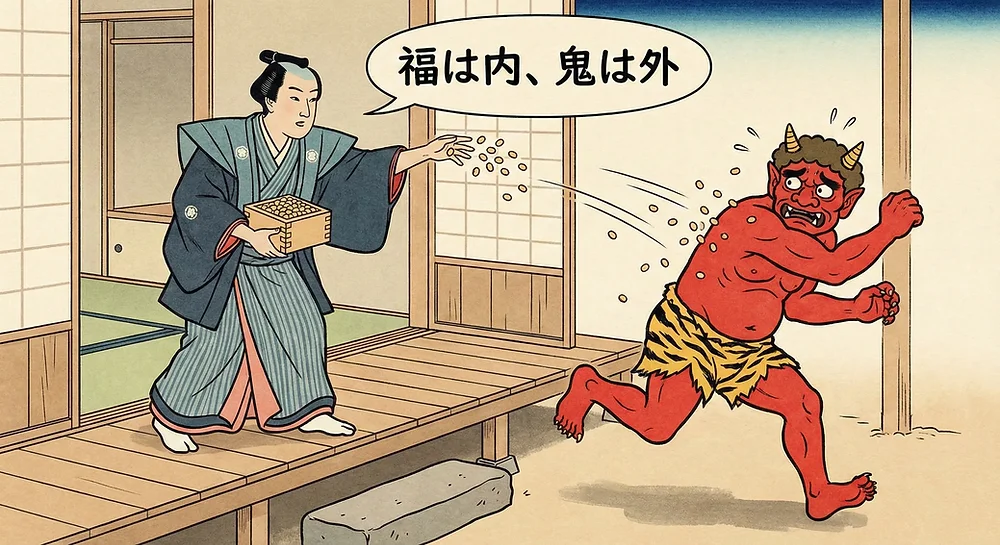
Mamemaki (豆まき or 豆撒き) means bean scattering. At home, people commonly throw roasted soybeans, known as fukumame or fortune beans, toward an entrance, around rooms or at a person representing an Oni. Similar bean-scattering ceremonies take place at Buddhist temples and Shinto shrines, sometimes with performers, local figures or invited guests.
| Common home sequence | What it expresses |
|---|---|
| Prepare roasted soybeans | The beans are used as fukumame, or fortune beans |
| Open an entrance or choose the throwing area | Creates a symbolic route for misfortune to leave |
| Say “Oni wa soto” while scattering outward | Sends Oni or harmful forces away |
| Say “Fuku wa uchi” while scattering inward | Welcomes good fortune |
| Eat a customary number of beans | Often one for each year of age, sometimes one extra |
| Clean up carefully | Important when young children or pets are present |
This sequence is descriptive, not compulsory. Some households simplify it, and public ceremonies may distribute packets rather than scatter loose beans. The familiar chant also has local variations. Nippon.com’s 2026 overview documents temples that welcome fortune without saying “Oni out,” reflecting the belief that no evil Oni can remain before the temple’s protective figures.
What does “Oni wa soto, fuku wa uchi” mean?
“Oni wa soto, fuku wa uchi” (鬼は外、福は内) is usually translated as “Oni out, fortune in” or “Demons out, good fortune in.” Oni here are not a biological species with one fixed meaning. In the Setsubun context, they act as visible forms of calamity, illness, harmful influence or bad luck that should be expelled before the seasonal transition.
Japan Search’s National Diet Library gallery describes Setsubun Oni as symbols of plagues and other disasters. This ritual role is narrower than the full range of Oni in Japanese stories. For the wider folklore, read the Oni mask meaning and history guide.
Why are roasted soybeans used?
There is no need to reduce the choice of beans to a single neat origin story. The National Diet Library explains that soybeans were counted among important cereals and were associated with the spirit or vitality of grain. Cultural accounts also record wordplay between mame, beans, and expressions interpreted as striking or destroying evil. Kyoto’s official guide presents this as one explanation among several, not a proven etymology.
Modern descriptions consistently specify roasted soybeans. The older article on this page stated that raw beans must never be used because sprouting would make misfortune take root. That is a circulating folk explanation, but it is not needed to explain the documented practice and should not be presented as a universal Japanese belief.
How are Tsuina and Setsubun connected?
Setsubun is often described as descending directly from a Chinese exorcism ritual called Tsuina. The connection is real, but the simple version hides several stages. The court ceremony and household bean scattering were related ways of expelling harmful forces, not necessarily the same ritual performed unchanged for a thousand years.
| Period or layer | What can be stated carefully |
|---|---|
| Chinese antecedents | Exorcism practices influenced Japanese court ritual |
| Heian period | Tsuina became an imperial court event in Japan |
| Muromachi period | Kyoto’s official guide says bean throwing became popular among commoners around this period |
| Edo period | The National Diet Library describes seasonal expulsion practices spreading through the general population |
| Modern Japan | Homes, schools, temples and shrines use varied forms of mamemaki and Oni imagery |
The chronology above follows the National Diet Library’s Setsubun overview and Kyoto’s official cultural presentation. It replaces the earlier claim that the complete modern family ritual was imported during the Nara period and merely simplified by peasants, which was too direct and unsupported.
Is an Oni mask essential to Setsubun?
No. A family member may put on a paper or costume Oni mask so children have a visible target during mamemaki. Schools also use Oni masks in seasonal craft activities. But the beans can be scattered through the home or toward an entrance without anyone wearing a mask, and temple or shrine ceremonies follow their own forms.
The wearer is not required to be the father or an older brother, and the role is not a licensed moment for children to attack an authority figure. Those ideas turn one possible family scene into a national psychological explanation. It is more accurate to say that the mask gives misfortune a recognizable face that participants can symbolically send away.
Red, blue and black Oni may appear in local ceremonies, but Setsubun does not impose one universal color code. The association between Oni colors and the Buddhist five hindrances is a separate interpretive tradition. See the sourced Aka-Oni meaning guide before treating red as desire, blue as anger or black as doubt.
Regional and modern Setsubun customs
| Custom | Careful description |
|---|---|
| Roasted soybeans | The best-known beans used for mamemaki |
| Unshelled peanuts | Used in some regions and households instead of soybeans |
| Hiiragi iwashi | A sardine head and prickly holly sprig displayed in some areas to repel harmful forces |
| Ehomaki | An uncut sushi roll eaten in silence while facing the year’s lucky direction |
| Chant variations | Some temples and regions change or omit “Oni wa soto” |
| Masks and performers | Common visual devices, but not required in every practice |
Ehomaki is now widely associated with Setsubun, but it should not be presented as an unchanged nationwide ancient custom. Japan’s Ministry of Agriculture identifies the practice with Osaka, says its exact origin is uncertain and notes that nationwide adoption accelerated through supermarket and convenience-store promotion in the 1990s. Seven fillings linked with the Seven Gods of Fortune are common today, but the ministry also notes that older rolls did not follow one fixed recipe.
For the documented food history and current eating method, see the Ministry of Agriculture, Forestry and Fisheries page on ehomaki and Osaka makizushi. The National Diet Library’s Japan Search gallery records hiiragi iwashi, while Nippon.com notes the use of peanuts and alternative wrapped foods in some homes.
A practical safety note for families
Hard beans and nuts can cause choking or aspiration. Japan’s Consumer Affairs Agency says not to feed them to children aged five or younger. Its Setsubun advice recommends individually wrapped beans as one safer option for scattering, close supervision and thorough cleanup so a child does not find and eat loose beans later.
This safety point matters more than reproducing every ritual detail. Read the Consumer Affairs Agency warning on hard beans and nuts before organizing mamemaki with young children.
Where a contemporary Dai Yokai mask fits
Dai Yokai masks are contemporary Japanese-inspired pieces made in Brittany, France. They are not historical Setsubun objects, shrine equipment or reproductions of Japanese ritual craft. A finished workshop mask can illustrate the visual language of horns, fangs and strong expressions associated with Oni, but it should not be presented as necessary for the ceremony.
Do not throw beans at a hand-painted display piece. For decoration, collection or a photographed costume scene, follow the product’s handling guidance and keep the ritual explanation separate from the object. You can compare the workshop designs in the handmade Oni mask collection.
Sources and verification
- National Diet Library: Setsubun and Jakibarai, for seasonal meaning, Tsuina and soybeans
- Japan Search: The Bean-Throwing Festival, for Oni, wordplay and hiiragi iwashi
- Consulate-General of Japan in Seattle: What is Setsubun?, for mamemaki and ehomaki
- Kyoto City Official Travel Guide: Setsubun Festival, for date variation and local ceremonies
- Japan Ministry of Agriculture: Ehomaki, for Osaka food history
- Nippon.com: Setsubun’s modern regional variations, for peanuts, wrapped alternatives and chant differences
- Consumer Affairs Agency: hard bean and nut safety
FAQ
What is Setsubun in Japan?
Setsubun means “seasonal division.” Today, it usually refers to the day before Risshun, the traditional beginning of spring. People mark the transition by driving out misfortune and welcoming good fortune, most visibly through mamemaki, the custom of throwing roasted soybeans.
Is Setsubun always on February 3?
No. Setsubun falls on the day before Risshun, so the calendar date can shift. It is usually February 2 or 3, although broader references sometimes give a February 2-4 range. Check the date for the specific year instead of treating February 3 as permanent.
What does “Oni wa soto, fuku wa uchi” mean?
The common translation is “Oni out, fortune in.” People say it while scattering beans during mamemaki. It expresses the two sides of the ritual: sending away harmful forces and inviting good fortune. The wording is widespread, but temples, shrines and regions may use different chants.
Why are roasted soybeans thrown at Setsubun?
Official cultural sources connect soybeans with the vitality or spirit of grain and also record wordplay linking mame, beans, with destroying evil. These are ritual explanations and legends, not one proven linguistic origin. Modern descriptions consistently specify roasted soybeans, called fukumame or fortune beans.
Is an Oni mask required for mamemaki?
No. A family member may wear an Oni mask so children have a visible figure to chase away, and schools often use paper masks, but beans can also be scattered toward an entrance or through the home. Temple and shrine ceremonies follow their own local forms.
Can peanuts be used instead of soybeans?
Yes. Roasted soybeans are the best-known Setsubun beans, but some Japanese regions and households use unshelled peanuts or other easy-to-collect alternatives. This is a regional variation, not a replacement rule for the whole country.
What is ehomaki and how is it eaten at Setsubun?
Ehomaki is an uncut sushi roll eaten while facing the year’s lucky direction, traditionally in silence while making a wish. Japan’s Ministry of Agriculture identifies it with Osaka and notes that its exact origin is uncertain. Supermarket and convenience-store promotion helped it spread nationwide from the 1990s.
Are Setsubun beans safe for young children?
Hard beans and nuts are choking hazards. Japan’s Consumer Affairs Agency says they should not be fed to children aged five or younger and recommends using individually wrapped beans for mamemaki, supervising the activity and cleaning up carefully so children cannot pick up and eat scattered beans.