Oni and Hannya are often confused because both can have horns, fangs and a threatening expression. They are not the same figure. Oni form a broad family of supernatural beings in Japanese folklore, while Hannya is a codified mask from Noh theatre. The right choice depends on the story, composition and visual effect you want.
Oni: a broad family of supernatural figures
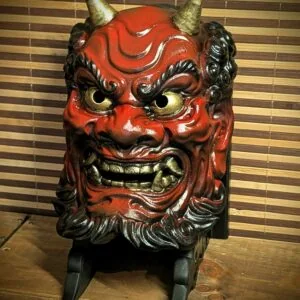
Oni appear in many Japanese stories, festivals and local traditions. They are often shown with horns, fangs and a powerful body, but their color, gender and role vary. At Setsubun they are driven away, while other narratives give oni a guarding or beneficial role. That variety is why an Oni cannot be reduced to a single meaning such as strength or protection.
Hannya: a codified Noh mask
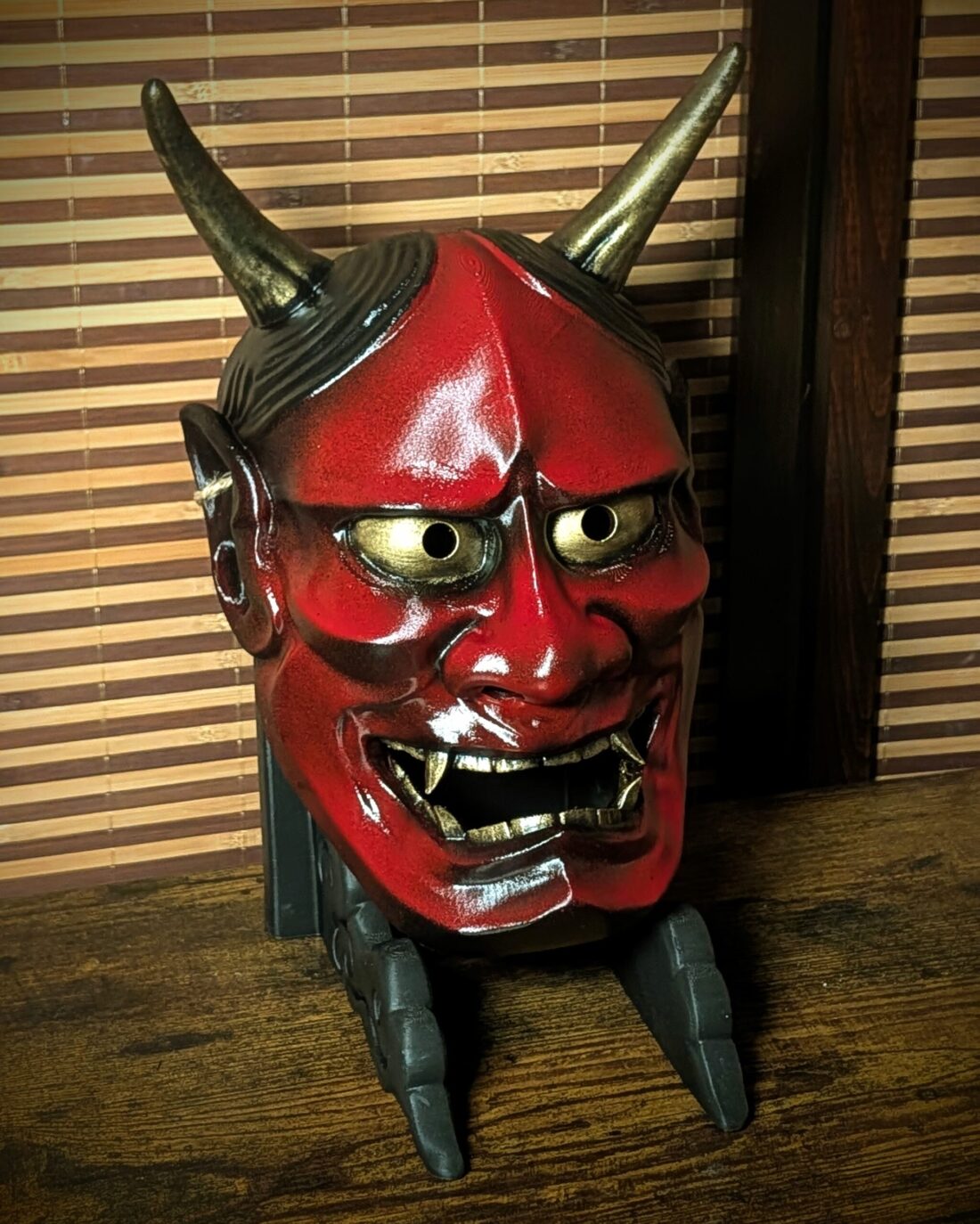
Hannya comes from Noh theatre. Its long face, horns, metallic eyes and open mouth represent a female demonic character marked by jealousy, resentment, rage and suffering. The expression can appear more furious or more sorrowful depending on the angle and light, which gives the mask its emotional tension.
Oni and Hannya compared
| Criterion | Oni | Hannya |
|---|---|---|
| Nature | Broad group of supernatural figures | Specific codified mask |
| Gender | Not restricted to one gender | Female demonic character in Noh |
| Origin | Folklore, stories, festivals and local traditions | Noh theatre |
| Visual form | Highly variable, often broad and powerful | Long face with codified features |
| Meaning | Depends on the story and setting | Emotional transformation, rage and suffering |
Which one for a tattoo?
For irezumi or a Japanese-inspired tattoo, start with the story of the full composition. An Oni can create a massive, threatening or guarding presence depending on the scene. Hannya introduces the tension of emotional transformation. The surrounding figures, colors, scale and direction of the gaze matter more than a universal label.
For a closer visual exercise, compare the contemporary Oni drawing study with the Hannya drawing study. Each separates horns, eyes, mouth and jaw before the design is adapted with a tattoo artist.
Which one for decor?
For a wall display, compare silhouette, scale and lighting. An Oni usually creates a broader, more frontal presence. A Hannya changes more visibly with the viewing angle because its expression combines anger and sorrow. Choose the piece that fits the room and the atmosphere you want, not an assumed spiritual property.
Which one for a gift?
There is no universally easier choice. Consider the recipient’s taste, whether they already know Japanese folklore or Noh theatre, and where the mask will be displayed. If possible, choose from the visual style they already collect rather than assigning a fixed meaning to the gift.
Which one for a tattoo studio?
Both can work in a tattoo studio. An Oni gives a broad and direct silhouette, while a Hannya brings a more angular, emotionally charged face. The useful choice is the one that fits the studio’s visual identity, available wall space and lighting.
In the Dai Yokai workshop
Dai Yokai makes contemporary Oni and Hannya masks in Brittany. Their PETG bases are prepared, sanded, painted and finished by hand. The designs are inspired by Japanese folklore and theatre, but they are not ritual objects, antiques or reproductions of traditional Noh masks carved in Japan.
If the Hannya side is what you are after, the full Hannya mask guide covers the Noh stories and the color readings.
FAQ
Are Oni and Hannya the same thing?
No. Oni is a broad term for different supernatural figures in Japanese folklore. Hannya is a specific type of Noh theatre mask representing a female demonic character shaped by jealousy, resentment or rage. They share visual features, but not the same origin.
Is Hannya simply a female Oni?
That description is too simple. Hannya represents a female demonic figure and can be compared with kijo, or female oni, but the word Hannya mainly refers to a codified Noh mask. Oni is a much broader category found in many stories and traditions beyond theatre.
Are Oni always male?
No. Oni are often represented as male, but the term is not restricted to men. Japanese folklore also includes female demonic figures such as kijo and onibaba, so gender alone does not distinguish an Oni from a Hannya mask.
How can you recognize a Hannya mask?
Hannya usually has a long, codified face, two horns, metallic eyes, an open mouth and an expression mixing anger with pain. Oni often have a broader face and heavier fangs, but their forms vary more. Contemporary designs may combine these visual codes.
Which is more protective, Oni or Hannya?
Neither has a universal protective function. At Setsubun, Oni are driven out of the home, while other stories or local motifs give them beneficial roles. Hannya comes from Noh theatre and should not be reduced to a talisman. Meaning always depends on context.
Oni or Hannya for a Japanese tattoo?
Choose according to the story of the full composition, not a fixed list of symbols. An Oni can bring a massive or threatening presence. Hannya carries tension linked to emotional transformation. The tattoo artist should adapt the motif, associated elements and direction of the gaze to the complete project.
Can Oni and Hannya appear in the same composition?
Yes, in a tattoo, collection or contemporary display. Their shapes create a strong visual contrast, but the pairing has no single traditional meaning. Its coherence comes from the complete design, scale, colors and the other figures used.
Are Dai Yokai Oni and Hannya masks traditional?
No. They are contemporary handmade creations inspired by Japanese folklore and theatre. Their PETG bases are prepared, sanded, painted and finished by hand in Brittany. They are not ritual objects, antiques or traditional Noh masks carved in Japan.