Yokai in brief
- Yokai (妖怪, also written yōkai) is a broad Japanese word for uncanny beings, presences and phenomena.
- “Spirit,” “monster,” “ghost” and “demon” are partial translations, not exact equivalents.
- Yokai can be animals, people, objects, places, sounds or events that break ordinary expectations.
- They are not automatically evil; their roles range from dangerous and comic to helpful or protective.
- Kami and yūrei overlap with yokai vocabulary in some contexts, but they are not interchangeable terms.
- Scrolls, printed books, theatre, manga, games and local storytelling have continually reshaped yokai imagery.
What is a yokai?
A yokai is a strange being, presence or phenomenon in Japanese folklore. The term can describe a river creature, a shapeshifting fox, an animated household object, a giant figure, an unexplained sound or an uncanny event. It is a flexible cultural category, not a single species with one origin, body or moral alignment.
The National Museums of World Culture’s Yokai exhibition describes yokai as spirits or creatures used to explain unusual events, warn people and express a relationship with an unpredictable natural world. Those functions are useful, but no single explanation accounts for every yokai story.
What does yokai mean?
Yokai is written 妖怪 and is commonly romanised yōkai. The pronunciation is close to “yo-kai,” with the first vowel held slightly longer in Japanese. The characters suggest something uncanny, suspicious or extraordinary, but an etymology alone cannot define the many beings and events gathered under the term.
English translations include monster, spirit, demon, goblin, phantom and apparition. Each works for some examples and fails for others. Kappa is creature-like, kitsunebi is a mysterious light, and batabata can be an unexplained sound. Keeping the word yokai is often more accurate than forcing all three into one English category.
Hirota Ryūhei’s study in the Japanese Journal of Religious Studies calls yōkai an elusive, amorphous category and documents its many English translations. That academic caution matters: a tidy one-line definition is helpful for orientation, but it should not become a rigid rule.
Yokai, kami, yūrei, oni and obake compared
| Term | Useful English shorthand | Key distinction |
|---|---|---|
| Yokai (妖怪) | Uncanny being or phenomenon | Broad folklore category; it may be material, immaterial, named or simply experienced |
| Kami (神) | Venerated deity or sacred presence | Honoured within Shinto practice and often enshrined at a jinja |
| Yūrei (幽霊) | Ghost of a dead human | Defined by human death and a continued presence among the living |
| Oni (鬼) | Ogre or demon-like being | A more specific class associated with force, punishment, danger and sometimes protection |
| Obake / bakemono (お化け / 化け物) | Changed or transforming thing | Emphasises transformation; often overlaps with animal shapeshifters and yokai |
Jinja Honcho’s introduction to Shinto explains that kami include ancestors and spirits of nature, and that people venerate them at jinja. Yokai are usually discussed through folklore rather than this relationship of enshrinement and veneration. The line can still move: the National Diet Library notes that tengu may be described as mountain yokai or as Shinto mountain gods.
For the human dead, read the separate guide to yūrei. For the sacred vocabulary, see the guide to kami. Keeping those articles distinct reduces the temptation to treat every Japanese spiritual being as the same kind of “spirit.”
Continue with yūrei and Japanese ghost traditions or kami in Shinto.
Why do yokai stories exist?
Yokai stories can give memorable form to danger and uncertainty. A kappa warns of deep water, a tengu marks the mountain as a place beyond ordinary control, and a strange household noise can become a named presence. The creature turns an invisible risk or confusing experience into something that can be described and retold.
That practical reading is only one layer. Yokai also entertain, parody social behaviour, make fun of authority, embody local identity and give artists a field for invention. Some stories preserve warnings; others were created for illustrated books, theatre or commercial popular culture. “Yokai explain the unexplained” is a useful starting point, not a universal origin theory.
From medieval scrolls to Edo picture books
Japanese supernatural beings existed in stories and images long before the modern word yokai became a familiar global label. Medieval picture scrolls showed strange processions, transformed animals and animated tools. The Hyakki Yagyō, or Night Parade of One Hundred Demons, became a powerful visual frame for gathering many beings into one moving crowd.
The parade is a flexible artistic and narrative motif rather than one fixed eyewitness account. Different scrolls and books change the participants, order and mood. The name can describe an actual procession in an image, while Toriyama Sekien later used it as the title of a picture-book collection that does not show one continuous parade.
The Library of Congress record for Sekien’s Night Parade books explains this distinction and describes sources ranging from Japanese and Chinese literature to regional folk traditions. The collection contains frightening figures, but also humorous inventions and visual jokes.
Toriyama Sekien catalogued and reinvented yokai
Toriyama Sekien published Gazu Hyakki Yagyō in 1776, followed by three related books. His compact pages helped make named supernatural figures easy to recognise, collect and reuse. Later artists drew on those books, so his influence on modern yokai imagery is enormous.
He did not simply record hundreds of unchanged oral traditions, and he did not invent the whole yokai world. His books mixed older literature, earlier picture-scroll imagery, folk material, wordplay and creative additions. Saying that Sekien “gave every yokai its definitive face” hides this process and ignores the variation visible in later prints.
The National Diet Library’s Sekien collection dates the four books and compares his figures with later artists. It also shows direct influence from earlier tsukumogami imagery, evidence that Edo print culture adapted an existing visual tradition rather than starting from nothing.
Useful yokai types, without a rigid taxonomy
There is no single traditional chart that places every yokai into mutually exclusive families. The categories below are practical ways to navigate stories. One figure may belong to more than one row, and its classification can change with the source.
| Practical group | Examples | What links them |
|---|---|---|
| Animal shapeshifters | Kitsune, tanuki, bakeneko, nekomata | Animals gain unusual age, intelligence, transformation or magical agency |
| Water and mountain beings | Kappa, tengu, umi-bōzu | Dangerous or sacred places take recognisable supernatural form |
| Animated objects | Tsukumogami, karakasa-kozō, bakezōri | Tools and household objects become active, often after neglect or long use |
| Humanoid and ogre-like beings | Oni, rokurokubi, yamauba | Bodies become excessive, transformed or threatening |
| Phenomena and sounds | Kitsunebi, yanari, batabata | A light, noise or event can be the yokai, even without a stable body |
| Modern or reworked yokai | Gashadokuro and media-era characters | New images can enter the shared tradition and later appear ancient |
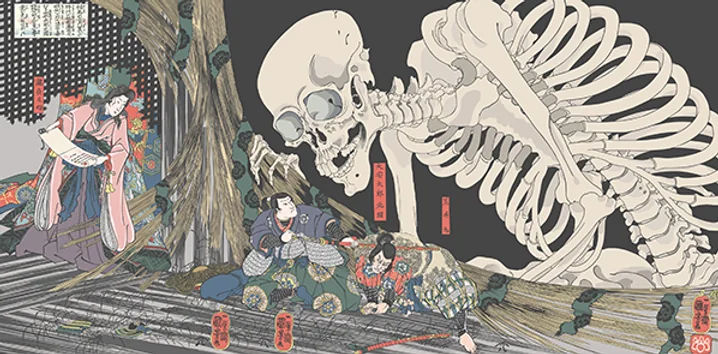
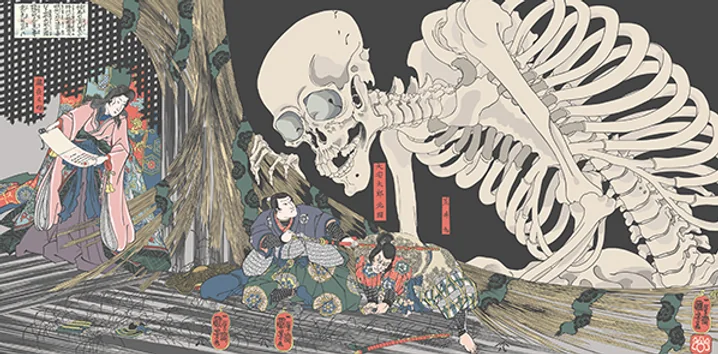
Gashadokuro is a useful warning against assuming that every famous yokai is ancient. Hirota’s academic history traces the giant skeleton as a modern creation publicised in 1966 and then absorbed into national yokai media. Folklore is transmitted, but it is also continually made.
Tsukumogami and the living-object tradition
Tsukumogami are old tools or household objects that acquire agency and transform. Popular summaries often say that every object becomes a yokai on its hundredth birthday. The older picture-scroll tradition is more specific and moral: discarded tools become resentful, take revenge and later pass through further religious events in the story.
The National Diet Library’s Tsukumogami Emaki presents abandoned old tools transforming into yokai to retaliate against humans. The scroll makes the objects part of a narrative about use, disposal and consequence, not a mechanical rule for every item that reaches an exact age.
Famous yokai and what they represent
| Yokai | Main setting or trait | Useful guide |
|---|---|---|
| Kappa | Rivers, ponds, drowning danger, sumo and promises | Water yokai |
| Kitsune | Fox transformation, deception and links with Inari traditions | Animal shapeshifter |
| Tengu | Mountains, flight, pride, martial skill and religious overlap | Mountain being |
| Oni | Force, punishment, calamity, outsiders and protective imagery | Ogre-like being |
| Tanuki | Transformation, tricks, humour and good-fortune imagery | Animal shapeshifter |
| Nekomata | Aged cats, split tails, transformation and dangerous agency | Cat yokai |
Explore the individual traditions in the guides to Kappa, Kitsune, Tengu, Oni, Tanuki and Nekomata and bakeneko.
For a list-led introduction rather than this definition and history guide, use the separate Top 10 Japanese Yokai. Keeping the two purposes separate avoids turning this page into another shallow list.
Are yokai dangerous, helpful or protective?
A yokai has no automatic moral alignment. Kappa stories can end in drowning, a broken promise, medical knowledge or local veneration. Tengu may abduct, punish pride, train warriors or guard a mountain. Animal shapeshifters can deceive a traveller in one tale and repay kindness in another.
This also means a yokai image is not automatically a protective charm. An oni face may be used apotropaically in a specific architectural or festival context, but a contemporary oni mask does not gain that religious function simply by facing a doorway. Meaning comes from the object, story, setting and practice together.
Yokai in modern manga, games and film
Modern media did not merely preserve a finished old catalogue. Artists such as Mizuki Shigeru redrew, selected and popularised yokai for new audiences, while later manga, animation, games and films continued the process. Some works use named folklore figures; others borrow the structure of transformation, collectable creatures or a hidden world beside everyday life.
Calling every Japanese fantasy monster a traditional yokai is therefore a mistake. A modern character may be inspired by yokai without appearing in older folklore, and a media creation can become culturally familiar enough to shape later ideas about the category.
Yokai imagery at Dai Yokai
Dai Yokai is a workshop in Brittany, France, creating contemporary masks inspired by Japanese folklore and mask aesthetics. The pieces are not Japanese ritual objects. Their PETG bases are prepared, sanded, primed, painted, varnished and finished by hand for display, collecting, conventions or suitable costume use.
The workshop focuses on specific visual families such as hand-painted Oni masks, Kitsune masks, Tengu masks and Hannya-inspired masks. Hannya belongs to Noh theatre rather than serving as a generic word for yokai, so each collection keeps its own context.
Sources and further reading
- Japanese Journal of Religious Studies: Yōkai in Postwar Japan, for the category’s changing definitions and modern media history
- National Diet Library: Toriyama Sekien’s Illustrated Night Parade, for dates, visual comparisons and Edo print history
- Library of Congress: Nocturnal Procession of the Hundred Demons, for Sekien’s sources and book structure
- National Museums of World Culture: Yokai, Spirits of Japan, for warnings, unusual events and popular culture
- Jinja Honcho: What is Shinto?, for kami, jinja and veneration
- National Diet Library: Tsukumogami Emaki, for the transformed-object story
Conclusion
Yokai is best understood as a flexible word for the strange beings and events of Japanese folklore, not as the name of one supernatural species. It can hold a river danger, an animal trickster, a living tool, an unexplained sound and a modern media creation. The category stays useful precisely because its boundaries move.
FAQ
What is a yokai?
A yokai is a strange being, presence or phenomenon in Japanese folklore. The category can include animal shapeshifters, animated objects, monsters, sounds and uncanny events. “Spirit,” “monster” and “demon” each translate part of the idea, but none covers every yokai.
What does yokai mean in Japanese?
Yokai is written 妖怪 and is also romanised yōkai. The word points to something uncanny, suspicious or extraordinary. In English it may be translated as spirit, monster, apparition, goblin or demon depending on context, but the broad Japanese term does not have one exact English equivalent.
Are yokai Japanese demons?
Some yokai can reasonably be described as demon-like, especially in a short translation, but yokai are not all demons. The category also contains playful animal shapeshifters, household beings, living objects and unexplained phenomena. Calling every yokai a demon wrongly suggests that they share one nature and are always evil.
Are yokai good or evil?
Yokai do not fit one moral category. A story may present one as violent, mischievous, helpful, protective or simply strange. The same named being can behave differently across regions and periods. It is more accurate to ask what a particular yokai does in a specific story than whether all yokai are good or evil.
What is the difference between a yokai and a kami?
Kami are venerated within Shinto practice and enshrined at jinja, while yokai usually belong to folklore about uncanny beings and events. The boundary is not absolute: some figures can be described as a yokai in one context and honoured as a kami in another. Tengu traditions show this overlap clearly.
What is the difference between a yokai and a yūrei?
A yūrei is specifically the ghost of a dead human. Yokai is a broader and less precise category that includes nonhuman creatures, transformed animals, animated objects and mysterious phenomena. Some museums and popular sources group ghosts under the yokai umbrella, but separating yūrei is useful when explaining Japanese ghost traditions.
Is an oni a yokai?
Oni are generally included within the broad world of yokai, but oni is a more specific term for powerful ogre-like beings associated with punishment, calamity, dangerous outsiders and protection in different traditions. Not every yokai is an oni, and not every horned figure in Japanese art has the same meaning.
Do old objects really become tsukumogami after 100 years?
The idea that old tools become tsukumogami after a long life, often simplified as 100 years, is a famous folklore motif. Medieval and early modern picture scrolls show abandoned objects transforming and taking revenge. It is a story pattern about age, use and disposal, not a universal religious rule about every household object.