By Jérémy, creator @dai.yokai · Updated July 2026
Short answer
Yokai and kami are not two opposing species of supernatural being. A kami is understood first through a relationship of veneration: a place, an offering, a rite, a living tradition. A yōkai lives mostly in stories, images and the explanations people give to the strange. The difference is less about appearance than about context.
Amaterasu and Inari are kami. The kappa and the Gashadokuro are yōkai. A fox, a Tengu or an Oni cannot always be sorted correctly without knowing the story, the place and the period. Fudō Myōō is neither: he is a protective figure of Buddhism.
Kami and yōkai at a glance
| Question | Kami | Yōkai |
|---|---|---|
| Core idea | A presence or power a community relates to through ritual | A strange being, transformation or phenomenon that is told, named or pictured |
| Usual context | Shrine, offering, festival, prayer, local tradition | Tale, legend, rumour, print, illustrated encyclopedia, popular culture |
| Relation to humans | Respect, gratitude, requests for protection | Fear, warning, curiosity, humour, explanation of the unknown |
| Clear examples | Amaterasu, Inari Ōkami | Kappa, Gashadokuro, Rokurokubi |
This table gives a method, not a universal taxonomy. Shinto, Buddhism, local cults and popular arts exchanged forms for centuries, so one appearance can carry very different statuses.
What is a kami?
Translating kami as "god" is convenient but narrow. The word can name a power tied to a place, a natural phenomenon, an ancestor, a mythical figure or a presence honoured by a community. The Encyclopedia of Shinto describes an open world often summarised by the phrase yaoyorozu no kami, the eight million kami, a way of saying countless.
The most useful test is the relationship. A kami receives respect, offerings, prayers or a festival. That bond may sit in a shrine, a landscape, a trade or the history of a group. It does not depend on measurable power or a human shape. Amaterasu, linked to the sun and the Ise Grand Shrine, is honoured through a continuous religious relationship. Inari Ōkami shows another difficulty: the foxes seen at Inari shrines are understood as messengers, not as Inari itself.
Shinto did not live in a bubble either. For much of Japanese history, kami and Buddhist figures were paired, interpreted together or honoured in mixed settings. The institutional separation imposed in the Meiji era should not be projected onto every earlier century.
What is a yōkai?
Yōkai is also a broad word. It can cover recognisable creatures, animal transformations, animated objects, apparitions or events that are hard to explain. The Nichibunken folktale and image databases collect thousands of these cases from across Japan.
The kappa of the rivers has a name, a silhouette and recurring behaviour. The Gashadokuro takes the spectacular shape of a giant skeleton. Other folklore entries describe mostly a sound, a light or a strange presence. Reducing every yōkai to a "Japanese demon" loses that range. A yōkai is not necessarily evil. Some attack or deceive, others warn, amuse or stage a social rule. Edo-period prints, illustrated encyclopedias, theatre, manga and games later fixed silhouettes that had once been more fluid.
Why the boundary stays blurry
The line is porous, but not because a yōkai follows a career to "become" a kami. That shortcut is misleading. Communities, places, stories and practices are what change how a figure is named and treated.
The same name can cover several traditions. Two tales using the word Tengu need not describe the same thing: an arrogant adversary, a mountain power, a master of discipline or a figure tied to a local religious practice. The right question is not only "what is a Tengu?" but "in which source and which context?".
Veneration changes the relationship, not always the image. A frightening look does not rule out a protective role, and a beautiful figure is not automatically a kami. Modern categories from dictionaries, museums and publishers are useful, but they should not suggest that every village and every era applied the same grid.
A reliable method to tell them apart
Start from the strongest evidence and keep appearance for last.
1. What is the precise source: shrine, temple, tale, print, local account? The original context beats a label found on an isolated image. 2. What do humans do with this figure: pray, offer, appease, tell, fear, laugh? The relationship usually separates cult from folklore. 3. Which region and which period? A name can shift meaning over time and place. 4. Does it look like a demon, an animal or a human? This is a weak clue. The same visual codes travel between religion, folklore and art.
This avoids two common errors: calling every protective figure a kami, or calling every monstrous face a yōkai. It also allows a careful answer when a source gives too little context.
Test cases
Amaterasu is a kami without useful ambiguity. Her status comes from a continuous religious relationship at Ise, not merely from supernatural power. Filing her among yōkai would make no sense.
Inari and the foxes separate a power from its messengers. Inari is a kami; the foxes at the shrines are messengers. Folklore also knows shapeshifting foxes that trick or help humans. The animal is the same, the relationships are not.
Kappa and Gashadokuro are yōkai of very different kinds: one has many local variants tied to water and drowning warnings, the other works mainly as a striking monstrous image. Neither is defined by a cult like Amaterasu or Inari.
Raijin and Fūjin are gods with demon-like faces. The Kyoto National Museum holds Tawaraya Sōtatsu's famous Wind God and Thunder God screens, a National Treasure showing two divine figures with fierce, almost demonic features. Their imagery proves that a monstrous face does not mean yōkai.
Tsukumogami show objects entering the tales: an old umbrella, lantern or instrument imagined with a face and behaviour. Their animation is not enough to establish a cult, so they sit on the yōkai side.
Three classic traps
The Kitsune is not always the same fox. Folklore foxes deceive, help or marry humans; the white foxes around Inari are messengers, not Inari. Saying "the Kitsune is both yōkai and kami" mixes several figures.
The Oni is not only an evil demon. It belongs largely to tale, theatre, image and popular ritual, as a threat or a force driven off at Setsubun, yet related forms also appear as guardians and in Buddhist imagery. "Oni equals yōkai, never kami" looks tidy but erases local uses.
The Tengu changes with the mountain and the source. It is often classed as a yōkai, yet some mountain cults treat it as a protective power. That exception should be named by place, not turned into a general rule.
Fudō Myōō: neither kami nor yōkai
A two-column comparison leaves out a third essential set: Buddhist figures. Fudō Myōō, or Achala, is a Wisdom King of esoteric Buddhism. The Metropolitan Museum of Art describes him as the Immovable Wisdom King, an emanation of Dainichi Nyorai, surrounded by flames, holding a sword that cuts through ignorance and a lasso that restrains obstacles. His furious face expresses determined protection, not the nature of an Oni or a yōkai.
| Figure | Useful class | What matters |
|---|---|---|
| Inari Ōkami | Kami | Cult, shrines, ritual relationship |
| Gashadokuro | Yōkai | Tale and image of a giant skeleton |
| Fudō Myōō | Buddhist figure | Wisdom King and protector in esoteric Buddhism |
| Raijin and Fūjin | Thunder and wind gods | Divine figures with fierce imagery across art and religion |
Appearance does not give the category
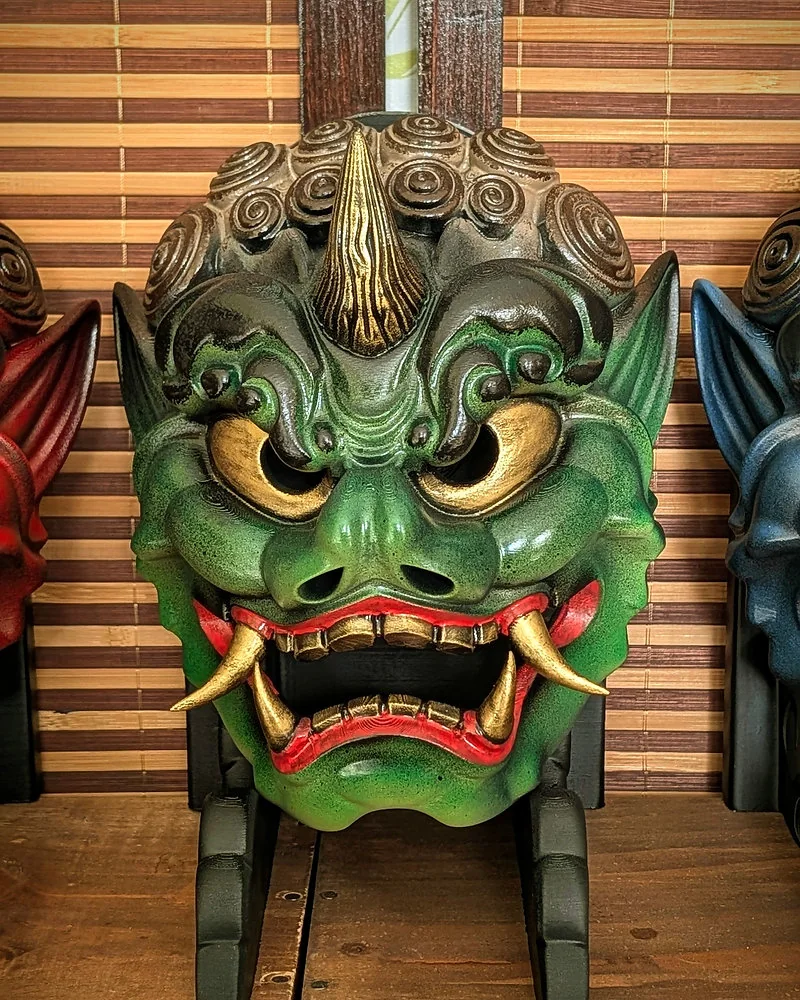
This is why a fierce face on a Japanese mask settles nothing. Horns, fangs and tense brows are visual codes, not a religious identity card. Raijin and Fūjin look like Oni yet stand for the gods of thunder and wind. An Oni belongs to folklore and its ambivalent force. Fudō Myōō belongs to Buddhism. Three fierce faces, three readings.
At the Dai Yokai workshop the pieces are decorative and wearable creations inspired by Japanese figures, made and finished by hand in Brittany. They are not objects of worship or ritual reproductions. For a closer look at how one silhouette can carry several meanings, the handmade Japanese masks of the workshop are a good starting point.
Frequently asked questions
What is the difference between yokai and kami?
A kami is understood through veneration: a shrine, offering, rite or tradition. A yōkai lives in stories, images and explanations of the strange. Context decides more than appearance.
Is a kami exactly a god?
Not exactly. Kami can name a power tied to a place, a natural force, an ancestor or a mythical figure. Some resemble Western gods, many do not.
Are all yōkai evil?
No. Some harm or deceive, others warn, amuse or explain a local danger. The meaning depends on the version of the tale.
Can a yōkai become a kami?
It is misleading to picture a fixed career. What changes is the relationship a community builds with a figure in a given place and period, not an automatic promotion.
Is the Kitsune a yōkai or a kami?
Both labels get mixed. Folklore foxes are yōkai; the foxes at Inari shrines are messengers of a kami. They should be told apart by source.
Is the Oni a kami or a yōkai?
Mostly a folklore and theatre figure, so usually a yōkai. Related forms appear as guardians and in Buddhist imagery, so local context matters.
Is Fudō Myōō a kami or a yōkai?
Neither. He is a Wisdom King of esoteric Buddhism, a protective figure, despite his fierce appearance.
Can you recognise a kami or a yōkai by appearance?
No. The same visual codes travel between religion, folklore and art. You need the name, the source, the place and the human relationship.