Fudō Myō-ō is easy to misread. The flames, sword, fangs and fixed glare can make him look like a demon or war god. In Japanese Buddhism, however, he is a wrathful protector whose fierce image serves wisdom, discipline and the removal of obstacles to enlightenment.
Who is Fudō Myō-ō?
Fudō Myō-ō is the Japanese Buddhist form of the Sanskrit deity Acala. He belongs to the Myō-ō, a group translated as Wisdom Kings, Kings of Light or Kings of Brightness. The Kyoto National Museum describes him as the most prominent of these wrathful deities and an incarnation of Dainichi, the central Cosmic Buddha of Esoteric Buddhism.
Fudō is especially important in Japanese Esoteric Buddhist traditions, including Shingon and Tendai. “Wrathful” does not mean evil. His intimidating form represents a forceful method of protecting the Buddhist teaching and confronting attachments or delusions that gentler imagery may not overcome.
What does “Fudō Myō-ō” mean?
Fudō means immovable or unshakable. The name points to steadfastness and to the unchanging reality represented beneath his fierce exterior. Myō-ō identifies his category among the Wisdom Kings. The English titles differ between museums, but “Immovable Wisdom King” is clear and widely understood.
The meaning is doctrinal rather than a personality slogan. Fudō is not simply a symbol for stubbornness. His immovability is linked to clarity and commitment that are not displaced by fear, temptation or illusion.
Fudō Myō-ō symbols at a glance
| Attribute | What it communicates |
|---|---|
| Sword | Wisdom cutting through ignorance, delusion and obstacles |
| Rope or lasso | Binding opposing forces and drawing straying beings back toward the path |
| Flames | Purification and transformative protective power |
| Rock seat or base | Immovability and spiritual steadfastness |
| Wrathful face | Forceful protection, not hatred or demonic identity |
| Dark or blue body | A common artistic convention that varies across works and periods |
| Kongara and Seitaka | Two attendants who may accompany Fudō |
The sword and rope are not ordinary weapons
The sword is commonly called a sword of wisdom. The Metropolitan Museum of Art explains that Fudō uses it to cut through ignorance. Its function is therefore directed at delusion and obstacles to enlightenment, not conquest in the ordinary military sense.
The rope or lasso restrains forces that block the Buddhist path. The British Museum describes it as binding the enemies of enlightenment, while other explanations emphasize drawing straying beings back. Both readings belong to a protective and transformative role.
Why Fudō stands before flames and rock
Fudō is often surrounded by a flaming halo or mandorla. The fire communicates purification and a power that consumes obstacles and defilements. Calling him a “fire god” removes that Buddhist context and makes the flames sound like control over a natural element.
The rock reinforces his name. Historical paintings and sculptures show him standing or seated on a firm rocky base. Together, rock and flame create a deliberate contrast: unmoving clarity at the centre of fierce transformative energy.
Why his face looks wrathful
Fudō’s expression can include glaring eyes, fangs, furrowed brows and a rigid posture. The Kyoto National Museum explains wrathful Buddhist figures as formidable defenders whose frightening appearance serves the Buddhist dharma.
Iconography varies. Some works show both eyes open; later images may show one eye partly closed, asymmetrical fangs or different body colors. Those differences make it risky to present one facial detail as a universal code. The overall role is more stable than every visual feature.
Kongara and Seitaka, the two attendants
Fudō can appear alone, as the foremost of five Wisdom Kings, or with two attendants named Kongara Dōji and Seitaka Dōji. A thirteenth-century Met painting places the two smaller figures beside him, emphasizing Fudō as the central protector.
Their absence does not make an image “incorrect.” Buddhist artworks were made for different settings, lineages and visual programs. When identifying a historical object, use the museum or temple record rather than expecting every possible attribute to appear.
Fudō Myō-ō in Japanese tattoo imagery
In Japanese tattoo imagery, Fudō can communicate steadfastness, discipline, protection and the defeat of ignorance. The flames, rock, rope and sword provide a powerful composition, but they are not interchangeable decoration. Their Buddhist meanings should shape the design.
A tattoo does not receive one automatic meaning from a search result. The wearer, artist, composition and religious awareness all matter. For a broader explanation of figures and pairings, use the Japanese tattoo meaning and motif guide.
Fudō is not a demon or yōkai
Fudō Myō-ō is a Buddhist protector. He should not be introduced as an Oni, demon or ordinary yōkai simply because his face is frightening. Oni belong to different bodies of folklore, religion and popular culture. Komainu are also guardians, but they are lion-like attendants rather than Wisdom Kings.
For that distinction, compare the separate guide to Komainu guardian lion-dogs. Both subjects can express protection, but their identities, attributes and religious contexts are not the same.
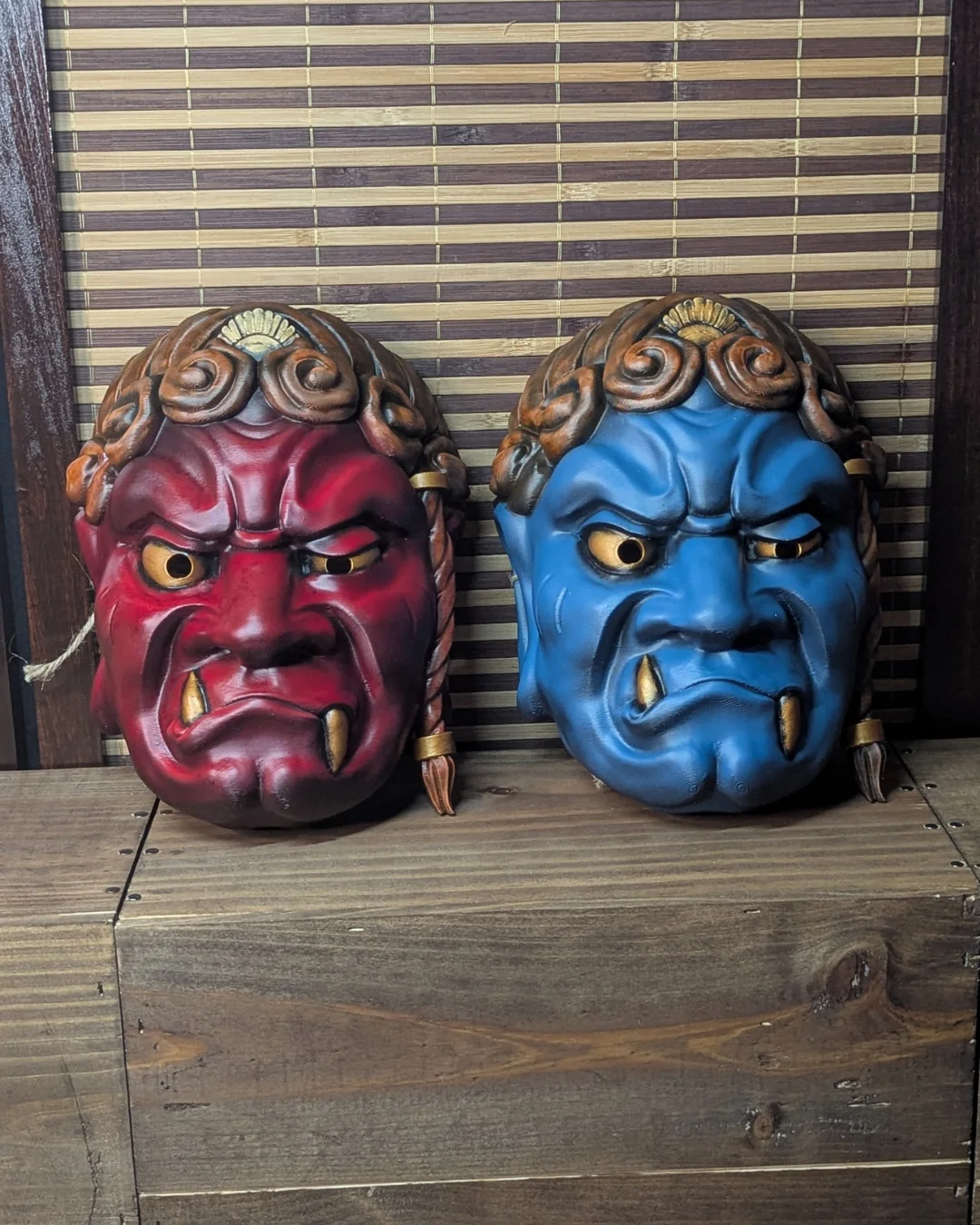
A contemporary Fudō-inspired mask by Dai Yokai
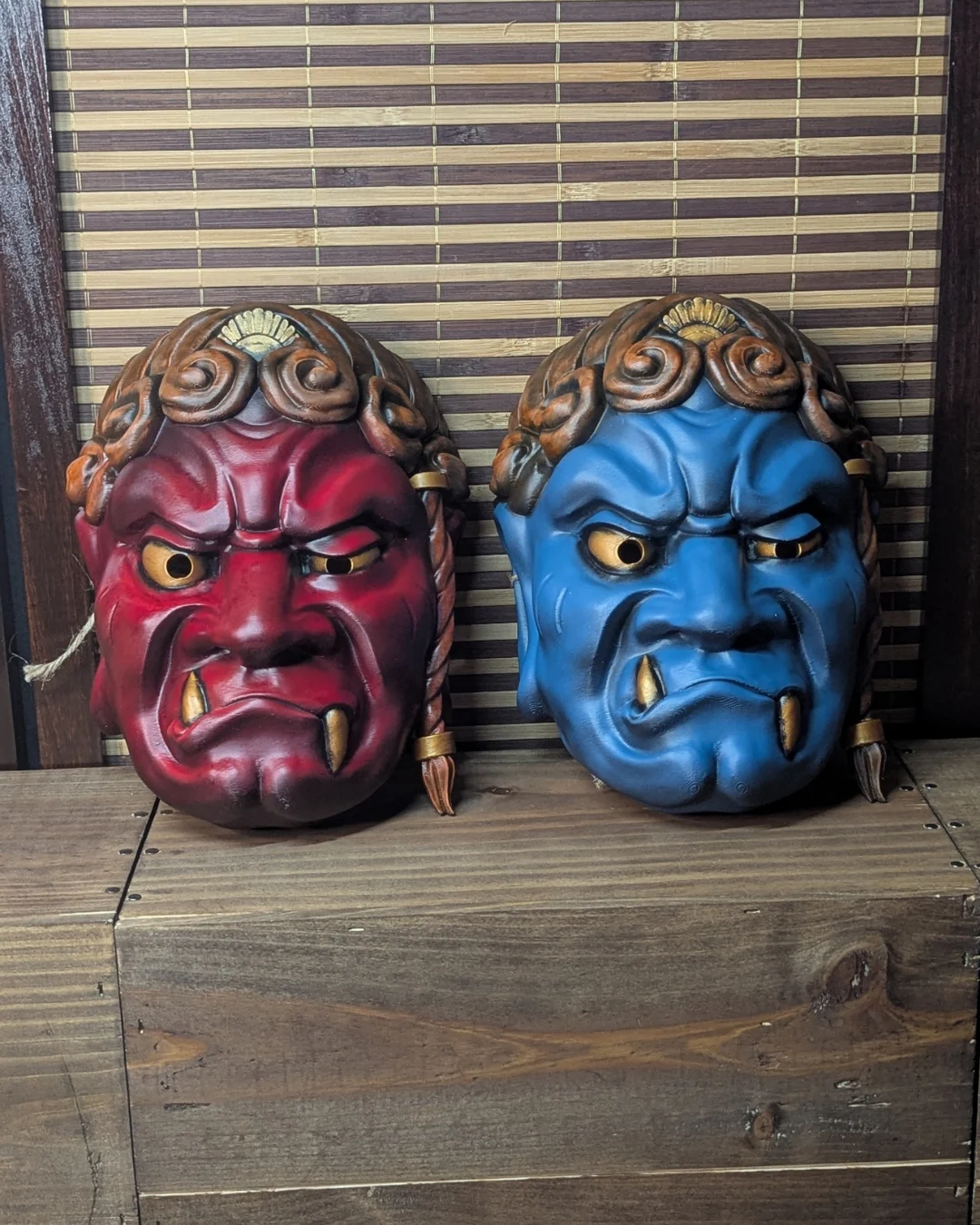
Dai Yokai makes a contemporary Fudō Myō-ō inspired mask in Brittany, France. The PETG base is prepared, sanded, painted, varnished and finished by hand. The design focuses on the fixed stare and guardian intensity associated with Fudō imagery.
The piece is not a temple sculpture, a consecrated object or a traditional ritual mask. It is a modern decorative interpretation. That distinction allows the product to acknowledge its visual source without claiming Buddhist authority or an invented ceremonial function.
How to read a Fudō image carefully
- Identify the sword, rope, flames and rock before guessing at symbolic meanings
- Check whether Kongara and Seitaka or other Wisdom Kings are present
- Do not classify Fudō as a demon solely from his wrathful face
- Expect variations in eyes, fangs, posture, body color and attendants
- Use the museum, temple or collection record for the specific historical work
Sources and further reading
- Kyoto National Museum, Fudō Myōō and the Wisdom Kings
- Metropolitan Museum of Art, Fudō’s sword, lasso and immovable form
- Metropolitan Museum of Art, Fudō with Kongara and Seitaka
- British Museum, Heian-period sculpture and iconographic variations
- Kyoto National Museum, wrathful Buddhist deities and their protective role
FAQ
Who is Fudō Myō-ō?
Fudō Myō-ō is the Japanese form of Acala, a prominent Wisdom King in Esoteric Buddhism. He is understood as a wrathful manifestation or emanation of Dainichi Nyorai, the Cosmic Buddha. His intimidating appearance expresses a forceful protective role: overcoming obstacles, delusion and attachments that prevent beings from following the Buddhist path.
What does the name Fudō Myō-ō mean?
Fudō means “immovable,” while Myō-ō is translated as Wisdom King, King of Light or King of Brightness. The name points to spiritual steadfastness and the unchanging reality beneath his fierce exterior. It does not mean that Fudō is emotionally cold or physically unable to move; the term belongs to Buddhist doctrine and iconography.
What do Fudō Myō-ō’s sword and rope mean?
The sword represents wisdom cutting through ignorance, delusion and obstacles to enlightenment. The rope or lasso binds forces that oppose the Buddhist teaching and can also be understood as drawing straying beings back toward the path. These objects are religious attributes, not simply weapons that make Fudō a warrior god.
Why is Fudō Myō-ō surrounded by flames?
Fudō’s halo or mandorla is often formed by flames. In his iconography, fire expresses purification and the power that consumes obstacles and defilements. It is therefore too simple to call him merely a god of fire. The flames belong to a wider Buddhist image of transformative, protective force.
Is Fudō Myō-ō a demon or yōkai?
No. Fudō Myō-ō is a Buddhist protector, not a demon or ordinary yōkai. His fangs, glare, dark body and flames can look frightening outside their religious context, but the wrathful form serves Buddhist teaching. Modern tattoos, games and fantasy may reinterpret him, yet those versions should not replace his identity as Acala, the Immovable Wisdom King.
Who are the two attendants beside Fudō Myō-ō?
Fudō is sometimes shown with two youthful attendants, Kongara Dōji and Seitaka Dōji. Museum objects identify them beside or below the central figure, although Fudō can also appear alone or as the leading figure among five Wisdom Kings. Their presence is common and important, but not required in every historical representation.
What does a Fudō Myō-ō tattoo mean?
A Fudō Myō-ō tattoo can evoke steadfastness, discipline, protection and the cutting away of ignorance. Its meaning is not automatically fixed by the image alone. The sword, rope, flames, rock and attendants belong to Buddhist iconography, so a respectful design should study those elements instead of reducing Fudō to a generic angry warrior.
Is the Dai Yokai Fudō mask a ritual object?
No. The Dai Yokai mask is a contemporary decorative creation inspired by Fudō Myō-ō’s wrathful face and visual attributes. Its PETG base is prepared, painted and finished by hand in Brittany. It is not consecrated, not used for Buddhist worship and not presented as a historical temple sculpture or an authentic ritual mask.