
Komainu are among the most recognizable guardians in Japan: compact lion-like figures watching an approach, gate or sacred building. In English they are often called lion-dogs and sometimes grouped with “Foo Dogs.” That shortcut is useful for recognition, but it can blur the difference between Japanese komainu, Chinese guardian lions and Okinawan shīsā.
What is a komainu?
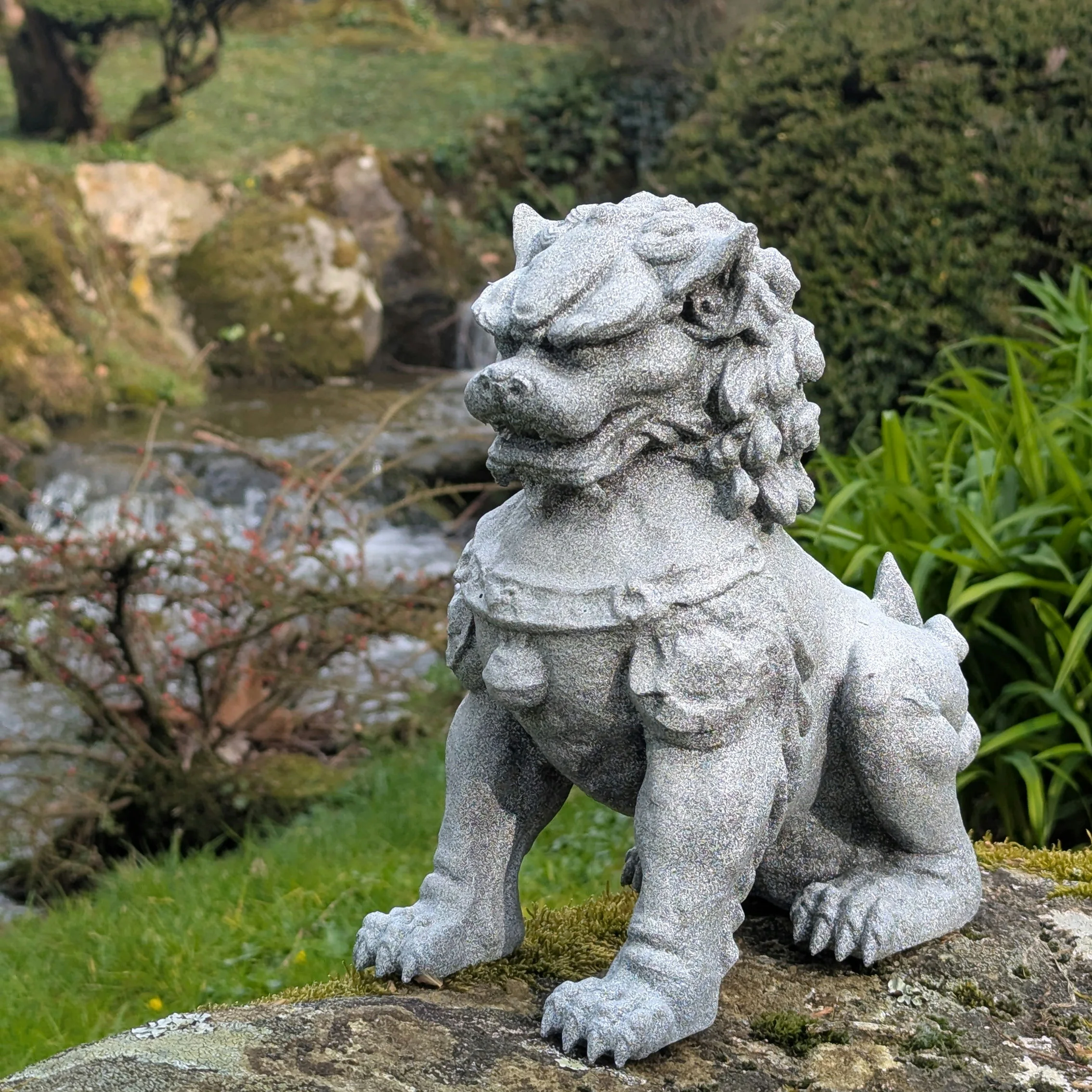
A komainu is a sculpted guardian with a lion-like body, mane and alert posture. Pairs can stand near shrine or temple entrances, beside an approach, in front of a worship hall or within a sacred building. Their role is protective: they mark and guard a place connected with a deity or Buddhist image.
The name 狛犬 is commonly translated as “lion-dog” or glossed literally as “Korean dog.” The animal is not a natural dog breed. It belongs to an artistic lineage of imagined guardian lions that travelled and changed across Asia. Its Japanese history is therefore more useful than a literal reading of the name alone.
What does a komainu symbolize?
Komainu symbolize guardianship, vigilance and the protection of sacred space. Their position near a threshold makes them visual markers between an ordinary route and a place of worship. This does not mean that every figure promises the same kind of luck, wealth or spiritual benefit.
Local history matters. A pair at one shrine may have a documented donor, date, material or legend that another pair does not share. For cultural accuracy, begin with the general protective role, then check the specific site before assigning a more detailed story.
From guardian lions to Japanese komainu
Lions are not native to Japan. Guardian-lion imagery travelled east through Buddhist art and court culture. The Kyoto National Museum explains that increasingly stylized lion images moved through China before entering Japan, where paired guardian lions and lion-dogs took on protective roles at shrines and temples during the Heian period.
Japan’s e-Museum describes links with Chinese pairs guarding Buddhist statues and with lion imagery preserved in early Japanese collections. It also notes that guardian forms used inside shrines or along verandas may have helped shape the independent statues later seen in sacred settings.
Shishi and komainu were once different figures
Today, people often call both animals in a pair komainu. Historically, the distinction could be more precise. The open-mouthed, unhorned figure was a lion or shishi; the closed-mouthed figure with a single horn was the komainu. The Kyoto National Museum collection database documents this lion-and-lion-dog pairing in a Kamakura-period work.
These traits did not remain fixed forever. Horns became less consistent, styles changed and the collective name komainu spread to both members of the pair. A modern stone pair may therefore look like two lions rather than a visibly different lion and horned dog.
Why one mouth is open and the other closed
The open-mouthed figure is called agyō and is associated with the sound “a.” The closed-mouthed figure is ungyō, associated with “un.” The pair is known as A-Un. Japan’s Tourism Agency explains this pattern as the beginning and end, related to the sacred Sanskrit sound “aum.”
The same open-and-closed contrast appears in other paired Japanese guardians, including Niō figures. It is a strong identifying feature, but not a reason to invent separate jobs such as “one repels evil while the other traps good energy.” That popular explanation is not needed to understand the documented A-Un pairing.
Komainu, Foo Dogs, shīsā and Inari foxes
| Guardian | Main context | Useful distinction |
|---|---|---|
| Komainu | Japanese shrines and temples | Japanese lion-like guardians, commonly paired as A-Un |
| Chinese guardian lion or “Foo Dog” | Chinese religious, civic and domestic architecture | Related lion tradition, but not an exact English synonym for komainu |
| Shīsā | Okinawan and wider Ryukyuan settings | Related local guardians often seen on roofs, gates and homes |
| Inari fox | Inari shrines | Fox messengers associated with Inari, not lion-dogs |
“Foo Dog” is best treated as an informal search term. It usually refers to Chinese guardian lions, despite the word “dog.” Komainu belong to the Japanese branch of the wider guardian-lion tradition. The two are related through artistic transmission, but they are not identical names for one unchanged object.
Shīsā are close relatives, not simply komainu moved to Okinawa. The official Okinawa travel guide describes them as guardians of rooftops and entrances derived from Chinese guardian lions and shaped by Ryukyuan spiritual culture. Their household setting and local stories deserve separate treatment. Inari foxes are easier to distinguish: they act as messengers of Inari, while komainu retain a lion-like guardian form.
Are komainu yōkai or demons?
Komainu are not best introduced as demons or ordinary yōkai. They are sacred guardians shaped by religious art and shrine or temple practice. Their fierce faces express vigilance and protection, not moral evil. Modern entertainment can reinterpret them as monsters, spirits or fantasy creatures, but that is a later creative use.
This distinction also separates them from Oni. Oni can be threatening, punished, converted or protective depending on the story and setting. Komainu begin from a guardian role. Another architectural protector is explained in the guide to Oni-gawara roof guardians.
Can you place komainu at home?
Historical komainu are strongly associated with pairs and sacred sites. Contemporary decorative statues are different objects. There is no need to claim that a home figure must reproduce a shrine’s exact left-right arrangement, face a particular compass direction or always be bought as a pair.
If you own one modern statue, place it where its silhouette and hand-finished surface can be seen safely: on a stable shelf, desk, display cabinet or entryway console. Describe it honestly as Japanese-inspired decor. Do not present it as consecrated, ritually active or equivalent to a historical shrine sculpture.
A Komainu statue made in the Dai Yokai workshop
Dai Yokai makes a contemporary Komainu Foo Dog statue in Brittany, France. The PETG base is prepared, textured, painted and finished by hand. Small variations in paint and surface are part of the workshop process.
The piece borrows the alert posture, mane and guardian presence associated with komainu. It is sold as one decorative statue unless the product option clearly states otherwise. It is not an antique, a ritual object or a reproduction of one specific shrine guardian.
How to identify a komainu carefully
- Look for a lion-like body, mane and guardian posture rather than a natural dog shape
- Check whether the figure belongs to an A-Un pair with open and closed mouths
- Do not require a horn: it is historically important but absent from many later examples
- Use the location and site documentation to distinguish shrine guardians from domestic shīsā or other lion figures
- Avoid assigning a precise date, school or religious meaning from appearance alone
Sources and further reading
- Kyoto National Museum, history of guardian lions and lion-dogs
- Kyoto National Museum collection database, pair of shishi and komainu
- National Institutes for Cultural Heritage e-Museum, early guardian-dog sculpture
- Japan Tourism Agency, Komainu guardian statues and A-Un
- Visit Okinawa Japan, shīsā in Ryukyuan spiritual culture
FAQ
What is a komainu?
A komainu is a Japanese lion-like guardian figure associated with Shinto shrines and Buddhist temples. The figures commonly appear in pairs near an approach, gate, worship hall or sacred interior. Historically, a pair could consist more precisely of a lion called shishi and a horned lion-dog called komainu, although both figures are now commonly called komainu.
What does a komainu symbolize?
Komainu symbolize guardianship of a sacred place and the boundary between ordinary and protected space. Their exact form and setting vary by period and site. It is safer to describe them as protective attendants than to assign universal promises such as wealth, luck or household energy, which are not the same across every shrine, temple or modern decoration.
Why does one komainu have its mouth open and the other closed?
The open mouth is associated with the sound “a” and the closed mouth with “un.” Together, A-Un expresses a beginning and an end, a pattern also found in paired Niō guardians. Many komainu pairs follow this arrangement, but surviving examples vary, so the mouth pattern should not be treated as an unbroken rule for every period and location.
Are komainu and Foo Dogs the same?
Not exactly. “Foo Dog” or “Fu Dog” is a loose Western name usually applied to Chinese guardian lions. Komainu are the Japanese development of a wider Asian guardian-lion tradition. The forms are related, but the names, histories and settings are not interchangeable. Calling every East Asian guardian lion a Foo Dog hides useful cultural distinctions.
Are komainu Japanese or Chinese?
Komainu are Japanese guardian figures shaped by ideas and images that travelled through Asia with Buddhism. Museum sources trace the wider guardian-lion tradition through India and China before its development in Japan. The Japanese pairing of shishi and komainu became established during the Heian period, then continued to change in later centuries.
What is the difference between komainu and shīsā?
Komainu and Okinawan shīsā belong to related guardian-lion traditions, but they developed in different settings. Shīsā guard rooftops, gates and homes within Ryukyuan culture, while komainu are strongly associated with shrine and temple approaches in mainland Japan. Calling shīsā “Okinawan komainu” is therefore too reductive as a complete definition.
Are komainu yōkai?
Komainu are not usually defined first as yōkai. They are better understood as sacred or protective guardian figures connected with shrines, temples and Buddhist-derived lion imagery. Modern games, manga and fantasy may treat them like supernatural creatures, but that popular classification should not replace their historical religious and artistic context.
Can you display one komainu statue at home?
Historical shrine and temple guardians are strongly associated with pairs, but there is no single universal rule governing every contemporary decorative object. A single handmade statue can be displayed as modern Japanese-inspired decor. It should not be presented as a consecrated shrine guardian, and its placement does not reproduce the ritual role of an original pair.