Kitsune (狐) means fox in Japanese. Fox folklore includes shapeshifters, spouses and dangerous yōkai, while foxes serve as messengers in the context of Inari worship. A Kitsune mask may draw on these images, but its meaning depends on the story, performance or contemporary design.
A Kitsune mask is a Japanese fox mask connected with fox folklore, Inari imagery and stories of transformation. Its meaning depends on context: a shrine messenger, a wild shapeshifter and a modern cosplay mask are not the same thing. White, red, black and gold designs should not be treated as one universal religious code.
What is a Kitsune?
Kitsune (狐) simply means fox in Japanese. In folklore, foxes may gain supernatural abilities, take human form, create foxfire or deceive people. In a different religious context, white foxes serve as messengers of Inari Okami. These roles overlap in popular culture, but they should not be collapsed into a single fixed definition.
The Kitsune and Inari: why is the fox a messenger?
At Fushimi Inari Taisha, white foxes serve as messengers of Inari Okami. Inari is the deity, not the fox. The shrine traces its foundation to 711 and is the head shrine of Inari worship. The Japan National Tourism Organization reports more than 30,000 Inari shrines across Japan and around 10,000 torii on Mount Inari.
Fox statues at Inari shrines may hold keys, rice, scrolls or jewels. Their details and interpretation vary by site. They provide useful context for Inari imagery, but they do not create one universal meaning for every modern Kitsune mask.
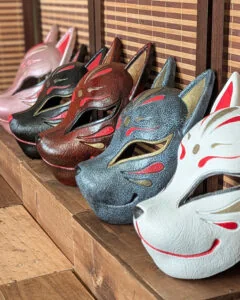
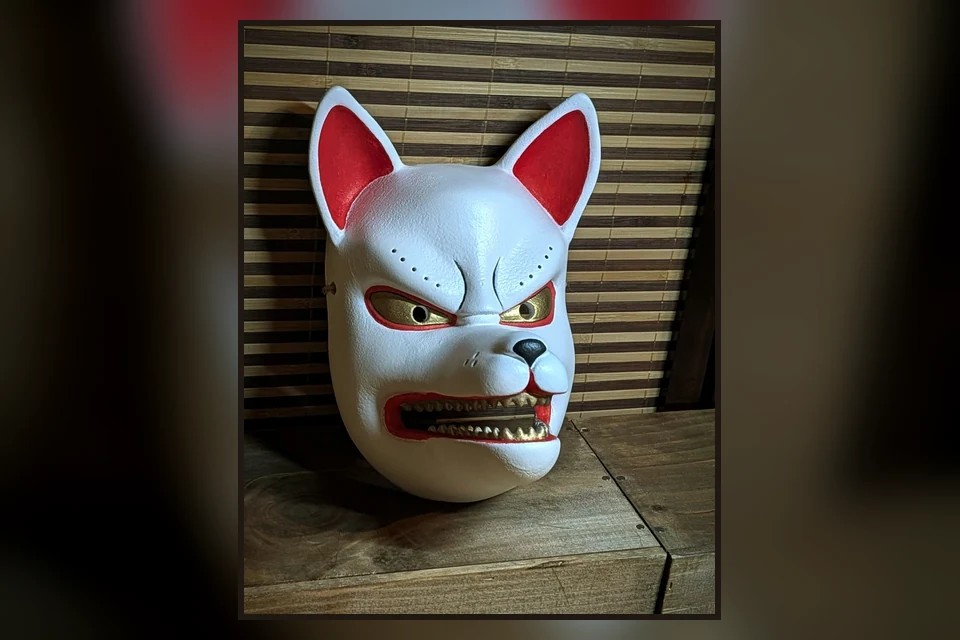
A contemporary mask can reference the white fox messenger visually without becoming a shrine object or ritual mask. Dai Yokai pieces are modern handcrafted creations inspired by this imagery.
Zenko and Nogitsune: useful labels, not a complete taxonomy
English-language explainers often use Zenko for benevolent foxes linked to Inari and Nogitsune or Yako for wilder fox spirits. This is a useful introduction, but Japanese fox traditions vary by period, region and religious context. The terms should not be treated as two biological species or as a complete official classification.
| Context | Inari messenger foxes | Wild folklore foxes |
|---|---|---|
| Religious link | Serve as messengers of Inari Okami | Not necessarily linked to Inari |
| Common role | Sacred or protective messenger | Shapeshifter, trickster or dangerous yōkai |
| Important caution | The fox is not Inari | Behavior changes from story to story |
For two contemporary color studies, see the white Kitsune guide and the black Kitsune guide. Their color readings are design context, not a universal religious code.
Are there really 13 types of Kitsune?
No single historical source defines 13 canonical elemental Kitsune types. Lists found online often combine folklore terms, religious language, games, manga and modern fan classifications. Names such as fire, wind or time foxes can be useful in fiction, but they should not be presented as a fixed system from Japanese tradition.
More reliable distinctions concern context: foxes linked to Inari, wild supernatural foxes, shapeshifting stories and multi-tailed fox imagery. Even those categories overlap. For a sourced overview of how fox-yōkai stories developed, see Nippon.com on Kitsune folklore.
Why do some Kitsune have nine tails?
Multiple tails usually signal that a supernatural fox is older or more powerful, and the nine-tailed fox became the best-known extreme. However, there is no universal rule that every century automatically adds one tail, and fixed power charts by tail count belong mainly to modern retellings.
| Image | Cautious reading |
|---|---|
| One fox tail | An ordinary fox or an early supernatural form, depending on the story |
| Several tails | A visual sign of greater age or supernatural power in later storytelling |
| Nine tails | A well-known powerful fox motif; meanings vary by story |
Two Kitsune legends to know
Tamamo-no-Mae and the nine-tailed fox
Tamamo-no-Mae is a courtly woman revealed as a dangerous supernatural fox. Her story changed over centuries. Earlier Japanese versions did not always describe her with nine tails; that form became prominent through later contact with Chinese nine-tailed fox traditions. Nippon.com traces that evolution and the legend of the Sesshō-seki, or Killing Stone.
The Kyoto University manuscript synopsis describes the fox with two tails. That concrete variation is a reason to read a named version rather than impose one tail-count chart on every story.
Kuzunoha: the fox wife
In the Kuzunoha legend, a fox takes human form, marries Abe no Yasuna and becomes the mother of Abe no Seimei. When her fox identity is discovered, she leaves her family. The story belongs to the wider fox-wife tradition and shows a gentler side of shapeshifting fox folklore.
The phrase kitsune no yomeiri, or “fox wedding,” has its own folklore around mysterious lights and sudden rain from a clear sky. It should not be presented as originating from the Kuzunoha story. See the British Museum fox bridal procession for an early-modern visual example.
What does kitsunetsuki mean?
Kitsunetsuki, often translated as “fox possession”, names a belief that a fox spirit could attach itself to a person. It is different from a shapeshifting story, in which the fox takes human form. The term belongs to the history of beliefs and storytelling, not to a diagnosis.
It should also be distinguished from Inari's messenger foxes. Fushimi Inari Taisha describes foxes as the deity's messengers, while Kokugakuin's account of Inari worship records historical intersections with fox oracles and spirit beliefs. These traditions sometimes overlapped, but the words do not describe one identical practice.
The social consequences also matter. Kokugakuin's entry on tsukimono, the broader category of possessing spirits, explains how accusations attached to family lineages could lead to exclusion and avoidance of marriage. These were beliefs used to label people, not evidence of a family's supernatural nature.
Possession also became a literary subject. A study of Nakajima Atsushi's Kitsune-tsuki examines how the story questions who is speaking, human or animal. That offers a way to read the motif without treating it as a description of a real person.
What does a Kitsune mask mean?
A Kitsune mask represents a fox, but its meaning depends on where and how it is used. It may evoke Inari messenger imagery, a shapeshifting yōkai, a festival fox, a theatrical character or a modern pop-culture design. The mask does not automatically grant protection, luck or supernatural abilities.
Fox masks appear in local festivals and contemporary events, including the revived Ōji fox parade around New Year. Their use is specific to each event rather than evidence of one national ritual. See Nippon.com on Ōji fox customs.
| Design choice | Careful interpretation |
|---|---|
| White with red markings | Often recalls shrine colors and white fox messenger imagery |
| Black | A contemporary dramatic treatment; meaning depends on the maker and context |
| Gold | A modern decorative association with value or radiance, not a fixed folklore rule |
| Cracked or metallic finish | A contemporary art treatment rather than a traditional Kitsune category |
When are Kitsune masks worn today?
Today, fox masks appear at some festivals, in performance, cosplay, conventions and photo shoots. They are also displayed as contemporary Japanese-inspired decor. Before wearing one at a religious or local cultural event, check the event’s own context instead of assuming every fox mask has the same role.
In the nō play Kokaji, a fox spirit associated with Inari assists the swordsmith Munechika, as the Nohgaku Performers’ Association synopsis explains. The modern Ōji Fox Parade began in 1993, drawing on an older legend pictured by Hiroshige. A stage role and this revived event are distinct uses of fox imagery.
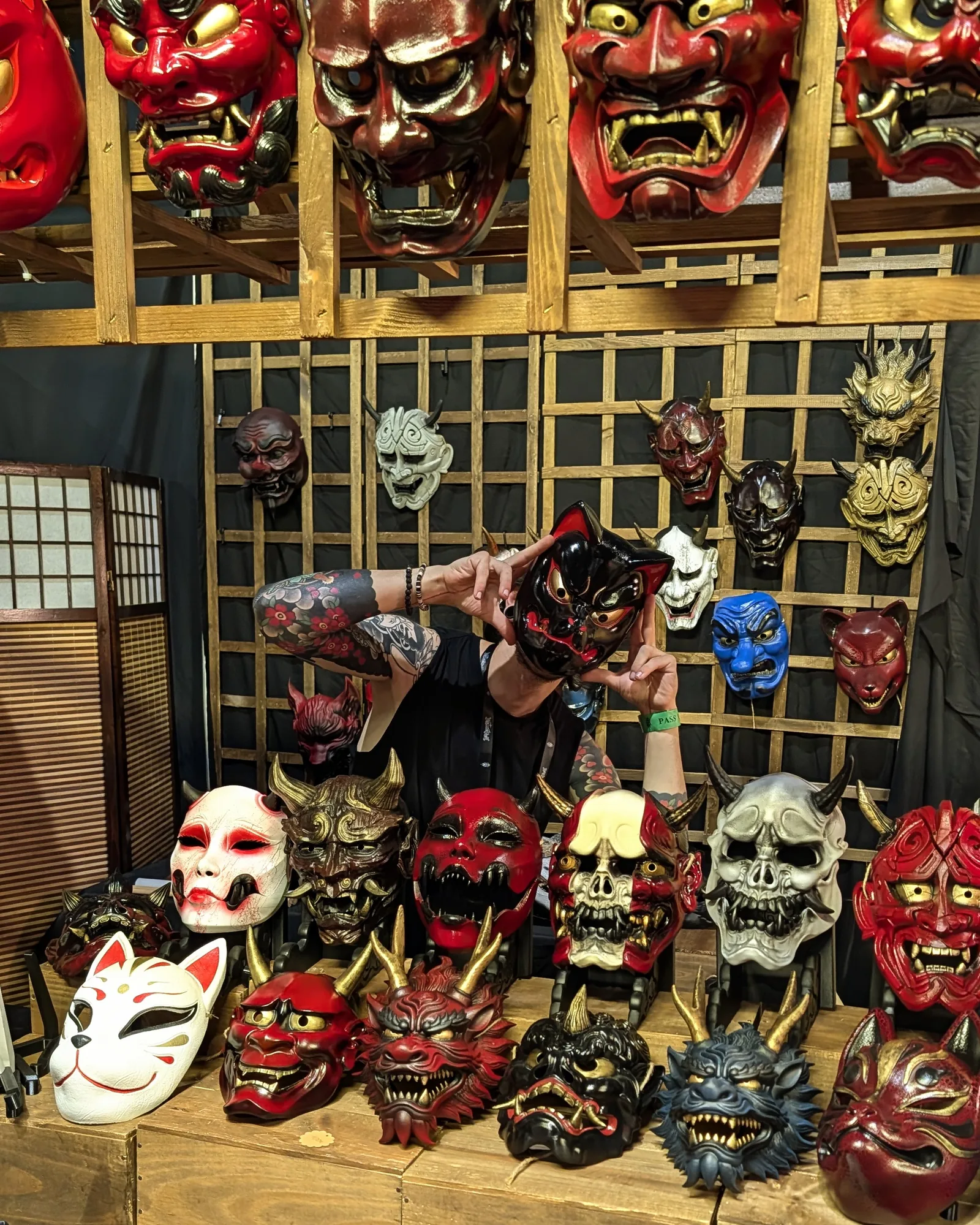
Kitsune, Oni, Hannya: quick comparison
| Mask | Main reading |
|---|---|
| Kitsune | Fox, Inari, cunning, transformation, ambivalence |
| Oni | Ogre-like being; danger, punishment or protection depending on context |
| Hannya | Noh theater, jealousy, pain, tragic human transformation |
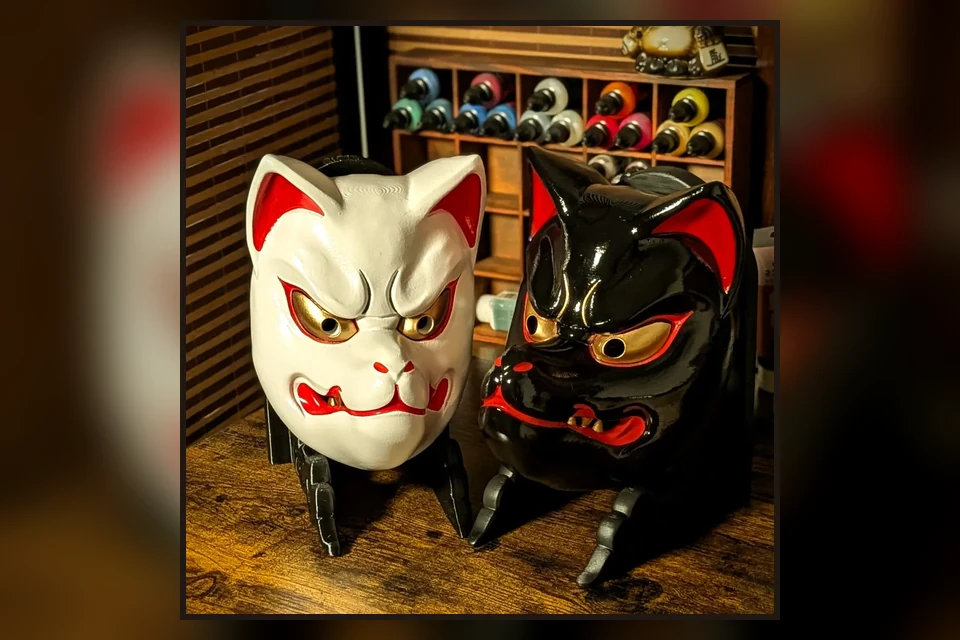
To move from the symbol to the object, start with the Dai Yokai Kitsune mask collection. For a direct white and red fox, the Japanese fox Kitsune mask is the clearest choice; the black-and-white duo explores visual contrast without identifying two fixed fox classes.
Making Kitsune masks in the Dai Yokai workshop
A Kitsune design depends on a narrow muzzle, upright ears and a controlled expression. In the Dai Yokai workshop in Brittany, the PETG base is sanded, primed, painted and varnished by hand. The aim is a contemporary fox mask with a clear silhouette and visible handcrafted finish, not a replica of a shrine or antique theatre object.
At his stand, Jérémy regularly hears visitors call a Kitsune mask “Inari.” He favours traditional-looking shapes over cute versions, with elongated eyes, a fine muzzle and large ears. White is his favourite, although he also likes black. In his experience, cute Kitsune designs attract more interest at manga conventions, while sharper expressions receive more attention online. These are his workshop observations, not a cultural rule.
White, red, black and gold are artistic choices within the Dai Yokai range. They can reference familiar shrine or folklore imagery, but they are not presented as a strict traditional code. Keep finished masks indoors, away from strong heat, prolonged direct sunlight and damp rooms.
Two masks can create a balanced wall display, but that arrangement is a contemporary decor choice. It should not be described as reproducing the symbolism of paired shrine statues unless a specific historical source supports the claim.
In the workshop
Kitsune masks to start from
For the full family, use the Kitsune masks collection. For a direct product choice, these cover the main fox-mask searches:
- Japanese fox mask, the sharper traditional fox face.
- Traditional Kitsune mask, the calmer matsuri-style version.
- Black and white Kitsune duo, two contrasting contemporary finishes.
The Kitsune mask in tattooing
In contemporary Japanese-inspired tattooing, a Kitsune mask may suggest transformation, hidden identity, foxfire or the tension between sacred messenger and trickster. Meaning depends on the artist, composition and wearer. For wider context, read the Japanese tattoo meaning guide and discuss placement or motif combinations with an experienced tattoo artist.
Sources and context
- Fushimi Inari Taisha, official shrine history and Inari context
- Japan National Tourism Organization, Fushimi Inari and fox messengers
- Nippon.com, development of supernatural fox legends
- British Museum, fox bridal procession imagery
FAQ
What does a Kitsune mask mean?
A Kitsune mask represents a fox, but its meaning depends on context. It may recall a white fox messenger of Inari, a deceptive shapeshifting yōkai, a festival character or a modern pop-culture design. It should not be reduced to one universal meaning such as luck, protection or wisdom.
Is Inari a fox?
No. Inari Okami is the deity, while white foxes serve as messengers. Fushimi Inari Taisha is the head shrine of Inari worship and uses fox imagery throughout the site, but the fox statues do not mean that Inari is literally a fox.
Are Kitsune good or evil?
Kitsune are not uniformly good or evil. Some foxes serve as sacred messengers, while folklore also describes shapeshifters that deceive, possess or help humans. Their role changes according to the story, period and religious context, which is why simple labels such as guardian or demon are often misleading.
Are there really 13 types of Kitsune?
There is no single historical canon of 13 elemental Kitsune types. Popular lists often mix folklore, religious terms, games, manga and modern fan classifications. They can be useful for fiction, but they should not be presented as an official system shared by all Japanese traditions.
Why do some Kitsune have nine tails?
Multiple tails became a sign of supernatural age and power, with nine tails becoming a prominent powerful fox motif in East Asian stories. However, there is no universal rule that every century adds one tail, and exact power levels by tail count are largely modern inventions.
Do Kitsune mask colors have fixed meanings?
No universal color code applies to every Kitsune mask. White and red often recall shrine colors and white fox messenger imagery, while black, gold or cracked finishes may be modern artistic choices. The meaning should be explained by the specific maker, performance, festival or story.
When are Kitsune masks worn?
Fox masks are worn in some local festivals, performances, cosplay events, conventions and photo shoots. Their cultural role varies by event. A mask used for modern cosplay or decoration should not automatically be described as a traditional ritual mask or a charm with supernatural powers.
Can you wear a handmade Kitsune mask for cosplay?
Yes, if the mask was designed to be worn. Check its fit, weight, visibility, ventilation and attachment system before a long event. Some handmade masks are better suited to wall display or short photo sessions, so confirm the intended use on the product page.