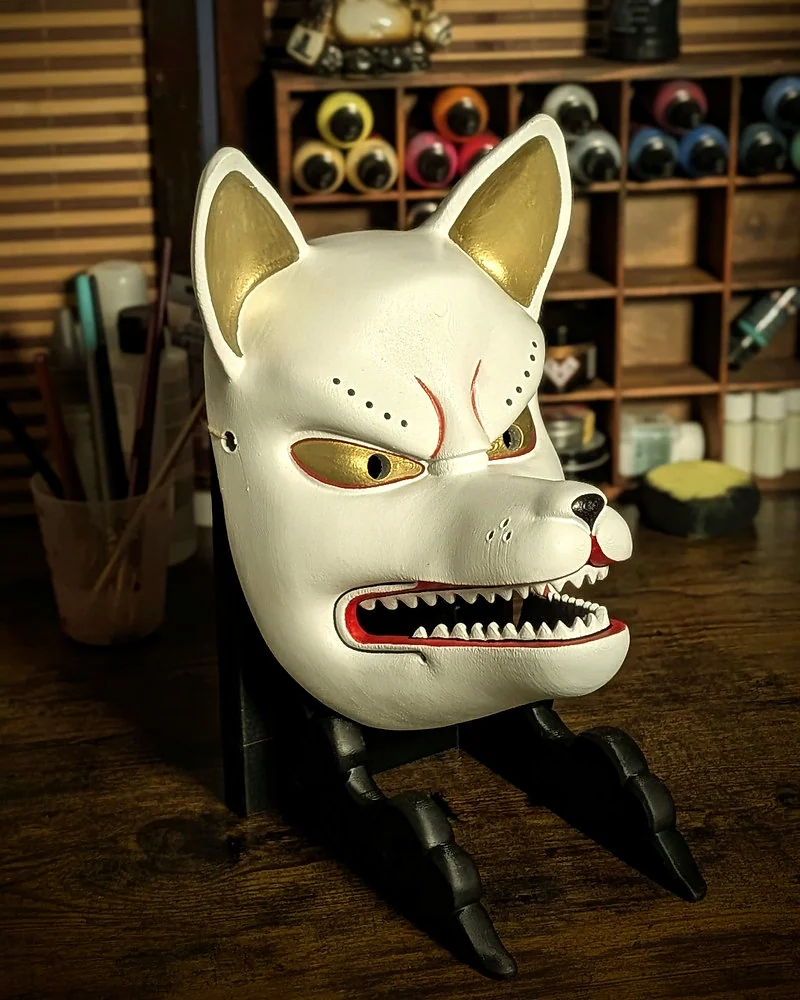
What does a white Kitsune mean?
A white Kitsune commonly represents a white fox connected with auspicious imagery, purity and the fox messengers of Inari. The official Fushimi Inari Taisha explanation calls those invisible messengers byakkosan, or white foxes. That is a strong documented reference, but not a rule that makes every white fox the oldest, most powerful or morally good Kitsune in every story.
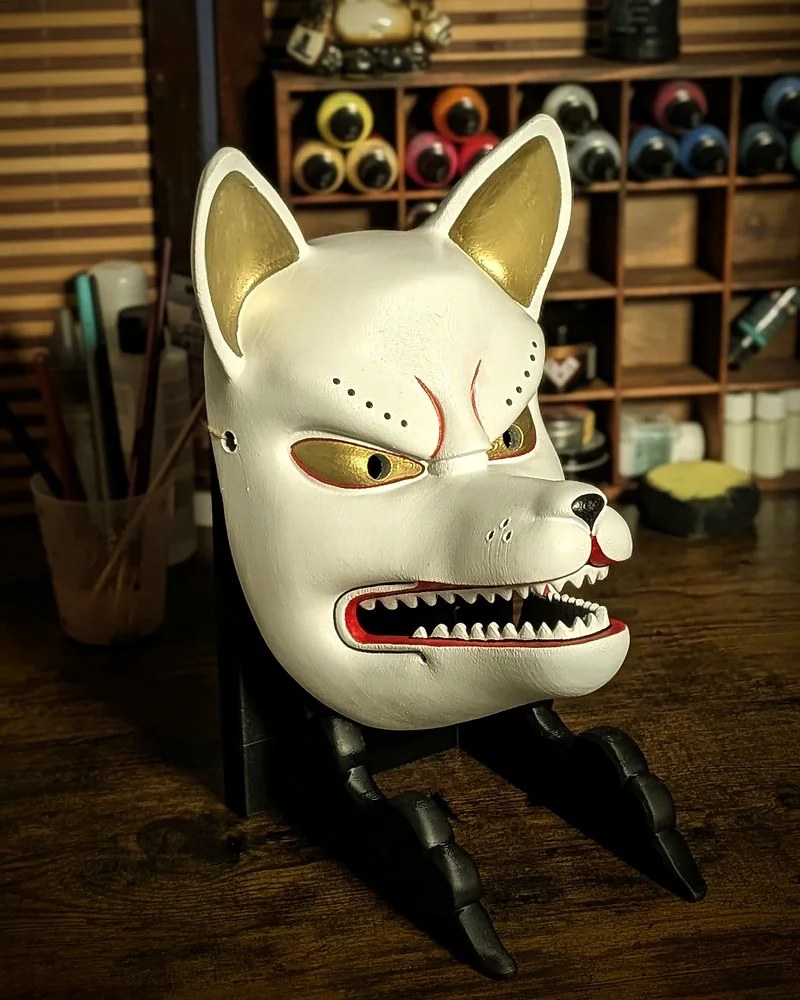
What does Byakko mean?
Byakko is written 白狐 and means white fox. It can describe white fox imagery in stories, art or religious contexts. At Fushimi Inari, the related respectful form byakkosan is used for the invisible fox messengers associated with Inari Ōkami.
The official Fushimi Inari Taisha FAQ makes two points that are easy to confuse online: the revered messengers are called white foxes because they are invisible, and Inari Ōkami is not a fox.
Modern English-language lists often present Byakko as a fixed supernatural rank. Japanese fox classifications developed across different texts and periods, so the safest definition is the literal one: a white fox, whose exact role depends on the source being discussed.
Is a white Kitsune Inari’s messenger?
White fox imagery is closely associated with Inari worship. The fox is described as a messenger or kindred of Inari rather than the deity itself. This matters when reading statues, masks and illustrations: a fox can point toward Inari without becoming Inari.
For the wider religious context, read the guide to Inari Ōkami and the fox messengers. For the broader folklore and mask context, see Kitsune mask meaning, history and symbolism.
Does white always mean purity in Japan?
White has several cultural uses in Japan, so it should not be reduced to one dictionary meaning. It can express purity and sacredness, including in the white shiromuku bridal outfit and in religious materials. It also appears in mourning contexts. The specific object and occasion decide which meaning is relevant.
A museum overview of white in East Asian clothing explains that white can symbolize purity while also appearing in mourning traditions. That supports a contextual reading, not the claim that every white object in Japanese culture has one spiritual meaning.
Is Byakko the oldest or most powerful Kitsune?
Not as a universal rule. Some later fox classifications rank white, black, celestial or many-tailed foxes by age or power. Other stories use different categories, and popular rural beliefs do not always match learned taxonomies. Saying that every fox becomes white after a precise number of centuries turns a changing tradition into a false fixed rule.
The academic survey Far Eastern Fox Lore emphasizes how literary, religious and regional fox traditions overlap. It is useful evidence for treating modern color charts and power rankings cautiously.
White Kitsune, Zenko and wild foxes
Zenko is commonly used in English explanations for benevolent foxes connected with Inari, while yako or nogitsune often describes wild foxes. That contrast is useful, but color alone does not create a complete taxonomy. A white fox can be shrine-associated, auspicious, ambiguous or simply descriptive depending on the source.
| Term | Careful definition | What not to assume |
|---|---|---|
| Byakko (白狐) | White fox | A single universal rank shared by every tradition |
| Byakkosan | Respectful name used by Fushimi Inari for invisible white fox messengers | That Inari Ōkami is a fox |
| Zenko | Common label for benevolent or Inari-associated foxes | That every white fox is automatically Zenko |
| Yako / Nogitsune | Wild-fox labels used in many modern explanations | That fur color alone defines the category |
Kitsune no Yomeiri: the fox’s wedding
Kitsune no Yomeiri means the fox’s wedding. The expression is associated with mysterious phenomena that people imagined as a hidden fox procession. Depending on the region and source, it can refer to a sunshower, atmospheric fox lights or a wedding procession seen at night.
Japan Search, operated with National Diet Library material, describes Kitsune no Yomeiri as a term for several phenomena, including atmospheric lights and sunshowers. The old version of this article claimed that only white foxes wed during sunshowers; that detail was not supported and has been removed.
What do red markings mean on a white Kitsune mask?
Red or vermilion details create a strong contrast with white and can visually recall shrine gates, festival objects and stylized fox masks. At Fushimi Inari, vermilion is explained as a color used against harmful forces and as an expression of the bountiful power of Inari Ōkami.
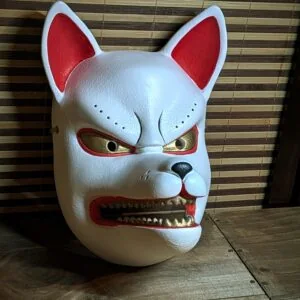
That does not make every painted line a fixed religious code. Eye, muzzle and ear markings vary between makers, performances, souvenirs and contemporary designs. Dai Yokai uses them as composition: to frame the eyes, clarify the muzzle and keep the fox silhouette readable.
White Kitsune mask meaning today
A white Kitsune mask can suggest purity, vigilance, transformation, protection or a connection with Inari-associated fox imagery. In conventions, photography and decor, it can also work simply because the bright base and red details make the fox expression easy to read.
Context should remain visible. A shrine fox, a stage prop, an anime-inspired design and a handcrafted wall mask are not interchangeable objects. Dai Yokai pieces are contemporary creations inspired by Japanese folklore and mask aesthetics, made in Brittany rather than presented as Japanese ritual masks.
White, black and red fox-mask imagery compared
| Visual direction | Documented or careful association | Best wording |
|---|---|---|
| White fox | Inari messenger imagery, purity or auspicious context | A white Kitsune inspired by Byakko and shrine fox imagery |
| Black fox | An auspicious court omen in an early chronicle; modern mystery imagery | A black Kitsune with a darker contemporary interpretation |
| White with vermilion details | Strong link to shrine color contrast, without a fixed line-by-line code | A contemporary white and red fox-mask design |
| Black and white pair | Modern visual contrast | A display pair, not an official Yin-Yang doctrine |
For the darker counterpart, read the sourced guide to black Kitsune meaning and Genkō. It explains why a black fox should not automatically be described as evil or as the official nocturnal half of a white pair.
How Dai Yokai makes a white Kitsune mask
Dai Yokai builds its white Kitsune masks from a PETG base, then sands, prepares, paints, varnishes and finishes the surface by hand in Brittany, France. White is visually demanding because dust, uneven sanding and small surface marks remain easy to see under direct light.
The goal is a clean handmade finish, not an invented promise of eternal white or total UV resistance. Paint, varnish, storage conditions and exposure all affect a finished object. The exact product page remains the source for model, fit, finish and wearing details.
Browse the current handmade Kitsune mask collection for available white, black and painted designs.
How to display or wear a white Kitsune mask
- For wall display, use soft side lighting to reveal the muzzle, brows and painted relief.
- On a light wall, leave enough shadow around the silhouette so the white shape does not disappear.
- On a dark wall, avoid a harsh frontal spotlight that flattens the varnished surface.
- For conventions or light cosplay, check straps, visibility, airflow and the exact product instructions before use.
- In tattoo studios or collections, pair the mask with neutral light so the painted red details remain accurate.
How to care for a white hand-painted mask
Use a clean, dry microfiber cloth for dust. Avoid household cleaners, solvents, abrasive sponges and soaking. Keep the mask away from radiators, parked vehicles and prolonged direct sunlight. Store it where the white finish cannot rub against rough or dark surfaces, and handle painted edges and raised details gently.
Sources and further reading
- Fushimi Inari Taisha FAQ, for the shrine’s explanation of Inari’s white fox messengers and vermilion
- Japan Search: Fox, for Kitsune no Yomeiri, fox lights and sunshowers
- Lam Museum: White, for the multiple uses of white in East Asian clothing and ritual contexts
- Far Eastern Fox Lore, for the diversity and overlap of East Asian fox traditions
Conclusion
The safest short answer is that Byakko means white fox, and white fox imagery has a documented connection with the messengers of Inari. Purity, good fortune and protection are useful contextual associations, but age rankings, color rules and fox-wedding details vary. Dai Yokai’s white Kitsune mask is a contemporary handcrafted interpretation of that visual language.
FAQ
What does a white Kitsune mean?
A white Kitsune commonly evokes a white fox connected with purity, auspicious imagery and Inari shrine iconography. At Fushimi Inari Taisha, the invisible fox messengers of Inari are called byakkosan, or white foxes. The meaning is contextual, however: not every white fox in folklore belongs to one fixed rank or moral category.
What does Byakko mean in Japanese?
Byakko is written 白狐 and means white fox. The word can describe white fox imagery, while Fushimi Inari uses the related respectful term byakkosan for Inari’s invisible fox messengers. English-language lists sometimes turn Byakko into a rigid Kitsune class, but historical classifications vary and should not be presented as one universal system.
Is a white Kitsune the same as Inari?
No. Fushimi Inari Taisha states that foxes are the messengers or kindreds of Inari Ōkami, not the deity itself. The shrine calls these invisible messengers byakkosan, or white foxes. A white Kitsune mask can reference that visual tradition, but it is not a depiction of Inari Ōkami and is not automatically a sacred object.
Are all white Kitsune Zenko?
Not necessarily. Zenko is commonly used for benevolent foxes associated with Inari, while yako or nogitsune refers to wild foxes in many modern explanations. These labels are useful shorthand, but regional stories and historical authors do not all use one identical taxonomy. White color alone cannot settle every fox’s identity or behavior.
Does a Kitsune turn white after one hundred years?
Some fox stories and later classifications connect age with greater power, extra tails or a change in appearance. There is no single Japanese rule proving that every Kitsune turns white at a set age. It is safer to describe the white, golden or many-tailed fox as a recurring motif whose details change between texts and traditions.
What is Kitsune no Yomeiri?
Kitsune no Yomeiri means the fox’s wedding. Japanese sources use the phrase for several mysterious phenomena, especially a sunshower and, in some traditions, lines of atmospheric fox lights imagined as a wedding procession. The stories vary by region. There is no reliable basis for saying that only white foxes marry during sunshowers.
Why are white Kitsune masks often painted red?
White and vermilion create a strong visual link with shrine architecture and modern fox-mask imagery. Fushimi Inari explains vermilion as a color used against harmful forces and, at that shrine, as an expression of Inari’s bountiful power. Individual mask markings are still design choices, not a universal code assigning one meaning to every line.
How do you care for a hand-painted white Kitsune mask?
Dust the mask with a clean, dry microfiber cloth. Avoid solvents, abrasive products, soaking, radiators, hot vehicles and prolonged direct sunlight. Handle painted edges and raised details gently. For a wearable model, check the straps before use and store the mask where the white finish will not rub against dark or rough surfaces.