| Question | Reliable answer |
|---|---|
| What is Inari associated with? | Rice, food, abundance, business prosperity and everyday protection |
| Is Inari a fox? | No. The white fox is a divine messenger or kindred |
| Is Inari one deity? | Traditions vary. Fushimi Inari Taisha enshrines five deities together |
| How many Inari shrines exist? | Around 30,000 according to Fushimi Inari Taisha |
| How many torii are at Fushimi Inari? | Around 10,000 of all sizes along the mountain paths |
Who is Inari Okami?
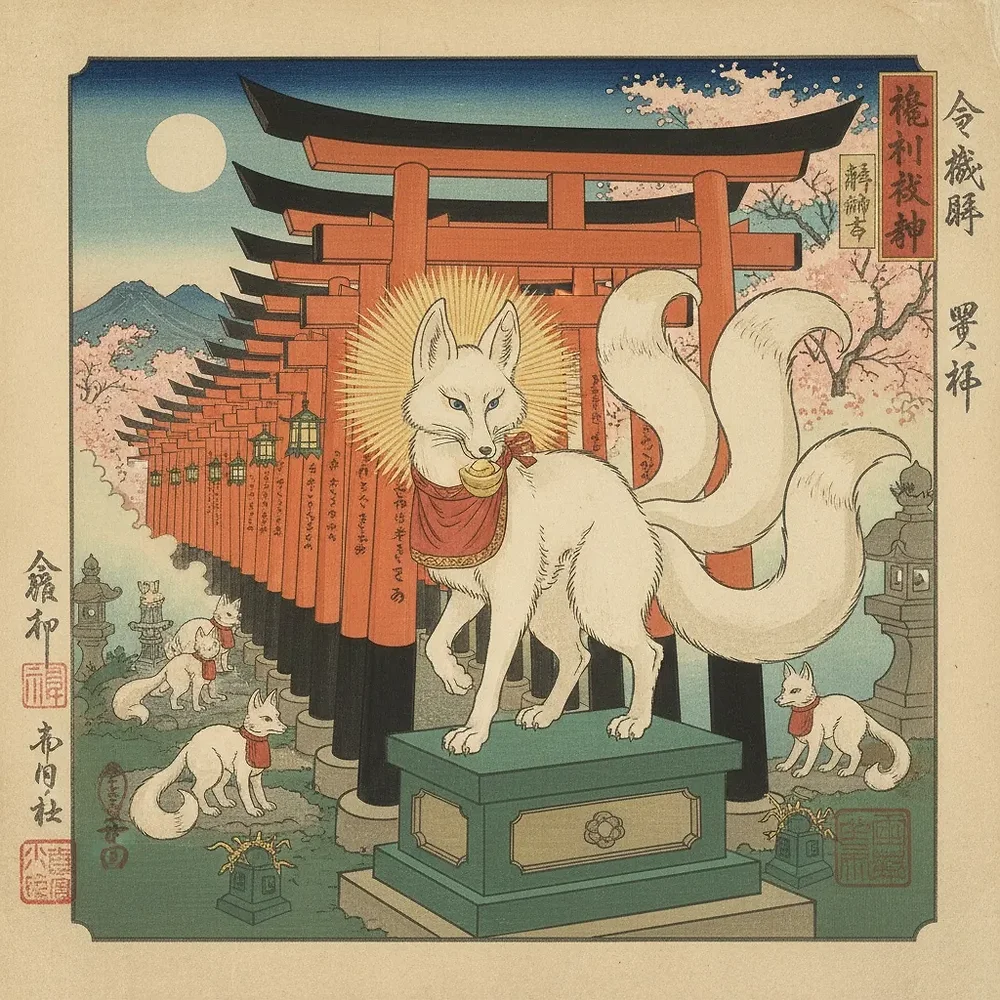
Inari Okami is not simply a “fox god.” The oldest layer of the tradition centers on rice, harvest and the forces that feed a community. Fushimi Inari Taisha describes Inari as a deity who provides the food, clothing and housing that support life and brings abundance and joy.
That meaning widened as Japanese society changed. Rice was food, wealth and a foundation of the economy, so a kami of rice could also become a protector of merchants, workshops and industries. Today the shrine lists business prosperity, industrial prosperity, household safety, traffic safety and improvement in the performing arts among Inari’s virtues.
The honorific Okami means “great kami.” It does not make Inari the supreme god of a fixed hierarchy. Kami are approached through particular places, stories and relationships, and Inari worship is unusually diverse across Japan.
What does the name Inari mean?
The official shrine explains Inari through the old expressions ine nari or ine ni naru, referring to rice ripening or being reaped. Rice is more than an ingredient here. It symbolizes the meeting of natural forces that allows people to live.
A foundation legend recorded by the shrine tells of a rice cake shot with an arrow, transformed into a swan and landing on a mountain peak where rice then grew. The historical tradition places Inari Okami on Mount Inari in 711, although forms of mountain and agricultural worship in the area may be older.
Is Inari male, female or a group of kami?
There is no single gender that covers every Inari tradition. Images and explanations have used male, female and collective forms at different places and times. Saying that Inari “changes gender” is also too simple, because several distinct deities and Buddhist interpretations have been brought into the wider history of Inari worship.
At Fushimi Inari Taisha, the main sanctuary contains five shrines. The central seat is Ukanomitama no Okami, joined by Satahiko no Okami, Omiyanome no Okami, Tanaka no Okami and Shino Okami. Together, these five pillars embody the virtues of Inari Okami.
For a clear overview of related figures, see our guide to Japanese kami. It helps separate a kami, a divine messenger and a yokai from folklore.
The fox is Inari’s messenger, not Inari
Fushimi Inari Taisha is explicit: foxes are the messengers or kindreds of Inari Okami, and Inari is not a fox. These sacred messengers are understood as invisible. Their white shrine form is called byakkosan, “white fox.” The color signals a divine being rather than an ordinary animal seen in the mountains.
The confusion is understandable. Fox statues stand at Inari shrines, red fox motifs appear on votive objects, and popular culture often compresses the entire tradition into a “fox god.” A more accurate reading keeps the roles separate: Inari is worshipped, while the fox serves and signals Inari’s presence.
| Fox statue object | Common association | What to remember |
|---|---|---|
| Granary key | Access to stored rice and abundance | This is the clearest agricultural reference |
| Jewel | Sacred power, fulfilled wishes or treasure | Meanings vary between traditions |
| Scroll | Knowledge, a decree or sacred teaching | Do not assume every scroll is a sutra |
| Sheaf of rice | Harvest and nourishment | A direct sign of Inari’s rice connection |
Why did the fox become linked to rice?
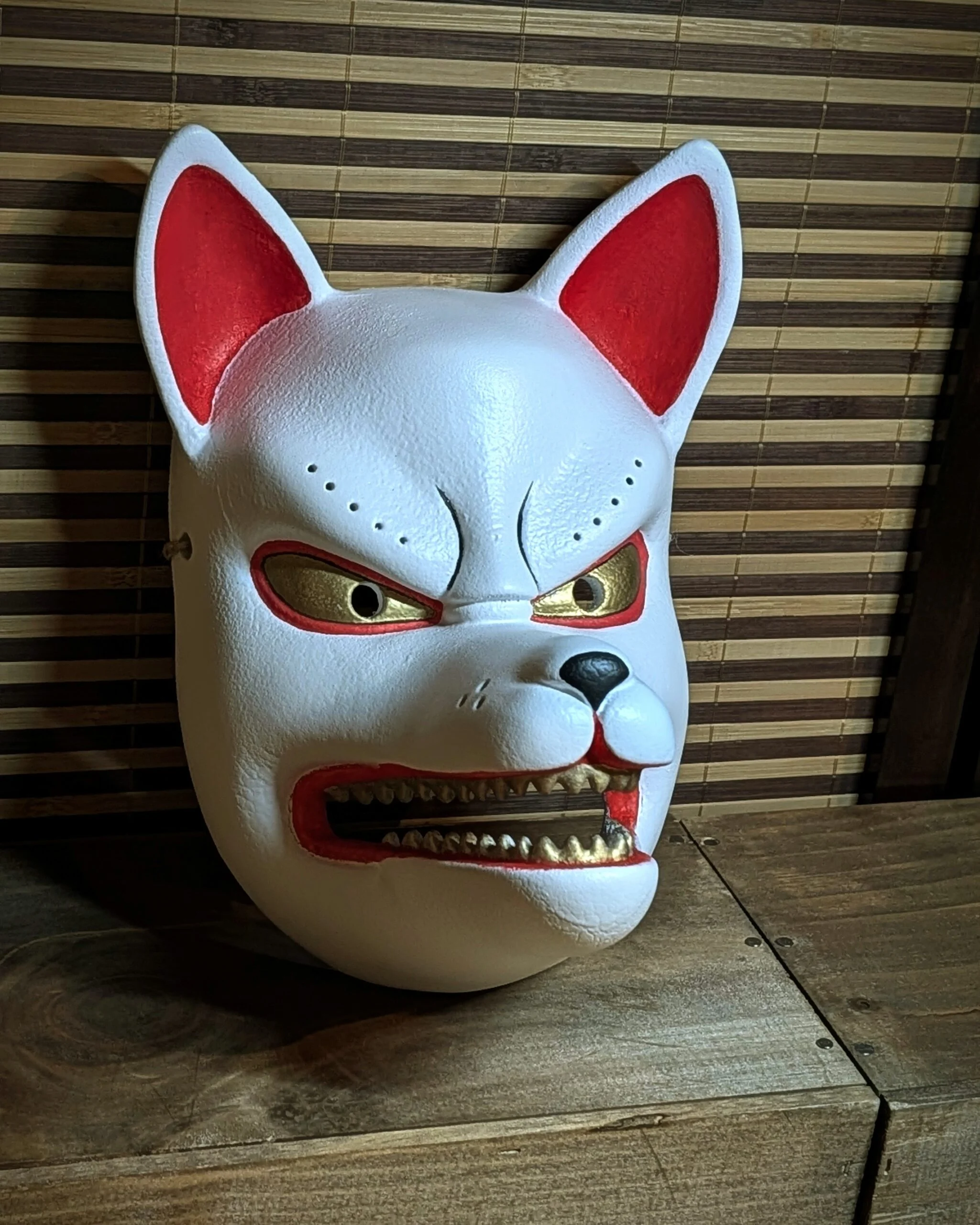
There is no single proven origin story. Agricultural explanations often point to foxes appearing near fields and hunting rodents that threatened grain. Seasonal movement between mountains and cultivated land may also have helped connect foxes with the rice cycle.
Religious history added further layers. The National Diet Library’s Japan Search overview notes the syncretism between Ukanomitama and the Buddhist deity Dakiniten, who could be shown riding a white fox. These influences helped rice, fox and prosperity imagery overlap without making every fox story part of one doctrine.
Fushimi Inari Taisha: 711, 30,000 shrines and 10,000 torii
Fushimi Inari Taisha in Kyoto is the head shrine of the Inari network. Its traditional foundation date is 711. The entire 233-meter Inariyama is sacred ground, with former shrine sites, worship stones, smaller shrines and torii spread along its paths.
| Figure | What the official shrine says | Important nuance |
|---|---|---|
| 711 | Inari Okami was enshrined on Mount Inari | This is the shrine’s traditional historical date |
| Around 30,000 | Inari shrines are said to exist across Japan | Higher totals may include small or private sites |
| Around 10,000 | Torii of all sizes line the mountain paths | Senbon Torii names a famous section, not the total count |
| Five | Deities are enshrined in the main sanctuary | Inari can be understood collectively at this shrine |
The numbers are often blurred online. Kyoto’s official travel guide describes more than 5,000 gates visible along the routes it presents, while the shrine itself gives about 10,000 torii of all sizes across the mountain. For the national shrine count, Fushimi Inari Taisha uses around 30,000. These sourced approximations are safer than claiming an exact inventory.
Why are Inari torii vermilion?
At Fushimi Inari Taisha, vermilion is described as a protective color against harmful forces and as an expression of the abundant harvests given by Inari Okami. The traditional pigment also helped preserve wood. The color is important, but it is not exclusive to Inari shrines.
Torii offerings became widespread by the start of the Edo period. A donated gate could express a wish or acknowledge that a prayer had “passed through” and been fulfilled. This history explains why donor names appear on the gates and why the mountain became a corridor of repeated offerings.
Inari in Shinto and Buddhist traditions
Inari is strongly associated with Shinto shrines, but Japanese religious history did not always keep kami and Buddhist figures in separate boxes. The Encyclopedia of Shinto distinguishes Fushimi-affiliated worship, other independent Inari shrines and a Buddhist current in which Dakiniten is combined with Inari.
This matters when interpreting gender, fox imagery or statues. A representation of Dakiniten on a white fox belongs to a Buddhist layer and should not automatically be treated as the standard form of the kami at every Inari shrine. The overlap is historical, but the traditions are not interchangeable.
The Oji fox legend and New Year procession
A famous Edo legend says that foxes from the Kanto region gathered beneath a hackberry tree on New Year’s Eve, changed their appearance and went to worship at Oji Inari Shrine. Villagers watched the foxfires and used their number to predict the next harvest.
Utagawa Hiroshige pictured the scene around 1857 in New Year’s Eve Foxfires at the Changing Tree, Oji. Japan’s National Diet Library documents both the legend and the historic print tradition. Today’s Oji Fox Pageant is a community procession that evokes this story. It should not be described as an unchanged ancient ritual.
Zenko and nogitsune: useful terms, not a perfect binary
Modern explanations often divide foxes into zenko, benevolent foxes linked to Inari, and nogitsune or yako, wild foxes acting independently. The contrast is useful as a first orientation, but Japanese fox lore is broader than a simple good-versus-evil chart.
Foxes in tales can protect, deceive, possess, repay kindness, marry humans or test them. A shrine messenger and a trickster from a folktale share fox imagery without necessarily being the same kind of being. Our dedicated guide to the meaning and types of Kitsune explores those independent traditions in more detail.
How to recognize an Inari shrine
Fox guardians are the strongest clue, especially a pair near the entrance or sanctuary. Vermilion torii, fox-shaped votive plaques and offerings connected with rice may reinforce the identification. Still, red paint alone is not proof, because vermilion appears at many Japanese shrines and temples.
At a shrine, treat fox statues as sacred attendants rather than fantasy monsters or props. Do not climb on them, move offerings or block worshippers for photographs. Fushimi Inari Taisha also asks visitors not to enter restricted areas, damage gates, feed wildlife or photograph commercially without permission.
From shrine symbol to contemporary Kitsune mask
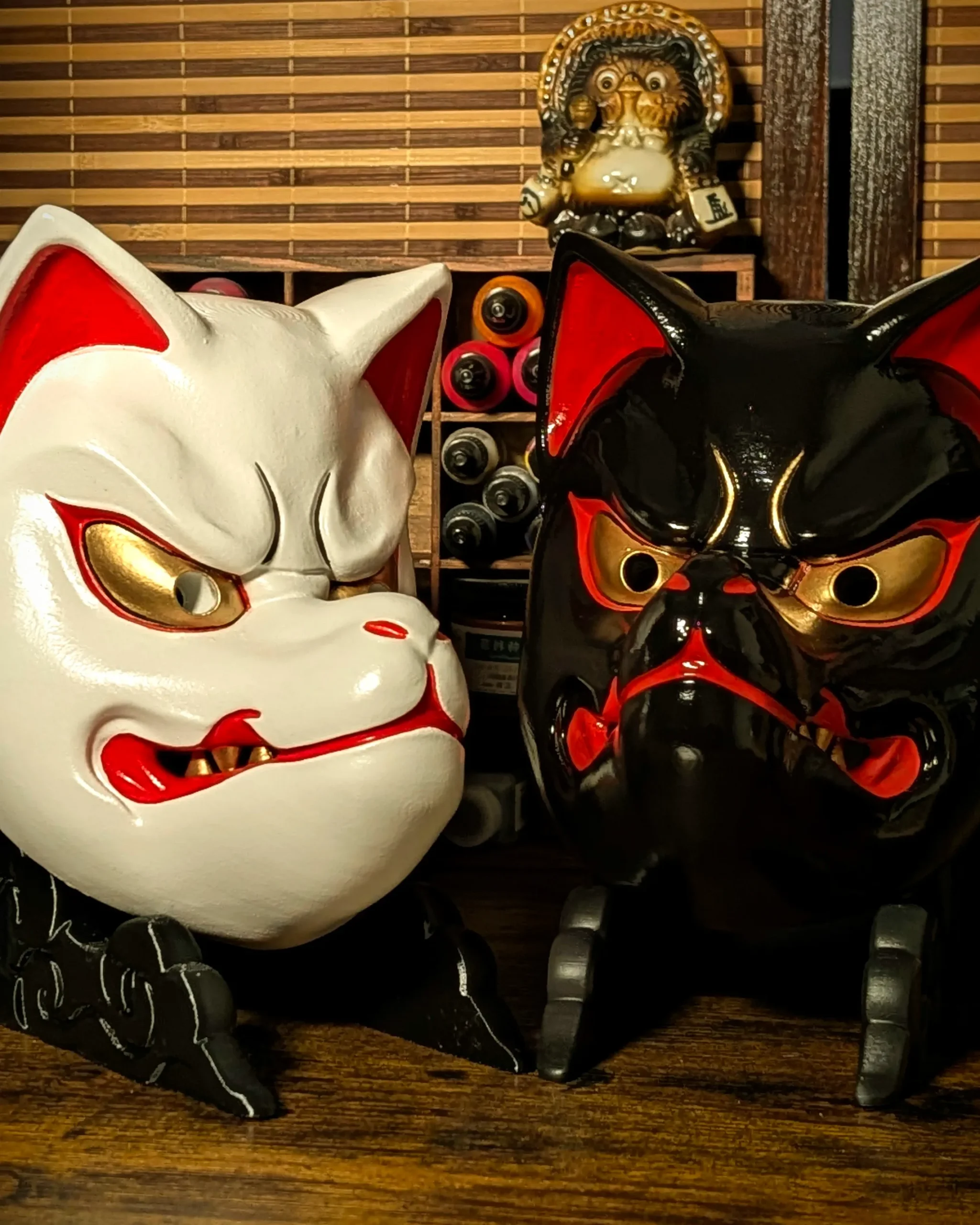
A contemporary Kitsune mask can borrow the pointed muzzle, alert eyes, white ground and red markings associated with fox imagery. That visual inspiration does not make the object a shrine mask or ritual object. Dai Yokai pieces are handmade art masks created in Brittany for display, costume and personal collections.
To compare forms and finishes, browse the Kitsune mask collection. The cultural distinction stays important: the sacred fox at an Inari shrine is a messenger, while a handmade mask is a modern artistic interpretation.
Sources and further reading
- Fushimi Inari Taisha, official overview, foundation date and national shrine count
- Fushimi Inari Taisha, Enshrined Deity, the five deities, the name Inari and modern virtues
- Fushimi Inari Taisha FAQ, fox messengers, vermilion, torii offerings and official approximate counts
- Kyoto City Official Travel Guide, visitor overview, fox statues and visible torii routes
- Kokugakuin University Encyclopedia of Shinto, the main forms of Inari faith and Buddhist syncretism
- National Diet Library, the Oji Inari fox gathering legend and historic image context
FAQ
Who is Inari Okami?
Inari Okami is a Japanese kami associated first with rice and the abundance that sustains life. At Fushimi Inari Taisha, five named deities are enshrined together as expressions of Inari Okami. Worship also extends to business prosperity, industry, household safety and other everyday concerns.
Is Inari a fox god?
Not in the teaching of Fushimi Inari Taisha. Foxes are the invisible messengers or kindreds of Inari Okami, not the kami itself. Their shrine images are commonly shown as white foxes called byakkosan.
Is Inari male or female?
There is no single answer across every Inari tradition. Inari may be understood through male, female or collective forms, and Fushimi Inari Taisha enshrines five deities together. It is safer to describe Inari as a kami rather than impose one universal gender.
What does Inari mean?
Fushimi Inari Taisha explains the name through ancient expressions meaning the reaping or ripening of rice. Rice represented the forces that sustain life, so the name points to abundance rather than simply translating as a personal name.
How many Inari shrines are there in Japan?
Fushimi Inari Taisha says there are around 30,000 Inari shrines in Japan and identifies itself as their head shrine. Some other sources use higher totals because they count small, private or unaffiliated sites differently.
Why are there so many red torii at Fushimi Inari?
Torii became common offerings at Inari shrines by the start of the Edo period. They can express a wish or thanks for a prayer being answered. The shrine states that about 10,000 torii of many sizes stand along the mountain paths.
What do the fox statues hold?
Common objects include a granary key, a jewel, a scroll or a sheaf of rice. A key refers directly to stored grain. The exact object and its interpretation can vary by statue and shrine, so it should not be treated as a rigid code.
What is the difference between Inari and Kitsune?
Inari is the kami being worshipped. Kitsune is the Japanese word for fox and also names a broad family of fox traditions. At Inari shrines, the white fox is a divine messenger. Other fox stories include independent, helpful, deceptive or dangerous beings.