What does a black Kitsune mean?
A black Kitsune does not mean an evil fox. The clearest historical evidence comes from the Shoku Nihongi: in 712, a black fox presented to the emperor was treated as an auspicious omen associated with profound peace under good government. Ideas such as shadow, stars and mystery are common in modern interpretations, but they should not all be presented as one fixed ancient meaning.
What the Shoku Nihongi actually records
An academic survey titled Far Eastern Fox Lore quotes the Shoku Nihongi account. Iga Province presented a black fox to the emperor in 712, and a later proclamation connected the omen with abundant crops and the idea that a black fox appears when a ruler brings about profound peace.
That passage supports a precise conclusion: a black fox could be read as a favorable court omen in early Japan. It does not prove that every black fox spirit in every region had the same meaning, or that modern color-based Kitsune lists form one universal religious system.
Genkō, Kokuko and Kurogitsune: why the names vary
English-language searches often use Genkō for 玄狐, while other sources use Kokuko or the descriptive Kurogitsune for a black fox. The spelling is useful for finding the topic, but it should not be treated as a perfectly standardized taxonomy shared by every shrine, chronicle and regional tradition.
This guide keeps the term Genkō because people actively search for it, while separating the historical black-fox omen from later online classifications. That distinction matters: search popularity is not the same thing as documentary proof.
Is a black Kitsune evil?
Color alone does not decide whether a fox figure is benevolent, dangerous or ambiguous. The black fox in the Shoku Nihongi was favorable, while other Japanese fox stories describe trickery, possession, protection, gratitude or transformation. The individual story matters more than a modern color chart.
For the broader context, read the Kitsune mask meaning guide. It explains why fox imagery can move between shrine associations, theatre, folklore and contemporary design without becoming one simple good-versus-evil category.
Is the black fox linked to the Big Dipper?
The Big Dipper claim needs a careful distinction. Far Eastern Fox Lore describes transformation stories in which a fox makes obeisance to the North Star in Japan or the Great Bear in China. It does not say that every black fox is an incarnation of those stars.
Modern websites and fan taxonomies often turn that wider stellar motif into a fixed definition of Genkō. It is safer to say that stars are a modern and secondary association unless a specific Japanese source is provided. Dai Yokai can still use stellar details as an artistic direction, but not as a guaranteed ancient rule.
Is Genkō an Inari fox?
The official Fushimi Inari Taisha FAQ describes Inari’s invisible fox messengers as byakkosan, meaning white foxes, and states clearly that the fox is a messenger rather than Inari Ōkami. This makes the white shrine fox a documented reference point.
A black Genkō should therefore not be presented automatically as the official night half of an Inari pair. Black and white masks can form a strong modern display composition, but that is a design choice rather than a rule stated by Fushimi Inari. See the separate guide to Inari and the fox messengers.
| Context | What can be verified | What not to assume |
|---|---|---|
| Black fox in the Shoku Nihongi | An auspicious omen associated with profound peace | That every black Kitsune has one fixed meaning |
| Byakkosan at Fushimi Inari | White fox messengers of Inari Ōkami | An official black-and-white Yin-Yang pair |
| Nogitsune or yako | A separate wild-fox label in folklore | A synonym for every black fox |
| Dai Yokai black mask | A contemporary handmade interpretation | A historical or consecrated Japanese object |
Black Kitsune and Nogitsune are not the same
Black Kitsune describes a color or visual motif. Nogitsune, also read yako in some contexts, is a different label commonly translated as wild fox. A Nogitsune is not defined by black fur, and a black fox is not automatically a Nogitsune.
The distinction prevents a common SEO shortcut from becoming folklore misinformation. A product or illustration may combine black coloring with a wild-fox mood, but the description should say that this is a contemporary interpretation instead of treating the two names as interchangeable.
The Dai Yokai black Kitsune mask
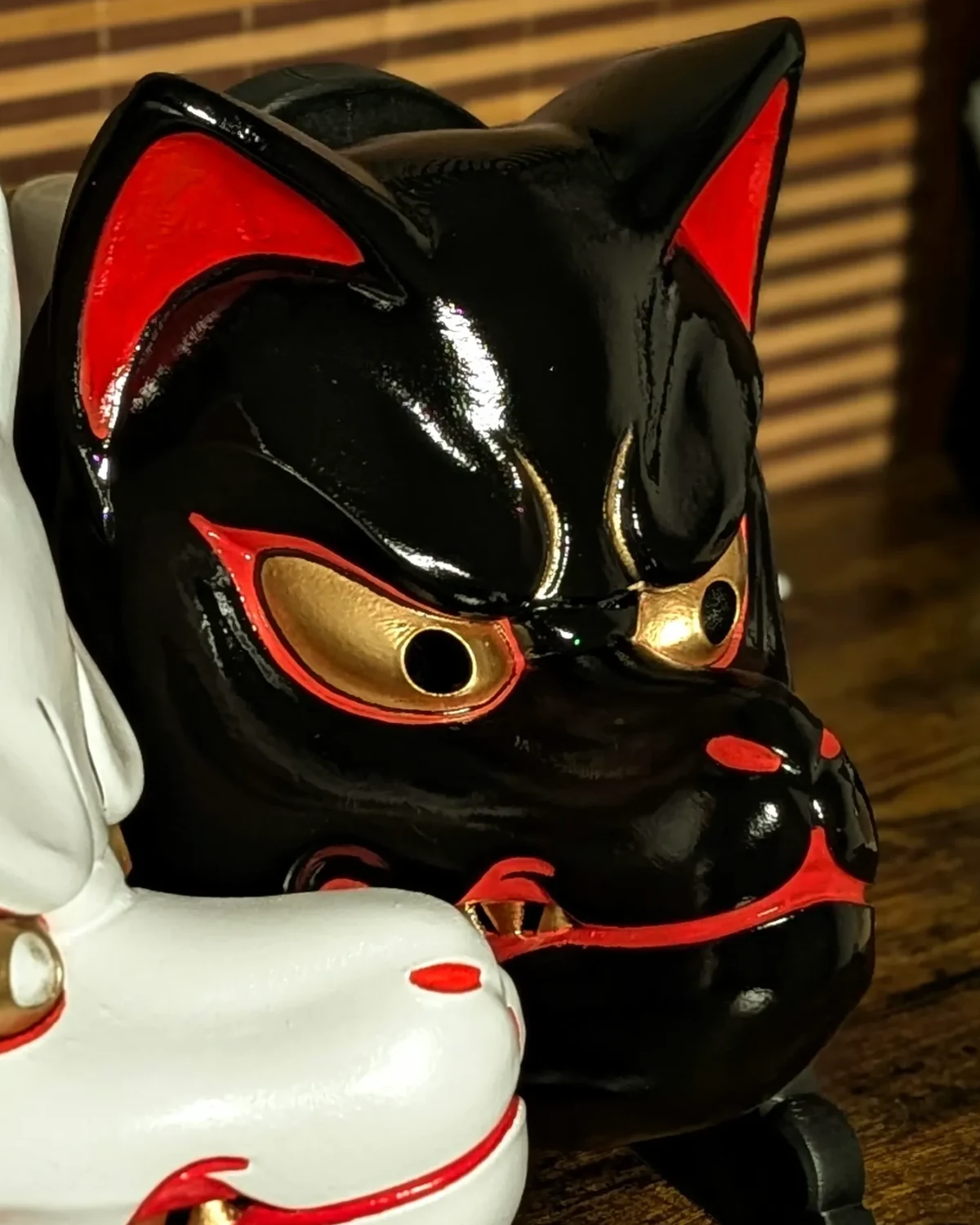
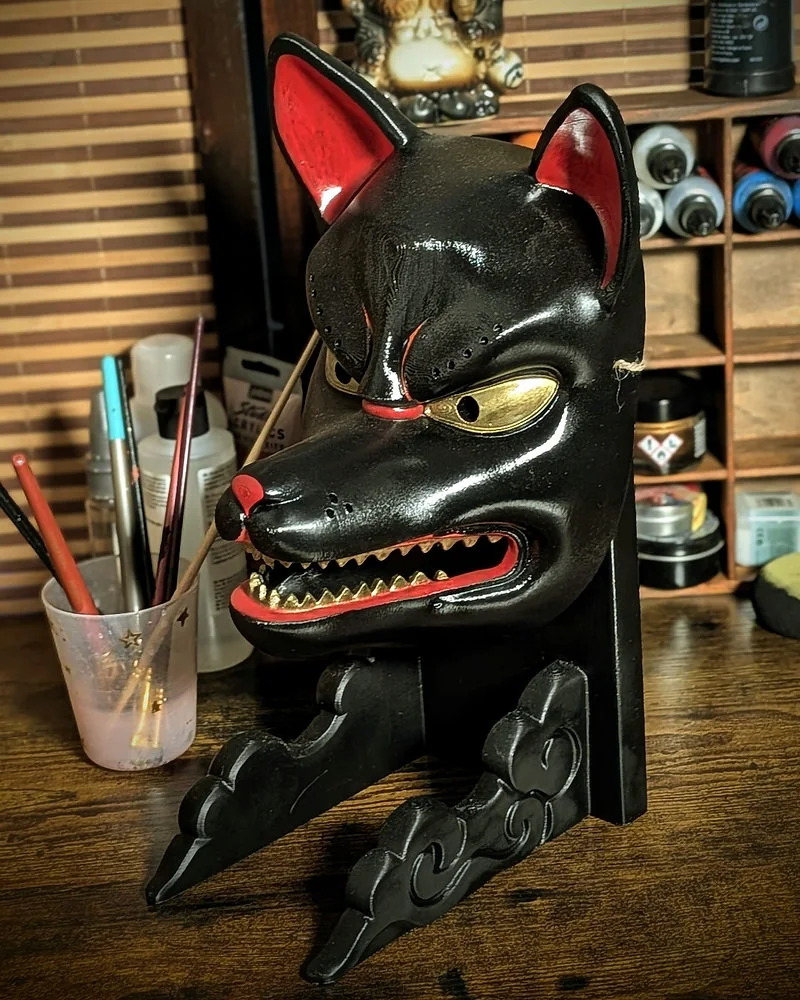
Dai Yokai makes a contemporary black Kitsune mask in Brittany, France. The PETG base is prepared, sanded, painted, varnished and finished by hand. Black gives the piece a quieter, nocturnal appearance, while metallic accents reveal the brows, muzzle and carved lines.
The design is inspired by Japanese fox imagery, not presented as an authentic shrine mask. Depending on the model and fit, it can be used for wall display, collection, photography, conventions or light cosplay. The product page should remain the source for the exact wearing and finish details.
Painting black without losing the shape
A fully uniform black surface can hide the volumes of a mask. In the workshop, sanding and controlled layers help the light catch the nose, brows and cheek planes. Matte finishes soften reflections, while satin areas and metallic details make the relief easier to read.
Gold creates a warmer contrast; silver creates a colder one. Neither color has to be presented as a fixed folklore code. Here they are workshop choices used to keep a dark mask legible from different angles and under indoor lighting.
Black and white masks as a modern display pair
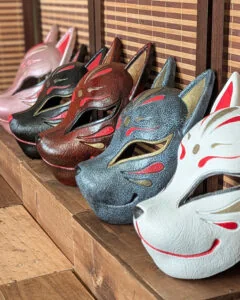
A black and white pair works because the contrast is immediate: dark and light, matte and bright, discreet and visible. It does not need an invented ancient Yin-Yang rule. The composition is already strong as contemporary decor.
| Display setting | Lighting approach | Practical effect |
|---|---|---|
| Dark wall | Warm side light | Reveals the black mask without flattening it |
| Black and white pair | Balanced light on both pieces | Keeps both masks readable as a deliberate contrast |
| Gaming or neon setup | Indirect colored light | Metallic details catch color while the base stays dark |
| Tattoo studio or workshop | Neutral directional light | Shows the painted relief without strong glare |
Wearing a black PETG mask safely
An UltiMaker PETG technical data sheet lists additional heat resistance up to 76°C for that specific material. The figure comes from controlled material testing; it is not a promise that every finished mask can remain in direct sun or a hot vehicle without movement or damage.
Black surfaces absorb heat quickly. For summer events, check straps, airflow and peripheral vision, take breaks in the shade and avoid prolonged exposure to direct sun. Never leave the mask on a dashboard or inside a parked car. Comfort and the exact product construction matter more than a single material number.
How to choose between black and white Kitsune masks
Choose by the visual effect and the specific product, not by a rigid moral code. A black mask gives a darker, lower-contrast presence. A white mask is brighter and closer to the byakkosan imagery documented at Inari shrines. For the white option, see the white Kitsune mask guide.
- Choose black for a subdued, nocturnal or graphic display.
- Choose white for a brighter fox-mask silhouette and shrine-associated visual reference.
- Choose a pair for contemporary contrast, not because folklore requires it.
- Check the product page for size, wearing advice, finish and intended use.
Sources and further reading
- Far Eastern Fox Lore, for the Shoku Nihongi black-fox omen and wider fox-star stories
- Fushimi Inari Taisha FAQ, for the official explanation of Inari’s white fox messengers
- UltiMaker PETG technical data sheet, for the cited material test value
Conclusion
The safest short answer is simple: an early Japanese court record treated a black fox as a favorable omen, not an evil one. The Big Dipper, Inari pairing and modern color meanings need more careful labels. Dai Yokai’s black Kitsune is a contemporary handmade interpretation built around that darker visual language.
FAQ
What does a black Kitsune represent?
A black Kitsune does not have one universal meaning across every Japanese tradition. The clearest historical evidence is a 712 court record in the Shoku Nihongi, where a black fox was treated as an auspicious omen associated with profound peace under good government. Modern art often adds ideas such as shadow, mystery or night.
Is a black Kitsune evil?
No, black does not automatically make a Kitsune evil. An early Japanese court record treated a black fox as a favorable omen. Other fox stories can describe helpful, ambiguous or dangerous beings, so morality depends on the specific story and context rather than fur color alone.
What does Genkō mean?
Genkō is a label commonly used in English-language searches for 玄狐, a dark or black fox. Romanizations and classifications vary between modern sources, which may also use Kokuko or Kurogitsune. The historically verifiable point is that a black fox appeared as an auspicious omen in an early Japanese court chronicle.
Is the black Kitsune linked to the Big Dipper?
Modern online lists often connect the black fox with the Big Dipper. An academic survey of fox lore records transformation stories involving the North Star in Japan and the Great Bear in China, but it does not establish that every black Kitsune is an incarnation of that constellation. The claim should therefore be treated cautiously.
Is Genkō an Inari fox?
The official Fushimi Inari Taisha explanation calls Inari’s invisible fox messengers byakkosan, or white foxes. That does not prevent black fox imagery from appearing in modern art, but it means a black Genkō should not automatically be presented as the official nocturnal counterpart of Inari’s white fox.
Is a black Kitsune the same as a Nogitsune?
No. Black Kitsune describes color or a black-fox motif. Nogitsune, also read yako in some contexts, is a separate label commonly translated as wild fox. A Nogitsune is not defined by black fur, and a black fox should not be called Nogitsune unless the specific story or design supports that identity.
Can you wear a black Kitsune mask in summer?
It depends on the model, fit and conditions. Black surfaces heat quickly in direct sun, and material test values are not guarantees for a finished mask. Check straps, airflow and visibility, take breaks, avoid prolonged sun exposure and never leave the mask inside a hot vehicle.
How do you care for a hand-painted black Kitsune mask?
Remove dust with a clean, dry microfiber cloth and avoid abrasive products, solvents or soaking. Store the mask away from direct sunlight, radiators and hot vehicles. Handle painted edges and raised details gently, and use the product instructions for the exact finish because matte and satin surfaces can react differently.