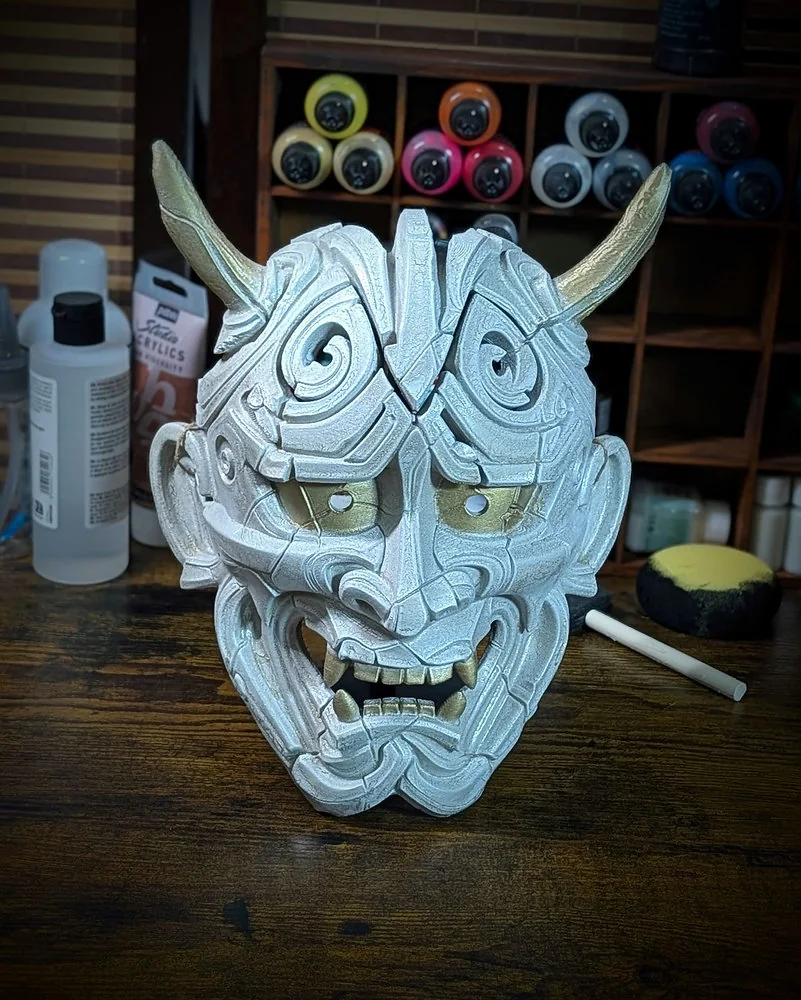
A kintsugi mask is usually a contemporary artwork, not a traditional repaired Japanese mask. Real kintsugi uses urushi lacquer to mend broken ceramics and may finish the repair with powdered gold. On a Hannya-inspired mask, golden cracks borrow that visual language as a modern metaphor. The Dai Yokai piece is printed intact, then textured and painted by hand.
| Quick question | Short answer |
|---|---|
| What does kintsugi mean? | Gold joinery |
| What does it normally repair? | Broken ceramics |
| Is every repair made with gold? | No |
| Is a kintsugi Hannya a traditional Noh mask? | No |
| Is the Dai Yokai mask actually repaired? | No, the crack effect is decorative |
What is real kintsugi?
Kintsugi (金継ぎ) means gold joinery. It is a Japanese repair method most closely associated with ceramics. Broken pieces are joined with urushi, a natural lacquer made from tree sap. Lacquer mixed with bulking materials can fill cracks or missing areas. Once the repair has cured and been levelled, a final lacquer layer may receive powdered gold.
The Smithsonian National Museum of Asian Art describes traditional repairs using raw lacquer, wheat paste and powdered gold. It also stresses that lacquer, not gold, is the central structural material. The Smithsonian’s Freer Gallery account explains that the multi-step lacquer repair becomes durable only after curing.
| Stage | Traditional material or action | Purpose |
|---|---|---|
| Join | Urushi lacquer and paste | Reconnect broken ceramic pieces |
| Fill | Lacquer with flour, paper, cloth or other bulking material | Replace gaps and level losses |
| Cure | Controlled humidity and time | Harden each lacquer layer |
| Finish | Fine lacquer and powdered gold | Protect and highlight the visible repair |
Methods vary by object, workshop and intended use. Some visible repairs use silver, while others retain plain lacquer without a gold finish. Modern kits often replace urushi with epoxy for convenience. Those kits can create a gold-colored seam, but they should not be confused with every material and step used in traditional lacquer repair.
Where did kintsugi come from?
The exact origin is unknown. Lacquer had been used to repair objects in Asia long before gold-decorated seams became common in Japan. Museum evidence places the spread of gold-highlighted ceramic repair alongside Japanese tea culture in the late sixteenth century.
The Smithsonian states that the precise beginnings of kintsugi are unknown and that the practice appears to have become more widespread with tea in the late 1500s. The Metropolitan Museum of Art likewise presents kintsugi as a way of restoring damaged ceramics while making valued objects more precious.
A frequently repeated story says that shogun Ashikaga Yoshimasa sent a broken Chinese tea bowl for repair and disliked the metal staples used to return it. The anecdote may help explain changing tastes, but it should not be presented as a proven single moment when one angry shogun ordered craftsmen to invent kintsugi.
Does kintsugi mean resilience or wabi-sabi?
Visible repair can support a powerful modern reading: an object keeps its history instead of pretending it was never damaged. Museums and contemporary artisans often discuss care, reuse, memory and a second life. Those themes make kintsugi useful as a metaphor for psychological recovery.
That metaphor is an interpretation, not the technical definition. Kintsugi is a repair practice. Wabi-sabi is a broader aesthetic idea with a long and contested history. Saying that kintsugi is simply the physical embodiment of wabi-sabi, or that every repaired crack means trauma transformed into strength, compresses several different ideas into one modern slogan.
A Smithsonian interview with kintsugi artisan Yuko Gunji offers a careful contemporary perspective: she connects the practice with saving meaningful objects and creating a new life for them, while emphasizing that urushi remains the essential natural adhesive.
What does the Hannya mask mean in Noh?
Hannya is a Noh mask type. It does not historically mean a broken woman who has repaired herself with gold. The Nohgaku Performers’ Association defines Hannya as a female demon or a woman transfigured by resentment. The horned face is used for theatrical roles in which human emotion has taken a demonic form.
The Nohgaku Performers’ Association guide to Noh masks explains that masks represent character types and that Hannya depicts a female demon or a woman transformed by resentment. It does not connect the historical mask type to kintsugi, ceramic repair or a fixed recovery narrative.
A contemporary artist can still pair the two ideas. The tension between resentment and visible repair can produce a coherent modern artwork. The important distinction is authorship: the Hannya meaning comes from Noh, the kintsugi method comes from ceramic repair, and the combined message belongs to the modern designer.
Real kintsugi versus a kintsugi-inspired mask
| Feature | Real kintsugi ceramic repair | Dai Yokai Hannya-inspired design |
|---|---|---|
| Starting object | Broken ceramic | Intact PETG mask |
| Structure | Pieces joined with lacquer | Single printed form |
| Crack lines | Follow actual breaks | Designed texture and crackle effect |
| Gold | Powder applied over lacquer | Gold-toned decorative finish |
| Primary purpose | Repair and preserve an object | Create a contemporary visual composition |
| Traditional object? | A repaired ceramic can be historical | No, it is a modern Japanese-inspired mask |
This distinction prevents a decorative effect from being sold as an ancient ritual technique. A gold-cracked mask can be meaningful without claiming that it was repaired, that it uses pure gold or that Noh theatre traditionally places kintsugi seams on Hannya masks.
How the Dai Yokai white-and-gold mask is made
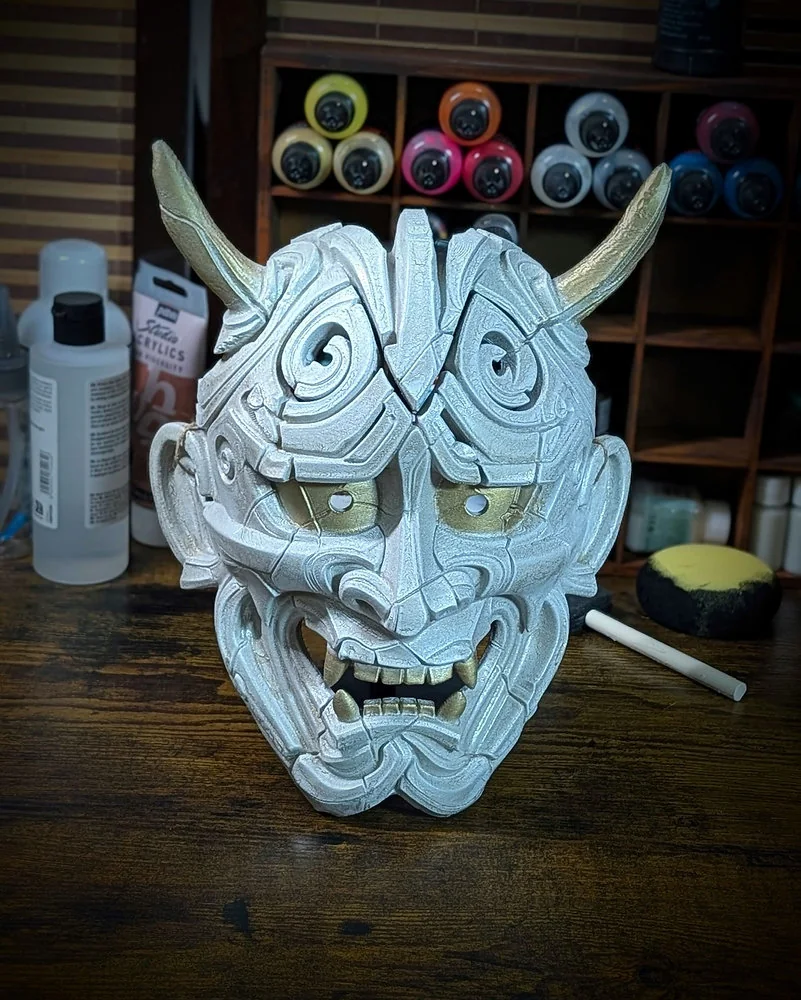
The mask begins as an intact PETG form printed in the Dai Yokai workshop in Brittany, France. Its Kezurata texture is part of the sculpted design. The surface is selectively sanded and primed, then white acrylic color is built in layers without flattening the relief.
A gold-toned crackle effect is created across the textured surface and protected with varnish. The visible lines do not hold broken pieces together. They are an aesthetic reference to visible repair, applied to a contemporary Hannya-inspired wall mask.
The physical piece is the white-and-gold Hannya Kezurata mask. For the historical theatrical context, read the Hannya mask meaning guide. The separate Kezurata design article explains the sculpted surface as a Dai Yokai creation.
Kintsugi, maki-e and gold-colored repairs
Maki-e is a decorative lacquer technique that creates images or surfaces by sprinkling metal and other powders onto lacquer. Kintsugi and maki-e are therefore not mutually exclusive categories. Gold powder can be applied to a kintsugi seam with techniques related to lacquer decoration, while maki-e can decorate an object that was never broken.
A gold-colored line is not enough to prove that an object was repaired with traditional kintsugi. To identify the process, ask what broke, what adhesive joined it, whether urushi was used, what metal or pigment finished the seam and whether the lines follow actual fractures.
Sources and further reading
- Smithsonian: The Beauty of Broken Objects
- National Museum of Asian Art: repairing and preserving
- Smithsonian Folklife: kintsugi artisan Yuko Gunji
- The Met: Japanese ceramics and kintsugi
- Nohgaku Performers’ Association: Noh masks
FAQ
What is kintsugi?
Kintsugi is a Japanese method for repairing broken ceramics with urushi lacquer. Lacquer paste joins pieces and fills losses; after curing, the visible repair can be finished with lacquer and powdered gold. The exact process varies, but real kintsugi follows actual damage and restores a broken object.
What does a kintsugi mask mean?
A kintsugi mask usually uses visible golden cracks as a modern metaphor for repair, memory or transformation. Kintsugi historically repairs ceramics, not Hannya masks. The meaning therefore belongs to the contemporary artwork and should not be presented as a fixed symbol from Noh theatre or traditional Japanese ritual.
Is a kintsugi Hannya mask traditional?
No. Hannya is a historical Noh mask type, and kintsugi is a repair method associated mainly with ceramics, but combining them into a gold-cracked mask is a contemporary design choice. A modern Hannya-inspired mask can refer to both traditions without becoming an authentic Noh mask or a genuine kintsugi repair.
Is the Dai Yokai mask actually broken and repaired with gold?
No. The Dai Yokai mask is printed intact in PETG. Its textured surface and gold-toned crackle are created as part of the design, then painted and varnished by hand. No broken ceramic is joined, no urushi repair is performed and the visible lines are not seams filled with powdered gold.
Does the Hannya mask represent a broken woman?
Not as an official definition. The Nohgaku Performers’ Association defines Hannya as a female demon or a woman transformed by resentment. Describing her as broken, healed or rebuilt is a modern psychological interpretation. It can guide an artwork, but it should not be confused with the mask’s traditional theatrical role.
Is kintsugi the same as wabi-sabi?
No. Kintsugi is a material repair practice, while wabi-sabi is a broad and difficult-to-translate aesthetic concept. Visible repair can be discussed alongside imperfection, age and change, but calling kintsugi the physical embodiment of wabi-sabi turns a complex history into a convenient modern slogan.
What is the difference between kintsugi and maki-e?
Kintsugi repairs a damaged object. Maki-e is a decorative lacquer technique in which metal or other powders are sprinkled onto lacquer to create an image or finish. They are not opposites: a kintsugi artisan may use maki-e-related techniques when applying gold powder over a cured repair.
What is the difference between a kintsugi Hannya and a Kezurata Hannya?
Kezurata is Dai Yokai’s name for a contemporary Hannya design with a sculpted, eroded surface. A white-and-gold Kezurata can use a crackle effect that recalls kintsugi, while another Kezurata may keep its texture raw or use different colors. Neither version is an actual repaired Noh mask.
Name the repair and the design honestly
Real kintsugi repairs a damaged object with lacquer. A kintsugi-inspired Hannya mask borrows the visible gold seam as contemporary visual language. Both can be valuable, but they are not the same process. The distinction makes the Dai Yokai design clearer, more credible and more interesting.