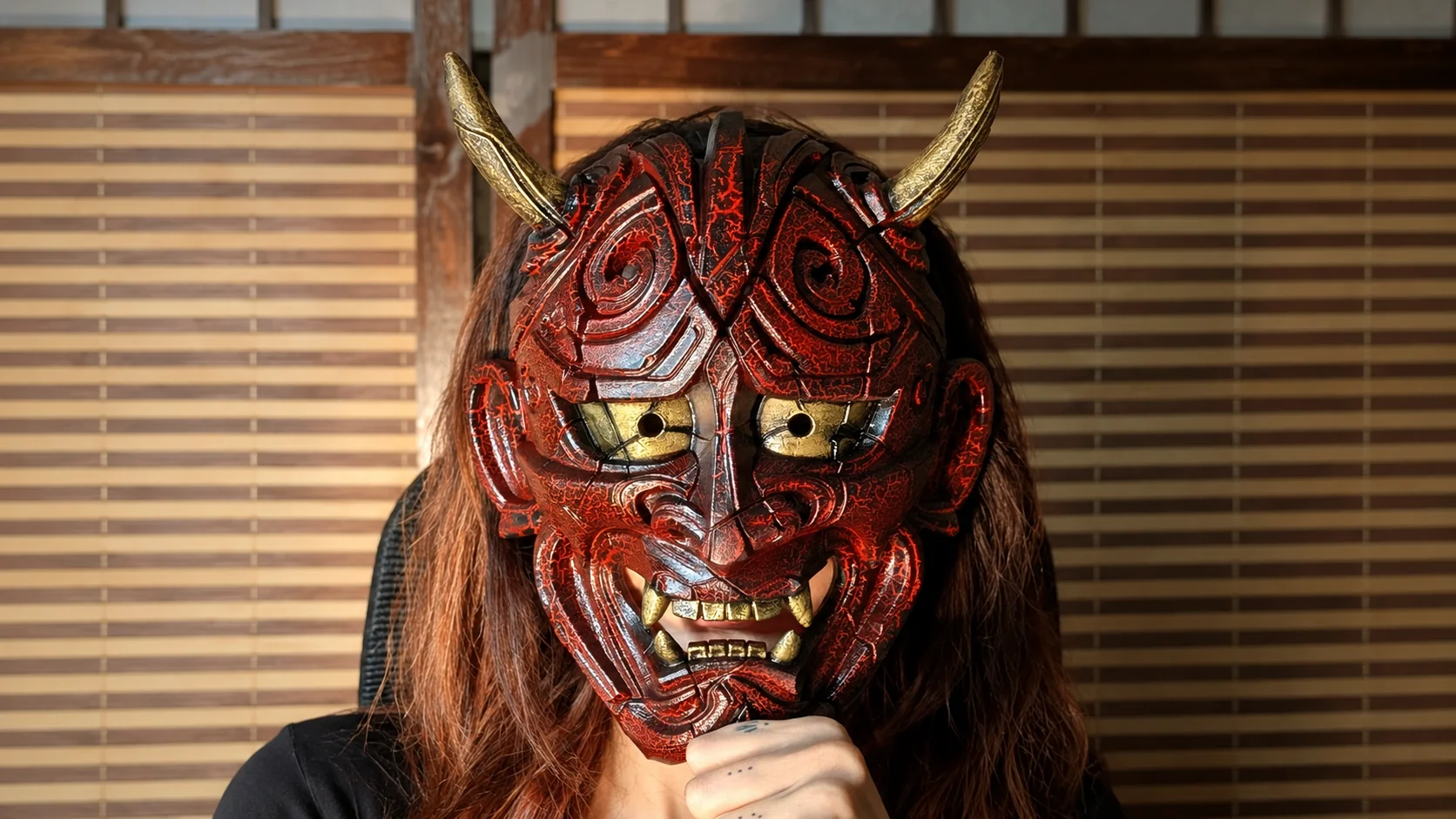
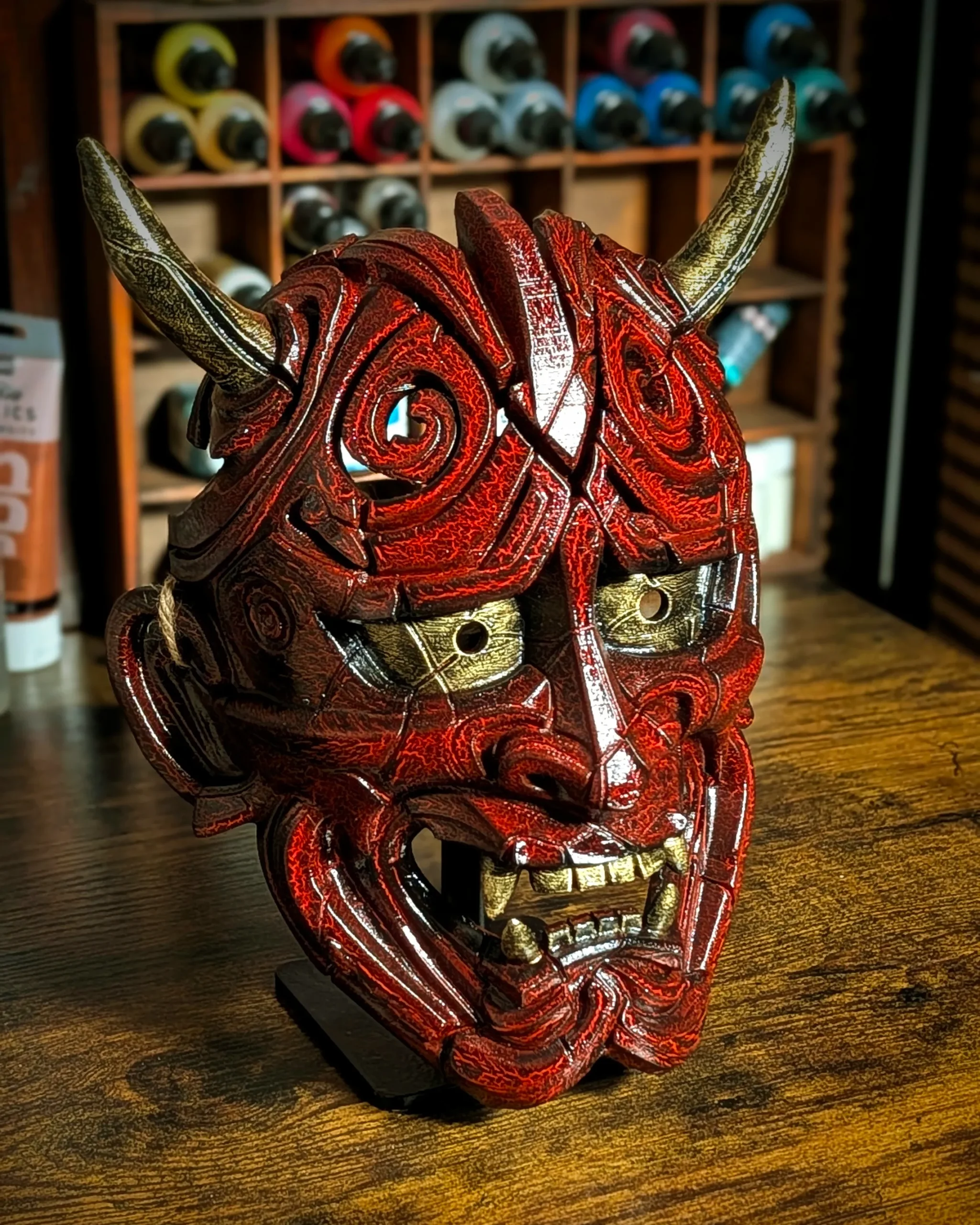
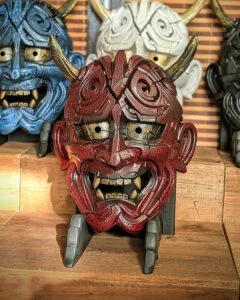
Kezurata is an original Dai Yokai Hannya design with a deliberately grooved and fissured surface. It uses the horned Hannya form as a visual starting point, then turns the smooth facial planes into deep lines that hold shadow and color. Kezurata is a contemporary workshop name and creation, not a traditional Japanese mask category or historical Noh term.
What is Kezurata?
Kezurata is the name Jérémy created for this Dai Yokai series. It is not found in the historical catalogue of Noh masks and should not be used as if it named an old Japanese tradition. The workshop name was built around the sound and idea of kezuru (削る), a Japanese verb associated with shaving, cutting or carving a surface.
That reference describes the appearance rather than the literal production method. The finished mask is not carved from a block of old wood. Its ridged texture belongs to the sculpted PETG base, which is then prepared and painted by hand. The name is therefore best understood as a design title: the Hannya face made visibly scored, eroded and fractured.
| Element | Documented source | Kezurata interpretation |
|---|---|---|
| Hannya form | A recognized female spirit mask in Noh theatre | The horned face, fangs and intense expression provide the starting silhouette |
| Grooved surface | Original Dai Yokai design choice | Deep lines divide the facial planes and catch dark washes |
| Name Kezurata | Coined in the Dai Yokai workshop | A product and series name linked to the idea of a cut or carved-looking surface |
| Cracked-face narrative | Artist’s concept | The grooves visualise emotion held so long that the surface appears to split |
| Material and finish | Dai Yokai workshop process | PETG base, sanding, primer, hand painting and varnish |
The Hannya reference, and where the invention begins
The British Museum describes Hannya as a Noh theatre mask representing a once-beautiful woman transformed by jealous rage, and records surviving examples carved and painted in wood. The Noh introduces Hannya among masks used for female ghosts and spirits with unresolved emotion. Those sources establish the theatrical reference; they do not describe a Kezurata surface.
Kezurata begins where that documented reference ends. The cracks are not a lost Noh convention, a ritual sign or a traditional code for a particular level of jealousy. They are Jérémy’s contemporary visual device. The imagined story is simple: emotion has remained inside the face long enough to mark the material itself.
For the theatrical background, read the sourced Hannya mask meaning guide. For current pieces, browse the handmade Hannya mask collection.
From sculpted texture to a hand-finished mask
The grooves must remain readable through every workshop stage. Heavy preparation could flatten the ridges, while too little preparation would leave unrelated print defects competing with the intended texture. The work is therefore selective: preserve the designed relief, clean the areas that need it, then build the finish around the surface rather than trying to make the face uniformly smooth.
| Workshop stage | Purpose on Kezurata | What remains visible |
|---|---|---|
| Digital sculpt and PETG base | Creates the Hannya silhouette and the deliberate grooves | The main ridges, fissures and changes of plane |
| Selective sanding | Cleans unwanted marks without erasing the design | Controlled texture rather than a uniformly polished face |
| Primer | Prepares the surface for color and reveals areas needing correction | The relief becomes easier to inspect under even color |
| Base color | Sets the dominant red, black, blue or white register | Broad planes of the face and horns |
| Washes and shadow | Push darker color into recesses and around intersections | Depth, separation and irregular rhythm in the grooves |
| Highlights and details | Restores contrast on raised areas, eyes, teeth and horns | A readable expression at normal viewing distance |
| Varnish and inspection | Protects the painted finish and checks the completed surface | The final balance of color, sheen and shadow |
The goal is not to disguise PETG as a historical material or claim that the mask is antique. The finish uses color and shadow to make the sculpted surface legible. At close range, the viewer should be able to distinguish designed grooves, sanding, brushwork and varnish as parts of one contemporary object.
How color changes the same surface
Kezurata has been produced in red, black, deep blue and white-and-gold versions. Availability may change, so the current product pages remain the source of truth. The surface design stays related across the series, but each base color changes how much contrast is needed in the grooves and on the raised planes.
| Produced version | Surface reading | Current product page |
|---|---|---|
| Red | High contrast between the warm base and dark recesses | Red Kezurata Hannya mask |
| Black | Subtle relief that depends more strongly on highlights and side light | Black Kezurata Hannya mask |
| Deep blue | Cool tonal transitions across the ridges and shadows | Blue Kezurata L’Entre-Deux |
| White and gold | A pale base with gold used as painted contrast, not ceramic repair | White Gold Kezurata mask |
Kezurata, a classic Hannya and a kintsugi-inspired design
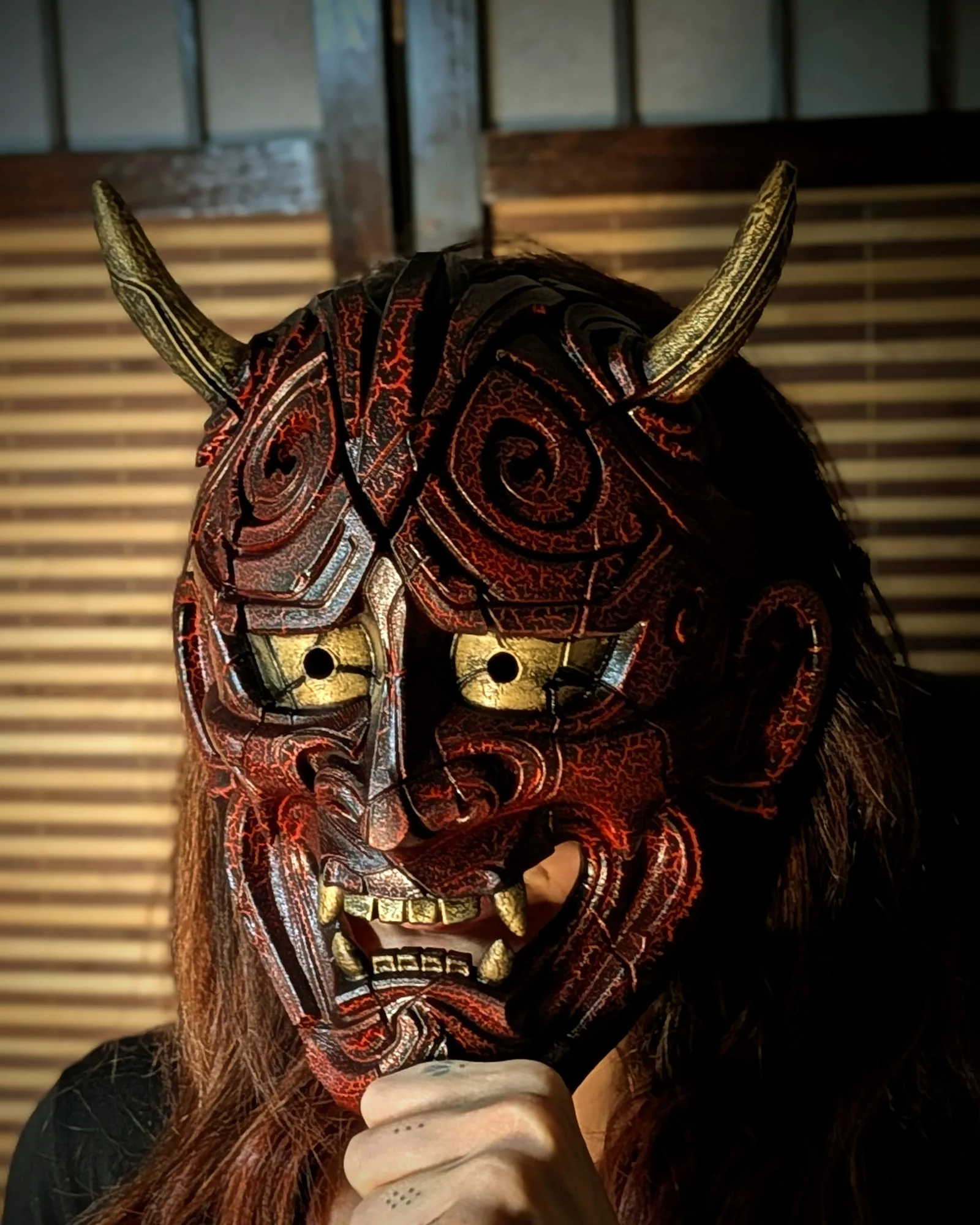
These designs can share a Hannya outline while using very different surface ideas. A classic Dai Yokai Hannya aims for cleaner facial planes. Kezurata exaggerates the relief and keeps the fissures dark. A kintsugi-inspired Hannya uses visible gold lines as a graphic reference to repair.
That last phrase needs precision. Museum sources describe kintsugi as the repair of broken ceramics with lacquer and metal powder. A PETG mask painted with gold crack lines is kintsugi-inspired decoration, not a repaired ceramic object made through the traditional process. Kezurata is different again: its surface is designed as fractured from the start and is not presented as repaired.
| Design | Surface treatment | Accurate description |
|---|---|---|
| Classic Dai Yokai Hannya | Cleaner planes with painted modeling | A contemporary hand-finished Hannya-inspired mask |
| Kezurata Hannya | Sculpted grooves emphasized with washes and highlights | An original textured Dai Yokai Hannya design |
| Kintsugi-inspired Hannya | Gold-colored lines used as a visible design element | A contemporary visual reference, not necessarily traditional ceramic kintsugi |
How to display the texture
Kezurata reads differently as the light moves across it. Soft side light usually makes the relief easier to see than flat, even illumination, but the light should not heat the surface or expose it to direct sun. A dark finish needs enough separation from the wall to keep the outline visible.
Before hanging, check the finished weight, dimensions and documented attachment for the exact mask. Do not hang it from horns, fangs or an elastic strap. The complete wall and stand guide explains how to match the support to the wall type and keep the piece away from unsafe fall zones.
Use the Japanese mask wall and stand guide for installation, and the mask wearing and care guide before any light costume use.
Care for a grooved painted surface
Dust settles more easily in a deeply textured surface than on a smooth mask. Begin with a clean, soft, dry microfibre cloth on accessible areas and a very soft clean brush used without pressure in the recesses. Do not use alcohol, solvents, household sprays, abrasive products or soaking on the hand-painted finish.
Support the mask with both hands when moving it. Protect horns, teeth and raised texture during transport, and do not let packing material rub against the painted face. If a groove, attachment or painted area is damaged, photograph it and contact the workshop before attempting heat, glue or structural repair.
The Kezurata place in the Dai Yokai workshop
Kezurata shows one way Dai Yokai works with a recognized mask form without claiming to reproduce a Noh object. The cultural reference remains identifiable, while the fractured surface, name, color series and fictional image of accumulated emotion belong to the contemporary design.
Each piece is produced in the Brittany workshop from a PETG base, then prepared, painted, varnished and finished by hand. Product specifications and availability can change, so use the current listing for purchase details and contact the workshop if you need a particular finish, event date or display arrangement.
FAQ
Is Kezurata a traditional Japanese mask?
No. Kezurata is the name of a contemporary Dai Yokai design created in Brittany. Its horned face is based on the visual language of the Hannya mask used in Noh theatre, but the deeply grooved, fissured surface and the name Kezurata belong to this workshop project. It should not be presented as a historical Noh mask category.
What does the name Kezurata mean?
Kezurata is a Dai Yokai product name, not a standard traditional mask term. It was coined in the workshop around the sound and idea of the Japanese verb kezuru (削る), associated with shaving, cutting or carving a surface. The name points to the design’s scored appearance; it is not offered as a formal Japanese translation.
How is Kezurata different from a Hannya mask?
Hannya provides the recognizable starting form: horns, metallic-looking eyes, fangs and the expression of a female spirit shaped by jealousy and rage in Noh. Kezurata keeps that silhouette but adds exaggerated grooves, fissures and layered paint shadows. It is a contemporary reinterpretation, not a replacement for the theatrical mask.
Is every groove hand-carved into the finished mask?
No. The texture is part of the sculpted design of the PETG base. After printing, the workshop sands and prepares the surface, applies primer, builds color and shadow into the relief, then varnishes the finished piece. Hand finishing changes how the grooves read, but the article does not claim that every line is individually carved from solid wood.
What materials are used for a Kezurata mask?
The Dai Yokai Kezurata base is printed in PETG, then sanded, primed, painted and varnished by hand in the Brittany workshop. Paint treatment varies with the color version and the individual finish. Check the current product page for dimensions, included parts, intended use and production information.
Which Kezurata colors have been produced?
Dai Yokai has produced red, black, deep blue and white-and-gold versions. Their names and availability can change, so the Hannya collection and individual product pages are the current source of truth. The shared element is the grooved Kezurata surface, while contrast and shadow are handled differently in each finish.
Can a Kezurata mask be worn?
A worn photograph shows the scale and face relationship, but it does not mean every Kezurata version or attachment is suitable for every person or long session. Check the exact product page for intended use and included hardware. Test vision, ventilation, fit and quick removal before any light costume use, following the cosplay mask care guide.
Is Kezurata the same as a kintsugi Hannya?
No. Kintsugi is a repair practice for broken ceramics using lacquer and metal powder. A kintsugi-inspired Hannya may borrow visible gold lines as a design reference, but Kezurata is not a repaired ceramic object. Its fissures are sculpted surface features emphasized with paint, and the design deliberately leaves them visually dark rather than gold-filled.