The Hannya x Berserk mask is an independent Dai Yokai fan-inspired design: a contemporary Hannya-based face carrying Berserk’s Brand of Sacrifice on the forehead. The two references come from different works and periods. Their combination is a workshop choice, not a historical Noh object, a documented influence on Berserk or an official collaboration.
Fan-work context: This independent design is not presented as official Berserk merchandise and no affiliation or endorsement is claimed. Berserk, the Brand of Sacrifice and related characters belong to their respective rights holders.
Two references, one independent workshop design
Hannya is a mask type used in Noh theatre. The British Museum describes its Hannya example as a painted wooden theatre mask representing a woman transformed by jealous rage. The Noh places Hannya among masks for female ghosts and spirits with unresolved emotion. Those sources describe the theatrical mask, not Berserk and not this contemporary product.
The Brand of Sacrifice belongs to Kentarō Miura’s Berserk. Dark Horse’s official manga guide describes the Brand as an unholy symbol that draws forces of darkness to Guts and marks him as a sacrifice. It is part of a modern fictional universe, not a Japanese crest, Buddhist symbol, Shinto sign or Noh convention.
| Element | Documented origin | Dai Yokai use |
|---|---|---|
| Hannya mask | Noh theatre mask for a female spirit shaped by jealousy and unresolved emotion | Provides the horned face, fangs and intense expression |
| Brand of Sacrifice | Fictional symbol from Berserk | Placed on the forehead as the main manga reference |
| Emotional parallel | Artist’s interpretation | Provides a reason to explore pain, change and contrast without claiming identical meanings |
| Finished object | Independent Dai Yokai workshop design | PETG base prepared, painted and varnished by hand in Brittany |
| Status | Fan-inspired work | No official collaboration or endorsement claimed |
Why the Brand sits on the forehead
The forehead offers a broad central plane that remains visible between the horns and above the eyes. Placing the Brand there turns it into a focal point and keeps it readable from the front. That is a composition decision. The previous claim about replacing the prayer lines of a Noh woman had no reliable source and has been removed.
Scale matters. A motif that is too small disappears after primer and paint; one that is too large competes with the eyebrows, horns and eye shape. The final treatment must also keep the line readable under normal room light rather than only in a close photograph.
| Design question | Workshop decision | Reason |
|---|---|---|
| Where should the motif sit? | Centred on the forehead | Keeps it visible between the horns and above the eyes |
| How deep should it read? | Enough relief or recession to survive preparation | Prevents primer and paint from erasing the line |
| How should it be colored? | Contrast chosen for the individual finish | Separates the Brand from the surrounding face |
| What remains Hannya-based? | Horns, fangs, eye shape and facial planes | Preserves the mask silhouette beneath the manga reference |
| What remains Berserk-specific? | The Brand motif | Avoids inventing extra links between Noh and the manga |
From PETG base to hand-painted finish
The mask is produced from a PETG base in the Dai Yokai workshop, then prepared and finished by hand. Selective sanding cleans print marks while preserving the intended facial modeling and forehead motif. Primer reveals defects and provides a consistent surface for color.
The base color is then built with airbrush and brush work depending on the version. Darker color can emphasize recesses, while gold or pale accents make horns, teeth or the Brand stand out. Varnish completes the finish. These are contemporary prop and wall-art techniques, not the carving and painting method of a historical wooden Noh mask.
| Stage | Purpose | Article claim kept precise |
|---|---|---|
| PETG base | Creates the Hannya-based form and Brand placement | The object is not described as carved from wood |
| Selective sanding | Removes unwanted print marks | Not every surface must become uniformly smooth |
| Primer | Prepares and checks the surface | Does not make the object a traditional mask |
| Base paint | Establishes the main color register | Color meaning is not treated as Berserk canon |
| Detail paint | Separates eyes, teeth, horns and Brand | Symbol visibility is a design choice |
| Varnish and inspection | Completes the hand-finished surface | Care still requires avoiding heat, solvents and abrasion |

Current finishes
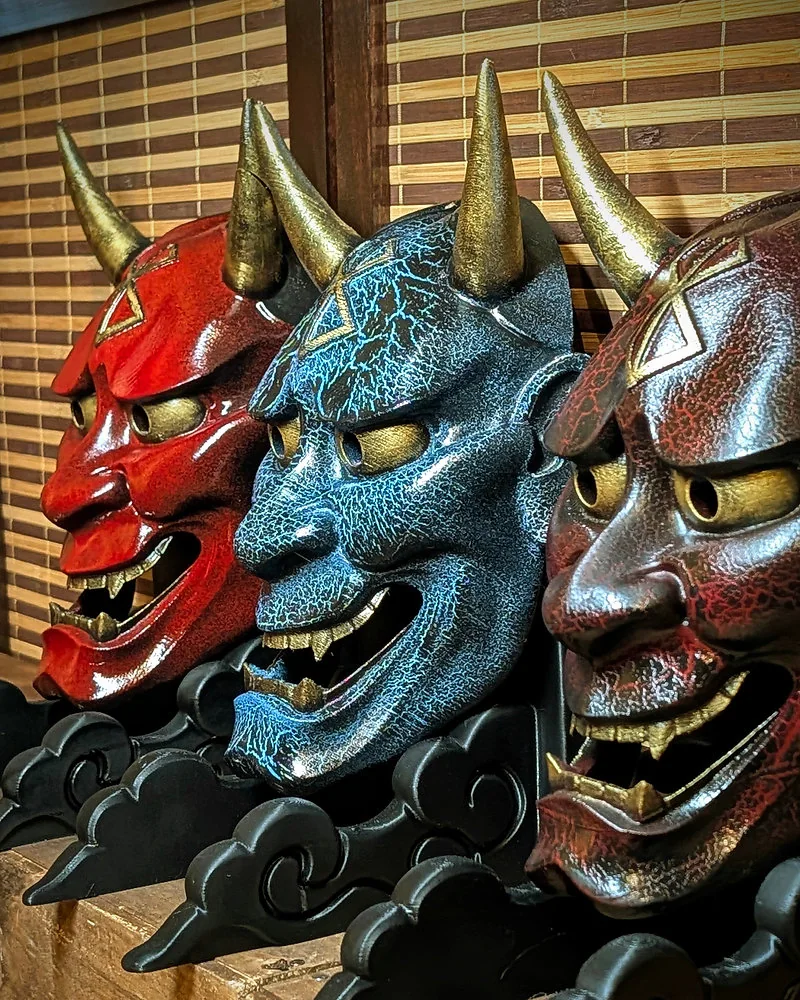
The Hannya Berserk product page offers three finishes: red, red cracked and blue cracked. These are options of the same model, not three separate designs. Check the live product page for the available finish, dimensions, weight, included parts and production information when ordering.
| Finish | Visible treatment | Product page |
|---|---|---|
| Red | Red hand-painted finish with the forehead motif | Check the finish options |
| Red cracked | Red crackled treatment with the Brand | Check the finish options |
| Blue cracked | Blue crackled treatment with the Brand | Check the finish options |
Similarity is interpretation, not cultural equivalence
A viewer may connect Hannya’s intense expression with Berserk themes such as sacrifice, trauma, transformation or survival. Those comparisons can explain why the composition feels coherent. They remain interpretations. Hannya and Griffith do not follow the same story, the Brand does not change the historical meaning of a Noh mask, and Berserk’s Apostles are not simply yokai under another name.
The earlier article also claimed broad Shinto, Buddhist and Muromachi-scroll influences without direct evidence from Miura. Those statements have been removed. A credible crossover does not need to rewrite either source. It is enough to show the two documented references and explain how the workshop combined their visual forms.
Read the sourced Hannya mask meaning guide, then compare the original workshop approach in the Kezurata Hannya design story.
Display and light costume use
For display, use the finished weight, depth and documented attachment of the exact product. Keep the mask away from direct sun, strong heat and unsafe fall zones. A dark wall or side light may emphasize the relief, but no color requires one prescribed room or lighting setup.
For light costume use, do not rely on the old promise of about 150 g or full-day comfort. Current specifications vary by listing and option. Test vision, ventilation, pressure, attachment and quick removal in short sessions. A worn or adult-scale photograph does not prove that the mask fits every face.
Use the Japanese mask display guide for mounting and the cosplay mask fit and care guide before wearing it.
Berserk publication context
Kentarō Miura created Berserk. After his death in 2021, Hakusensha announced that serialization would continue with the credits “Original work by Kentarō Miura, manga by Studio Gaga, supervised by Kouji Mori.” Official Hakusensha listings in 2026 continue to use those credits. The article links to the publisher rather than freezing sales numbers or calling the series finished.
What this design represents at Dai Yokai
The result is a contemporary object made in Brittany, not a Noh theatre mask and not official Berserk merchandise. That clear description protects the cultural context, gives readers useful production information and lets the photographs carry the visual crossover without unsupported mythology.
FAQ
What is the Hannya x Berserk mask?
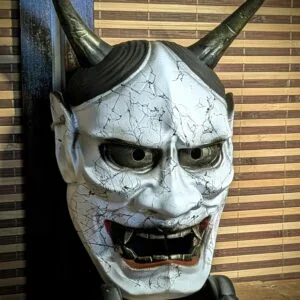
It is an independently made Dai Yokai fan-inspired design that places Berserk’s Brand of Sacrifice on a contemporary Hannya-based mask. The Hannya reference comes from Noh theatre; the Brand comes from Kentarō Miura’s manga. Their combination is Jérémy’s workshop concept, not a historical Japanese object or an official Berserk collaboration.
Is this official Berserk merchandise?
No official collaboration or endorsement is claimed. The design is presented as an independent fan-inspired workshop piece. Berserk, the Brand of Sacrifice and related characters belong to their respective rights holders. A disclaimer does not turn fan work into licensed merchandise, so the article avoids language that could imply approval, partnership or official status.
What is the Brand of Sacrifice?
Within Berserk, the Brand is an unholy mark associated with sacrifice and supernatural danger. Dark Horse’s official manga guide describes it as a symbol that draws forces of darkness to Guts and marks him as a sacrifice. It is a fictional symbol from Berserk, not a traditional Japanese crest, Noh sign or historical religious mark.
Why combine the Brand with a Hannya mask?
The combination works visually because the Brand creates a strong forehead focal point and the horned Hannya form already carries an intense expression. Any emotional parallel between the two is an artist’s reading, not a documented influence on Berserk or a claim that both symbols mean the same thing. The article keeps reference and interpretation separate.
Do Hannya and Berserk tell the same story?
No. Hannya is a mask type used in Noh for female spirits shaped by jealousy, resentment and unresolved emotion. Berserk is a modern dark-fantasy manga with its own characters, cosmology and narrative. Dai Yokai places the two images together because their contrast is visually compelling, not because one historically derives from the other.
How is the mask made?
The Dai Yokai base is printed in PETG in Brittany, then selectively sanded, primed, painted, detailed and varnished by hand. The Brand motif is incorporated into the design on the forehead and highlighted during finishing. Exact dimensions, weight, options and production information should be checked on the current product page rather than generalised across every version.
Which Hannya x Berserk versions are currently documented?
The product page lists red, red cracked and blue cracked finishes for the same Hannya Berserk model. Check its selectable options and current availability before ordering, as catalogue information may change.
Can the Hannya x Berserk mask be worn?
Do not assume that it fits every adult or remains comfortable for a full convention day. Check the exact product page for dimensions, finished weight, intended use and included attachment. Before light costume use, test vision, ventilation, balance and quick removal in short sessions, following the Dai Yokai cosplay mask care guide.