Japanese dragons are not one fixed species with one fixed meaning. Ryū and tatsu are general words for dragon, while Ryūjin is a sea deity, mizuchi describes a water-associated serpent or dragon-like spirit, and Yamata no Orochi is an individual eight-headed legendary serpent. Water, rain, clouds and movement connect many of these figures.
| Quick question | Short answer |
|---|---|
| What is a Japanese dragon called? | Ryū or tatsu |
| Main traditional associations | Water, rain, clouds and the sea |
| Is there one official list of species? | No, sources mix general terms, deities, spirits and individual legends |
| Best-known dragon deity | Ryūjin, the Dragon King or dragon god of the sea |
| Best-known serpent legend | Yamata no Orochi, defeated by Susanoo |
What is a Japanese Ryū dragon?
Ryū (龍 or 竜) and tatsu are Japanese readings associated with the dragon. In art, the familiar Japanese dragon is usually long and serpentine, with horns, whiskers and clawed feet. It often moves through waves or clouds rather than standing on wings like a medieval European dragon.
Japanese museum collections repeatedly pair dragons with waves, clouds and water imagery. The Tokyo National Museum also notes that the Asian dragon forms familiar in Japan first developed in China and spread through Korea to Japan. Japanese dragon imagery is therefore both local and part of a wider East Asian history.
Japanese dragon types: terms, deities and legends
Search results often promise eight, nine or more Japanese dragon species. That is misleading. The lists usually combine vocabulary, named deities, individual monsters, Buddhist dragon kings, directional symbols and modern color labels. A clearer approach is to classify each name by context.
| Name | Best classification | What to remember |
|---|---|---|
| Ryū or Tatsu | General term | The broad Japanese word or reading for a dragon, not one individual being |
| Ryūjin | Dragon deity | A sea dragon god or Dragon King associated with the underwater palace and tides |
| Mizuchi | Water spirit or dragon-like serpent | An old, variable term often associated with rivers and water |
| Takaokami and Kuraokami | Water and rain deities | Linked with water, rain and dragon-god interpretations at Kifune Shrine |
| Seiryū | Directional guardian | The Azure Dragon of the East within the Four Symbols inherited from East Asian cosmology |
| Yamata no Orochi | Individual legendary serpent | An eight-headed and eight-tailed being defeated by Susanoo |
| Ryūō | Dragon King title | A title used in Buddhist and East Asian dragon-king traditions, not a single species |
Ryūjin: the Dragon King of the Sea
Ryūjin is more specific than ryū. He is a dragon deity connected with the sea, tides and the undersea realm often called Ryūgū. Depending on the artwork, Ryūjin may appear as a dragon or as a fierce human figure accompanied by a dragon.
An 18th-century Japanese netsuke catalogued by the Los Angeles County Museum of Art is titled Ryūjin: Ruler of Seas and Tides. This museum record supports Ryūjin as a specific named figure, not a generic species. Dragon jewels appear in several Buddhist, dragon-king and narrative contexts, so the object should be identified before a fixed meaning is assigned.
Mizuchi, Takaokami and other water-dragon figures
Mizuchi should be handled carefully. English pages often translate it simply as a hornless dragon or water dragon, but historical usage is less tidy. It can refer to a dangerous water spirit, serpent or dragon-like river being. It is related to the wider dragon world without being interchangeable with Ryūjin.
Kifune Shrine identifies Takaokami as a deity who rules over water and records a tradition connecting Takaokami and Kuraokami with mountain and abyss dragon gods. This is a better documented example of a named water or rain deity than many unsourced species lists found online.
Yamata no Orochi: serpent, dragon or monster?
Yamata no Orochi is not a normal type of ryū. It is an individual mythological serpent with eight heads and eight tails. In the legend, Susanoo defeats it and discovers a sword inside one tail. English retellings often call Orochi a dragon, but serpent is the more precise starting point.
The Japan Tourism Agency describes Yamata no Orochi as a mythological serpent whose story appears in some of Japan’s oldest written records. Keeping Orochi separate from general dragon terminology makes the article clearer and avoids creating a false species list.
Japanese, Chinese and Western dragons compared
Japanese and Chinese dragon imagery cannot be separated by one simple visual test. Forms and stories moved across Asia for centuries. Three claws are common in Japanese works, but Chinese art also used three-clawed dragons. Period, object, story and cultural setting matter more than counting toes alone.
| Tradition | Common visual form | Frequent associations | Important caution |
|---|---|---|---|
| Japanese ryū imagery | Long, serpentine, often wingless, with horns, whiskers and claws | Water, rain, clouds, sea, dragon deities and local legends | No single list or meaning covers every figure |
| Chinese long imagery | Long, serpentine and composite animal form | Rain, imperial imagery, cosmic order, prosperity and power | It strongly influenced Japanese dragon art |
| Western medieval dragon imagery | Large reptilian body, wings and claws | Fire, treasure, danger, guardianship and heroic combat | Modern fantasy mixes traditions freely |
How to recognize a Japanese dragon in art
Look for a long body that coils through the composition, horns, whiskers, scales and clawed feet. Waves and clouds often matter as much as the creature itself. A jewel may appear near the claws or body, but its meaning depends on the subject and should not automatically be labelled a wish, pearl of wisdom or tide jewel without context.
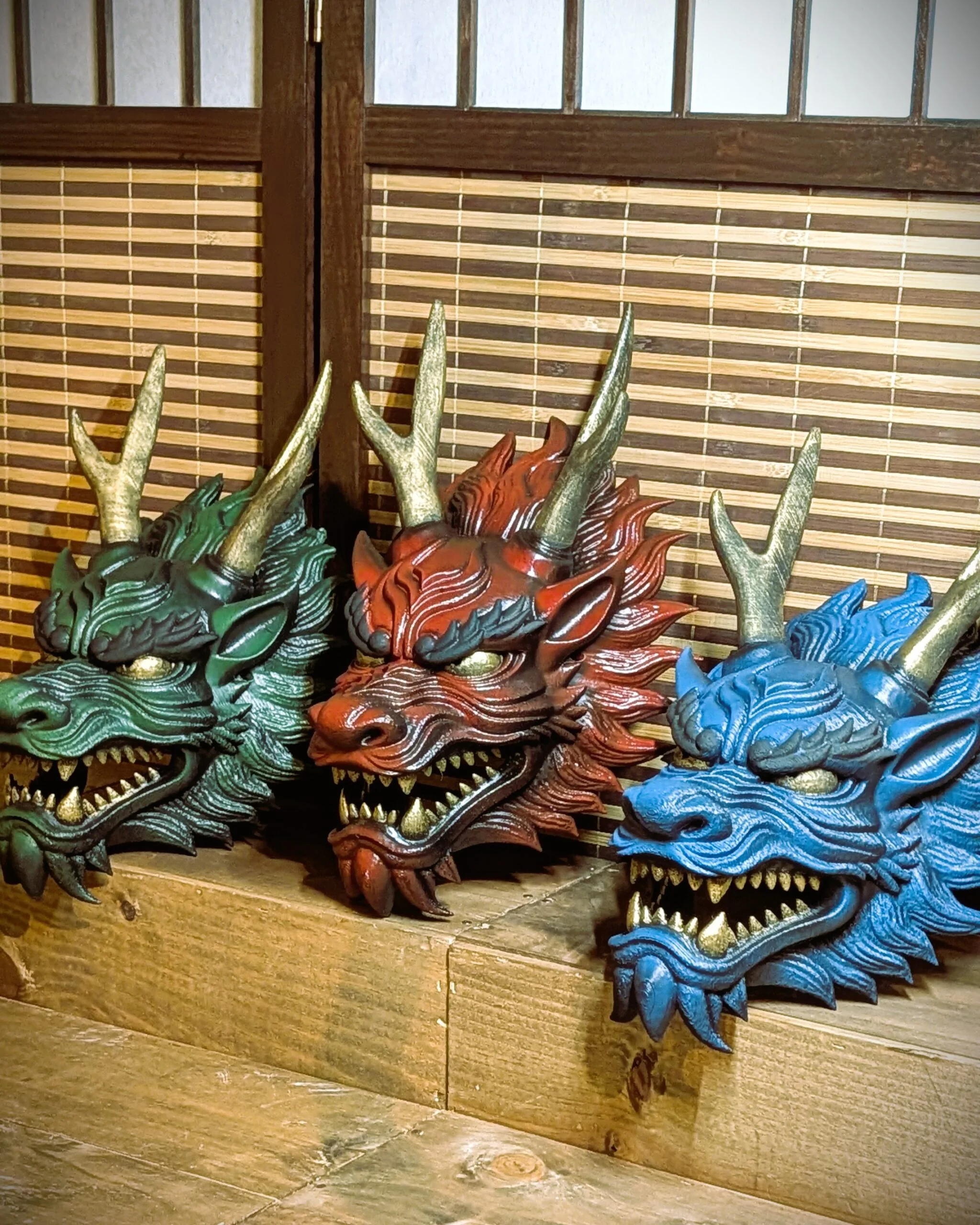
Color is also contextual. Blue-green, red, black, white and gold can change the mood of a print, tattoo or contemporary mask, but there is no universal Japanese code that assigns one permanent meaning to every dragon color. Artist, period and surrounding motifs must be considered.
Japanese dragon meaning in irezumi
In irezumi, the dragon’s serpentine body can follow the back, arm, thigh or torso and connect with waves, clouds and wind bars. This makes it a powerful compositional subject. Protection, movement, authority and controlled force are possible readings, not automatic translations.
The surrounding composition decides the final reading. Compare the broader Japanese tattoo motifs guide, the Oni tattoo guide and the Hannya tattoo guide. A tattooer’s design and the wearer’s intent matter more than a generic chart of symbols.
From Japanese dragon imagery to a contemporary mask
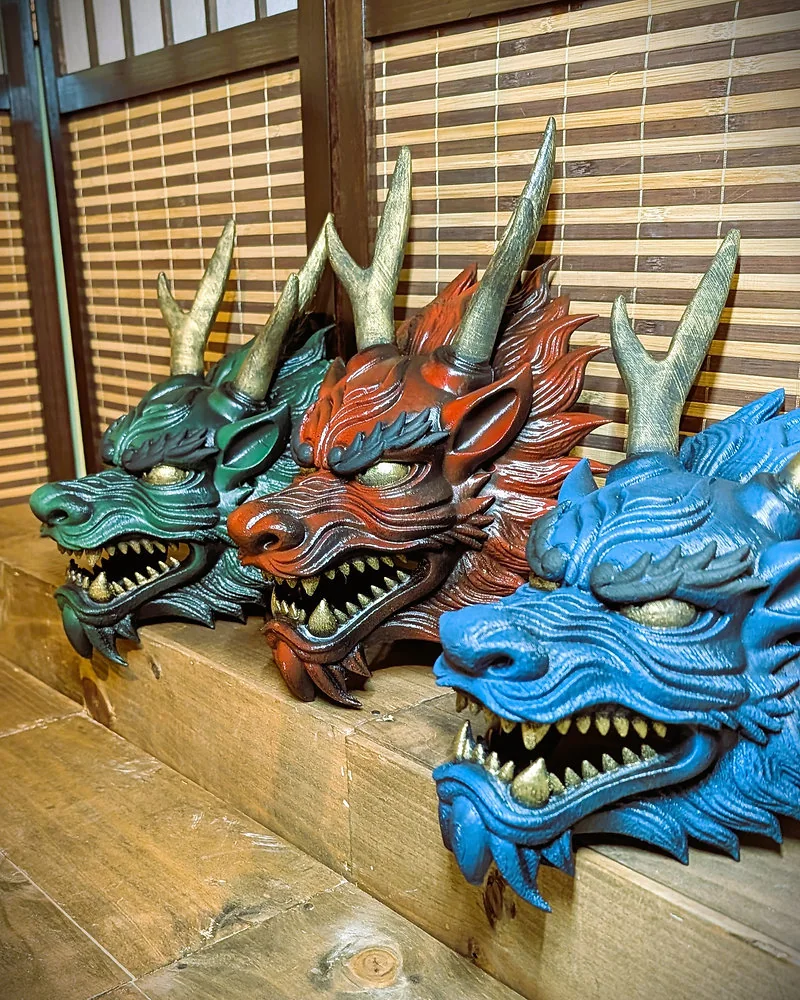
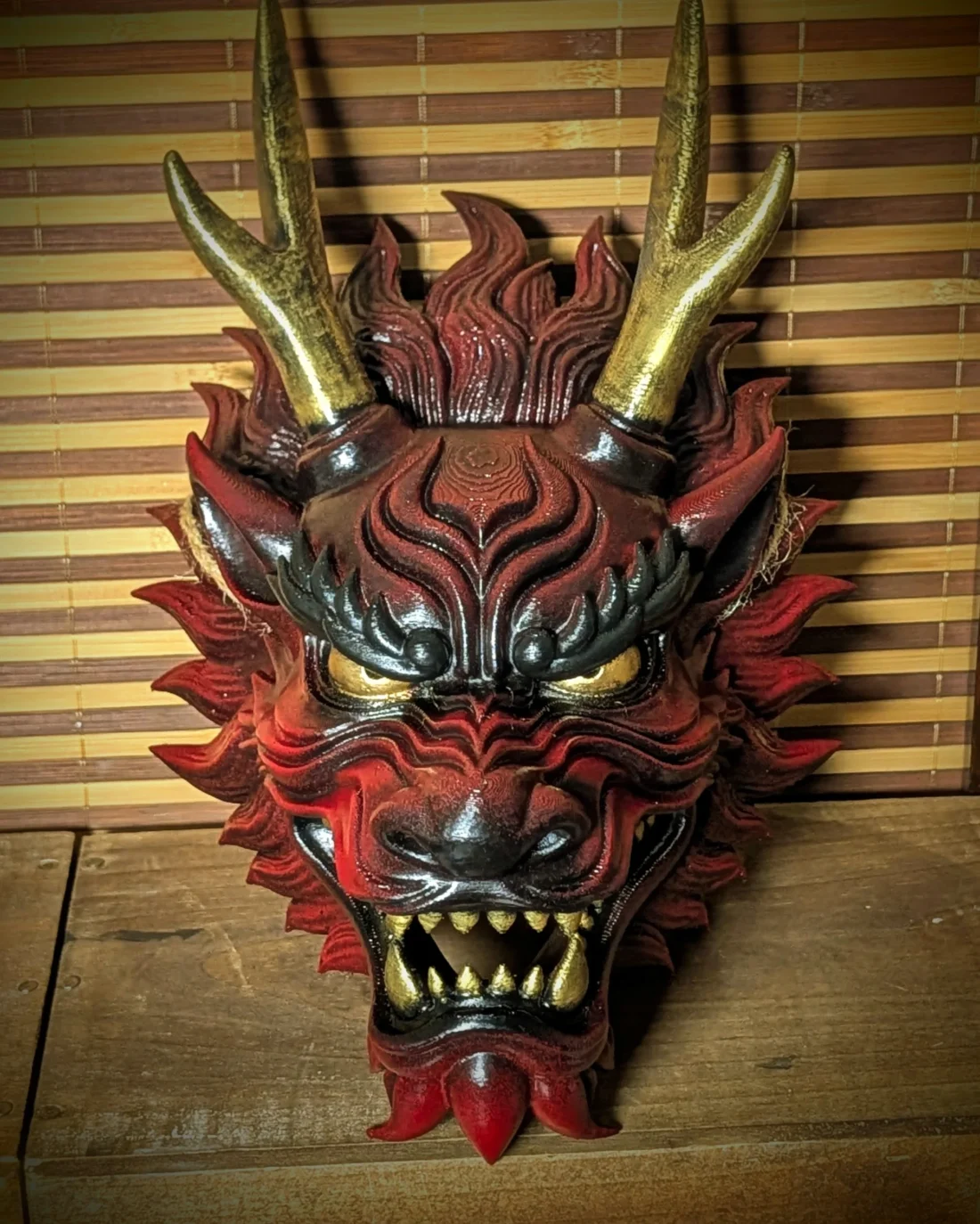
Dai Yokai does not present its Dragon mask as a ritual object or historical Japanese artifact. It is a contemporary Japanese-inspired creation made in Brittany, France. The form is produced in PETG, then sanded, primed, painted, varnished and finished by hand.
The design borrows visual cues such as the flowing jawline, horns, whisker-like movement and strong color contrasts. You can view the handmade Ryū Dragon mask, explore the Japanese-inspired mask collection, or continue with the guide to Japanese masks and meanings.
Sources and further reading
- Tokyo National Museum: The Soaring Majesty of Dragons in Asian Art
- LACMA: Ryūjin, Ruler of Seas and Tides
- Kifune Shrine: Takaokami and Kuraokami
- Japan Tourism Agency: Yamata no Orochi
From an idea to the workshop model
Jérémy wanted his own dragon mask, without presenting it as a traditional design. He sees the muzzle and gaze as its clearest Ryū features and prefers the red finish through personal taste, not a historical colour code. The shape is still being refined and does not fit the face correctly. The current Dragon Ryū model is a decorative and collectible piece, not a wearable mask.
FAQ
What is a Japanese dragon?
A Japanese dragon, called ryū or tatsu, is usually shown as a long, serpentine creature with horns, whiskers and clawed feet. In Japanese art and belief, dragons are strongly associated with water, rain and clouds. Individual stories may present them as deities, guardians, dangerous beings or legendary opponents.
What are the main types of Japanese dragons?
There is no single authoritative list of Japanese dragon species. Useful distinctions include the general ryū or tatsu, the sea dragon deity Ryūjin, water spirits such as mizuchi, rain deities such as Takaokami or Kuraokami, the Azure Dragon Seiryū, and individual legendary beings such as Yamata no Orochi.
Is Ryūjin a dragon or a god?
Ryūjin is a dragon deity linked to the sea, tides and the underwater dragon palace. Japanese artworks may show Ryūjin in dragon form or as a fierce human figure accompanied by a dragon and a tide-ruling jewel. Ryūjin is therefore more specific than the general word ryū, which simply means dragon.
Is Mizuchi the same as Ryūjin?
No. Mizuchi is an old and variable term for a water-associated serpent or dragon-like spirit, often connected with rivers. Ryūjin is a named dragon deity of the sea. Both belong to Japan’s wider water-dragon imagery, but they should not be treated as two names for the same figure.
What is the difference between Japanese and Chinese dragons?
Japanese dragon imagery was deeply influenced by Chinese and broader Asian traditions, so the forms overlap. Both are often serpentine and connected with water or clouds. Three claws are common in Japanese works, but claw count is not an absolute national rule. Context, period, object and story are more reliable than a simple toe-count test.
Do Japanese dragons breathe fire?
Water, rain, clouds and the sea are more characteristic associations in historical Japanese dragon imagery than fire breathing. That does not create a universal rule for every story or modern design. A fire-breathing Japanese dragon can appear in contemporary fantasy, but it should not be presented as the defining traditional feature.
What does a Japanese dragon symbolize?
A Japanese dragon can suggest water, rain, protection, authority, movement or spiritual force. Meanings depend on the specific deity, legend and artwork. Modern tattoo and decorative interpretations also vary, so colors and poses should be read as design choices rather than a fixed traditional code.
Why is the dragon important in Japanese tattooing?
The dragon’s long body can follow the back, arm, thigh or torso and connect naturally with waves, clouds and wind bars. This makes it a powerful compositional motif in irezumi. Its meaning is not automatic: the tattooer, wearer, direction, surrounding motifs and overall design determine the final reading.
Can I wear the Dai Yokai Dragon Ryū mask?
No. The current model is intended for decoration and collection. Its shape is not fitted to accommodate the face; consult the product page for dimensions and current specifications.
Read the name before reading the symbol
The clearest way to understand a Japanese dragon is to identify the figure first. Ryū, Ryūjin, mizuchi, Seiryū and Yamata no Orochi do not describe the same thing. Once the name, source and context are clear, the water symbolism, artwork or tattoo composition becomes much easier to read.