The Ryū dragon is one of the most adaptable subjects in Japanese tattooing. Its winding body can follow a back, wrap around an arm or cross a thigh. Its meaning goes beyond “strength, wisdom and protection”. A considered design should establish which dragon it depicts, how it moves and the landscape it inhabits.
At a glance: a Japanese dragon tattoo can suggest controlled natural power, protection, adaptability or transformation. Ryū is closely associated with water, clouds and rain. Claws, colour and direction offer clues, but none provides a universal code on its own.
- Main idea: power in motion, not violence for its own sake.
- Natural elements: water, rain, clouds, wind and rocks.
- Watch out for: colour and claw charts presented as absolute rules.
- Composition: the head draws the eye; the body connects the different areas.
What does a Japanese dragon tattoo mean?
Ryū first represents a natural force. Japanese beliefs and imagery closely connect dragons with water, clouds, rain and atmospheric phenomena. Depending on the composition, a tattoo can use that power to explore self-control, protection, transformation or the ability to navigate an unsettled period.
The dragon is not always benevolent. It can be a guardian, a water deity, a commanding presence or a dangerous force. Like a river or a storm, it does not fit neatly into “good” or “evil”.
The design therefore needs to make a choice. A calm dragon emerging from clouds tells a different story from a tense Ryū, claws extended, in a turbulent sea. For the wider history, names and mythological figures, see the guide to the Japanese Ryū dragon.
| Possible reading | How to show it | What not to promise |
|---|---|---|
| Controlled strength | A flowing body, focused gaze and stable composition | That any dragon automatically makes its wearer stronger |
| Protection | A dragon overlooking or surrounding another element | That it is a universal talisman |
| Transformation | Movement between water and clouds, with changes in level | That one direction is always positive |
| Natural power | Rain, waves, wind, rocks and depth | That Ryū is merely a decorative fantasy animal |
Japanese Ryū, Chinese dragon or Western dragon?
The Japanese dragon did not develop in isolation. Images and stories travelled between China, India and Japan. Japan Search explains that Ryū combines local snake beliefs with influences from Indian nāga and Chinese dragons.
| Visual tradition | Common features | Keep in mind |
|---|---|---|
| Japanese Ryū | A winding body, often without wings, water, rain and clouds | Claws and colours vary between works |
| Chinese Lóng | A related East Asian form, heavenly authority and imperial conventions in certain contexts | Five claws do not sum up all Chinese dragon imagery |
| Western dragon | A heavier body, often wings, fire and stories of confrontation | Modern fantasy designs readily combine these conventions |
Start with documented Japanese works rather than random references. The aim is not to determine a dragon’s nationality by counting claws, but to create a clear visual language.
Three claws or five: a clue, not a law
“Three claws for Japan, five for imperial China” can help identify certain conventions, but is misleading as an absolute dividing line. Period, patronage, artistic borrowing and individual artists affect the number of digits.
In a tattoo, claws should remain readable and consistent with the chosen reference. Counting them cannot replace attention to the head, whiskers, horns or movement. Ask your artist to show you the Japanese works behind the drawing.
Water, clouds and the dragon’s direction
Japan Search connects Japanese dragons with control over water and rain, particularly in farming. Ryū can appear in seas, rivers, storms or clouds. This is a stronger basis for a design than a simplistic contrast between a “kind” Asian dragon and an “evil” Western one.
Direction does not impose a moral judgement. The Kyoto National Museum notes that paired ascending and descending dragons were a common painting subject. A descending dragon is not automatically defeated or negative.
On skin, direction should respond to anatomy. The gaze can turn towards the body’s centre, the tail can connect an empty area and clouds can follow a change of plane. An upward arrow drawn without considering the arm or back often looks rigid.
The dragon’s pearl: beyond “a pearl of wisdom”
A dragon sometimes appears with a jewel or pearl near its mouth or claws. It is often associated with the hōju, the wish-fulfilling jewel in Buddhist imagery. Depending on the work, it may also belong to a story about the sea, treasure or power.
Check the particular reference before assigning a personal meaning. “Pearl of wisdom” is convenient but too narrow when the source image does not support that reading.
Ryū colours: atmosphere, contrast and ageing
No universal colour chart fixes a dragon’s age, rank or character. Red, blue, green, black and gold create different moods. The palette should remain clear against the background, skin tone and existing tattoos.
| Palette | Possible visual effect | What not to assume |
|---|---|---|
| Black and grey | Volume, clouds, depth and understated ageing | That black always means an ancient or evil dragon |
| Blue or green | An aquatic, cool or plant-like impression | That colour alone determines an element or status |
| Red | A warm focal point, tension and strong contrast | That a red Ryū automatically becomes a fire dragon |
| Gold accents | Highlights on horns, eyes, claws or the jewel | That gold proves a divine or imperial role |
Building a coherent irezumi composition
The dragon works well in large designs because its body connects several areas. The head can become the focal point, while the tail, legs and clouds guide the eye. In a sleeve, consider what disappears inside the arm and what remains visible from the front.
- Choose the head’s position and gaze first.
- Decide where the body passes before or behind clouds and waves.
- Leave space between scales, whiskers, claws and background.
- Use plants to establish a season rather than adding incompatible flowers.
- Check the design when the arm, leg or back moves.
The dragon and tiger pairing is an established subject in Japanese painting, as a work catalogued by Japan Search shows. Every tattoo need not use the pair. Ryū can work alone or alongside an Oni, provided the artist builds a coherent story rather than accumulating symbols.
For backgrounds, waves and clouds in a large piece, see the guide to Japanese tattoo motifs.
Where should a Ryū dragon tattoo go?
| Placement | What it allows | Watch out for |
|---|---|---|
| Back | A complete dragon, landscape, large head and extended body | Balance shoulders, spine and lower back |
| Arm or sleeve | A coiling body alternating head, claws and clouds | Do not hide every identifying feature inside the arm |
| Thigh or leg | Width for the head and length for the body | Allow for knee movement and the side view |
| Chest or side | A diagonal line and possible connection with the back | Adapt to breathing and the ribs |
A small, highly detailed dragon quickly becomes hard to read. With limited space, a clear head, claw and a few clouds work better than squeezing in a whole body, pearl, waves and several flowers.
Questions to ask your tattoo artist
- Do they work in traditional Japanese, neo-Japanese or illustrative styles?
- Which Japanese works inform this Ryū?
- How will it fit existing tattoos?
- Which elements remain visible with the limb at rest?
- Are direction, claws and palette deliberate choices or drawing habits?
- How will the background and colours age?
Dai Yokai does not provide tattooing services. The final drawing, technique, pigments and healing guidance belong with a qualified tattoo artist, ideally experienced in large Japanese compositions.
The Ryū dragon in the Dai Yokai workshop
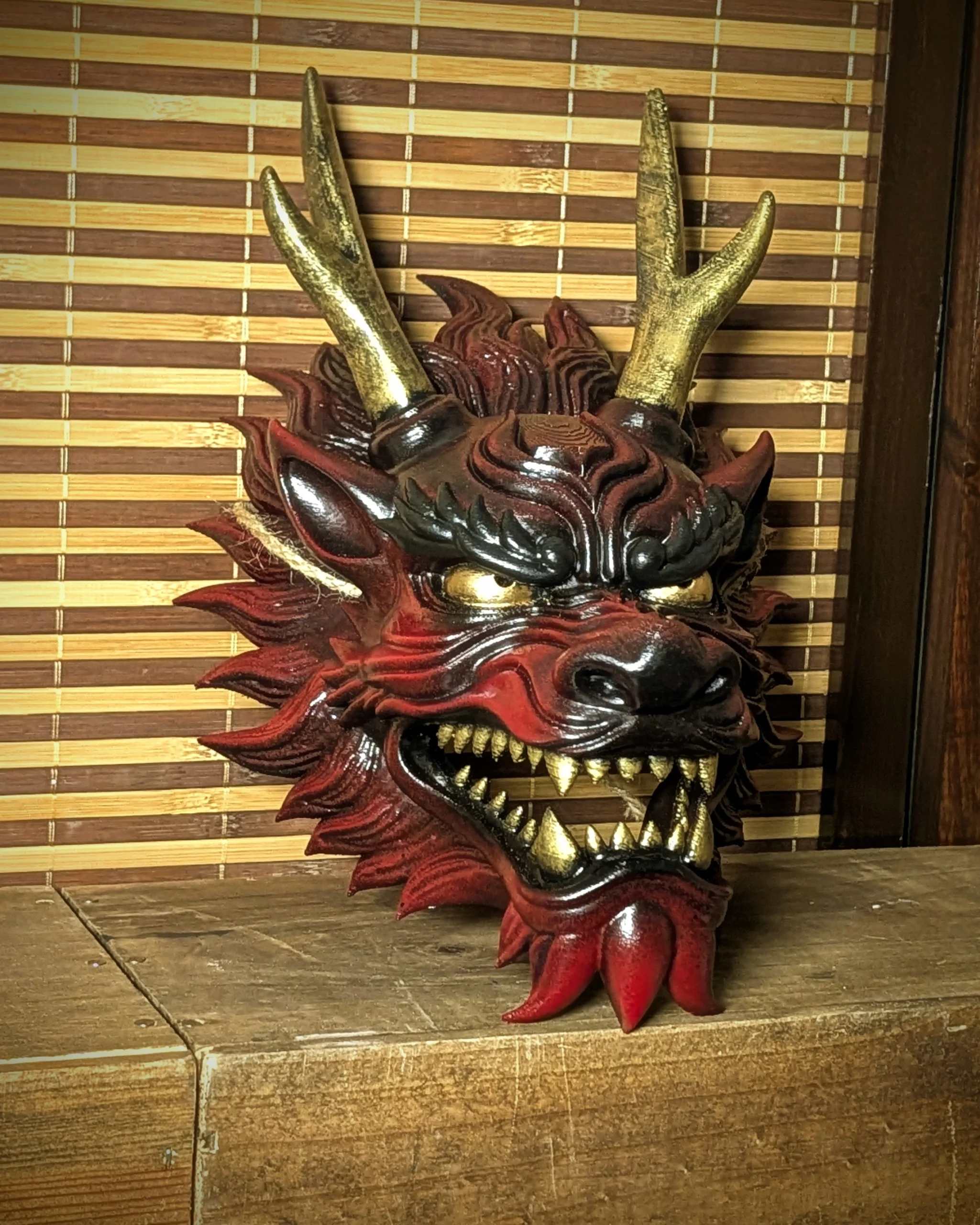
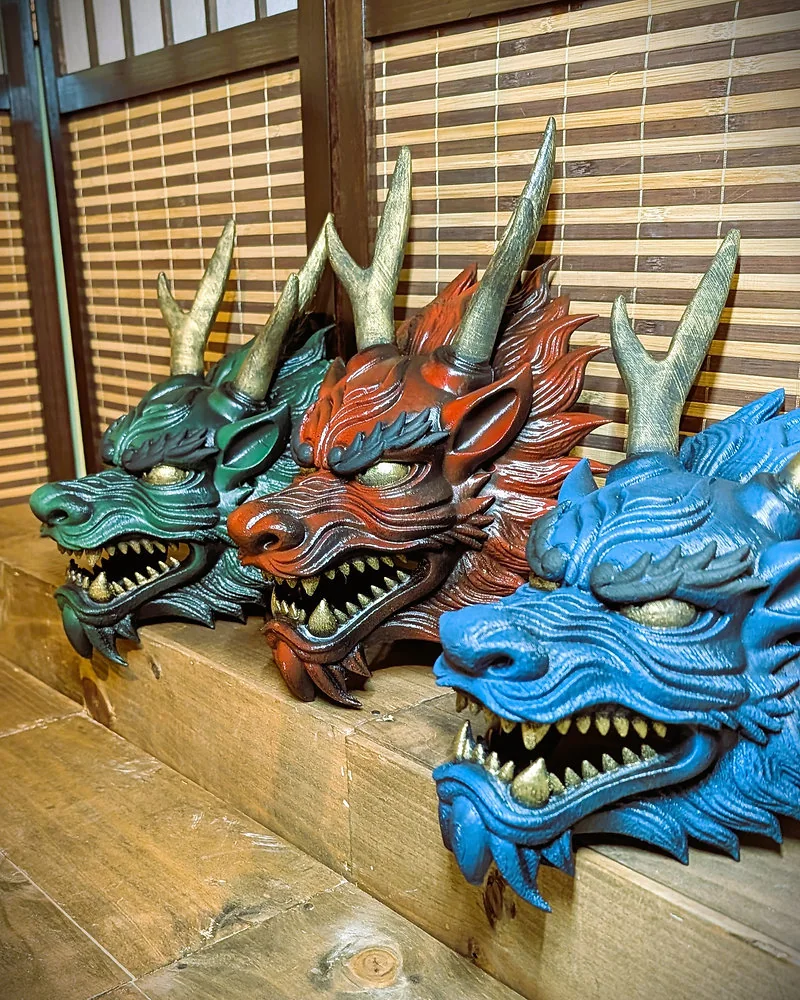
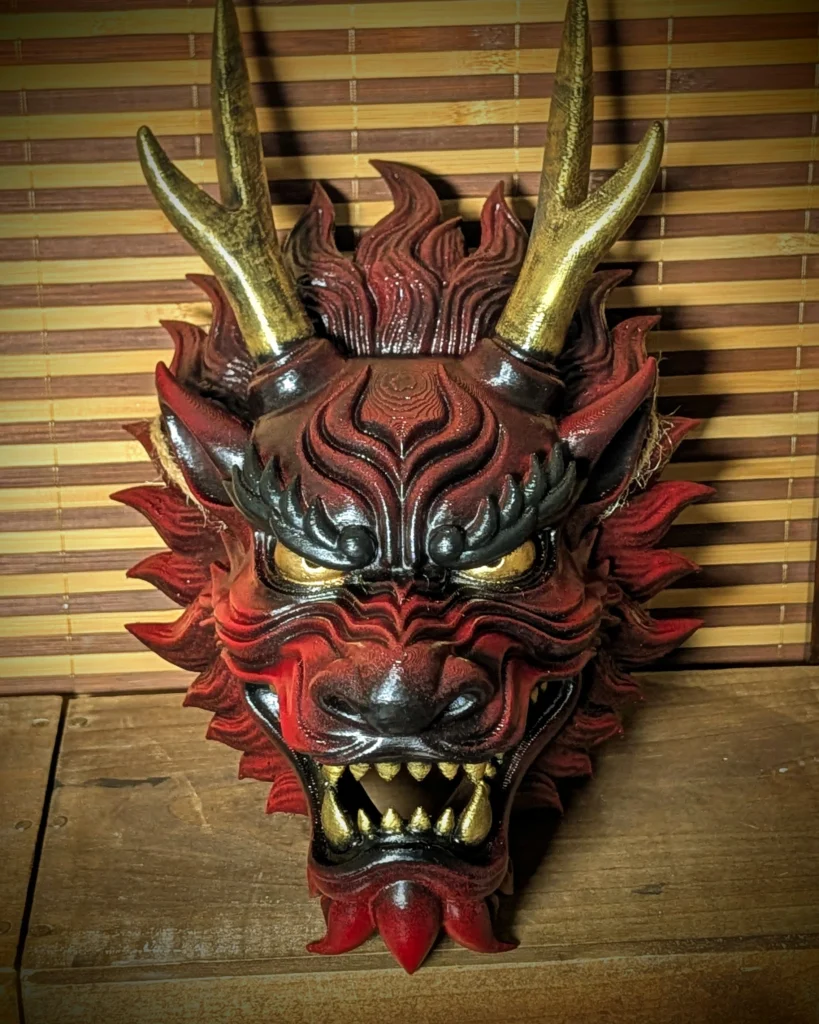
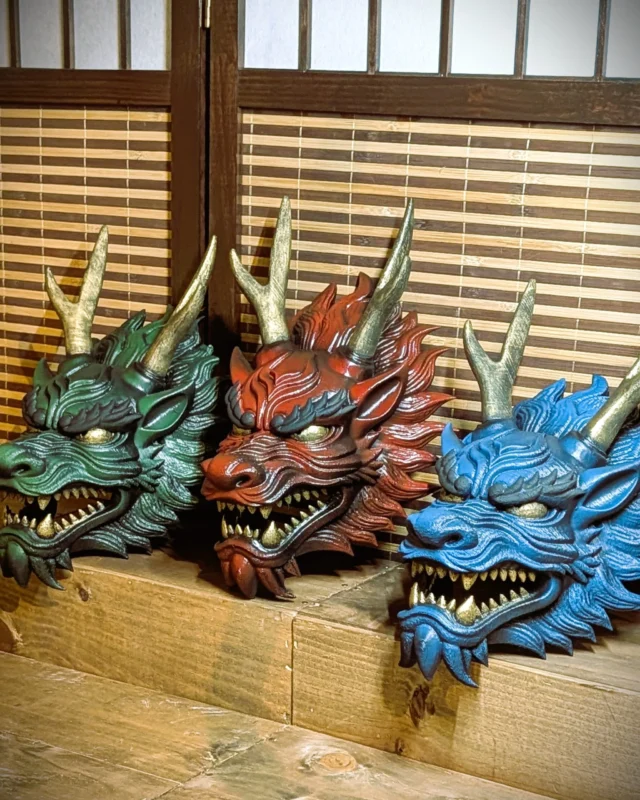
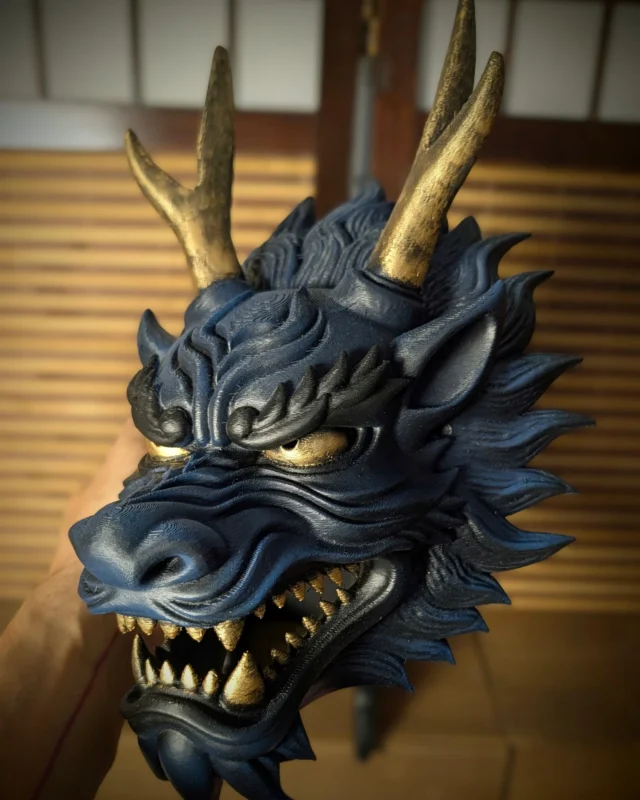
Dai Yokai does offer a Ryū dragon mask, contrary to an earlier version of this article. It is intended mainly for wall display, a tattoo studio, a collection or a display cabinet. Its printed PETG base is prepared, sanded, painted and varnished by hand in Brittany.
These are contemporary creations inspired by Japanese imagery, not authentic ritual objects. Their volume can help when studying horns, brow ridges, whiskers and shadows before drawing a dragon for skin.
Pieces connected with Ryū and irezumi
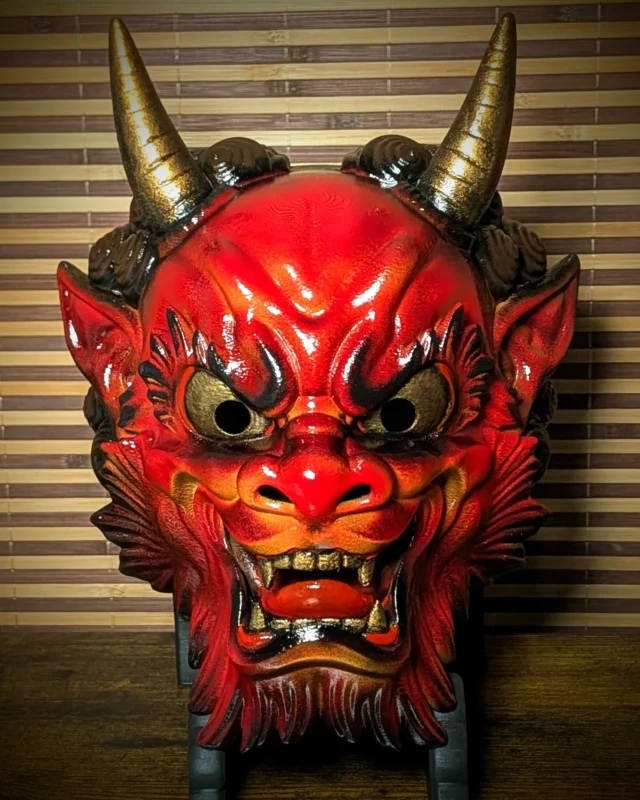
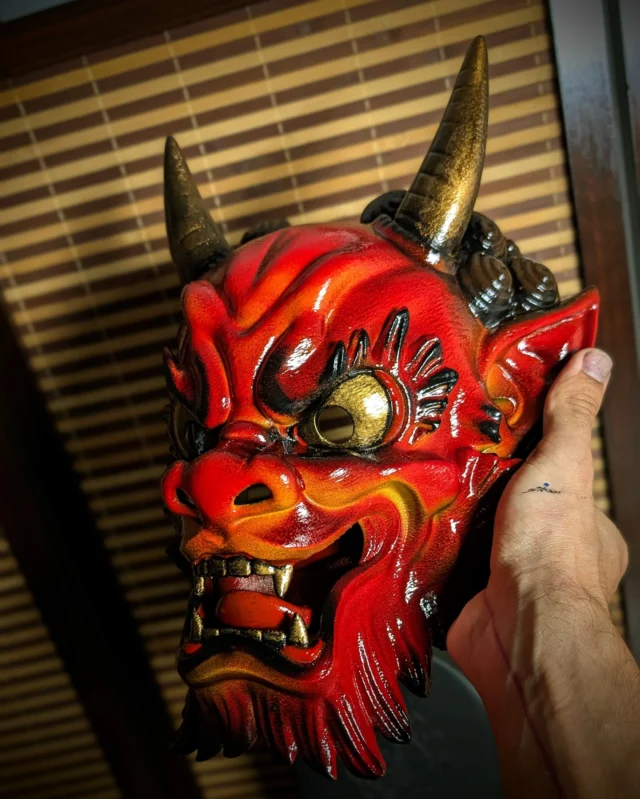
The Japanese Ryū dragon mask is directly connected with this subject. The Oni Irezumi mask offers another approach to a strong face and a palette inspired by tattoo culture.
Sources
- Japan Search, Dragons: influences, Ryūjin, water, rain and dragons in clouds.
- Kyoto National Museum, Dragons and Clouds: ascending and descending dragons in Japanese painting.
- Japan Search, Dragon and Tiger: a historical example of the pairing.
Frequently asked questions
What does a Japanese dragon tattoo mean?
It can suggest controlled natural power, protection, adaptability, authority or transformation. Ryū is strongly connected with water, clouds and rain. Its meaning depends on the pose, setting, other motifs and story developed with the artist.
Is the Japanese dragon associated with water or fire?
Ryū is mainly associated with water, rain, rivers, the sea and clouds. Stylised flames sometimes appear around its body, but do not necessarily make it a Western fire-breathing dragon. The background should remain consistent with the whole design.
How do Japanese and Chinese dragons differ?
They belong to closely related East Asian visual traditions, with influences travelling between China and Japan. Ryū often has a winding body associated with water and clouds. Claw counts and imperial attributes offer clues but cannot identify every work alone.
Must a Japanese dragon have three claws?
Three claws are common in modern Japanese depictions, not an absolute law. Older works, Chinese influences and artists’ choices show variations. Start with a documented Japanese reference and ask the artist to explain the drawing rather than only counting claws.
Do Ryū tattoo colours have fixed meanings?
No. Black and grey, red, blue, green and gold create different moods, but no universal chart determines a dragon’s character, age or powers. The palette should support contrast, skin tone, ageing and the other motifs.
Is an ascending dragon more positive than a descending one?
Not automatically. Both appear in Japanese painting. Direction serves movement, the gaze and the story. On the body, choose it according to placement, background flow and other subjects, rather than an invented moral rule.
Where can a Japanese dragon tattoo be placed?
The back allows a complete scene; an arm or leg suits a coiling body. The thigh provides width for head and claws. Smaller designs need simplification so scales, whiskers and the gaze remain readable as the tattoo ages.
Does Dai Yokai offer a Ryū dragon mask?
Yes. It is intended mainly for wall display and made to order in Brittany from a PETG base, then prepared, sanded, painted and varnished by hand. It is a contemporary creation inspired by the Japanese dragon, not an authentic ritual object.